
BEAVER, Pennsylvania — Josh Shapiro has spent 20 years in Pennsylvania politics, and every time he has seen one party simultaneously control the governor’s office, the state House, and the state Senate, that party has been the Republicans.
He took notes.
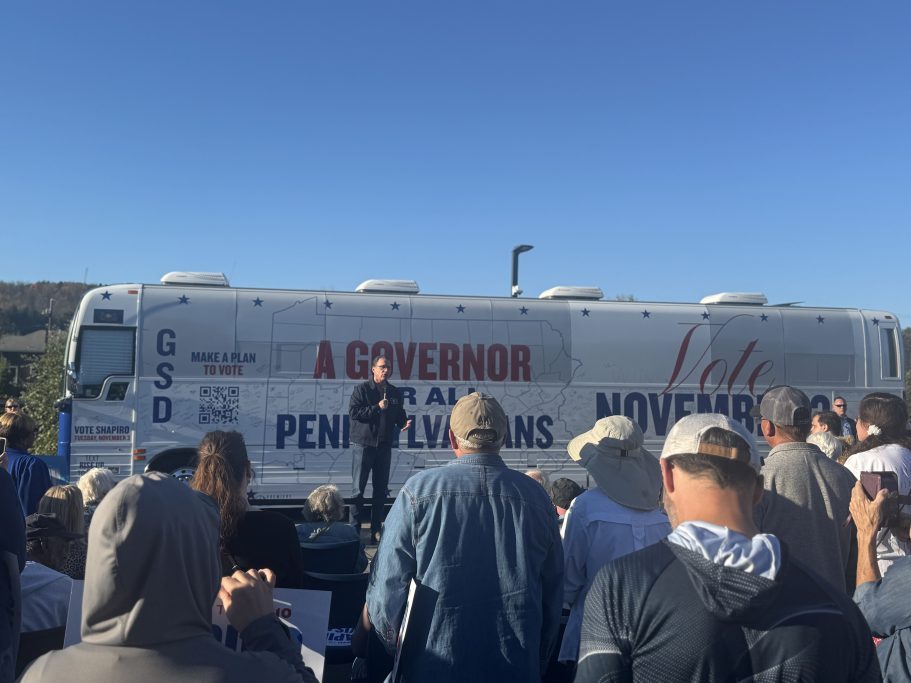
“My only frame of reference over the last 20 years in Pennsylvania, the trifecta, has been a Republican trifecta,” the Democratic governor said in an interview Saturday aboard his campaign bus, parked outside the new International Brotherhood of Electrical Workers Local 712 training center here. He had just addressed a rally of union electricians, apprentices, and local Democrats at the center.
“[GOP Gov. Tom] Corbett had that. [GOP Gov. Tom] Ridge did a little bit. I thought Gov. Ridge handled it responsibly. I thought Gov. Corbett fell into the trap … thinking you can do whatever you want, and they ended up being extreme and dysfunctional at the same time,” Shapiro said.
The question of what happens if he wins it all is no longer hypothetical. With eight days left before the Nov. 3 election, the governor is so far ahead of his Republican challenger that the real drama in Pennsylvania has moved down the ballot, to a handful of state Senate seats in the Philadelphia suburbs, the Lehigh Valley, and the Poconos that would hand Democrats unified control of Harrisburg for the first time since 1993.
That is when, history shows, the overreach usually begins. A party wins, mistakes the voters’ anger at the other side for affection for its own agenda, and governs as though it has a mandate it never really had.
Shapiro says he knows the trap and will not walk into it.
“It’s a great question, and it’s one I’ve thought a lot about,” he said. “I think those values have remained relatively constant over the years. I’ve learned, and I’ve changed maybe a view here or there, but those values have stayed the same. Whether I’ve got a Democratic House and Senate or a split legislature, my values are going to stay the same.”
What a trifecta changes, he argued, is speed, not direction.
“What a trifecta would allow me to do is to move quicker on things, to get that minimum wage increased to 15 bucks an hour, to be able to give access to justice for victims and not have to have the yearslong horse-trading to get there,” he said. “It’s not going to change my views. It’s not going to change my values. It’s not going to make me do something different in January if I have a trifecta than what I’m talking about today.”
“I can guarantee you my views and values are going to stay the same,” he added. “We’ll move a lot quicker, and we’ll get a lot more done for people, and we’ll be able to show our results and make people’s lives better.”
It is a promise every politician makes before the keys are handed over. Presidents of both parties, Barack Obama and Donald Trump among them, came into Washington with unified control and spent it faster than voters expected. In Pennsylvania, the margin for that kind of error is thinner still because no Democrat wins statewide here without Republican votes, and those voters expect to be treated as more than a rounding error once the votes are counted.
Shapiro said they will be.
“Those Republicans who vote for me this November, they’re going to get a governor who’s going to fight for them to raise minimum wage and also continue to respect those that don’t vote for me and make sure I’m a governor for all Pennsylvanians,” he said.
He has not been coy about what he would do with a friendly legislature. He says it at nearly every stop.
“All across Pennsylvania, a little less so here because we’re in Matzie’s district, but I talk a lot about what it would look like with a trifecta,” Shapiro said, a nod to state Rep. Rob Matzie, the Ambridge Democrat who chairs the House majority caucus and has represented this stretch of Beaver County since 2008. Matzie’s seat is a safe one for Democrats, so there is little need to sell the trifecta here. The selling happens in the swing districts down the road.
The first bill, he said, would raise the state’s minimum wage to $15 an hour, something the Republican-controlled Senate has refused to do. The second would open a window for survivors of childhood sexual abuse to sue their abusers in court, an issue he has carried since his days as attorney general, when his office’s grand jury report on abuse in the Catholic Church shook the state. The Senate has blocked that, too.
“While I’m proud of the work we’ve done to bring Democrats and Republicans together to fund our schools, cops, economic development … there’s some things that the Senate has blocked me on,” he said.
Third is something closer to the building he was standing in front of: a large fund to build both energy infrastructure and housing.
“That’s a big piece of, I think, how we can really help continue to grow our economy,” Shapiro said. “We’ve been really purposeful about filling up halls like this with more apprentices, 43,000 on my watch. We got to make sure they got work for generations to come.”
“Some we’re going to need a trifecta for,” he said. “Others, I’m just going to keep chipping away if we don’t have that, to bring people together and get that done.”
The state House is the easier part, if anything in Pennsylvania politics is easy. Democrats hold the 203-member chamber 103-100, and it takes 102 seats to control it, which means Republicans need a net gain of two seats to flip it, and Democrats can afford to lose no more than one.
The Senate is the prize. Republicans have held it for most of the last half-century, and they hold it now 27-23. Only half of the 50 seats are on the ballot. A net gain of three seats gives Democrats an outright 26-24 majority. A net gain of two produces a 25-25 tie that Democratic Lt. Gov. Austin Davis could break, though only on procedural matters, which would let Democrats pick the Senate’s leader, write its rules, and run its calendar.
Both parties have poured money into the same four Republican-held seats: Sen. Frank Farry’s 6th District in Bucks County, Sen. Jarrett Coleman’s 16th in Bucks and Lehigh counties, Sen. Tracy Pennycuick’s 24th in Montgomery and Berks counties, and Sen. Rosemary Brown’s 40th in the Poconos. Republicans, meanwhile, are trying to take back a Lancaster County seat that Democrat James Malone won in a special election last year. If they do, Democrats would need to flip three just to get to a tie.
Shapiro is not leaving that to chance. He has given more than $10 million to the state party and the House and Senate Democratic campaign committees for downballot races and has cut television ads for the four Democrats challenging those Republican senators.
His own race has barely moved all year.
The Franklin & Marshall College Poll released last Thursday found Shapiro leading state Treasurer Stacy Garrity, a Republican, 59% to 36% among likely voters, with 42% of voters saying they still do not know enough about Garrity to have an opinion of her. Among all registered voters, including those leaning one way, it was 54% to 33%. Earlier this month, Quinnipiac University had him up 59% to 34%, with 17% of Republicans backing him.
If that holds, it would be the most lopsided Pennsylvania governor’s race in decades, bigger even than his 15-point win over Republican Doug Mastriano four years ago.
Garrity has spent the final stretch campaigning on state spending, energy, and tax relief, including a stop on Sunday in Windber, Somerset County, but she has been badly outspent and has struggled to introduce herself to voters.
The governor’s coattails matter for Congress as well, and Pennsylvania could decide control of the U.S. House on its own.
A New York Times/Philadelphia Inquirer/Siena poll of four Republican-held swing districts released Sunday found Democrats ahead or tied in all four:
- In the 8th District in northeastern Pennsylvania, Scranton Mayor Paige Cognetti leads Rep. Rob Bresnahan 51% to 46%.
- In the 7th District in the Lehigh Valley, firefighters union leader Bob Brooks leads Rep. Ryan Mackenzie 49% to 44%.
- In the Bucks County-based 1st District, county Commissioner Bob Harvie leads Rep. Brian Fitzpatrick 48% to 46%.
- In the Harrisburg-based 10th District, Rep. Scott Perry and former TV anchor Janelle Stelson are tied at 48% in their rematch.
The polling samples for each district carry margins of error of 5.7 to 5.8 percentage points, so only the Cognetti and Brooks leads are close to clear of the noise. But the same voters gave Shapiro a 56% to 39% edge over Garrity across the four districts. Even in Perry’s district, where the House race is a dead heat, Shapiro leads 55% to 41%. That gap between the governor and his party is exactly the gap his promise of restraint is meant to address.
In the back of everyone’s mind is the fact that Pennsylvania voters habitually split their tickets, so coattails are certainly not a sure thing.
The men and women standing behind Shapiro on Saturday are the ones whose work depends on whatever gets built next in western Pennsylvania, whether it is roads, power plants, housing, or the enormous data centers rising on old industrial ground along the Ohio River.
Down the Ohio River in Shippingport, Aligned Data Centers broke ground last month on Project Phoenix, a 2-gigawatt campus beside the shuttered Bruce Mansfield coal plant that will be powered by on-site natural gas rather than the local grid. The developer has said it will follow the strict standards the governor laid out in his August executive order, which requires developers to bring their own power, hire locally, offer community benefit agreements, and sign a legally binding consent order with the state’s Department of Environmental Protection.
Shapiro said the Shippingport developers came to his office almost as soon as the ink was dry.
“To their credit, they reached out to my staff right away after the executive order, like, ‘Hey, are we in adherence with it? Do we need to do anything? Let us know,’” he said. “So they’ve been very good to do it.”
Asked about the other big projects, including the redevelopment of the old coal plant site at Homer City in Indiana County, he said his team is meeting with developers of the handful of projects already underway across the state, “maybe four-ish,” and that most fit the same pattern.
“In general, they are responsible developers who want to know exactly what the requirements are, sign the consent order, and then meet the standards,” Shapiro said. “As I predicted it, the developers who put up a fight, well, they were the ones who never had power and never had an end user and are not interested in signing a consent order. And that’s fine, because we don’t want them to be working here and wreaking havoc around communities.”
“The responsible ones have come right in and said, ‘Tell us what we need to do,’” he said. “And they’ve been pretty close to already meeting those standards.”
He also pushed back on the idea that every data center is an artificial intelligence warehouse.
“Any major hospital today has a quote-unquote data center in it,” he said. “Now it’s not what the average person thinks of when they think of a data center, but obviously technology is necessary, whether you’re welding, learning to weld here at this IBEW hall, whether you’re practicing medicine at [Allegheny Health Network] or [University of Pittsburgh Medical Center],” he added, referring to the region’s two major hospital systems. “There’s technology in everything. When people talk about the data centers, they’re talking about these football field-length warehouses that house computers, and that’s where we’ve got these strict guidelines that they got to meet.”
Beaver was the fourth stop on the first day of a 10-day, 29-county bus tour Shapiro and Davis are taking through Election Day, a deliberate echo of the bus tour Shapiro launched from the same city four years ago. “We’re running it back,” he posted from Erie.
They started Saturday morning in Erie, then rolled south through Crawford, Mercer, and Beaver counties before a nighttime rally at the IBEW Local 5 hall on Pittsburgh’s South Side, where Shapiro told the crowd to “vote like the future of our country depends on it.” Sunday began at a Steelers watch party in Pittsburgh and wound through Somerset, Bedford, and Huntingdon counties before ending on the lawn of Old Main at Penn State.
SALENA ZITO: THE CONSERVATIVE WHO SAID YES TO BUCKS COUNTY, USA
On Monday and Tuesday, he is expected in Blair, Cambria, Westmoreland, Columbia, and Union counties. The rest of the route runs through Lancaster, York, Cumberland, Dauphin, Schuylkill, Pike, Monroe, Lackawanna, Lehigh, Berks, Chester, Bucks, Montgomery, Delaware, and Philadelphia counties.
Fourteen of the 29 counties voted for both Trump in 2024 and Mastriano in 2022. Six more, Beaver among them, backed Shapiro four years ago and then swung to Trump two years later. That is the electorate Shapiro is asking to give him a bigger mandate, and the one he says he will not take for granted if he gets it.
Continue reading...
[ H/T Washington Examiner ]