

Guest Post by Martin Armstrong

Vice President JD Vance has openly blamed the war with Iran for the Republican Party’s devastating defeat in the November 3 midterm elections. Vance wrote on November 4 that the central reason Republicans lost was the war itself. He challenged those defending the intervention to explain whether sacrificing control of the Senate was worth the price and acknowledged that voters who supported Trump and Vance in 2024 had crossed over to the Democrats.
Vance cited polling showing that former Trump supporters wanted the government to “End the war,” “Focus on cost of living/inflation,” “Put America First,” and “Change our relationship to Israel.” The Republican Party has traditionally treated support for Israel as a political obligation, yet Vance is publicly acknowledging that a portion of Trump’s own electorate wants that relationship reconsidered.
When Trump was asked whether he regretted the war, he told the Wall Street Journal, “I did the right thing. I would have done it again.” The president is defending his decision while his vice president is emphasizing its political consequences. Trump campaigned on ending America’s endless wars and avoiding another prolonged conflict in the Middle East. Yet the United States entered a direct war with Iran alongside Israel in February 2026.
I wrote back in July how Vance was positioning himself for 2028 by separating himself from the administration’s Middle Eastern policy. At the time, Vance had criticized Israeli officials who opposed negotiations with Iran and questioned their belief that military force could resolve every regional security problem. He asked what alternative they were proposing and pointed out that Israel, a nation of approximately nine million people, could not simply eliminate every threat through military operations. He also urged Israeli leaders to recognize the enormous support the United States had already provided. Those were unusually direct comments from an American vice president, and they demonstrated that disagreements over the war had developed well before the midterm defeat.
Vance had privately opposed the February military operation and had sought independent assessments from American military commanders. According to the New York Times, he became concerned about depleted munitions, the resilience of Iranian forces, and the difficulty of achieving the administration’s objectives. Yet Vance publicly defended Trump after the decision was made. In March, he expressed confidence that the president would avoid the mistakes of previous administrations. Vance may have opposed the war privately, but he remained part of the administration carrying it out.
"The initial founding vision was that we were going to use technology to change the whole world and basically over-turn the monetary system of the world... the basic idea was that we could never win an election on getting certain things because we were in such a small minority... But maybe you could actually unilaterally change the world-without having to constantly convince people and beg people and plead with people who were never going to agree with you-through technological means... technology is this incredible alternative to politics."
-Peter Thiel, 2010
However, nobody should mistake Vance for an independent outsider who reached Washington without powerful financial backing. His political career is closely connected to billionaire Peter Thiel. Vance worked at Thiel’s Mithril Capital, and Thiel helped support the venture capital firm Vance later co-founded. When Vance entered the 2022 Senate race, Thiel contributed $15 million to a super PAC supporting his campaign. That money helped establish Vance as a national political figure. Trump supplied the endorsement that helped him secure Republican voters, but Thiel’s financial support was instrumental in launching his political career.
Thiel represents a different concentration of economic power. He co-founded Palantir, which has become deeply involved in American military intelligence, surveillance, and government data systems. Palantir has received substantial federal contracts, including an Army agreement with a potential value of $10 billion over ten years. The company provides technology used by military and intelligence organizations, while other businesses associated with Silicon Valley investors depend upon artificial intelligence, data centers, semiconductor manufacturing, and access to international capital. These industries have their own priorities, and a prolonged disruption to global energy markets creates significant economic risks.
The distinction is not that Thiel’s companies oppose all military spending. Palantir benefits from defense and intelligence contracts, and warfare can generate demand for precisely the technologies it develops. But there is a difference between selling advanced military software and supporting a conflict that drives energy prices higher, threatens supply chains, and increases the cost of capital. Artificial intelligence requires enormous electricity consumption. Data centers, semiconductor fabrication facilities, and advanced manufacturing depend upon reliable power and continued investment. A sustained energy shock can damage the broader technology economy even when individual defense contractors benefit.
Now consider the financial relationships surrounding Jared Kushner, Trump’s son-in-law and an important participant in Middle Eastern diplomacy. Kushner’s investment firm, Affinity Partners, has received substantial financing from Middle Eastern sovereign wealth funds, including Saudi Arabia. Bloomberg reported that the firm’s assets reached approximately $6.2 billion at the end of 2025. Kushner also has longstanding political and business relationships with Israel, developed partly through his role in negotiating the Abraham Accords during Trump’s first administration.
CNN reported in October that Affinity Partners held the largest stake in Phoenix Financial, an Israeli financial services company with investments in businesses supplying Israel’s military. Public filings identified hundreds of millions of dollars in Phoenix investments involving military-linked companies, including Elbit Systems. Affinity reportedly realized a substantial return when it sold part of its Phoenix position. CNN found no evidence that Kushner’s diplomatic activities influenced those investments, and his representatives denied that he directed Phoenix’s investment decisions. Nevertheless, these relationships raise legitimate questions about financial conflicts of interest when private investors participate in negotiations involving governments and industries connected to their investments.
This is where the difference between Trump and Vance becomes particularly interesting. Trump’s administration has maintained close relationships with Israeli leadership while pursuing military objectives against Iran. Kushner’s network is deeply involved in Middle Eastern diplomacy and regional investment. Vance, meanwhile, emerged from the Silicon Valley investment community and has increasingly emphasized the economic and political costs of continuing the conflict. These relationships do not prove that either man’s foreign-policy position is dictated by a financial patron. They do demonstrate that powerful interests surrounding the two politicians are not identical.
Vance’s statement suggests that he understands the political damage this has caused. He is acknowledging that voters who supported Trump in 2024 were unwilling to continue supporting a government they believed had abandoned its original promises.
Vance may oppose the foreign policy interests pushing Washington toward continued confrontation with Iran, but his own political network includes investors whose companies profit from government intelligence and military technology. Vance cannot credibly present himself as independent of powerful financial interests merely because his patrons differ from those surrounding Trump.
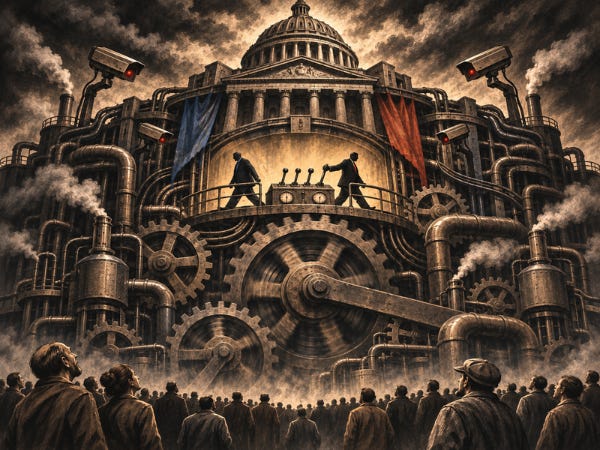
The question for 2028 is whether Vance represents a genuine change in American foreign policy or simply a different collection of interests competing for control of Washington. Trump’s political relationships are closely connected to Israel and the traditional national security establishment. Vance has powerful connections to Silicon Valley, military technology, and the expanding surveillance industry. Neither network is free of economic interests, and neither should be exempt from scrutiny.
The American people voted for an end to endless wars and a government that would place domestic prosperity first. They now face the consequences of another Middle Eastern conflict, while politicians and their financial supporters position themselves for the next election. Vance is trying to distinguish himself from Trump’s decisions, but he still needs to prove his political independence. Another interesting aspect is that Peter Thiel portrays himself as a “conservative libertarian” within the Republican Party. I now wonder: will Vance be the third-party candidate our computer has been hinting at who may appear in the 2028 U.S. presidential election?
Tweet
Continue reading...
[ H/T The Burning Platform ]