






President Donald Trump should strike a killing blow at the rulers of Iran and their lackeys in October if not earlier. Press reports about the president’s alleged alteration between hawk and dove seem designed to confuse our enemy, and that is working. There is hardly a person on the planet who would presume to guess what Trump will do. “Strategic ambiguity,” meet your personification in the president.
The rump regime atop the Islamic Republic of Iran is best understood as a military junta with a through line of religious zealotry connecting its members. “Fanatics with guns and a dwindling supply of ballistic missiles and weaponized drones” is the best way to think of them. They are not scholars and political scientists with a comprehensive grasp of American and Israeli politics, though it seems as though they think of themselves as masters of those very complicated universes.
The members of the Iranian junta are also not the first-, second-, or third-string of leaders that the country began 2026 with. Those people are dead. Whether the “best of the rest” rose up to claim command, we cannot know, but that Ahmad Vahidi seems to be first among equals does seem like a good bet.
Vahidi, 68, was just off the bench when the all-out battle began in February, and while he had previously served in numerous senior capacities, he had failed to stay in the quest for leadership in a regime run by an octogenarian. The ayatollah, Ali Khamenei, was 86 when he was killed in the opening salvo of the battle, and he had not kept Vahidi in the inner circle.
Another now-important figure to the junta is 72-year-old Mohsen Rezaei, who was also on the beach with Vahidi when the battle began in 2025 with the “12-day war.”
Rezaei is back now as secretary of the Supreme National Security Council, a man who occasionally puts out statements on Iranian policy. Like Vahidi, Rezaei was called off the sidelines because of the devastation visited on Iran’s senior leadership on Feb. 28 of this year. Keep in mind that these two and their junta colleagues had been passed over by Khamenei.
The Islamic Revolutionary Guard Corps was established by the leader of Iran’s Islamic Revolution, the Ayatollah Ruhollah Khomeini, on May 5, 1979, barely three months after the shah of Iran went into exile. Its purpose was simple: to protect the new Islamic Revolution from a counterrevolution by consolidating the numerous revolutionary militias and armed groups in the Iran of 47 years with the dual purpose of establishing armed oversight over the country’s conventional military, the Artesh, and to defend the ideological character of the new regime.
A half-century later, the Guard numbers between 200,000 and 250,000, and it is supplemented by a force of thugs, the Basij, the regime’s “brown shirts,” fewer than 100,000 of whom are paid and another half-million of whom are muscle for the streets. These are the forces that keep 92 million Iranians under their thumbs.
If the junta can keep its bodyguards and the bodyguards of its bodyguards paid and receiving the benefits of what is essentially “party membership,” the regime can endure a while. The United States’s blockade and vast and, for the first time, wholly comprehensive economic sanctions on the regime are grinding the Iranian economy to a halt. But there are 91 million Iranians the junta can loot, impoverish, and, if necessary, kill to hold on to power. What the regime demonstrated in January, when it slaughtered between 30,000 and 50,000 of its own people, is that its ruthlessness cannot be underestimated.
Once a regime has murdered on that scale, it knows, collectively and individually, that it cannot go quietly into the night. The families of its victims, extending from 1979 through the January massacre and the hardships of the six-month battle with the U.S., Israel, and all of the Gulf countries, have left the regime with no path of retreat that does not involve exile or facing a vengeance-seeking population.
The junta is cornered and afraid. The fates of deposed dictators Muammar Gaddafi of Libya, Nicolae Ceausescu of Romania, and a score of others must be on their minds. Brutal killers don’t live peacefully in retirement.
Such a group will seize on any hope of staying in power — or bolting abroad. This junta’s collective hope appears to be that if it can make it through the Israeli and American elections, it can survive. This has some analysts in the West confused about what is likely to happen before Israel’s elections on Oct. 27 and America’s on Nov. 3. Some expect Iran or its proxies that are left alive in Yemen and Lebanon to try and launch attacks on its enemies in the run-up to the voting in the two democracies. For whatever reason, those analysts think these dictators think that driving the cost of oil up around the world will help them.
In fact, any attack on American forces or Israel would bring swift and punishing counterstrikes. Israel’s government has made it clear that if struck again from Iran, it will not continue the restraint that left Iran’s oil production capacity intact over the two rounds of Israeli bombing in Iran, the first from June 13-24, 2025, and the second, which began on Feb. 28 of this year and which ran through April 7.
Over the course of the two major air campaigns, Iran suffered devastation of its nuclear weapons program, ballistic missiles, and general defense forces, including the complete loss of its navy and grounding of its air force, as well as the “blinding” of its ability to monitor traffic through the Strait of Hormuz.
This last blow has allowed America to escort hundreds of millions of barrels of oil as well as massive quantities of natural gas out of the strait to the world’s energy markets. While the cost of oil has briefly topped $100 a barrel on a few occasions since the start of the February-April combat operations, it is again dropping as buyers again assess that Iran cannot, in fact, close the Strait of Hormuz.
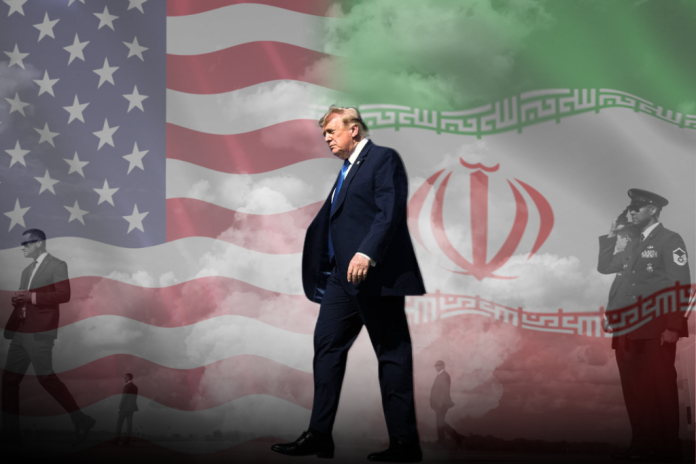
Photos by AP Newsroom and Canva, Graphic by Grace Hagerman/Washington Examiner
" data-large-file="https://www.washingtonexaminer.com/wp-content/uploads/2026/08/Iran-Trump-1.png?w=696" src="https://www.washingtonexaminer.com/wp-content/uploads/2026/08/Iran-Trump-1.png?w=696" alt="Graphic of Donald Trump and Iran flag." class="wp-image-4705942" srcset="https://www.washingtonexaminer.com/wp-content/uploads/2026/08/Iran-Trump-1.png 1024w, https://www.washingtonexaminer.com/wp-content/uploads/2026/08/Iran-Trump-1.png?resize=300,200 300w, https://www.washingtonexaminer.com/wp-content/uploads/2026/08/Iran-Trump-1.png?resize=768,512 768w, https://www.washingtonexaminer.com/wp-content/uploads/2026/08/Iran-Trump-1.png?resize=150,100 150w, https://www.washingtonexaminer.com/wp-content/uploads/2026/08/Iran-Trump-1.png?resize=696,464 696w" sizes="(max-width: 1024px) 100vw, 1024px">
Photos by AP Newsroom and Canva. (Graphic by Grace Hagerman/Washington Examiner)
The junta appears to be hoping that a change in the distribution of power in the governments of both Israel and the U.S. would be good for the regime. Again, these are not the first-team spelling bee champions of the Guard. They are aging ideologues trying to discern some way forward for themselves and their “revolutionary” colleagues. When there is only one hope, a collapse of will among your enemies, there aren’t many options.
So the junta is gambling on Israeli Prime Minister Benjamin Netanyahu being ousted and on Americans handing control to the Democrats in the House and Senate. Some brilliant analyst may have forgotten to brief the bosses that any leader in Israel is going to pulverize Iran’s energy sector the next time a missile is fired from Iran at Israel. Those same brains have failed to brief the “leadership” that American presidents in their last two years in office become much more focused on the powers inherent in the presidency and much less focused on “working with Congress.”
The junta could use a briefing from American legal experts on what a president can order even when Congress is controlled by the party in opposition. The briefing could start with President Richard Nixon’s Christmas bombing of Hanoi and Haiphong from Dec. 18-29, 1972. Democrats had massive majorities in Congress from 1971 to 1975.
Former President George W. Bush ordered “the surge” in Iraq after getting “thumped” — W’s word — in the 2006 elections. Former President Barack Obama ordered strikes against the Islamic State in Syria and Libya after he suffered crippling losses in the 2014 elections.
Those are the precedents the junta should be focused on if it is hoping for a hobbled Trump come Nov. 4. That’s not how it works in America. A president with less ability to legislate acts where he can, which means in the spheres of foreign affairs and military actions.
It would be irrational to expect the crazed fanatics left atop the junta to think through its options rationally. It had “won” some temporary relief when the “memorandum of understanding” was agreed to on June 17. A week later, somebody in Iran ordered a drone attack against a vessel in the Strait of Hormuz. Trump chose to ignore that provocation, but when someone in Iran ordered strikes on three vessels in the strait on July 7, the deal was done for.
Since then, exchanges of fire have overwhelmingly favored the U.S., and Iran’s “leaders” seem to have figured out that Trump is not a “tit-for-tat” commander in chief given to “proportional” responses, but rather one who believes in replying to provocations with exponentially more devastating strikes than whatever strike Iran delivered. That has brought us to the current situation where a staggering and economically isolated Iran is out of options save surrender to realities or desperate longest-of-shots.
Iran has one card to play, strikes from its missile and drone arsenal, and 27 months of Trump ahead. Is it so isolated from reality that Vahidi and whoever rules with him could conclude now is the time to renew hostilities with America and Israel?
Israel will be governed by a hard-liner on all matters related to Iran, whether his name is Netanyahu, Eisenkot, Bennett, or Lieberman. The junta in Iran is quite obviously afraid of Bibi, but who knows what their assessment is of the other would-be prime ministers of Israel?
Iranian fever dreams might imagine that one or more of the leading candidates for prime minister in the Jewish state would be an easier opponent to cow than Netanyahu — some “analysts” in America seem to have landed there. But they all would be wrong.
Trump, Netanyahu, and whoever will succeed Bibi down the road, whether in months or years, are not going to change their posture toward Iran. But could either or both Trump and Netanyahu decide it is best for the nation’s security to get the jump on the junta before the elections?
There is an excellent case for preemptive strikes against Iran as the countdowns to elections in both democracies run down. Reuters reported Tuesday that an “Iranian official” told the wire service that Iran can reopen the Strait of Hormuz within seven days if the U.S. eases military pressure and lifts its blockade on Iranian ports. With the strait effectively “open” to America and its allies already, this is hardly the stuff of actual negotiations. Were the junta to invite inspectors from the International Atomic Energy Agency to visit its old nuclear weapons sites as well as Pickaxe Mountain, that would be a serious play at reopening peace talks. Don’t hold your breath. Vahidi et al. won’t be going down that road.
Very old revolutionaries, like very old dogs, don’t learn new tricks. The appeal of a desperate gamble of a large-scale attack taken on the tiny and ill-founded hope of affecting elections in the Big and Little Satans is going to grow as the junta recognizes the straitjacket it put itself into.
Which brings the choice before Trump into focus. As it would be very reasonable to expect the crazies in Iran to act crazy, again, why wait for it to get in the next “first blow”?
TRUMP ENDORSES DIESEL EXPORT BAN
Trump shouldn’t. No one can predict the political consequences of a late-September-to-October replay of the 40-day battle of February to April. But the consequences of absorbing a “surprise” attack from the junta are potentially too steep to just let the big squeeze of the blockage plus sanctions work its inevitable result on the collapsing regime.
Trump, working in concert with our Israeli and Arab allies, shouldn’t “wait and see.” He should act. Again. The wounded and reeling enemy is still a danger to all of its neighbors, America, and indeed the West. Time to put it down, or at least guarantee that it will never regain the cash flow it needs to rebuild its shattered nuclear program and defenses.
Continue reading...
[ H/T Washington Examiner ]