


As in 2024, with polls open for the midterm elections, the cost of living remains voters’ top priority. As for investors, their primary concern in the aftermath of the Federal Reserve’s first rate hike since 2023 isn’t inflation in particular. Rather, it’s the federal government’s deficit.
It’s the classic good-news-bad-news dichotomy of the economy approaching the halfway point of President Donald Trump’s second term. The stock market has continued its sky-high ascent, bolstered by robust economic growth and AI-fueled productivity gains.
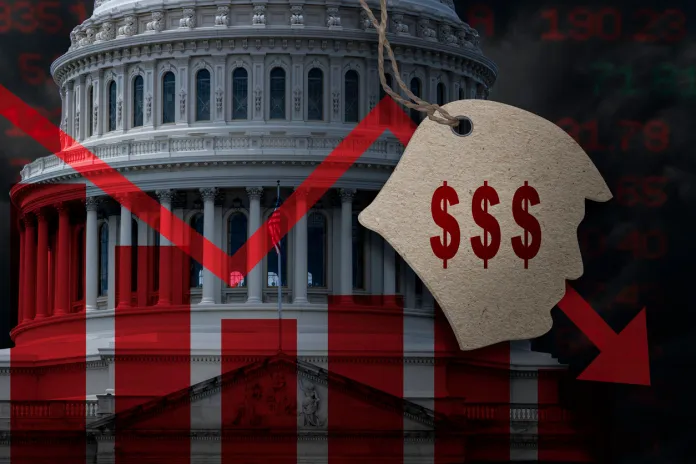
Meanwhile, the U.S. government bond market continues its implosion. Rising bond yield rates may be a warning sign for the economy because they raise borrowing costs and reflect underlying pressures such as high government deficits and heavy debt issuance.
In the month since the Fed hiked the federal funds rate based on its projection that the labor market will persist near full employment, the S&P 500 and the Nasdaq have both hit all-time highs. Yet, the benchmark 10-year Treasury yield and the 30-year Treasury yield both hit 24-year highs. And the 30-year fixed mortgage rate, which runs downstream of those long-term Treasurys, is around 7.5%.
(Getty Images)
" data-large-file="https://www.washingtonexaminer.com/wp-content/uploads/2026/10/iStock-2204987907.jpg?w=696" height="683" width="1024" src="https://www.washingtonexaminer.com/wp-content/uploads/2026/10/iStock-2204987907.jpg?w=696" alt="Bond market inflation congress spending" class="wp-image-4760514" style="width:360px;height:auto" srcset="https://www.washingtonexaminer.com/wp-content/uploads/2026/10/iStock-2204987907.jpg 1254w, https://www.washingtonexaminer.com/wp-content/uploads/2026/10/iStock-2204987907.jpg?resize=300,200 300w, https://www.washingtonexaminer.com/wp-content/uploads/2026/10/iStock-2204987907.jpg?resize=768,512 768w, https://www.washingtonexaminer.com/wp-content/uploads/2026/10/iStock-2204987907.jpg?resize=1024,683 1024w, https://www.washingtonexaminer.com/wp-content/uploads/2026/10/iStock-2204987907.jpg?resize=150,100 150w, https://www.washingtonexaminer.com/wp-content/uploads/2026/10/iStock-2204987907.jpg?resize=696,464 696w, https://www.washingtonexaminer.com/wp-content/uploads/2026/10/iStock-2204987907.jpg?resize=1068,712 1068w" sizes="(max-width: 1024px) 100vw, 1024px">
(Getty Images)
A booming stock market and a collapsing bond market are the real K-shaped economy. And this divergence explains why, unlike during the Fed’s rate hike campaign under former President Joe Biden, investor concern isn’t squarely focused on long-term inflation. Instead, toward a bipartisan consensus about ballooning the federal budget deficit and national debt.
When the Fed started its Biden-era rate hikes, the bond market began to go bust, yes, but so did the stock market. The S&P 500 fell 13% in the first quarter of the campaign. In short, the bond market and the stock market moved in tandem in response to the federal funds rate hike, evidence that the Fed was getting its desired monetary tightening.
That’s not what’s happening now. We got the same bond market sell-off as in 2022, although not one in the stock market. And the difference can be found in expected long-term inflation. It’s not only the Fed that remains confident in returning inflation to its 2% target. The market-aggregated two-year expected inflation rate actually cooled after the September rate cut, whereas that expected inflation rate surged past 3% after the start of the 2022 rate hikes. Rather than investors not caring at all about inflation, markets clearly believe that the Fed, by taking inflation seriously and early, will handle restoring price stability.
So, the bond market sell-off is not an indictment of the Fed, but instead of the White House and Congress. Especially with the AI and hyperscaler buildout delivering oodles and orders of magnitude of return to investors, a federal government that spends over 5% of its annual economic output just on deficit spending — and one that spends 87% of all of its revenue on Social Security, Medicare, Medicaid, and new interest payments on the existing $40 trillion national debt — must pay a much, much higher term premium to justify investors parting with their money.
And of course, this fundamental and structural fault of Uncle Sam’s deficit spending is why Treasury Secretary Scott Bessent’s bond buyback scheme hasn’t calmed the chaos. Even prior to the rate hike, the recently released minutes from the September Fed meeting showed that the Fed desk believed that “changes in inflation compensation accounted for most of the net increase in shorter-maturity Treasury yields, while changes in real rates contributed to most of the net increase in longer-maturity Treasury yields.”
OPENAI CONCEDES ITS RESPONSE TO AUSTRALIAN MEDICARE WEBSITE HACK WAS ‘NOT GOOD ENOUGH’
And since the Fed has raised the federal funds rate, the subsequent 30-basis-point explosion in the 10-year Treasury yield has essentially all come from real yields, not inflation compensation. With their faith in the Fed’s ability, under new Chairman Kevin Warsh, to tame inflation, Treasury investors may not believe that fiscal dominance is upon us yet.
But investors are acting like bond vigilantes. In 2022, bond investors punished Jerome Powell’s Fed for being too late to take inflation seriously. Four years later, it’s not the central bank that’s being punished. Rather, it’s the politicians who refuse to shut down the $7 trillion spending spree.
Tiana Lowe Doescher (@TianaTheFirst) is an economics columnist for the Washington Examiner.
Continue reading...
[ H/T Washington Examiner ]