



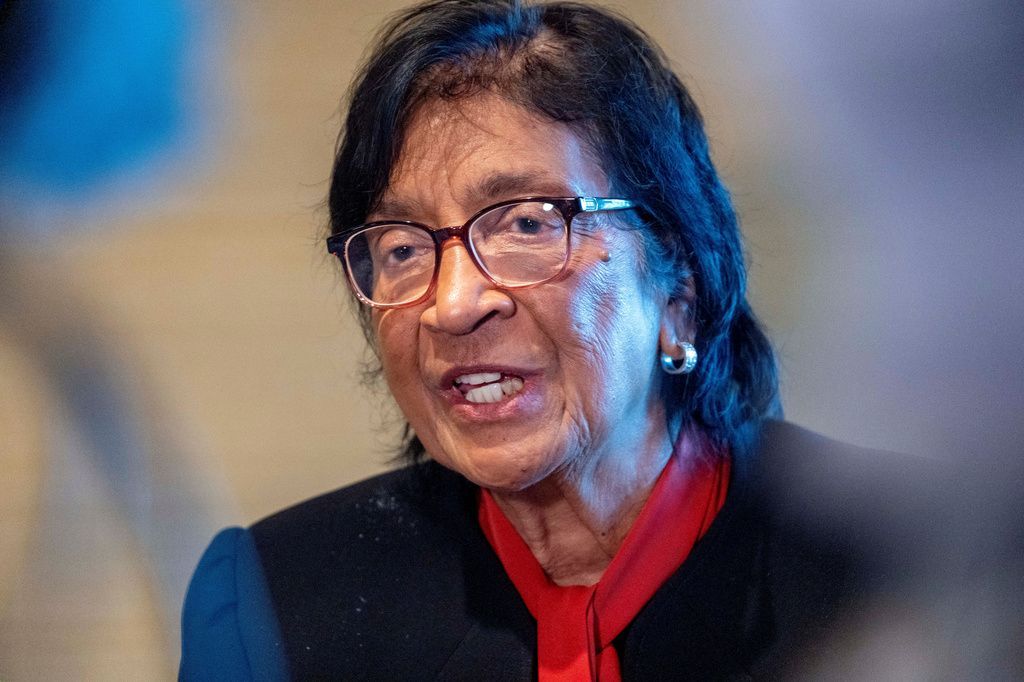
On elite campuses, many students and professors both demonize the Jewish state of Israel. The United Kingdom’s Green Party has declared Zionism to be racism. Norwegian politicians chose South African jurist Navi Pillay as this year’s Nobel Peace Prize recipient largely because Norwegians agreed with her efforts to blame the Jews.
More than three years after Hamas, during a ceasefire, launched an invasion of southern Israel to rape, torture, kidnap, and slaughter Jews, there is no doubt that criticism of Israel’s military response has gained traction among the young, ignorant, and antisemitic. Within the Democratic Party, accepting the calumny that Israel committed genocide has become a litmus test, a perverse one because it requires embracing fiction over fact to justify a litany of other policies upon which the lie serves as the foundation.
Democratic senators led by Chris Van Hollen and Chris Murphy, and representatives such as Ro Khanna, have exposed their political cynicism by viciously turning on the Jewish state and its supporters. Nor are Democrats alone. After the National Conservativism Conference in Jerusalem, many conservative and nativist intellectuals questioned both Israel’s behavior and the wisdom of continuing such a close U.S. partnership with Israel.
Should Israel’s supporters panic? Perhaps. Among Americans, opposition to close ties with Israel is growing. Many journalists draw moral equivalence between terrorists and fighters of terrorists, and human rights activists despise the Jewish state. But how permanent is the obsession?
For decades, the political Left has demonized countries that many young activists could never place on a map. In the 1970s, college students and their progressive mentors rallied against the Shah of Iran, never imagining what came after could be far worse. Richard Falk, a Princeton professor who would later become a U.N. human rights monitor, opined in the New York Times that “the depiction of [Khomeini] as fanatical, reactionary and the bearer of crude prejudices seems certainly and happily false.”
In the 1980s and 1990s, students joined the Committee in Solidarity with the People of El Salvador on dozens of university campuses. CISPES described itself as a grassroots group; in reality, it was a front for the Soviet-backed Farabundo Marti National Liberation Front. Many of those marching to protest U.S. crimes, real and imagined, never had a clue that organizers simply saw them as useful idiots.
Cuba is a constant symbol for progressives, many of whom happily wear Che Guevara shirts not realizing that Che was a sociopathic murderer who represented the antithesis of human rights. To adorn oneself with Che’s image is no different than wearing Hitler, Mao, or Putin paraphernalia.
Fast forward to 2011. Against the backdrop of the Arab Spring, Bahrain cracked down on Shia activists. Some grievances were real, but Iran’s Islamic Revolutionary Guard Corps co-opted their movement to try to oust the ruling Khalifa dynasty. Across “Occupy Wall Street” encampments, activists flew Bahraini flags in solidarity with protesters.
Curiously, neither the anti-Tutsi genocide in Rwanda nor the Uyghur genocide in China ever caught the attention of the wider progressive public. Quite the contrary, many in the media bash Rwanda’s Paul Kagame despite his role ending the genocide against Western ineffectiveness, but simultaneously whitewash Communist China’s crimes. The common denominator in both cases is capitalism; Kagame embraces it and has transformed Rwanda into Africa’s Singapore, while Beijing rejects it.
FOR KATIE ZACHARIA, IT’S ONLY UP FROM HERE
The question to ask is whether Israel is just the demon of the moment and the Palestinians the saints. At every historical moment, activists see their cause to be both pivotal and permanent. Often, though, causes have a shelf life. While Qatari and Chinese money help fund anti-Israeli vitriol, the Achilles’ heel of the movement is that many of its proponents are freaks. Green-haired, overly pierced lesbians spouting Ibrahim X. Kendi, Edward Said, and Michel Foucault seldom win over mainstream America.
Zionists and classical liberals should not compromise; sometimes, storms must simply be weathered.
Michael Rubin is director of policy analysis at the Middle East Forum, a distinguished fellow at India’s Usanas Foundation and a contributor to Beltway Confidential.
Continue reading...
[ H/T Washington Examiner ]