





If This Was A Normal Week...
Submitted by Peter Tchir of Academy Securities
Maybe it was because I was in Europe that last week didn’t seem “normal.” Maybe that is why some of the things that I would think are most topical don’t seem topical (or at least weren’t what markets were responding to?). Or maybe it was just a weird week, where the underlying narrative wasn’t as much about the usual suspects, and was much more about supply (of bonds, energy, chips), stop losses (in every market everywhere), and dismal depth of true liquidity (or what we refer to as faux liquidity?).
In any case, much of the price action fits well into our recent narratives, and we were lucky enough to get to focus on yields not being driven by traditional data, and the warning signs coming from credit markets bright and early on Friday morning to kick off Morning Call on CNBC (which timewise wasn’t so bad from a hotel room in Paris).
There seemed to be no shortage of news on the domestic political front that individually might have moved markets, and collectively should have (and maybe it did play a role, but it certainly wasn’t the driving issue, which likely means it is lurking, making any recovery for risk takers more difficult):
While none of these themes seem to have directly induced any of this week’s market moves, I find it difficult to believe they aren’t playing any role.
We are in the midst of a changing world order, with multiple hot wars in progress, so it seems extremely difficult to believe that things impacting the policy and credibility of the U.S. aren’t contributing to market moves.
Last week we went into some detail on Diesel and Yields. We argued that:
The Russian Diesel Deal was too small to matter:
The EU release of diesel was bigger and more important, and could disappoint:
Diesel Export Ban
Need Agreements in the Conflict Zones
Not optimistic on a big decline in energy prices anytime soon, but it cannot be ruled out, so be careful being too bullish on the commodities themselves. Owning energy producers, globally, is still my main focus, knowing that there will be a sell-off (hopefully small and brief) after any resolution, because longer-term energy independence is the order of the decade.
Using the word “seems” is weak. Period. End of story. It is a cop-out. And yet, try as I might, I cannot gather the courage to eliminate “seems” and be more assertive in this report. There are two main reasons:
So, while it is a cop-out to use “seems” so frequently, I cannot get comfortable being more assertive, when in the back of my mind, I know we could get messaging from the admin that completely contradicts one of the views I espouse.
Two things I can say with complete conviction:
For those not familiar with what started as National Production For National Security (and resilience), which we now refer to as ProSec (Production for Security), here are two of our longer reports on the subject:
Now that we are moving on to markets, where I feel on more solid ground (despite the volatility), we can try to reduce the use of “seems.”
Two weeks ago, for the first time in a long time, we focused on not just Treasury Yields, but also Credit Risk in Something is Rotten in the State of Yields. Last weekend we argued that enough had occurred that both the bulls and bears could take some heart from the price action. This week, definitively on credit, we moved from a yellow alert to an orange alert.
We will not rehash the work from two weeks ago (this report is already getting long, and much of what we argued then, remains the case today).
We will highlight a few things and emphasize a couple of others that really bear more attention:
I’m as nervous and cautious on corporate credit risk as I’ve been in a long time. It has little to do with credit quality and everything to do with positioning and a false sense of liquidity that has not yet been tested. But, judging by what we’ve seen in credit-adjacent markets (fancy way of saying France, Spain, and Italy), any test could get ugly quickly (yes, I will use “ugly” as a legitimate term). But let’s call that 10 to 20 bps on IG and 3 to 5 points on HY.
I believe that the risk to a large fast move to the downside is much greater than the chance that we see a big move tighter.
Virtually everything written about credit and rates applies to equities. The positioning, vol suppression, and faux liquidity apply as much to equities as to credit.
Furthermore, it doesn’t surprise me that equities held up to rising Treasury yields quite well. It would surprise me if equities stand up to rising credit spreads as well, especially when the spreads are hitting the sectors that are driving equity returns and the economy – compute spend/build!
Given my view on the risk/reward on credit, I have to be very cautious on the equity side of things.
I will add one issue that I think is not only “unique” to equities, but is also a driver of equity returns that doesn’t get enough attention (though the T-Report does mention it frequently) and that is the “mechanical” buying and selling, not just of top-heavy indices (indices where a handful of names dominates the index on a percentage basis) but also the leveraged ETFs. Of particular concern is that the Nasdaq 100 and the SOXX Semiconductor indices have both top-heavy weighting, and a large amount (in number and volume) of leveraged ETFs, including on single names.
Finally, there was a lot of speculation around another fund getting into trouble (and I did follow some accounts that claim to follow Leopold’s trading (if you know, you know)), but it would be too simple if this recent high and recent low follow the same pattern as Situational Awareness. It is possible, but I doubt it. Check out August’s piece on Situational Unawareness.
I have a very strong view on what could play out in the coming days (weeks). I think it is perfectly logical. Yet, it requires a couple of “leaps of faith” outside of the ordinary to work.
I deleted and re-inserted this section 3 times. It seems to be “too clever” and needs to rely on a few things happening that don’t happen that often in markets. Yet, it seems so plausible (yes, I did use that word again, but c’est la vie) to me, that I need to leave it in.
Enjoy today, and I expect to see a lot of “green” dots on Bloomberg terminals tonight, despite how unreliable Sunday night trading sessions have been! The only thing more unreliable than Sunday night trading (which so often seems to reverse on Monday mornings) is the NFP jobs data, but we go through the motions on that one. At least tonight we can have the NFL on in the background or the MLB (while the Jays couldn’t make it back this year, at least the Dodgers are out), or I guess 60 Minutes if that is more your cup of tea!
A lot to digest and think about. Don’t hesitate to reach out to your Academy rep if you have any questions, thoughts, or just want to point out all the things I got wrong – it is the nature of the beast in these types of confusing and stressful markets! Take care, good luck, and I’m really excited to be on Bloomberg TV at 8 am Monday morning; it seems impossible as I write this that there won’t be a lot to talk about one way or the other at that time.
Tyler Durden Sun, 10/18/2026 - 19:00
Continue reading...
[ H/T ZeroHedge ]
Submitted by Peter Tchir of Academy Securities
Maybe it was because I was in Europe that last week didn’t seem “normal.” Maybe that is why some of the things that I would think are most topical don’t seem topical (or at least weren’t what markets were responding to?). Or maybe it was just a weird week, where the underlying narrative wasn’t as much about the usual suspects, and was much more about supply (of bonds, energy, chips), stop losses (in every market everywhere), and dismal depth of true liquidity (or what we refer to as faux liquidity?).
In any case, much of the price action fits well into our recent narratives, and we were lucky enough to get to focus on yields not being driven by traditional data, and the warning signs coming from credit markets bright and early on Friday morning to kick off Morning Call on CNBC (which timewise wasn’t so bad from a hotel room in Paris).
Did Politics Even Matter?
There seemed to be no shortage of news on the domestic political front that individually might have moved markets, and collectively should have (and maybe it did play a role, but it certainly wasn’t the driving issue, which likely means it is lurking, making any recovery for risk takers more difficult):
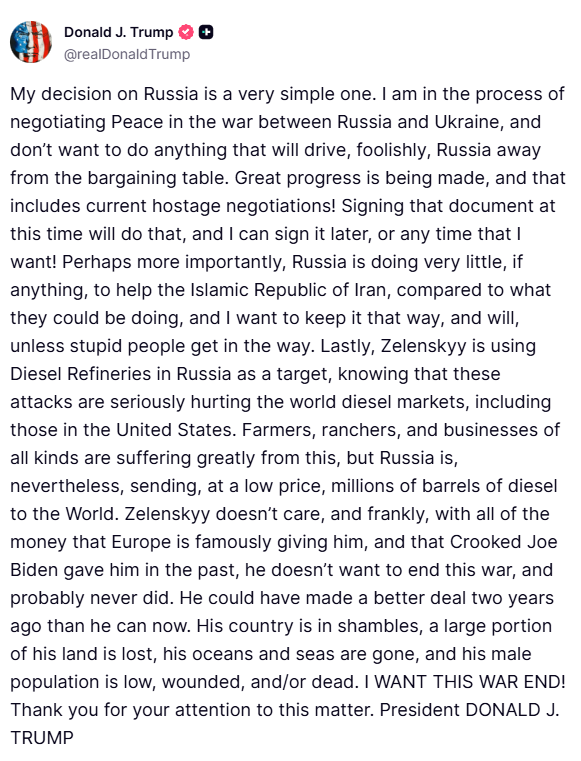
- Russian diesel. On September 18th the President signed the “bipartisan” Lindsey O. Graham Sanctioning Russia and Iran Act of 2026 into law. On October 17th (less than one month after signing the law and two days before the implementation deadline), the President waived part of the bill. Clearly a lot going on with the ongoing fighting with Iran, with the Houthis and Saudis fighting, and Russia and Ukraine continuing to attack each other, but again, a rather quick change to something that was actually passed through Congress.
- Starlink managed to get itself dragged into Russia and Ukraine in a different way. Not only has Musk joined the President’s social media campaign that Zelensky must go (could just be a negotiating ploy, but it is out there), but there are also numerous reports that Starlink wasn’t working properly for the Ukrainian military. The reporting could be incorrect, and it may not have hit the valuations of any of Musk’s companies. Having said that, this, along with threats on restricting diesel exports, seemed to convince Europe that their dependence on the U.S. is quite fragile – which, for better or worse, is very good for ProSec™ going global.
- The President put out a Truth Social post on October 14th on oil and Greenland. “Massive Oil, Gas, and Mineral Exploration is getting ready to begin in our new and beautiful Greenland! There are Experts that are saying that the amount of easily available Oil is far greater than that of almost any land, anywhere in the World…” The oil complex barely moved on this post. The market seemed to instantly “fact check” the word “our” as well as “easily available.” It seems like only a few weeks ago an announcement as bold as this would have moved markets, at least for a little while? Maybe all of the algos, especially any that paid for early access (according to Grok the program was implemented though it is unclear how many, if any, signed up), have lost so much money trading on Truth Social posts that they’ve been given time-outs by their controllers? News agencies are still reporting things like this as “Breaking News,” but markets have become far more discerning, which is an interesting development as volatility has increased of late.
While none of these themes seem to have directly induced any of this week’s market moves, I find it difficult to believe they aren’t playing any role.
We are in the midst of a changing world order, with multiple hot wars in progress, so it seems extremely difficult to believe that things impacting the policy and credibility of the U.S. aren’t contributing to market moves.
Diesel
Last week we went into some detail on Diesel and Yields. We argued that:
The Russian Diesel Deal was too small to matter:
- Markets seem to have agreed that the amount was small and whatever they could export they were going to export anyway. Also, the President “seemed” to back off the concept that the exports were coming to the U.S., expressing it more as a gift to the world.
The EU release of diesel was bigger and more important, and could disappoint:
- The IEA and the EU seemed to have come in around the “middle of the road” in terms of their decision. From all accounts, the IEA and Europe have largely agreed to accelerate the remaining reserves that were agreed to be released back in March of this year. So, it isn’t 50 million new barrels. It is around 20 million barrels that will be released sooner than previously scheduled, assuming each government that has unfulfilled release “quotas” fulfills their part. That seemed far from certain last week because the calculus around the war between Russia and Ukraine has changed (at least for many Europeans).
Diesel Export Ban
- I think that would be a mistake (more on what it does for future trade (not good) than for how it helps in the near term (marginal at best)). The admin backed off of that concept, but who knows in this “rapidly evolving” policy-making atmosphere.
Need Agreements in the Conflict Zones
- Despite the shift in focus to Russia and Ukraine, the most immediate boost would come from a resolution in the Middle East. While oil is making it out of the region with some regularity, there is no evidence that there is as much success with distillates. After months of conflict, the region seems to be getting trickier, rather than easier to assess from a military or diplomatic standpoint, but it is the key to getting all fuel prices significantly lower.
- The U.S. blockade on Iranian shipping is clearly working. Presumably, greater enforcement of sanctions is also working, but that is more difficult to ascertain. This is good for putting pressure on Iran, but not great for energy prices. I’m in agreement that it is probably a small price to pay to try to change the policies of Iran. It will turn out to be an incredibly cheap price to pay if it succeeds in doing that.
- Both the Houthis and Iran seem to be willing and able to hit targets, causing the entire region to remain on precarious footing. To the extent they are curtailing supplies it is bad for prices with no benefits accruing to the U.S. (unlike the U.S. blockade).
- The countries within the region seem to be rapidly reassessing what stance they want to take with the U.S. (evidence of distancing), with Israel (mixed, but in some cases more cooperation), and with Iran and the Houthis/Saudi Arabia (so far seems to be leaning towards some expedient way to “get back to normal” rather than broadening the conflict, with the exception of the Houthis/Saudi Arabia conflict).
- Back to Russia and Ukraine.
- As of now it seems like it is up to Europe and Ukraine itself to figure out how to continue to prosecute the defense. Presumably there remains significant support behind the scenes from the U.S. (though difficult to tell at the moment), but going forward it seems clear that Europe and Ukraine had better figure out if they can do this alone (it seems like they are getting comfortable that they can).
- Ukraine agreed to hold off on attacking Russian refineries and did so for a couple of days, but resumed when Russia did not reciprocate. Do we get another attempt at such a ceasefire where this time Russia obliges? It is quite possible, but it is only going to have a second-order effect on energy prices globally (not bad, but only okay, not game-changing).
- Putin can do what he wants. Zelensky is restricted by a constitution. Iran may have no viable leadership with which to negotiate. Maybe that is why it appears that the President has gravitated to working more closely with Russia as they are the only ones in position to do something decisively (and in a way that might maximize the benefit to America)?
Not optimistic on a big decline in energy prices anytime soon, but it cannot be ruled out, so be careful being too bullish on the commodities themselves. Owning energy producers, globally, is still my main focus, knowing that there will be a sell-off (hopefully small and brief) after any resolution, because longer-term energy independence is the order of the decade.
Apologizing For A Record Number of “Seems”
Using the word “seems” is weak. Period. End of story. It is a cop-out. And yet, try as I might, I cannot gather the courage to eliminate “seems” and be more assertive in this report. There are two main reasons:
- I am reasonably certain that whoever speaks to the President last has the best possible available information at the time. The recency effect is in full swing. If you talk to the President at 8:30 am you have the best information available to anyone. But, by 3:30 pm, whoever speaks to him then has the best information, which may or may not have changed, with or without a catalyst to change it. This ties directly to some points I was trying to make in the first section.
- It is incredibly unclear what is a change in policy or what is just a negotiating point that was never meant to be policy. It is perfectly rational with so many things going on that the admin has to keep its real agenda very secret. Telling everyone exactly what we are planning is unlikely to help our position. Yet, it is difficult to ascertain what is noise and what is signal when we are bombarded (figuratively, not literally) with information every single day.
So, while it is a cop-out to use “seems” so frequently, I cannot get comfortable being more assertive, when in the back of my mind, I know we could get messaging from the admin that completely contradicts one of the views I espouse.
Two things I can say with complete conviction:
- The world is moving to ProSec as we’ve passed the tipping point in the ability to bring global trust back to where it was.
- After the midterms, no matter what, we will be discussing the U.S. steps on ProSec™, though what is prioritized and how it is implemented may start to change.
For those not familiar with what started as National Production For National Security (and resilience), which we now refer to as ProSec (Production for Security), here are two of our longer reports on the subject:
- ProSec 2026 and Vertically Integrated Nations from July 2026.
- ProSec 2026 from January 2026.
Now that we are moving on to markets, where I feel on more solid ground (despite the volatility), we can try to reduce the use of “seems.”
Yields, Spreads, Signals, and Liquidity
Two weeks ago, for the first time in a long time, we focused on not just Treasury Yields, but also Credit Risk in Something is Rotten in the State of Yields. Last weekend we argued that enough had occurred that both the bulls and bears could take some heart from the price action. This week, definitively on credit, we moved from a yellow alert to an orange alert.
We will not rehash the work from two weeks ago (this report is already getting long, and much of what we argued then, remains the case today).
We will highlight a few things and emphasize a couple of others that really bear more attention:
- The size and speed of moves.
- The move from 4.4% to 5.35% in three months in the 10-year Treasury was noticeable. It was a bit more of a steady grind, but during that entire move, there were barely any pullbacks. This week’s move of 17 bps was quite sizeable and rapid. The size and speed work in both directions. I believe the biggest driver of lower 10-year yields this week was the anticipation/hope/maybe even fear that the “compute”-related debt issuance might be set to be slower than anticipated. Economic data? Nah. The Fed? Nah. The deficit? Nah. Positioning and some respite from corporate issuance? Heck yeah.
- European Sovereign Credit Risk. German vs French (and Italian) 2-year bonds blew out 50 bps in 2 days. That fits our definition of size and speed. Was there some news that drove that move? “Drove” is too strong of a word. Catalyzed a view around issues that had been hanging out near the hoop, but hadn’t yet caused a reaction? It is more plausible that the narrative, once expressed, tested liquidity (too little) and positioning (too complacent).
- You can now add at least some of the “compute” issuers to that size and speed risk. We will come back to credit in a moment, because my biggest fear has little to do with actual credit risk and everything to do with size, positioning, and a false risk management comfort in liquidity.
- Volatility – MOVE vs the VIX
- In “Something Rotten” we highlighted that the VIX was well below its average for the year while the MOVE index was almost at the peak it hit in March. VIX finally moved on Thursday and especially on Friday, but still closed well below levels it hit as recently as in June and July and well below 30, which it breached during the early days of the Iran conflict. VIX is relatively useless as a predictor since so many “income alternatives” serve to suppress vol.
- Selling volatility, in many shapes and forms, has become an “income alternative” for many individuals, wealth managers, and institutions. (I think we can safely say that vol selling strategies are one reason the “traditional” 60/40 strategies are not investing anywhere close to 40% in bonds for their income). As an overall theme, just as we are getting more bond supply from governments and corporations, asset managers are reducing their allocation on a percentage basis. There is an almost cult following (a very smart cult to be sure) of the JEPQ and JEPI roll dates ($90 billion of combined ETF AUM). Grok provided a quick list of other “vol-selling” equity ETFs, including QQQI, SPYI, QYLD, DIVO, GPIQ, and GPIX, that approach another $100 billion of combined AUM.
- Will these vol suppression strategies continue to be able to suppress vol, or will they be forced to cover via outflows? Or for risk management? For now, I view these types of strategies as having suppressed equity vol, making things like VIX useless as a predictive measure, but they may also be the seeds of a much bigger move higher.
- In “Something Rotten” we highlighted that the VIX was well below its average for the year while the MOVE index was almost at the peak it hit in March. VIX finally moved on Thursday and especially on Friday, but still closed well below levels it hit as recently as in June and July and well below 30, which it breached during the early days of the Iran conflict. VIX is relatively useless as a predictor since so many “income alternatives” serve to suppress vol.
- Credit Beta vs Fair Value. That is probably an overly complex way of saying that I think the basis between where credit beta products are trading (CDX indices and Credit ETFs) and where their fair value plays a major role in whether moves will be contained or they risk accelerations.
- The good news is that HYG, JNK, LQD, VCSH, and JAAA as a sample of the high yield, long-dated IG, short-dated IG, and AAA CLO sectors are all trading right around their NAV. JBBB (BBB CLO) and ANGL (fallen angel) are trading at a slight discount, but nothing to get too worried about as signals from these aren’t as reliable as those from some of the other ETFs listed.
- The CDX index is trading slightly tighter than its intrinsic value (according to Bloomberg), which is actually positive for my theory as the “arbs” would be selling protection on single names and buying protection on the index, which tends not to reinforce moves to wider and wider spreads. That being said, I’m not sure how accurate the “intrinsic” value calculation I’m seeing on Bloomberg is. Let’s call this “jury is still out.”
- So far, even with the spread widening we have seen, it has been orderly, in terms of the underlying bonds and the beta products. I would fade that “orderly,” as I suspect we are moving into the fast and furious stage.
- Two-week-old new issues. I think the liquidity in new issues that are a week or two old is very important to observe. I’m not arguing that they have to be trading better than their new-issue spread. Markets move. What I’m looking for is if you can pick up the phone and sell a block of $25 million on the wire. In “good” times, those bonds that are 1 to 2 weeks old are still fresh enough for dealers to support. Still new enough that the index crowd should be buying them or looking to buy them into month-end. They also tend to be the bonds that people use to manage risk in the early stages of de-risking (you don’t want to be seen as flipping new issues necessarily, but you can justify “lightening” up on some of those types of bonds). Probably the biggest thing I missed this week from being on the road is a good sense of where the “day-old bread” equivalents of new issues are trading. Lots of dealers making live 2-way prices, or having to pick and choose who you engage with as a seller to get the best execution? From our trading desk, which has been growing in volume, where Paul Giroux continues to expand Academy’s presence in secondary trading, the sense is that dealers are pulling back with liquidity and being cautious. Another reason to fade the idea that “orderly” will continue.
I’m as nervous and cautious on corporate credit risk as I’ve been in a long time. It has little to do with credit quality and everything to do with positioning and a false sense of liquidity that has not yet been tested. But, judging by what we’ve seen in credit-adjacent markets (fancy way of saying France, Spain, and Italy), any test could get ugly quickly (yes, I will use “ugly” as a legitimate term). But let’s call that 10 to 20 bps on IG and 3 to 5 points on HY.
I believe that the risk to a large fast move to the downside is much greater than the chance that we see a big move tighter.
Equities
Virtually everything written about credit and rates applies to equities. The positioning, vol suppression, and faux liquidity apply as much to equities as to credit.
Furthermore, it doesn’t surprise me that equities held up to rising Treasury yields quite well. It would surprise me if equities stand up to rising credit spreads as well, especially when the spreads are hitting the sectors that are driving equity returns and the economy – compute spend/build!
Given my view on the risk/reward on credit, I have to be very cautious on the equity side of things.
I will add one issue that I think is not only “unique” to equities, but is also a driver of equity returns that doesn’t get enough attention (though the T-Report does mention it frequently) and that is the “mechanical” buying and selling, not just of top-heavy indices (indices where a handful of names dominates the index on a percentage basis) but also the leveraged ETFs. Of particular concern is that the Nasdaq 100 and the SOXX Semiconductor indices have both top-heavy weighting, and a large amount (in number and volume) of leveraged ETFs, including on single names.
- Focusing solely on leveraged ETFs (ignoring the top-heavy nature of the indices themselves), the Nasdaq 100 (according to Grok) has TQQQ, QLD, and SQQQ, adding up to close to $60 billion.
- From a positioning standpoint TQQQ (3x Nasdaq 100) has a $34 billion market cap versus SQQQ (-3x Nasdaq 100), which has a $2.2 billion market cap. This would indicate positioning is aggressively bullish. SQQQ has had some inflow, but it looked like there was a lot of “profit taking” or more likely “just get me out of this” on Friday. TQQQ had some selling starting in mid-September, but the dip buying began in earnest. Retail dip buying has been smart, but at almost its largest AUM, how much more can go into it?
- For SOXX, SOXL is the juggernaut at $22 billion, with things like SOX and USD adding another $5 billion or so.
- On the single-name side of things, most are small, but with NVDL leading the way, there is probably $4 billion tied up in leveraged ETFs on NVDA. MUU is roughly that size. While others haven’t gained the traction, there is a lot of speculation and potentially “mechanical” buying in this sector.
Finally, there was a lot of speculation around another fund getting into trouble (and I did follow some accounts that claim to follow Leopold’s trading (if you know, you know)), but it would be too simple if this recent high and recent low follow the same pattern as Situational Awareness. It is possible, but I doubt it. Check out August’s piece on Situational Unawareness.
A Strong View That Might Require Too Many Contortions
I have a very strong view on what could play out in the coming days (weeks). I think it is perfectly logical. Yet, it requires a couple of “leaps of faith” outside of the ordinary to work.
- The sell-off in credit and equities starts with the compute space widening.
- The compute equities do poorly because the spending and buildout are a key part of their valuation.
- Other credit spreads start to widen, not because their own credit has changed, but positioning, losses in other names, and relative value demand it.
- This is the tricky part. At some point investors start pricing in a slowdown for compute-related debt issuance.
- Compute-related spreads tighten. (That isn’t the tricky part).
- Compute equities, general credit spreads, and general equities all continue to sell off. This is the tricky part.
- If wider compute spreads started the selling, wouldn’t tighter compute spreads end it or even reverse it?
- I guess my case rests on the idea that once we’ve started triggering selling, even once compute bond spreads reverse, investors will be very nervous about the state of the overall economy. Compute spend was a big part of the overall spend. Compute valuations may sell off more, as reacting to widening spreads with lower equity is normal, but the real hit would take place if the growth potential for compute-related stocks gets downgraded as investors doubt the access to capital?
I deleted and re-inserted this section 3 times. It seems to be “too clever” and needs to rely on a few things happening that don’t happen that often in markets. Yet, it seems so plausible (yes, I did use that word again, but c’est la vie) to me, that I need to leave it in.
Bottom Line
Enjoy today, and I expect to see a lot of “green” dots on Bloomberg terminals tonight, despite how unreliable Sunday night trading sessions have been! The only thing more unreliable than Sunday night trading (which so often seems to reverse on Monday mornings) is the NFP jobs data, but we go through the motions on that one. At least tonight we can have the NFL on in the background or the MLB (while the Jays couldn’t make it back this year, at least the Dodgers are out), or I guess 60 Minutes if that is more your cup of tea!
A lot to digest and think about. Don’t hesitate to reach out to your Academy rep if you have any questions, thoughts, or just want to point out all the things I got wrong – it is the nature of the beast in these types of confusing and stressful markets! Take care, good luck, and I’m really excited to be on Bloomberg TV at 8 am Monday morning; it seems impossible as I write this that there won’t be a lot to talk about one way or the other at that time.
Tyler Durden Sun, 10/18/2026 - 19:00
Continue reading...
[ H/T ZeroHedge ]