





Guest Post by Milan Adams

Midnight fell differently on February 28, 2026. Across trading floors from Singapore to Chicago, monitors flickered with data streams that would soon curdle into panic. At 0400 hours Tehran time, American B-2 Spirit bombers and Israeli F-35I Adir fighters crossed into Iranian airspace, unleashing Operation Epic Fury. Nine hundred strikes in twelve hours. Ali Khamenei, Supreme Leader of the Islamic Republic, perished in the initial bombardment, his body recovered from the rubble of a command bunker beneath Tehran’s northern suburbs. Markets had anticipated conflict. They had not anticipated decapitation.
Brent crude, trading at $72.48 per barrel at market close on February 27, surged past $120 within seventy-two hours. By March 19, Dubai crude reached $166 per barrel, an all-time record. California gasoline exceeded $5 per gallon.
Kristalina Georgieva, Managing Director of the International Monetary Fund, stood before cameras in Washington on April 9, 2026. “All roads now lead to higher prices and slower growth,” she declared. Her institution had just slashed global growth projections to 3.1 percent, down from 3.4 percent anticipated before the first missiles launched. “Had it not been for this shock, we would have been upgrading global growth.” Instead, the Fund warned of a “severe scenario” where global growth collapses to 2.0 percent, brushing against the technical definition of worldwide recession—a threshold breached only four times since the Second World War. “This would mean a close call for a global recession,” the World Economic Outlook stated.
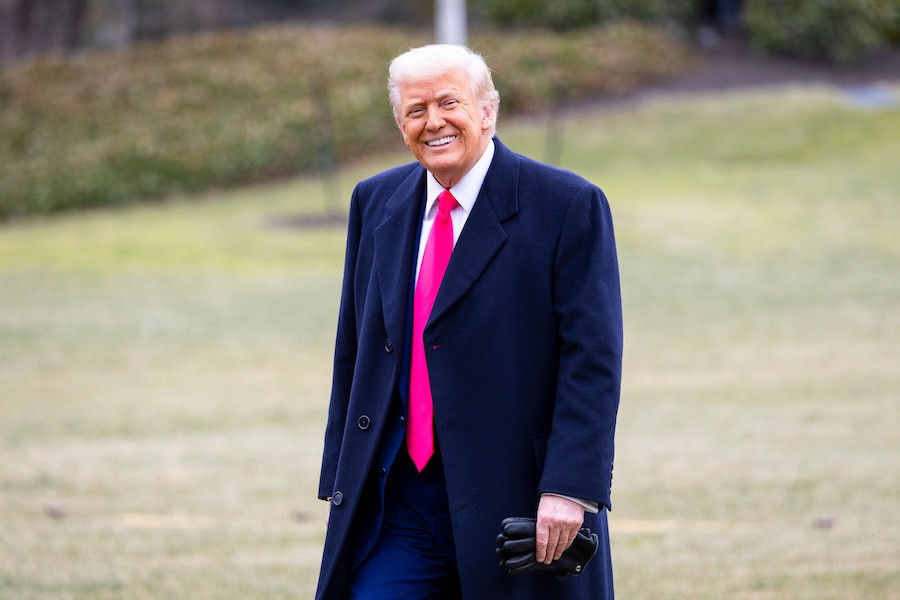
Donald Trump, returned to the presidency for a second non-consecutive term, addressed the nation from the Oval Office on August 20, 2026. “Any country that allows its financial institutions, businesses, airports, or government entities to provide any type of lifeline to Iran will itself face tremendous economic consequences,” he warned, announcing what he termed “the toughest sanctions in history.” Earlier, he had posted an image on social media showing the Strait of Hormuz crudely labeled as “New US Territory,” a digital annexation that sent tremors through diplomatic channels. His administration’s Operation Economic Fury sought to complete what Operation Epic Fury had begun. “To the ordinary soldiers supporting this regime,” Trump addressed Iranian conscripts directly, “as more and more of your paychecks stop or are supposedly just delayed, ask whether your commanders are leading your country to triumph or to ruin.”
Jerome Powell, in his final months as Federal Reserve Chair, confronted the economic paradox that would define 2026. At a Harvard forum on March 30, he admitted the central bank’s predicament with uncharacteristic candor. “Nobody knows,” he stated, referring to the war’s ultimate economic impact, while acknowledging that “you can be confident that an inflationary shock will fade, but have very little idea how long it will take.” The Fed’s March 18 decision to hold interest rates steady—projecting only a single rate cut for the year despite inflation spiking to 3.3 percent—represented a capitulation to uncertainty. Powell’s institution projected higher inflation, steady unemployment, and minimal monetary relief.
Nouriel Roubini, the economist whose prescient warnings preceded the 2008 financial collapse, offered scenarios in May 2026 that chilled institutional investors. “Oil prices could spike past $200 a barrel in the worst-case scenario,” he predicted, describing a return to “1970s stagflation.” Mohamed El-Erian, former Pimco chief and now Chief Economic Advisor at Allianz, tweeted his assessment of the IMF’s April report: “Reading between the lines, the message of today’s IMF flagship report is sobering: Virtually every challenge facing the global economy is poised to intensify due to the fallout of the Middle East War.”
The World Bank’s June 11, 2026 Global Economic Prospects report confirmed these apprehensions. Global growth would slow to 2.5 percent in 2026, the weakest expansion since the COVID-19 pandemic. For developing and emerging markets, the forecast plummeted to 3.6 percent. Iran’s economy contracted by 6.1 percent, with the Bank noting that “real GDP is projected to contract by 6.4 percent in 2026, reflecting the collapse in tourism, weaker consumption, disrupted supply chains, heightened insecurity, and prolonged displacement.” Qatar and Kuwait faced potential GDP contractions of 14 percent. The Institute for Economics and Peace calculated that a resumption of full-scale hostilities would deliver a $2.2 trillion hit to the world economy.
Economic Impact Projections by Institution, 2026
Regional GDP Contraction Projections, 2026
Oil Market Disruption Metrics, February-September 2026
Beneath these statistics lies a more troubling reality. Global debt reached $348 trillion in 2025, according to the Institute of International Finance, expanding by nearly $29 trillion in that single year. By mid-2026, estimates placed the figure above $365 trillion. This edifice of obligation, constructed during fifteen years of central bank suppression of interest rates, now faces a refinancing crisis as monetary authorities maintain elevated borrowing costs to combat inflation. The OECD’s Global Debt Report 2026 warned of “increasing pressures from sustained fiscal deficits, rising interest costs and investment needs, a structural decline in long-term demand, and growing refinancing risks as the maturity of issuance shortens.”
Small and medium enterprises find themselves particularly exposed. S&P Global’s 2026 banking risk analysis noted that SMEs “have thinner capital buffers and proportionately more floating-rate exposure,” rendering them acutely vulnerable to the higher interest costs that the Iran war’s inflationary impact necessitates. When the Federal Reserve chose steady rates over relief in March 2026, these businesses absorbed the blow directly.
The weaponization of the dollar has generated blowback that Washington’s Treasury Department struggles to contain. China’s Cross-Border Interbank Payment System (CIPS), processing the equivalent of $245 trillion in yuan-denominated transactions in 2025, has emerged as a functional alternative to SWIFT. By January 2026, CIPS linked 1,467 indirect participants across 119 countries, connecting 4,800 banks in 185 nations. While still smaller than SWIFT, its trajectory suggests a fragmentation of monetary infrastructure that the Iran conflict has only accelerated.
The petrodollar system faces unprecedented stress. Russia and Saudi Arabia, the two largest oil producers, generated “essentially zero petrodollars” in 2025 according to Wright Research analysis, having shifted to yuan-denominated settlements. Iran, excluded from dollar markets since 1979, pioneered this transition. Now the template spreads. BRICS nations conducted an estimated 90% of intra-bloc transactions in local currencies by 2025.
This matters profoundly for American fiscal sustainability. Foreign holdings of U.S. Treasury securities have plateaued as central banks diversify reserves. The dollar’s share of global foreign exchange reserves declined from 73% in 2001 to approximately 54% in 2025, per IMF data. Each percentage point shift represents hundreds of billions in reduced demand for dollar-denominated assets, increasing the interest premium Washington must pay to finance its $34.6 trillion national debt.
The Iran war operates as an accelerant upon these pre-existing trends. When Trump threatened “crushing economic warfare” in August 2026, he extended a sanctions regime that had already demonstrated diminishing returns. Iran’s economy, while battered by 6.4 percent contraction and currency collapse, had developed sophisticated evasion mechanisms through shadow banking networks and cryptocurrency channels. The Islamic Republic’s oil smuggling to China, estimated at 1.2 million barrels daily despite sanctions, continued through “dark fleet” tankers operating with disabled transponders.
European Central Bank President Christine Lagarde, in deliberations that postponed planned rate cuts on March 19, 2026, confronted the dilemma that would define transatlantic economic divergence. Energy-intensive European economies faced technical recession risks if the Hormuz maritime blockade persisted. German manufacturing, already weakened by the cessation of Russian natural gas supplies following the Ukraine conflict, confronted additional input cost shocks. The ECB raised its 2026 inflation forecast while slashing growth projections.
Japan’s position proved equally precarious. As the world’s largest liquefied natural gas importer, Tokyo faced energy security vulnerabilities that the Iran war exposed with brutal clarity. QatarEnergy’s declaration of force majeure on LNG exports during the March 2026 Hormuz closure sent Japanese utilities scrambling for alternative suppliers at premium prices. The yen, already depreciating against the dollar amid interest rate differentials, faced additional pressure as import costs surged.
China’s strategic calculus shifted in response. While publicly advocating de-escalation, Beijing accelerated yuan internationalization through energy purchase agreements denominated in renminbi. Saudi Arabia’s 2024 decision to allow yuan-settled oil sales, followed by similar arrangements with Iraq and the UAE, created the infrastructure for a parallel monetary order. The Iran war’s disruption of dollar-denominated energy flows provided practical demonstration of the vulnerabilities inherent to single-currency dependence.
India’s position illustrated the impossible choices facing emerging economies. As the third-largest oil importer, New Delhi faced inflationary pressures that threatened the Modi government’s economic credibility. Yet India’s strategic partnership with the United States constrained options for evading American sanctions on Iranian oil. The result: higher import bills, currency depreciation, and postponed infrastructure spending as fiscal resources diverted to energy subsidies.
The banking sector’s exposure to these stresses remains imperfectly understood. Commercial real estate loans, particularly those financing office properties in urban centers hollowed out by remote work trends, carry default risks that energy price shocks amplify. Regional banks in the United States, having faced depositor flight in the 2023 Silicon Valley Bank collapse, now confront renewed pressure as bond portfolios lose value amid interest rate volatility. The $1.5 to $2.1 trillion private credit market operates with opacity that systemic risk assessments struggle to penetrate.
Corporate debt maturities in 2026-2027 present a refinancing cliff of historic proportions. Companies that borrowed at near-zero rates during the quantitative easing era must now roll obligations at 6-8 percent interest, if markets remain open to them at all. The “zombie firm” phenomenon—enterprises kept operational only through continuous debt refinancing rather than operational profitability—threatens mass insolvency if credit conditions tighten further.
Agricultural markets compound these vulnerabilities. Wheat and corn prices, already elevated by Ukraine conflict disruptions and climate anomalies, face additional pressure from energy-intensive fertilizer production costs. Natural gas, the primary feedstock for nitrogen fertilizer manufacturing, saw European prices spike 300% during the March 2026 Hormuz closure. The transmission to food prices operates with inevitable lag but equal certainty.
Humanitarian consequences extend beyond abstract statistics. Iran’s population of 87 million faces food insecurity as sanctions disrupt import financing and currency collapse destroys purchasing power. The rial’s depreciation against the dollar, exceeding 80% since 2021, has rendered imported medicines unaffordable for ordinary families. Brain drain accelerates as professionals emigrate to Dubai, Istanbul, and European capitals.
Israel’s economy, despite receiving $14.3 billion in American military aid during 2026, faces its own contradictions. The Bank of Israel slashed growth prospects as the war’s toll mounted, with defense spending consuming resources that might otherwise support social services. Military mobilization of reservists disrupted technology sector productivity, while tourism revenues collapsed amid security concerns.
The United States enters the final quarter of 2026 with economic indicators that defy simple categorization. Unemployment remains near historic lows at 4.1%, yet labor force participation among prime-age males continues declining. GDP growth, projected at 1.8% for the year, masks distributional shifts that concentrate gains in asset-owning classes while wage workers confront eroded purchasing power. The Federal Reserve’s preferred inflation metric, core PCE, hovers above target at 3.3%, constraining monetary policy flexibility.
Presidential rhetoric in this environment oscillates between triumphalism and threat. Trump’s August 2026 declaration that Iran “outsmarted themselves” over Hormuz control, accompanied by social media posts depicting the waterway as American territory, suggests a transactional approach to territorial sovereignty that unsettles international law. His simultaneous threats against nations maintaining economic ties to Tehran create compliance dilemmas for allies whose strategic interests diverge from Washington’s.
The configuration of military confrontation, monetary stress, and debt fragility creates conditions for systemic stress that would exceed the 2008 financial crisis in scope. Not through single catastrophic event but through cascading failures that compound across interconnected systems. An oil price spike above $200 per barrel, as Roubini warned, would trigger demand destruction in transport sectors that eliminates millions of jobs. Corporate defaults in energy-intensive industries would cascade through credit default swap markets that remain opaque to regulators. Sovereign debt crises in emerging markets would force IMF interventions that impose austerity conditions, generating political instability that feeds further conflict.
The dollar’s reserve currency status faces its most credible challenge since Bretton Woods. Not because rivals possess superior alternatives—the yuan remains non-convertible, the euro fragmented—but because Washington’s weaponization of financial infrastructure has created irresistible incentives for diversification. Each sanctions round against Iran accelerates this process. Each threat of secondary sanctions against allies hastens the construction of parallel systems.
The optimistic scenario, increasingly dismissed by market participants, envisions negotiated settlement by early 2027, Hormuz reopening, and gradual price normalization. Even this outcome, Georgieva emphasized, leaves “permanent scarring” on growth trajectories. Output levels in 2030 will remain 2% below pre-war trends according to IMF projections. The opportunity cost of military confrontation—the infrastructure unbuilt, the research unfunded, the human potential unrealized—accumulates across decades.
The pessimistic scenario defies precise modeling because its variables interact non-linearly. Oil at $200 per barrel simultaneously triggers recession and accelerates energy transition investments that strand fossil fuel assets. Banking crises in vulnerable jurisdictions propagate through derivatives exposures that regulatory stress tests failed to capture. Political radicalization, fed by economic desperation, produces leadership incapable of crisis management.
Historical analogies offer limited guidance. The 1973 oil shock occurred within a Bretton Woods framework that no longer exists. The 2008 financial crisis, while demonstrating interconnected fragility, benefited from coordinated central bank responses that current geopolitical polarization may preclude.
What distinguishes the present moment is the convergence of multiple stressors upon a system already operating near capacity. Global debt at $365 trillion represents claims that cannot all be satisfied simultaneously. The Iran war’s energy price shock applies pressure to this leveraged structure in ways that individual components—sovereign borrowers, corporate issuers, financial intermediaries—may withstand in isolation but cannot survive collectively.
The Strait of Hormuz, that narrow channel through which one-fifth of global petroleum flows, embodies this vulnerability. Twenty-one million barrels daily transit waters barely twenty-one miles wide at their narrowest point. Iranian missile batteries, mines, and fast attack craft can interdict this flow with minimal warning. American carrier groups can suppress such threats at enormous cost but cannot eliminate them entirely.
Trump’s social media annexation of Hormuz as “New US Territory” in August 2026, however rhetorical, signaled an American willingness to assert direct territorial control over international waterways that precedent has long treated as global commons. Such assertions, if operationalized, would encounter resistance not merely from Iran but from China, Russia, and regional powers whose energy security depends upon unimpeded navigation.
Economic warfare, as practiced against Iran in 2026, operates through mechanisms that escape traditional accounting. The exclusion of Iranian banks from SWIFT messaging does not merely inconvenience; it severs commercial relationships built over decades. The secondary sanctions threatening foreign entities that transact with Iran force impossible choices upon multinational corporations between American market access and Iranian commercial relationships. The cumulative effect is a fragmentation of global commerce into competing blocs that reduces overall efficiency and prosperity.
The BRICS bloc’s expansion in 2024 to include major oil producers Iran, Saudi Arabia, and the UAE created an organizational framework for this monetary diversification. While the proposed common BRICS currency remains technically distant, the infrastructure for reduced dollar dependence develops apace.
For American households, these macroeconomic abstractions translate into concrete hardships. Gasoline prices above $5 per gallon, as experienced in California during March 2026, reduce discretionary spending that drives consumer-dependent growth. Home heating costs surge in northern winters. Food prices, transported by diesel-powered logistics networks, follow energy costs upward. The Federal Reserve’s interest rate restraint, maintained despite these pressures to combat underlying inflation, keeps mortgage rates elevated and housing affordability diminished.
The political economy of these stresses generates feedback loops that complicate resolution. Populist movements, fed by economic grievance, demand more aggressive confrontation with perceived adversaries rather than diplomatic compromise. Interest groups benefiting from military expenditure lobby for sustained confrontation. Media ecosystems amplify threat perception, reducing the political space for negotiation.
Iran’s leadership, despite decapitation and economic devastation, maintains negotiating positions that reflect their assessment of American political constraints. They observe the American electoral cycle, the influence of pro-Israel constituencies, and the transactional nature of Trump’s diplomacy. Their strategy of brinkmanship—escalating to de-escalate—assumes that Washington’s pain threshold, while higher than Tehran’s, remains finite.
The September 2026 ceasefire, brokered through Qatari intermediation, paused direct military confrontation but resolved nothing. Iranian nuclear facilities, though damaged, remain operational at undeclared sites. Israeli security guarantees, demanded as condition for permanent settlement, exceed what Tehran’s fractured leadership can deliver. American troops remain deployed across the region in configurations vulnerable to proxy attack.
Economic forecasts for 2027 diverge based upon assumptions about this unresolved confrontation. The IMF’s reference scenario assumes short-lived conflict with gradual normalization, projecting 3.1% global growth recovery. Its adverse scenario, increasingly probable as negotiations stall, envisions 2.5% growth with 5.4% inflation. The severe scenario—2.0% growth brushing recession—requires only modest additional escalation: Hormuz closure persisting beyond three months, Iranian missile strikes on Saudi infrastructure, or Israeli expansion of operations into Lebanon and Syria.
Each of these triggers remains plausible. Iranian Revolutionary Guard factions, empowered by Khamenei’s death and competing for succession influence, may calculate that renewed confrontation serves domestic political purposes. Israeli leadership, facing domestic pressure for decisive security solutions, may authorize strikes that previous restraint avoided. American electoral considerations in the approach to 2028 may incentivize foreign policy aggression that rallies domestic support.
The debt dimension compounds these risks. Sovereign borrowers facing recessionary revenue shortfalls and inflationary expenditure increases encounter debt servicing requirements that crowd out productive investment. Corporate issuers with 2027 maturities confront rollover costs that render previously viable enterprises insolvent. Financial intermediaries, holding claims upon these borrowers, face capital constraints that restrict new lending. The resulting credit contraction amplifies recessionary dynamics.
Central banks, having deployed extraordinary measures during the COVID-19 pandemic, possess diminished capacity for repetition. Balance sheets already swollen with asset purchases offer limited room for additional expansion. Interest rates, while above zero, remain below inflation in real terms, constraining traditional monetary policy space. Fiscal authorities, confronting debt burdens that limit countercyclical spending, face political resistance to deficit expansion.
A system that requires 3%+ growth to service $365 trillion debt will struggle to maintain stability at 2% growth without structural adjustment that political processes resist. The Iran war, by reducing growth and increasing inflation simultaneously, forces this adjustment upon unwilling participants. Whether through negotiated settlement that restores energy flows and reduces risk premiums, or through continued confrontation that amplifies systemic stress, adjustment will occur.
The form it takes—gradual normalization or sudden rupture—remains the variable that will define economic experience for the decade ahead. Current trajectory favors rupture: unresolved confrontation, accumulating sanctions, escalating rhetoric, and structural fragility that compound across months rather than years. The optimistic scenario requires not merely ceasefire but durable settlement, not merely sanctions relief but economic reconstruction, not merely diplomatic engagement but fundamental reassessment of regional order.
Such reassessment appears improbable given current leadership configurations. Trump approaches his final term’s conclusion with incentive to cement confrontational legacy rather than compromise. Iranian factions compete for succession advantage through nationalist positioning rather than pragmatic accommodation. Israeli security establishment, validated by apparent military success, resists territorial concessions that might address underlying grievances.
The economic consequences of this political configuration will unfold across quarters and years with accumulating damage. Growth forecasts will revise downward repeatedly. Inflation projections will revise upward. Debt sustainability assessments will deteriorate. Financial market volatility will increase. Each revision, each deterioration, each increase reduces the margin for error that prevents systemic crisis.
The Iran war has demonstrated that geopolitical confrontation can impose economic costs that exceed the combatants’ calculations. Those costs, interacting with pre-existing vulnerabilities in global debt and monetary architecture, create conditions for crisis that policy instruments cannot readily address. Whether this crisis arrives in 2026, 2027, or beyond matters less than its likelihood given current trajectory.
Markets, having priced some risk premium, may remain complacent until rupture occurs. Policymakers, having normalized extraordinary measures, may discover their exhaustion only in crisis. Populations, having accommodated gradual deterioration, may confront sudden deprivation with inadequate social infrastructure. The Iran war’s ultimate economic legacy may prove not the direct costs of military confrontation but the revelation that global economic integration, assumed permanent, rests upon political foundations more fragile than understood.
Tweet
Continue reading...
[ H/T The Burning Platform ]
Midnight fell differently on February 28, 2026. Across trading floors from Singapore to Chicago, monitors flickered with data streams that would soon curdle into panic. At 0400 hours Tehran time, American B-2 Spirit bombers and Israeli F-35I Adir fighters crossed into Iranian airspace, unleashing Operation Epic Fury. Nine hundred strikes in twelve hours. Ali Khamenei, Supreme Leader of the Islamic Republic, perished in the initial bombardment, his body recovered from the rubble of a command bunker beneath Tehran’s northern suburbs. Markets had anticipated conflict. They had not anticipated decapitation.
Brent crude, trading at $72.48 per barrel at market close on February 27, surged past $120 within seventy-two hours. By March 19, Dubai crude reached $166 per barrel, an all-time record. California gasoline exceeded $5 per gallon.
Kristalina Georgieva, Managing Director of the International Monetary Fund, stood before cameras in Washington on April 9, 2026. “All roads now lead to higher prices and slower growth,” she declared. Her institution had just slashed global growth projections to 3.1 percent, down from 3.4 percent anticipated before the first missiles launched. “Had it not been for this shock, we would have been upgrading global growth.” Instead, the Fund warned of a “severe scenario” where global growth collapses to 2.0 percent, brushing against the technical definition of worldwide recession—a threshold breached only four times since the Second World War. “This would mean a close call for a global recession,” the World Economic Outlook stated.
Donald Trump, returned to the presidency for a second non-consecutive term, addressed the nation from the Oval Office on August 20, 2026. “Any country that allows its financial institutions, businesses, airports, or government entities to provide any type of lifeline to Iran will itself face tremendous economic consequences,” he warned, announcing what he termed “the toughest sanctions in history.” Earlier, he had posted an image on social media showing the Strait of Hormuz crudely labeled as “New US Territory,” a digital annexation that sent tremors through diplomatic channels. His administration’s Operation Economic Fury sought to complete what Operation Epic Fury had begun. “To the ordinary soldiers supporting this regime,” Trump addressed Iranian conscripts directly, “as more and more of your paychecks stop or are supposedly just delayed, ask whether your commanders are leading your country to triumph or to ruin.”
Jerome Powell, in his final months as Federal Reserve Chair, confronted the economic paradox that would define 2026. At a Harvard forum on March 30, he admitted the central bank’s predicament with uncharacteristic candor. “Nobody knows,” he stated, referring to the war’s ultimate economic impact, while acknowledging that “you can be confident that an inflationary shock will fade, but have very little idea how long it will take.” The Fed’s March 18 decision to hold interest rates steady—projecting only a single rate cut for the year despite inflation spiking to 3.3 percent—represented a capitulation to uncertainty. Powell’s institution projected higher inflation, steady unemployment, and minimal monetary relief.
Nouriel Roubini, the economist whose prescient warnings preceded the 2008 financial collapse, offered scenarios in May 2026 that chilled institutional investors. “Oil prices could spike past $200 a barrel in the worst-case scenario,” he predicted, describing a return to “1970s stagflation.” Mohamed El-Erian, former Pimco chief and now Chief Economic Advisor at Allianz, tweeted his assessment of the IMF’s April report: “Reading between the lines, the message of today’s IMF flagship report is sobering: Virtually every challenge facing the global economy is poised to intensify due to the fallout of the Middle East War.”
The World Bank’s June 11, 2026 Global Economic Prospects report confirmed these apprehensions. Global growth would slow to 2.5 percent in 2026, the weakest expansion since the COVID-19 pandemic. For developing and emerging markets, the forecast plummeted to 3.6 percent. Iran’s economy contracted by 6.1 percent, with the Bank noting that “real GDP is projected to contract by 6.4 percent in 2026, reflecting the collapse in tourism, weaker consumption, disrupted supply chains, heightened insecurity, and prolonged displacement.” Qatar and Kuwait faced potential GDP contractions of 14 percent. The Institute for Economics and Peace calculated that a resumption of full-scale hostilities would deliver a $2.2 trillion hit to the world economy.
Economic Impact Projections by Institution, 2026
| Institution | Global Growth Forecast | Inflation Projection | Severe Scenario | Oil Price Assumption |
|---|---|---|---|---|
| IMF (April 2026) | 3.1% (down from 3.4%) | 4.4% | 2.0% growth, 5.4% inflation | $100/bbl (reference), $140+ (adverse) |
| World Bank (June 2026) | 2.5% (down from 2.9%) | 4.0% | 2.0% or below | $120/bbl average |
| OECD (March 2026) | 2.7% | 3.2% US, 3.0% Eurozone | Technical recession in energy-intensive economies | $90-110/bbl range |
| Oxford Economics | 2.8% | 4.2% | 1.5% growth if Hormuz closed 3+ months | $140/bbl threshold for demand destruction |
Regional GDP Contraction Projections, 2026
| Economy | Pre-War Forecast | Post-War Projection | Revision | Primary Transmission Channel |
|---|---|---|---|---|
| Iran | +1.1% | -6.1% to -6.4% | -7.2 pp | Infrastructure destruction, sanctions |
| Qatar | +3.2% | -14.0% | -17.2 pp | LNG export disruption, Hormuz closure |
| Kuwait | +2.8% | -14.0% | -16.8 pp | Oil export cessation |
| Iraq | +2.1% | -8.5% | -10.6 pp | Supply chain fracture, refugee costs |
| Bahrain | +1.9% | -6.8% | -8.7 pp | Financial sector exposure |
| Saudi Arabia | +3.5% | -3.0% | -6.5 pp | Reduced oil volumes, price volatility |
| UAE | +3.8% | -5.0% | -8.8 pp | Trade finance disruption |
| Eurozone | +1.2% | +0.8% | -0.4 pp | Energy import costs, manufacturing |
| United States | +2.1% | +1.8% | -0.3 pp | Gasoline prices, consumer sentiment |
Oil Market Disruption Metrics, February-September 2026
| Metric | Pre-War (Feb 27) | Peak Crisis (Mar 19) | Recovery Phase (Jun 24) | Current (Sep 30) |
|---|---|---|---|---|
| Brent Crude ($/barrel) | $72.48 | $166.00 (Dubai) | $72.24 | $73.23-$97.00 |
| Daily Oil Flow via Hormuz (mbpd) | 21.0 | 0.5 | 8.2 | 14.5 |
| Strategic Reserve Drawdown (US, mb) | 0 | 180 | 120 | 85 |
| Gasoline Price California ($/gal) | $4.12 | $5.08+ | $4.45 | $4.28 |
| LNG Force Majeure Declarations | 0 | 12 (QatarEnergy) | 3 | 0 |
Beneath these statistics lies a more troubling reality. Global debt reached $348 trillion in 2025, according to the Institute of International Finance, expanding by nearly $29 trillion in that single year. By mid-2026, estimates placed the figure above $365 trillion. This edifice of obligation, constructed during fifteen years of central bank suppression of interest rates, now faces a refinancing crisis as monetary authorities maintain elevated borrowing costs to combat inflation. The OECD’s Global Debt Report 2026 warned of “increasing pressures from sustained fiscal deficits, rising interest costs and investment needs, a structural decline in long-term demand, and growing refinancing risks as the maturity of issuance shortens.”
Small and medium enterprises find themselves particularly exposed. S&P Global’s 2026 banking risk analysis noted that SMEs “have thinner capital buffers and proportionately more floating-rate exposure,” rendering them acutely vulnerable to the higher interest costs that the Iran war’s inflationary impact necessitates. When the Federal Reserve chose steady rates over relief in March 2026, these businesses absorbed the blow directly.
The weaponization of the dollar has generated blowback that Washington’s Treasury Department struggles to contain. China’s Cross-Border Interbank Payment System (CIPS), processing the equivalent of $245 trillion in yuan-denominated transactions in 2025, has emerged as a functional alternative to SWIFT. By January 2026, CIPS linked 1,467 indirect participants across 119 countries, connecting 4,800 banks in 185 nations. While still smaller than SWIFT, its trajectory suggests a fragmentation of monetary infrastructure that the Iran conflict has only accelerated.
The petrodollar system faces unprecedented stress. Russia and Saudi Arabia, the two largest oil producers, generated “essentially zero petrodollars” in 2025 according to Wright Research analysis, having shifted to yuan-denominated settlements. Iran, excluded from dollar markets since 1979, pioneered this transition. Now the template spreads. BRICS nations conducted an estimated 90% of intra-bloc transactions in local currencies by 2025.
This matters profoundly for American fiscal sustainability. Foreign holdings of U.S. Treasury securities have plateaued as central banks diversify reserves. The dollar’s share of global foreign exchange reserves declined from 73% in 2001 to approximately 54% in 2025, per IMF data. Each percentage point shift represents hundreds of billions in reduced demand for dollar-denominated assets, increasing the interest premium Washington must pay to finance its $34.6 trillion national debt.
The Iran war operates as an accelerant upon these pre-existing trends. When Trump threatened “crushing economic warfare” in August 2026, he extended a sanctions regime that had already demonstrated diminishing returns. Iran’s economy, while battered by 6.4 percent contraction and currency collapse, had developed sophisticated evasion mechanisms through shadow banking networks and cryptocurrency channels. The Islamic Republic’s oil smuggling to China, estimated at 1.2 million barrels daily despite sanctions, continued through “dark fleet” tankers operating with disabled transponders.
European Central Bank President Christine Lagarde, in deliberations that postponed planned rate cuts on March 19, 2026, confronted the dilemma that would define transatlantic economic divergence. Energy-intensive European economies faced technical recession risks if the Hormuz maritime blockade persisted. German manufacturing, already weakened by the cessation of Russian natural gas supplies following the Ukraine conflict, confronted additional input cost shocks. The ECB raised its 2026 inflation forecast while slashing growth projections.
Japan’s position proved equally precarious. As the world’s largest liquefied natural gas importer, Tokyo faced energy security vulnerabilities that the Iran war exposed with brutal clarity. QatarEnergy’s declaration of force majeure on LNG exports during the March 2026 Hormuz closure sent Japanese utilities scrambling for alternative suppliers at premium prices. The yen, already depreciating against the dollar amid interest rate differentials, faced additional pressure as import costs surged.
China’s strategic calculus shifted in response. While publicly advocating de-escalation, Beijing accelerated yuan internationalization through energy purchase agreements denominated in renminbi. Saudi Arabia’s 2024 decision to allow yuan-settled oil sales, followed by similar arrangements with Iraq and the UAE, created the infrastructure for a parallel monetary order. The Iran war’s disruption of dollar-denominated energy flows provided practical demonstration of the vulnerabilities inherent to single-currency dependence.
India’s position illustrated the impossible choices facing emerging economies. As the third-largest oil importer, New Delhi faced inflationary pressures that threatened the Modi government’s economic credibility. Yet India’s strategic partnership with the United States constrained options for evading American sanctions on Iranian oil. The result: higher import bills, currency depreciation, and postponed infrastructure spending as fiscal resources diverted to energy subsidies.
The banking sector’s exposure to these stresses remains imperfectly understood. Commercial real estate loans, particularly those financing office properties in urban centers hollowed out by remote work trends, carry default risks that energy price shocks amplify. Regional banks in the United States, having faced depositor flight in the 2023 Silicon Valley Bank collapse, now confront renewed pressure as bond portfolios lose value amid interest rate volatility. The $1.5 to $2.1 trillion private credit market operates with opacity that systemic risk assessments struggle to penetrate.
Corporate debt maturities in 2026-2027 present a refinancing cliff of historic proportions. Companies that borrowed at near-zero rates during the quantitative easing era must now roll obligations at 6-8 percent interest, if markets remain open to them at all. The “zombie firm” phenomenon—enterprises kept operational only through continuous debt refinancing rather than operational profitability—threatens mass insolvency if credit conditions tighten further.
Agricultural markets compound these vulnerabilities. Wheat and corn prices, already elevated by Ukraine conflict disruptions and climate anomalies, face additional pressure from energy-intensive fertilizer production costs. Natural gas, the primary feedstock for nitrogen fertilizer manufacturing, saw European prices spike 300% during the March 2026 Hormuz closure. The transmission to food prices operates with inevitable lag but equal certainty.
Humanitarian consequences extend beyond abstract statistics. Iran’s population of 87 million faces food insecurity as sanctions disrupt import financing and currency collapse destroys purchasing power. The rial’s depreciation against the dollar, exceeding 80% since 2021, has rendered imported medicines unaffordable for ordinary families. Brain drain accelerates as professionals emigrate to Dubai, Istanbul, and European capitals.
Israel’s economy, despite receiving $14.3 billion in American military aid during 2026, faces its own contradictions. The Bank of Israel slashed growth prospects as the war’s toll mounted, with defense spending consuming resources that might otherwise support social services. Military mobilization of reservists disrupted technology sector productivity, while tourism revenues collapsed amid security concerns.
The United States enters the final quarter of 2026 with economic indicators that defy simple categorization. Unemployment remains near historic lows at 4.1%, yet labor force participation among prime-age males continues declining. GDP growth, projected at 1.8% for the year, masks distributional shifts that concentrate gains in asset-owning classes while wage workers confront eroded purchasing power. The Federal Reserve’s preferred inflation metric, core PCE, hovers above target at 3.3%, constraining monetary policy flexibility.
Presidential rhetoric in this environment oscillates between triumphalism and threat. Trump’s August 2026 declaration that Iran “outsmarted themselves” over Hormuz control, accompanied by social media posts depicting the waterway as American territory, suggests a transactional approach to territorial sovereignty that unsettles international law. His simultaneous threats against nations maintaining economic ties to Tehran create compliance dilemmas for allies whose strategic interests diverge from Washington’s.
The configuration of military confrontation, monetary stress, and debt fragility creates conditions for systemic stress that would exceed the 2008 financial crisis in scope. Not through single catastrophic event but through cascading failures that compound across interconnected systems. An oil price spike above $200 per barrel, as Roubini warned, would trigger demand destruction in transport sectors that eliminates millions of jobs. Corporate defaults in energy-intensive industries would cascade through credit default swap markets that remain opaque to regulators. Sovereign debt crises in emerging markets would force IMF interventions that impose austerity conditions, generating political instability that feeds further conflict.
The dollar’s reserve currency status faces its most credible challenge since Bretton Woods. Not because rivals possess superior alternatives—the yuan remains non-convertible, the euro fragmented—but because Washington’s weaponization of financial infrastructure has created irresistible incentives for diversification. Each sanctions round against Iran accelerates this process. Each threat of secondary sanctions against allies hastens the construction of parallel systems.
The optimistic scenario, increasingly dismissed by market participants, envisions negotiated settlement by early 2027, Hormuz reopening, and gradual price normalization. Even this outcome, Georgieva emphasized, leaves “permanent scarring” on growth trajectories. Output levels in 2030 will remain 2% below pre-war trends according to IMF projections. The opportunity cost of military confrontation—the infrastructure unbuilt, the research unfunded, the human potential unrealized—accumulates across decades.
The pessimistic scenario defies precise modeling because its variables interact non-linearly. Oil at $200 per barrel simultaneously triggers recession and accelerates energy transition investments that strand fossil fuel assets. Banking crises in vulnerable jurisdictions propagate through derivatives exposures that regulatory stress tests failed to capture. Political radicalization, fed by economic desperation, produces leadership incapable of crisis management.
Historical analogies offer limited guidance. The 1973 oil shock occurred within a Bretton Woods framework that no longer exists. The 2008 financial crisis, while demonstrating interconnected fragility, benefited from coordinated central bank responses that current geopolitical polarization may preclude.
What distinguishes the present moment is the convergence of multiple stressors upon a system already operating near capacity. Global debt at $365 trillion represents claims that cannot all be satisfied simultaneously. The Iran war’s energy price shock applies pressure to this leveraged structure in ways that individual components—sovereign borrowers, corporate issuers, financial intermediaries—may withstand in isolation but cannot survive collectively.
The Strait of Hormuz, that narrow channel through which one-fifth of global petroleum flows, embodies this vulnerability. Twenty-one million barrels daily transit waters barely twenty-one miles wide at their narrowest point. Iranian missile batteries, mines, and fast attack craft can interdict this flow with minimal warning. American carrier groups can suppress such threats at enormous cost but cannot eliminate them entirely.
Trump’s social media annexation of Hormuz as “New US Territory” in August 2026, however rhetorical, signaled an American willingness to assert direct territorial control over international waterways that precedent has long treated as global commons. Such assertions, if operationalized, would encounter resistance not merely from Iran but from China, Russia, and regional powers whose energy security depends upon unimpeded navigation.
Economic warfare, as practiced against Iran in 2026, operates through mechanisms that escape traditional accounting. The exclusion of Iranian banks from SWIFT messaging does not merely inconvenience; it severs commercial relationships built over decades. The secondary sanctions threatening foreign entities that transact with Iran force impossible choices upon multinational corporations between American market access and Iranian commercial relationships. The cumulative effect is a fragmentation of global commerce into competing blocs that reduces overall efficiency and prosperity.
The BRICS bloc’s expansion in 2024 to include major oil producers Iran, Saudi Arabia, and the UAE created an organizational framework for this monetary diversification. While the proposed common BRICS currency remains technically distant, the infrastructure for reduced dollar dependence develops apace.
For American households, these macroeconomic abstractions translate into concrete hardships. Gasoline prices above $5 per gallon, as experienced in California during March 2026, reduce discretionary spending that drives consumer-dependent growth. Home heating costs surge in northern winters. Food prices, transported by diesel-powered logistics networks, follow energy costs upward. The Federal Reserve’s interest rate restraint, maintained despite these pressures to combat underlying inflation, keeps mortgage rates elevated and housing affordability diminished.
The political economy of these stresses generates feedback loops that complicate resolution. Populist movements, fed by economic grievance, demand more aggressive confrontation with perceived adversaries rather than diplomatic compromise. Interest groups benefiting from military expenditure lobby for sustained confrontation. Media ecosystems amplify threat perception, reducing the political space for negotiation.
Iran’s leadership, despite decapitation and economic devastation, maintains negotiating positions that reflect their assessment of American political constraints. They observe the American electoral cycle, the influence of pro-Israel constituencies, and the transactional nature of Trump’s diplomacy. Their strategy of brinkmanship—escalating to de-escalate—assumes that Washington’s pain threshold, while higher than Tehran’s, remains finite.
The September 2026 ceasefire, brokered through Qatari intermediation, paused direct military confrontation but resolved nothing. Iranian nuclear facilities, though damaged, remain operational at undeclared sites. Israeli security guarantees, demanded as condition for permanent settlement, exceed what Tehran’s fractured leadership can deliver. American troops remain deployed across the region in configurations vulnerable to proxy attack.
Economic forecasts for 2027 diverge based upon assumptions about this unresolved confrontation. The IMF’s reference scenario assumes short-lived conflict with gradual normalization, projecting 3.1% global growth recovery. Its adverse scenario, increasingly probable as negotiations stall, envisions 2.5% growth with 5.4% inflation. The severe scenario—2.0% growth brushing recession—requires only modest additional escalation: Hormuz closure persisting beyond three months, Iranian missile strikes on Saudi infrastructure, or Israeli expansion of operations into Lebanon and Syria.
Each of these triggers remains plausible. Iranian Revolutionary Guard factions, empowered by Khamenei’s death and competing for succession influence, may calculate that renewed confrontation serves domestic political purposes. Israeli leadership, facing domestic pressure for decisive security solutions, may authorize strikes that previous restraint avoided. American electoral considerations in the approach to 2028 may incentivize foreign policy aggression that rallies domestic support.
The debt dimension compounds these risks. Sovereign borrowers facing recessionary revenue shortfalls and inflationary expenditure increases encounter debt servicing requirements that crowd out productive investment. Corporate issuers with 2027 maturities confront rollover costs that render previously viable enterprises insolvent. Financial intermediaries, holding claims upon these borrowers, face capital constraints that restrict new lending. The resulting credit contraction amplifies recessionary dynamics.
Central banks, having deployed extraordinary measures during the COVID-19 pandemic, possess diminished capacity for repetition. Balance sheets already swollen with asset purchases offer limited room for additional expansion. Interest rates, while above zero, remain below inflation in real terms, constraining traditional monetary policy space. Fiscal authorities, confronting debt burdens that limit countercyclical spending, face political resistance to deficit expansion.
A system that requires 3%+ growth to service $365 trillion debt will struggle to maintain stability at 2% growth without structural adjustment that political processes resist. The Iran war, by reducing growth and increasing inflation simultaneously, forces this adjustment upon unwilling participants. Whether through negotiated settlement that restores energy flows and reduces risk premiums, or through continued confrontation that amplifies systemic stress, adjustment will occur.
The form it takes—gradual normalization or sudden rupture—remains the variable that will define economic experience for the decade ahead. Current trajectory favors rupture: unresolved confrontation, accumulating sanctions, escalating rhetoric, and structural fragility that compound across months rather than years. The optimistic scenario requires not merely ceasefire but durable settlement, not merely sanctions relief but economic reconstruction, not merely diplomatic engagement but fundamental reassessment of regional order.
Such reassessment appears improbable given current leadership configurations. Trump approaches his final term’s conclusion with incentive to cement confrontational legacy rather than compromise. Iranian factions compete for succession advantage through nationalist positioning rather than pragmatic accommodation. Israeli security establishment, validated by apparent military success, resists territorial concessions that might address underlying grievances.
The economic consequences of this political configuration will unfold across quarters and years with accumulating damage. Growth forecasts will revise downward repeatedly. Inflation projections will revise upward. Debt sustainability assessments will deteriorate. Financial market volatility will increase. Each revision, each deterioration, each increase reduces the margin for error that prevents systemic crisis.
The Iran war has demonstrated that geopolitical confrontation can impose economic costs that exceed the combatants’ calculations. Those costs, interacting with pre-existing vulnerabilities in global debt and monetary architecture, create conditions for crisis that policy instruments cannot readily address. Whether this crisis arrives in 2026, 2027, or beyond matters less than its likelihood given current trajectory.
Markets, having priced some risk premium, may remain complacent until rupture occurs. Policymakers, having normalized extraordinary measures, may discover their exhaustion only in crisis. Populations, having accommodated gradual deterioration, may confront sudden deprivation with inadequate social infrastructure. The Iran war’s ultimate economic legacy may prove not the direct costs of military confrontation but the revelation that global economic integration, assumed permanent, rests upon political foundations more fragile than understood.
Tweet
Continue reading...
[ H/T The Burning Platform ]