
On the third anniversary of the Oct. 7, 2023, terrorist attacks, attitudes toward Israel and Gaza have increasingly divided the Democratic Party and are likely to play an outsize role in the party’s 2028 presidential primary.
Former Chicago Mayor Rahm Emanuel, who is weighing a 2028 presidential bid, said this week that America is ready to elect its first Jewish president while challenging Democrats who want to cut U.S. military support for Israel to explain what their broader Middle East strategy would be.
Emanuel has increasingly positioned himself as a centrist voice, arguing that Democrats need to balance Israel’s security, Palestinian statehood, and a bigger regional peace strategy.
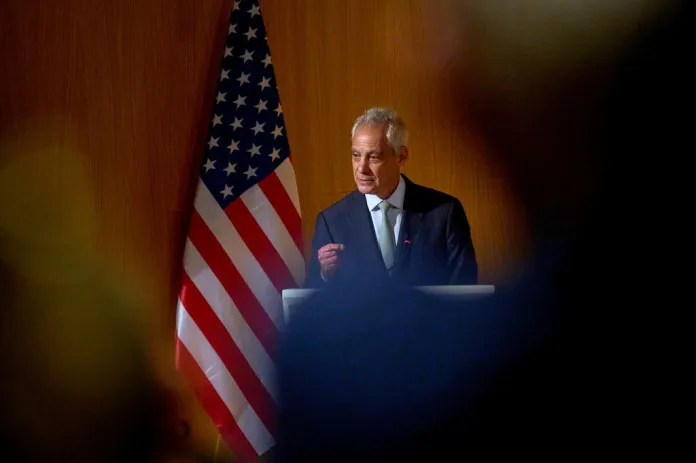
FILE – Rahm Emanuel, a potential Democratic presidential candidate and longtime defender of Israel, speaks at Tel Aviv University, Israel, July 8, 2026. (AP Photo/Ariel Schalit, File)
" data-image-caption="
FILE – Rahm Emanuel, a potential Democratic presidential candidate and longtime defender of Israel, speaks at Tel Aviv University, Israel, July 8, 2026. (AP Photo/Ariel Schalit, File)
" data-large-file="https://www.washingtonexaminer.com/wp-content/uploads/2026/10/rahm-emanuel-israel.jpg?w=696" src="https://www.washingtonexaminer.com/wp-content/uploads/2026/10/rahm-emanuel-israel.jpg?w=696" alt="Rahm Emanuel." class="wp-image-4756435" srcset="https://www.washingtonexaminer.com/wp-content/uploads/2026/10/rahm-emanuel-israel.jpg 1024w, https://www.washingtonexaminer.com/wp-content/uploads/2026/10/rahm-emanuel-israel.jpg?resize=300,200 300w, https://www.washingtonexaminer.com/wp-content/uploads/2026/10/rahm-emanuel-israel.jpg?resize=768,512 768w, https://www.washingtonexaminer.com/wp-content/uploads/2026/10/rahm-emanuel-israel.jpg?resize=150,100 150w, https://www.washingtonexaminer.com/wp-content/uploads/2026/10/rahm-emanuel-israel.jpg?resize=696,464 696w" sizes="(max-width: 1024px) 100vw, 1024px">
Rahm Emanuel, a potential Democratic presidential candidate and longtime defender of Israel, speaks at Tel Aviv University, Israel, July 8, 2026. (AP Photo/Ariel Schalit, File)
The issue puts him squarely in the path of a potential 2028 field that could include Gov. Josh Shapiro (D-PA), one of the Democratic Party’s most prominent Jewish politicians and a staunch supporter of Israel, as well as candidates whose positions are much more critical of Israel. Shapiro happens to be debating his Republican gubernatorial opponent, Stacy Garrity, on the third anniversary of the attacks.
At the other end of the Democratic spectrum are figures including the likes of Michigan Senate nominee Abdul el Sayed, who has faced sustained pressure from Jewish leaders over his views on Israel and U.S. military aid. The Democratic Socialists of America, a major storyline in this election cycle, has come under scrutiny for its attitudes toward Israel and Zionism.
The case of el Sayed illustrates how sensitive the issue has become for Democrats running in the 2026 midterm elections, and offers a preview of the battles that could consume the 2028 primary. The party is still picking up the pieces after the Uncommitted Movement, a group composed largely of Arab American voters upset with the Biden administration’s handling of the Israel-Gaza conflict, refused to back former Vice President Kamala Harris in 2024, arguably costing her crucial states, particularly Michigan, in her election battle with President Donald Trump.
“Israel has become a real fault line inside the Democratic Party because the disagreement now reaches voters, elected officials, donors, activists, universities, and party organizations,” Irina Tsukerman, a geopolitical analyst and president of Scarab Rising, told the Washington Examiner. “Younger Democrats have moved especially far from the older Democratic consensus on Israel. Arab and Muslim Democrats have also become more willing to punish candidates over Gaza, while progressive organizations have made arms sales and military aid part of primary politics.”
Dave Spencer, a political analyst, said Israel has become a significant fault line for the party’s progressive and socialist wing, including voters who could support candidates such as el Sayed.
“For most Democrats, it is an issue without necessarily being a defining issue,” Spencer told the Washington Examiner.
One reason, Spencer said, is that many Democrats who remain supportive of Israel have become deeply critical of Israeli Prime Minister Benjamin Netanyahu and his government.
The outcome of Israel’s next election on Oct. 27, as well as what happens in Gaza between now and 2028, could therefore have an enormous impact on the politics of the issue in the United States.
“If Netanyahu loses and there is a change in Israeli leadership and the war in Gaza changes course, Israel could become a less defining political issue by 2028,” Spencer said.
Michael Fahey, another political analyst, sees a more fundamental shift.
“I think Oct. 7 and everything that has happened since has fundamentally changed the politics of Israel inside the Democratic Party,” Fahey told the Washington Examiner. “This isn’t just a small group of activists making noise anymore.”
Fahey pointed to a measurable shift among younger and more progressive Democratic voters, arguing that anyone considering a 2028 presidential campaign will have to account for it.
At the same time, he cautioned against assuming that the most vocal activists represent the entire Democratic electorate.
“A presidential primary is a coalition-building exercise,” Fahey said. “Jewish voters remain an important part of that coalition, as do Arab American and Muslim voters, progressives, moderates, and voters who may have deep concerns about the conduct of the war but still believe strongly in Israel’s right to exist and defend itself.”
That creates a particularly complicated political calculation for potential candidates such as Shapiro.
The Pennsylvania governor’s Jewish identity and strong support for Israel could give him credibility with Jewish voters and Democrats who favor maintaining the U.S.-Israel alliance. But those same positions could make him a target for progressive activists who have grown increasingly critical of Israel and U.S. military assistance.
“I don’t think being Jewish or supportive of Israel is inherently a liability in a Democratic primary,” Fahey said. “But the old political language around Israel probably isn’t enough anymore.”
Candidates such as Shapiro and Emanuel will have to explain what support for Israel means after Oct. 7, the war in Gaza, and years of civilian suffering, Fahey said.
Candidates further to the left will face their own challenge.
“Opposing military aid is a position. It isn’t, by itself, a Middle East policy,” Fahey said.
That distinction could become increasingly important as Democrats debate whether the U.S. should continue military assistance to Israel, condition that assistance, or end it altogether.
For Tsukerman, the political impact will also vary significantly depending on where candidates are campaigning.
“The electoral effect still depends heavily on who votes and where,” she said. “A Democrat in Michigan may encounter organized pressure over Gaza that a Democrat running elsewhere never experiences at the same level.”
That dynamic is already visible in Michigan, where el Sayed has faced questions about his views on Israel, Hamas, and U.S. aid.
The issue also extends beyond traditional foreign policy. In New York City, Mayor Zohran Mamdani (D) has sought to draw a distinction between criticism of Israel and antisemitism while making combating antisemitism a priority in City Hall. But Mamdani’s attitude towards Israel has repeatedly been called into question, so much so that Israel’s Consul General in New York, Ofir Akunis, has invited the mayor to watch a film documenting the Oct. 7 attack, saying he would see “for the first time, what the people he supports really did.” His invitation comes as several left-wing groups have promoted an anti-Zionist “resistance” rally outside City Hall on Wednesday.
Political analyst James Christopher told the Washington Examiner that the Democratic debate has become more complicated since Oct. 7 as the war has reshaped the region and more Democrats have separated criticism of Israel from accusations of being “pro-Hamas.”
But Christopher said Israel is only one piece of a larger transformation within the Democratic coalition.
“The Democratic divide has become much bigger than Israel,” he said, pointing to the rise of the DSA and the growing influence of the party’s left flank.
“Treating Democrats as monolithic on Israel — or much of anything else — misses the political realignment happening in plain sight,” Christopher said.
Spencer similarly cautioned that the issue’s ultimate importance in 2028 will depend on what happens over the next two years.
“If the situation remains largely unchanged, yes, Israel could become a significant issue in the Democratic primary,” he said.
But if Israeli leadership changes or the war in Gaza takes a dramatically different turn, the political landscape could look very different by the time Democrats begin choosing their presidential nominee. If that happens, the party could face bigger questions about its identity.
“I don’t think the successful candidate can simply be ‘pro-Israel’ or ‘anti-Israel,’” Fahey said. “Voters are going to demand more nuance than that.”
He added that the candidate who navigates the issue successfully will have to argue simultaneously that Israel has a right to exist and be secure, Palestinians have a right to dignity, security, and self-determination, and American support for Israel “is not a blank check.”
EL SAYED CREATES ‘MIKE ROGERS IS WATCHING YOU’ WEBSITE HIGHLIGHTING WORK ON PATRIOT ACT
That could make Israel one of the most revealing tests of the 2028 Democratic primary.
“It won’t just tell us where Democrats stand on Israel,” Fahey said. “It will tell us a lot about what kind of Democratic Party emerges from this decade.”
Continue reading...
[ H/T Washington Examiner ]