




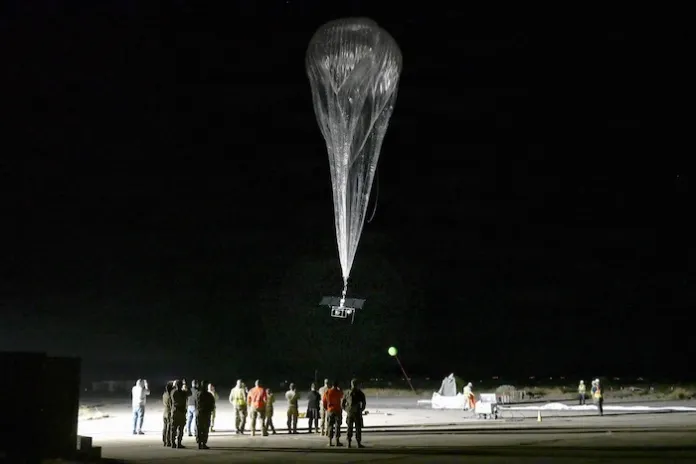
The head of the Army’s Space and Missile Defense Command is a “huge believer” in the service’s exploration and development of high-altitude surveillance balloons despite his initial skepticism.
The idea of intelligence, surveillance, and reconnaissance high-altitude balloons “sounded crazy to me,” Lt. Gen. John Rafferty, commanding general of Space and Missile Defense Command, told reporters on Wednesday at the Annual Association of the U.S. Army conference in Washington, D.C. His opinion changed quickly after he and SDMC Command Sgt. Maj. Rickey Jackson went to Morocco for a training exercise on the ISR balloons a while back.
“I was immediately convinced after I understood better how they worked and how their ability to station-keep, and their ability to sense and even deliver effects from high altitude,” Rafferty said, adding that with every demonstration, “they gain more and more support.” “It was game-changing for me. So I went from nowhere to a huge believer very quickly once I saw them in action.”
Army Col. Joseph Mroszczyk, head of SMDC’s Transformation Integration Directorate for Space Superiority, wants to see differently sized platforms in this realm, which would provide varying capabilities.
“What I’m pushing for, is a family of stratospheric systems that really covers smaller size all the way up to larger size types of platforms in terms of balloons, and what that enables us to provide is space-like capabilities, really exploiting a transition point between what is normally considered the aerial layer and the space domain,” he said.
The Army has long experimented with similar technologies, though the increased need for air-based sensors has presented a new opportunity for the low-tech plan, which could contribute to the broader efforts. The balloons, which can float tens of thousands of feet above the ground, can carry ISR systems, communications equipment, and electromagnetic warfare payloads. Sensors, both ground-and-air-based, have become an increasingly important part of the military’s eyes and ears for defense across the globe.
The Army had to scrap a large-scale high-altitude balloon demonstration in the Indo-Pacific after the military was instead directed to send those assets to the Middle East.
“We were asked to pivot and do some experimentation in combination with operations, and we pivoted and supported operations in CENTCOM [US Central Command],” Andrew Evans, the director for the Strategy & Transformation Office inside the Army’s Deputy Chief of Staff for Intelligence shop, told Breaking Defense.
While their use was “effective for the mission that they were assigned,” logistical challenges emerged tied to their means of transportation.
LOCKHEED MARTIN ANNOUNCES NEW AIR DEFENSE INTERCEPTOR MISSILE DESIGNED FOR HYPERSONICS
“Balloons can be a little finicky in terms of temperature, and you have to contend with environmental characteristics,” Evans said, adding that, “As you think about employing your systems and going from something like a Pacific [theater] to something like a CENTCOM [theater], you learn where those friction points might exist between what the military might need to inherently own, and … what a vendor could help provide in terms of the service.”
Continue reading...
[ H/T Washington Examiner ]