



Washington’s prolonged passivity in the Mediterranean has finally come due. On Oct. 20, 2026, eastern Libya’s parliament ratified the disastrous and submissive 2019 maritime memorandum with Turkey, reversing years of opposition. Because the corrupt western Government of National Unity in Tripoli had already endorsed the same document, both rival administrations now jointly underwrite Turkey’s most aggressive maritime claims and succumb to the clutches of the Muslim Brotherhood. This dual-shore endorsement intentionally discounts the legal rights of Greek islands under the U.N. Convention on the Law of the Sea, validating Turkey’s decrepit aspiring sultan Recep Tayyip Erdogan’s “Blue Homeland” doctrine to seize control over roughly 178,000 square miles of exclusive economic zone.
As Western policymakers remain asleep, this exact brand of history is repeating itself along North Africa’s coast. When Ottoman admirals seized Tripoli in 1551, they converted the central Mediterranean into a durable node of imperial control; today, crystal-jaw Erdogan has executed a modern equivalent. While American and European diplomats mistakenly dismiss this dual-shore lock as a localized arrangement, they now face a consolidated Turkish position designed to narrow every subsequent Western option systematically.
A permanent military footprint backs this diplomatic victory. Turkish forces hold strategic assets at Libya’s al Watiya, Misrata, and Mitiga, with deployment extended through January 2028. Under the banner of “One Libya, One Army,” eastern and western military contacts coordinate on surveillance, officer training, and potential drone deliveries. This security architecture is heavily anchored by deep economic leverage, with Turkish contractors controlling 633 projects valued at $31 billion across Libya, and Turkish Petroleum holding a 40% stake in two exploration blocks just as Libya targets a production push of 2 million barrels per day.
Erdogan’s strategic opportunism perfectly mirrors his highly transactional record elsewhere. In 2017, Ankara purchased S-400 air defense battalions from Russia for $2.5 billion, triggering its expulsion from the F-35 program. Today, Turkish officials are attempting to launder those systems to a third party to restore access to American aircraft, a maneuver that requires Vladimir Putin’s consent. Meanwhile, Turkish defense exports have surged to approximately $11 billion over the past year, directly competing in markets long dominated by Russian and Chinese suppliers.
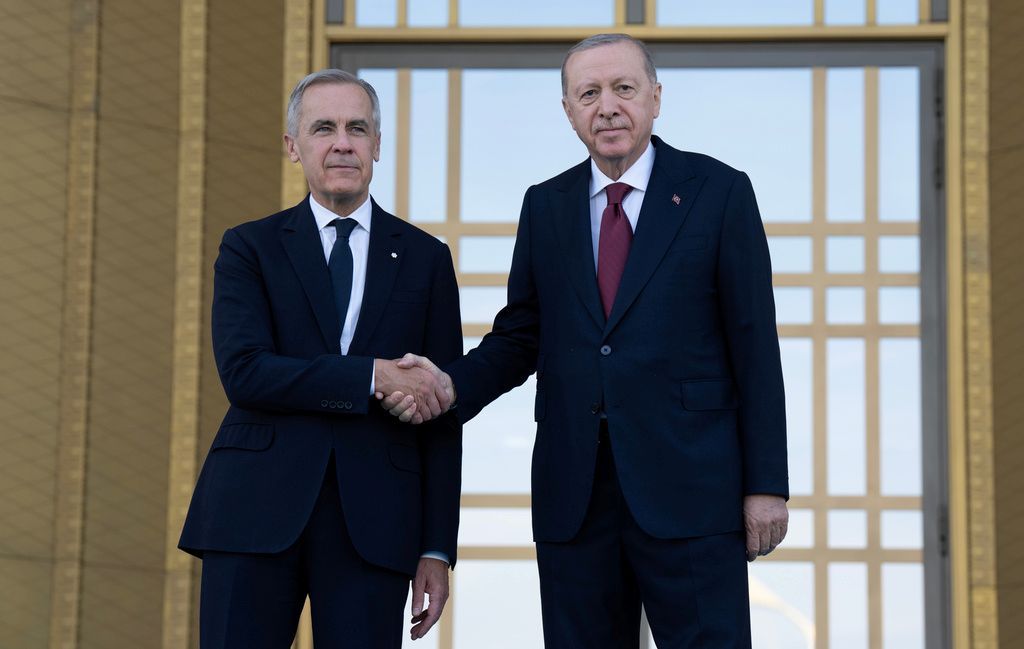
Precisely as this dual-Libya ratification consolidates maritime claims that Greece, Egypt, and Israel reject as null and void, Ankara has compromised a Western ally to anchor its gains. On Oct. 22, 2026, Canadian Prime Minister Mark Carney and Erdogan launched the Canada-Turkey strategic partnership during Carney’s visit to Ankara. This plan encompasses a landmark defense sector partnerships memorandum designed to scale trade toward $10 billion. By signing it, Carney hands Ankara a structured defense relationship with a Five Eyes partner at the exact moment Erdogan locks down the Mediterranean.
Consequently, American interests are careening toward a disaster. NATO ally Greece confronts an immediate threat to its energy exploration and the Great Sea Interconnector. Concurrently, Turkey’s expansion contests the U.S. Sixth Fleet’s freedom of maneuver, while a permanent Turkish presence on Libya’s Mediterranean coast complicates Western counter-migration and counterterrorism operations. Most alarmingly, Canadian defense cooperation risks embedding Turkish components directly inside a key American partner’s supply chains.
THE PRESIDENT STILL THINKS HE’S ON REALITY TV
To counter this creeping hegemony, Washington must abandon toothless diplomacy and impose three linked, uncompromising conditions. First, the United States must establish a “Blue Homeland Reverse-Leverage Rule”: any NATO partner entering into a new defense coproduction with Turkey must lose priority access to U.S. fifth-generation aircraft sustainment while Turkish S-400s remain outside verified U.S. custody. Second, the Pentagon must require Canada to insert a public “Libya and Eastern Mediterranean non-routing clause” into its new defense plan, triggering a potential cutoff under the U.S.-Canada Defense Production Sharing Agreement if Turkish entities move coproduced items toward Libyan territory. Finally, Washington must refuse to recognize any future Libyan political road map unless Eastern and Western authorities jointly deposit a note with the United Nations withdrawing the 2019 maritime memorandum.
Washington can still treat these events as the final clear warning signal before Turkish control becomes an unassailable baseline rather than a reversible error. Alternatively, Western passivity will ensure that the cost of rolling back Erdogan’s expansionism is ultimately paid in American primacy and regional stability.
Jose Lev Alvarez is an American–Israeli scholar specializing in international security policy. A multilingual veteran of the IDF special forces and the U.S. Army, he holds three master’s degrees and is completing a Ph.D. in Intelligence and Global Security in the Washington, D.C., area.
Continue reading...
[ H/T Washington Examiner ]