






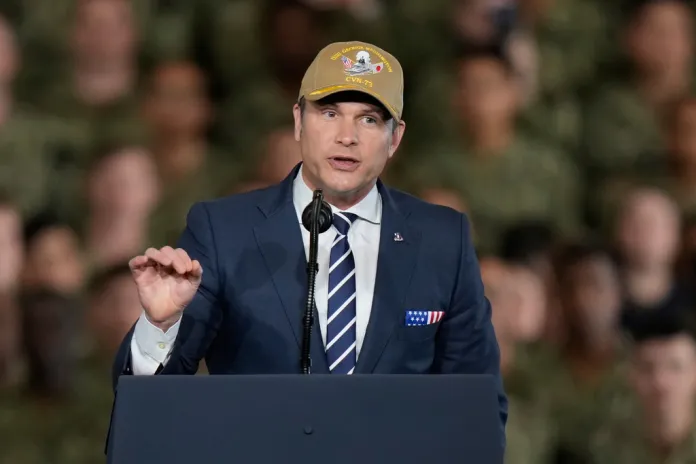
War Secretary Pete Hegseth’s plan to test military service members for low testosterone may be useful for helping special operations forces strengthen and recover from intense combat.
Medical experts familiar with the toll of military service are cautiously optimistic that Hegseth’s “High-T military program” announced this month could be beneficial for the unique health conditions facing elite special forces, such as Navy SEALs and Green Berets.
The plan, as outlined by the secretary, includes adding testosterone screening to annual physicals for service members over age 30 and offering optional testosterone replacement therapy when needed. Younger service members can voluntarily request testosterone screening during their mandatory physicals as well.
Hegseth’s memo on the policy says the new protocol comes from the department’s broader goal of addressing a condition commonly known as “Operator Syndrome,” a collection of symptoms experienced by special forces personnel due to the intense physiological stress experienced in combat.
Symptoms of Operator Syndrome include sleep disturbances, chronic pain, anxiety, depression, and hypogonadism, the medical name for “low-T.” The American Urological Association defines hypogonadism as having a total serum testosterone level of less than 300 nanograms per deciliter and physical symptoms that negatively impact quality of life.
“Operator Syndrome represents a unique convergence of health challenges that require proactive clinical intervention,” Hegseth’s memo reads.
The program, however, is not solely directed toward the roughly 70,000 personnel in the U.S. Special Operations Command but rather across the entire military as part of the department’s Total Force Fitness initiative. Hegseth’s memo says, “Applying lessons learned from treating Operator Syndrome across the Total Force including target testosterone therapy directly optimizes Warfighter readiness.”
While the bulk of the initiative appears to be aimed at maximizing the lethality of the fighting force, Hegseth also sees the program as improving the comprehensive wellness of the individual service member: “Taking care of your long-term health means ensuring you remain strong, resilient, and capable-not just for your next deployment, but for the rest of your life, so you can thrive long after you take off the uniform.”
The Pentagon denied the Washington Examiner’s request for an interview with a health policymaker within the military on the new policy. Several outside experts who spoke with the Washington Examiner expressed concern about testosterone testing for the entirety of the military force, but were enthusiastic about treating those with severe symptoms of Operator Syndrome.
Dr. Chris Freuh, clinical psychologist at the University of Hawaii and a specialist in the conditions of elite operators, told the Washington Examiner he sees potential in the new program, but that the details would matter.
“It all depends on how this is medically handled,” Freuh said. “If it’s handled appropriately, then it’s about treating hypogonadism, which will have the benefits of optimizing performance as well as long-term health.”
‘Operator Syndrome’ and low-T
Freuh, one of the pioneering researchers on Operator Syndrome, said he first noticed the symptom patterns of the condition among his active-duty and retired friends in special operations.
With his more than 15 years of experience in a Veterans Affairs hospital post-traumatic stress disorder clinic, Freuh developed a reputation among the special operations community as someone who could help service members struggling to adjust to life outside of a combat zone.
“I just informally was hanging out with these guys,” Freuh said, “and a typical conversation started like this: they would say something to the effect of, ‘Doc, I’m not doing well. I can’t sleep. I can’t concentrate. I don’t have any motivation. I don’t have much interest in anything.’”
In these initial stages of what would become his specialty research project, Freuh spoke with dozens of active-duty and retired special operators, most of whom requested anonymity for fear of reprisal or stigma from their branches.
Most of the men in contact with Freuh said they had been referred to PTSD clinics, but the psychiatric drugs they received did not help with their physical symptoms, ranging from chronic pain, sleep disturbances, low sex drive, and infertility.
Brain scans also revealed that the men in Freuh’s informal sample also had what he said “essentially looked like 80- year old brains,” caused by repeated traumatic brain injury. Even minor TBI caused by repeated blast exposure can decrease testosterone levels over time.
Over time, the physiological stress of training and combat conditions for elite operators — including heavy physical loads, sleep deprivation, repeated TBI, and severe calorie restriction — can lead to the conglomeration of symptoms that both cause and are worsened by low testosterone.
“All of the stress affects all of the human physiological systems, the endocrine system, the nervous system, the metabolic system, the respiratory, cardio, musculoskeletal, everything, they’re all interconnected,” Freuh said. “So you injure one part of the physiological, any one physiological system, it affects the other ones, and they’re bidirectional, so they affect each other.”
Freuh said these physiological symptoms also “cascade over into the social system. So marriage is parenting, families, work, civilian transitioning to civilian life are all profoundly affected.”
Dr. Sevann Helo, a professor of urology at the Mayo Clinic in Minnesota who treats hypogonadism, told the Washington Examiner that hormone replacement for men with symptoms of low testosterone “can substantially improve their quality of life.”
She recommended the new policy be in line with American Urological Association guidelines on treating hypogonadism, which require two separate abnormal testosterone blood test values along with physiological symptoms of low testosterone to arrive at a diagnosis.
“I think we want to embrace it, but also make sure that we’re clear that we want it to be done according to what we know is safe and guidelines that give us some framework to do that in,” Helo said.
Defense Secretary Pete Hegseth administers the oath of enlistment to a group of National Guard soldiers, at the base of the Washington Monument, Friday, Feb. 6, 2026 in Washington. (AP Photo/Kevin Wolf)
" data-large-file="https://www.washingtonexaminer.com/wp-content/uploads/2026/07/AP26037547226518.jpg?w=696" src="https://www.washingtonexaminer.com/wp-content/uploads/2026/07/AP26037547226518.jpg?w=696" alt="War Secretary Pete Hegseth speaking to a group of National Guard soldiers" class="wp-image-4662361" srcset="https://www.washingtonexaminer.com/wp-content/uploads/2026/07/AP26037547226518.jpg 1024w, https://www.washingtonexaminer.com/wp-content/uploads/2026/07/AP26037547226518.jpg?resize=300,200 300w, https://www.washingtonexaminer.com/wp-content/uploads/2026/07/AP26037547226518.jpg?resize=768,511 768w, https://www.washingtonexaminer.com/wp-content/uploads/2026/07/AP26037547226518.jpg?resize=150,100 150w, https://www.washingtonexaminer.com/wp-content/uploads/2026/07/AP26037547226518.jpg?resize=696,463 696w" sizes="(max-width: 1024px) 100vw, 1024px">
War Secretary Pete Hegseth administers the oath of enlistment to a group of National Guard soldiers at the base of the Washington Monument, Friday, Feb. 6, 2026, in Washington. (Kevin Wolf/AP Photo)
Optimization, enhancement, and the ‘super soldier’
While military and medical experts are enthusiastic about using testosterone therapy for special operators, skeptics of the program say there is a fine line between improving a service member’s health and attempting to make him a “super soldier” by giving him supra-normal capabilities.
Most of the concern over the new testosterone program comes from the subtle language difference between “optimization” and “enhancement.”
Lukasz Kamienski, a professor at Jagiellonian University in Poland and author of Shooting Up: A History of Drugs in Warfare, told the Washington Examiner that optimization is best thought of as “correcting naturally decreasing capabilities,” whereas enhancement is “bringing extra capabilities or skills beyond the natural baseline performance of an individual.”
“Optimization is like when I feel sleepy, I drink a coffee and maybe my level of alertness gets to the natural one,” Kameinski said. “Enhancement is when I take some brain stimulation techniques and they not only bring me back to my natural, but make me even more focused, alert, so on and so forth.”
Militaries throughout history have used chemicals and pharmaceuticals, including alcohol and hallucinogens, to improve their fighting force. Kameinski said the first known “super soldier” is the Greek mythology figure Achilles, the Trojan war hero whose mother dipped him in the River Styx to make him invulnerable to attack.
In modern warfare, militaries have experimented with amphetamines as “uppers” to enhance alertness and focus, as well as psychedelics to alleviate PTSD symptoms while on the battlefield.
But testosterone is different from other drugs because a man’s baseline testosterone level is highly individual, blurring the line between optimization and enhancement. While the American Urological Association sets thresholds for abnormally low or high testosterone, there is a highly variable range that is considered medically normal or natural.
Hegseth said in his video announcement that testosterone testing and therapy are “not about artificial enhancement” but rather are “about restoring and optimizing your natural capabilities, protecting your longevity, ensuring you have the biological foundation required to sustain the fight.”
Helo said testosterone replacement therapy, where clinically appropriate, can optimize a service member’s health — but he strongly cautioned against enhancement.
“If they have true testosterone deficiency, replacing them back into the normal physiologic range can help them restore muscle mass, energy, function,” Helo said. “But that’s very different than giving supra-physiologic doses to healthy individuals, which is considered performance enhancement and certainly carries substantially greater risks.”
President Donald Trump and Defense Secretary Pete Hegseth salute as a U.S. Army carry team moves a transfer case containing the remains of Pvt. Isabella Gonzales of Carrollton, Texas, Wednesday, July 22, 2026, at Dover Air Force Base, Del. (AP Photo/Julia Demaree Nikhinson)
" data-large-file="https://www.washingtonexaminer.com/wp-content/uploads/2026/07/AP26203598592337.jpg?w=696" height="683" width="1024" src="https://www.washingtonexaminer.com/wp-content/uploads/2026/07/AP26203598592337.jpg?w=696" alt="President Donald Trump and War Secretary Pete Hegseth salute" class="wp-image-4662743" srcset="https://www.washingtonexaminer.com/wp-content/uploads/2026/07/AP26203598592337.jpg 2696w, https://www.washingtonexaminer.com/wp-content/uploads/2026/07/AP26203598592337.jpg?resize=300,200 300w, https://www.washingtonexaminer.com/wp-content/uploads/2026/07/AP26203598592337.jpg?resize=768,512 768w, https://www.washingtonexaminer.com/wp-content/uploads/2026/07/AP26203598592337.jpg?resize=1024,683 1024w, https://www.washingtonexaminer.com/wp-content/uploads/2026/07/AP26203598592337.jpg?resize=1536,1024 1536w, https://www.washingtonexaminer.com/wp-content/uploads/2026/07/AP26203598592337.jpg?resize=2048,1366 2048w, https://www.washingtonexaminer.com/wp-content/uploads/2026/07/AP26203598592337.jpg?resize=150,100 150w, https://www.washingtonexaminer.com/wp-content/uploads/2026/07/AP26203598592337.jpg?resize=696,464 696w, https://www.washingtonexaminer.com/wp-content/uploads/2026/07/AP26203598592337.jpg?resize=1068,712 1068w, https://www.washingtonexaminer.com/wp-content/uploads/2026/07/AP26203598592337.jpg?resize=1920,1280 1920w" sizes="(max-width: 1024px) 100vw, 1024px">
President Donald Trump and War Secretary Pete Hegseth salute as a U.S. Army carry team moves a transfer case containing the remains of Pvt. Isabella Gonzales of Carrollton, Texas, on Wednesday, July 22, 2026, at Dover Air Force Base, Delaware. (Julia Demaree Nikhinson/AP Photo)
Putting the ‘T’ in Total Force
Critics of the testosterone policy also worry that screening the whole of the military for “low-T” rather than just special operators could incentivize improving soldiers’ fighting capacity at the expense of overall health.
The secretary’s Total Force Fitness initiative memo, issued in May, compares maintaining the physical health of warfighters to material assets in war, like weapons systems and equipment. The May memo says the new goal is to “treat the Warfighter as a readiness capability, held to the same disciplined evaluation, maintenance, and optimization we demand of every asset that preserves combat power.”
A growing body of clinical trial research suggests that short-term supplemental testosterone prior to intense combat-like conditions can preserve lean muscle mass and cognitive function that would normally be depleted under severe sleep deprivation and calorie restriction.
From a bioethics perspective, Kamienski said, he is leery of how Hegseth’s program seems to be “very public and very strict and very unquestionable, without taking into account human autonomy, dignity, and diversity.”
Freuh, on the other hand, said treating the symptoms of Operator Syndrome with testosterone goes hand-in-hand with readiness on the battlefield.
“Are we really going to send a platoon of soldiers who are sleep deprived, circadian corrupted, low testosterone, cognitive deficits, functioning with chronic joint pains?” Freuh asked. “Do we want to send them on a no-fail mission, presidential no-fail mission, like a bin Laden raid?”
Freuh also supported the universality of Hegseth’s testosterone screening so service members don’t suffer in silence and fall through the cracks.
“If you’re an operator, we presume you have signs and symptoms, and we know that you don’t talk about those signs and symptoms,” Freuh said. “You’re not going to admit them while you’re on active duty.”
JUDGE QUESTIONS WHETHER HEGSETH’S TESTOSTERONE PLAN UNDERMINES TRANSGENDER TROOPS BAN
Overall, Freuh said he is “optimistic that this is potentially a good step in the right direction, especially if there’s a thoughtful effort made with an advisory council of the right kinds of people.”
“I don’t think this is about building people up to create secret super soldiers. I don’t think this is about that,” Freuh said. “But again, the devil’s in the details.”
Defense reporter Mike Brest contributed to this report.
Continue reading...
[ H/T Washington Examiner ]