Hedge Fund Walleye Returns Capital, Fires Head Of Equities After Worst Month Since COVID: Read The Full Letter
One week ago, when Nomura's Charlie McElligott told clients that the October "pod purge" was the multi-strat model simply "cleansing" itself, we were less sanguine: "we suspect the next round of stop-outs is probably just a matter of time." Well, Charlie was wrong, we were right: it took about a week. And this time it's an entire fund.
Moments ago, Bloomberg reported that Walleye Capital, the $17 billion multistrategy hedge fund run by CIO Will England, is returning a portion of its capital to investors and gutting its internal equities business after its worst month since March 2020. Walleye lost 5.9% in October, bringing its 2026 losses through last month to 6.8%, according to people familiar. Anil Gondi, the firm's head of equities, has been let go along with a "substantial" portion of the internal long/short teams, according to a letter sent to investors on Thursday, which we have obtained and post in full below.
Here is the math: if October's 5.9% loss took Walleye to -6.8% YTD, the fund was down roughly 1% for the year going into the month. That's the "already challenging 2026" England references in his first paragraph. Then October turned a mediocre year into a bad one.
The letter is short, and unusually blunt for a hedge fund letter. England opens with "discipline, humility, and self-awareness" and then gets right to the point:
Investors will hear later about "the quantum, timing, and mechanics" of the capital return. As for why, England writes that internal equity L/S has been Walleye's weakest strategy since 2023 and "substantially underperformed" the firm's external long/short business (i.e., the outside managers Walleye allocates to). Several years and a new leadership team later:
In other words, a $17 billion fund just admitted it can't out-pod the pod shops, at least not in single-stock long/short, where Millennium, Citadel, Balyasny and Point72 are all bidding for the same PMs and crowding into the same trades.
The irony is that Walleye spent the past 18 months trying to do exactly that. Gondi, a former Balyasny PM, was hired in 2025 to lead the equities unit, in the same overhaul in which Walleye dismissed its credit and commodities teams to focus on volatility, quant and fundamental long/short. As recently as mid-October, trade press reported Walleye was still building out its equities business under Gondi, adding Balyasny's chief equities strategist and a Millennium recruiter. Meanwhile, the equity unit's COO had already left in September to return to Citadel, per Hedgeweek. Three weeks is a long time in pod land.
Walleye isn't quitting stocks entirely. It will keep allocating to external long/short managers "as we have for over 10 years," keep its day-one seeding of new managers (with a nod to the "natural strategic alignment" with Dockside, the platform it launched in 2023 to connect investors with smaller managers), and keep its "highest conviction" internal PMs, who will now report directly to England. Partners Tom and Chris "will step back into the management of this external long/short business, reporting to me as they did before in 2024 and most of 2025." Translation: the old org chart is back, minus the people hired to replace it.
The more interesting line is the one about size. Back in July 2025, Walleye stopped taking money from new investors after a capital raise, with England writing that the strategies needed time to "settle at their new size." At the time, the fund managed a little over $8 billion. Today it manages more than $17 billion. So assets more than doubled in about 16 months, and the fund has now decided the "optimal size" is smaller than what it has.
That's precisely the dynamic McElligott described in his "CLEANSING" note (available to pro subs), which we covered in "The Pod Purge Will Pass" last week: asset growth in multi-strats, "the near pervasive demand for bodies to fill seats to manage that money (potentially 'talent dilutive')," and the leverage the model requires create "'Perpetual Crowding'-risk" and "periods of rolling stop-outs." Walleye just ran that diagnosis on itself: too much money, chasing too few good stock-pickers, in the most crowded corner of the market.
And England's letter has one more tell. The volatility business, he writes, had its strongest month on record in October and is on track for its best year ever in dollar P&L. If the vol book had a record month and the whole fund still lost 5.9%, then the rest of the book lost a lot more than 5.9%.
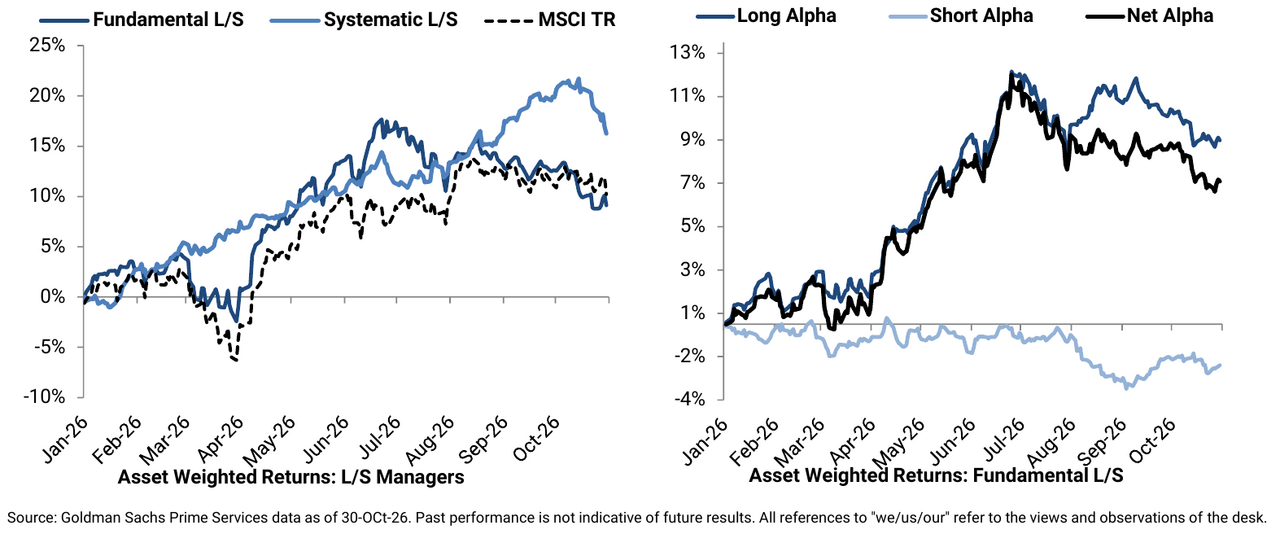
Not all of that was the stock pickers. England concedes quant had "a softer 2026," which is putting it gently given what happened to systematic funds last month. As we reported on Tuesday, Goldman's Prime Brokerage "October 2026: First Look on Hedge Fund Performance and Positioning" (available to pro subs) showed Systematic L/S funds lost 3.6% in October, "the first down month since Jul '25 and the worst monthly drawdown in six years," with quant alpha a staggering -5.06%. The light blue line on the left shows the quants' entire YTD lead evaporating in the last two weeks of the month:
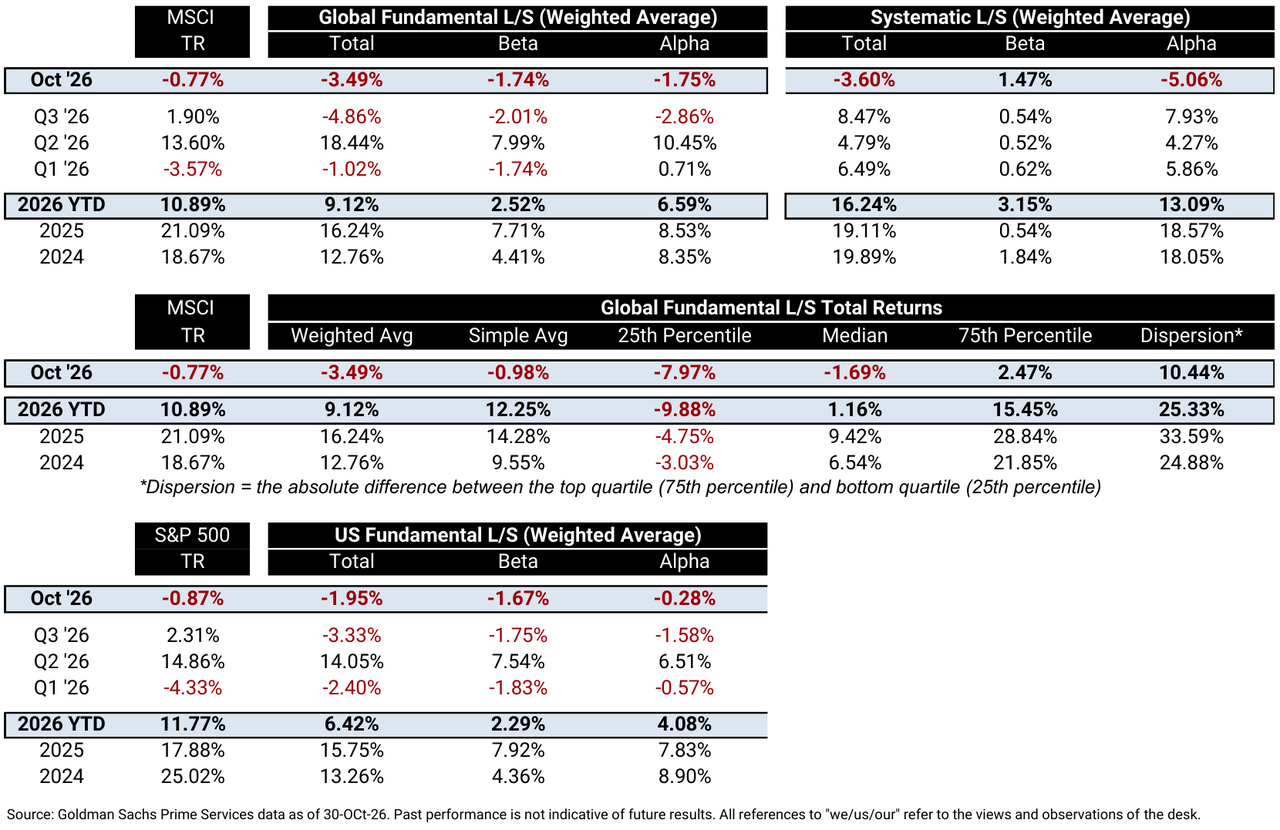
Walleye was hardly alone. As we detailed in "Nowhere To Hide" on Tuesday, global Fundamental L/S funds lost 3.49% in October while quants lost 3.6%, the first time on Goldman's record (going back to 2016) that both cohorts lost 3% or more in the same month:
Goldman's other observation now looks prescient: the asset-weighted return (-3.49%) was far worse than the median (-1.69%), "suggesting large managers underperformed." Ten months into the year, the median fundamental L/S fund was up just 1.16% vs 10.89% for the MSCI World, and the bottom quartile was down 9.88%. Walleye, at -6.8%, sits a lot closer to the bottom quartile than to the median:
Bloomberg's tally of the big names tells the same story. Millennium lost 2.3% in October, ExodusPoint 2.4%, Marshall Wace's Eureka 5.4%, and credit fund Arini was on track for its worst month ever, down 12.1% through Oct 23. And just this afternoon, Bloomberg reported that Greg Coffey's Kirkoswald had its worst month ever, losing about 6.4% on the back of Brazil's election whiplash and breaking a 16-month winning streak. The lone giant in the green was, naturally, Citadel, up 1.7% in its flagship Wellington fund. Which is also where Walleye's equity COO went back to in September. Funny how that works.
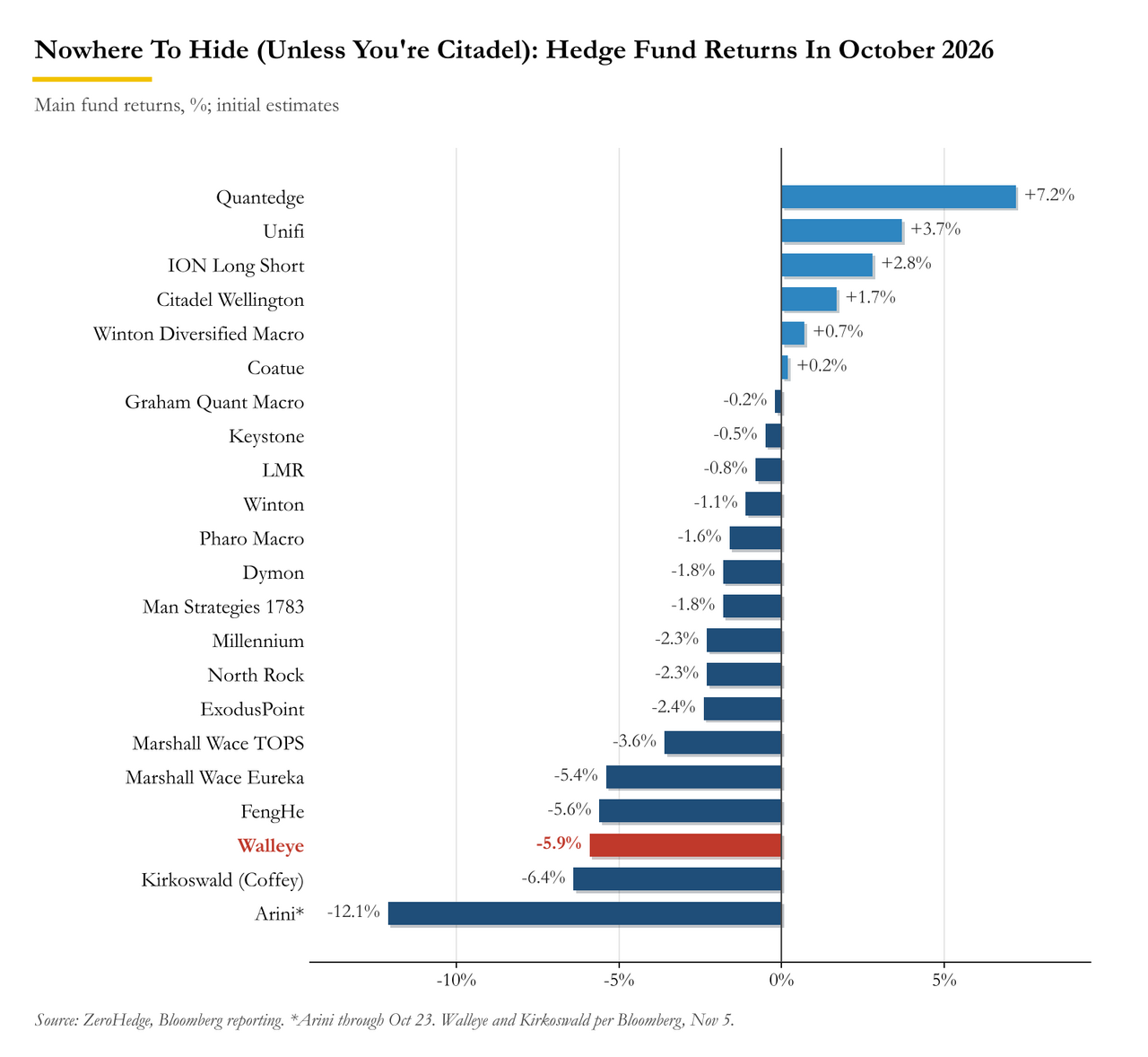
As JPMorgan's positioning intelligence team put it, "October is a month that most hedge funds will probably want to forget." Walleye apparently decided forgetting wasn't enough.
The timing of the letter (Thursday, with the market in freefall) is probably not entirely a coincidence either. As we noted earlier today, UBS trader Torsten Sippel said hedge funds opened the session 23/75 buy/sell, with the "clearest sign of capitulation" in neoclouds and semis, while Goldman's John Flood reported that "our phones are exploding" with requests for color, and "we are not seeing buyers step in to defend anything just yet."
Most relevant for Walleye's peers, Goldman's Prime Brokerage (Marco Laicini) had this snapshot as of mid-morning:
So that's two bad days in a row for the pods' equity books, right as allocators read Walleye's letter and start asking their own managers some uncomfortable questions about "optimal size."
Recall that by headhunters' count, roughly 100 PMs were already out of a job in October (vs. ~40 in September and ~20 before that), per eFinancialCareers, with one PM complaining that "hedge funds hired too many morons." Walleye's cuts will add to that tally, though for once the purge came from the top of the org chart rather than the bottom.
England frames the move as "proactive," noting that "several of our largest partners" encouraged the simplification, and that investor demand for Walleye's vol, quant and external strategies remains strong. Maybe. But a fund that closed its doors to new money 16 months ago to let its strategies "settle at their new size" is now shrinking after its worst month since the COVID crash, and that's hard to spin as anything other than a retreat.
McElligott's view last week was that this "too shall pass," the model "cleansing the excess Positioning and Leverage out of the system." We remain skeptical: with gross leverage in the 97th percentile on Goldman's five-year lookback, nets near one-year lows, the median fund barely positive for the year and the year-end clock ticking, the cleansing has so far come from PMs being stopped out, while gross has barely moved. Walleye returning capital is the first sign that allocators, and the platforms themselves, are starting to shrink the capital base too. That's the part of the cycle where "get smaller" finally happens, and it's rarely orderly.
Or, as England himself put it, "our competitive advantage is not going to be trying to replicate the traditional multi-manager equity long/short model." A lot of mid-sized multi-strats which spent the past three years trying to do just that may soon be reaching the same conclusion... and writing similar letters.
Below is the full letter Walleye sent to investors on Thursday:
Tyler Durden Thu, 11/05/2026 - 15:03
Continue reading...
[ H/T ZeroHedge ]
One week ago, when Nomura's Charlie McElligott told clients that the October "pod purge" was the multi-strat model simply "cleansing" itself, we were less sanguine: "we suspect the next round of stop-outs is probably just a matter of time." Well, Charlie was wrong, we were right: it took about a week. And this time it's an entire fund.
Moments ago, Bloomberg reported that Walleye Capital, the $17 billion multistrategy hedge fund run by CIO Will England, is returning a portion of its capital to investors and gutting its internal equities business after its worst month since March 2020. Walleye lost 5.9% in October, bringing its 2026 losses through last month to 6.8%, according to people familiar. Anil Gondi, the firm's head of equities, has been let go along with a "substantial" portion of the internal long/short teams, according to a letter sent to investors on Thursday, which we have obtained and post in full below.
Here is the math: if October's 5.9% loss took Walleye to -6.8% YTD, the fund was down roughly 1% for the year going into the month. That's the "already challenging 2026" England references in his first paragraph. Then October turned a mediocre year into a bad one.
"Not Going To Be Trying To Replicate" Millennium
The letter is short, and unusually blunt for a hedge fund letter. England opens with "discipline, humility, and self-awareness" and then gets right to the point:
Investors will hear later about "the quantum, timing, and mechanics" of the capital return. As for why, England writes that internal equity L/S has been Walleye's weakest strategy since 2023 and "substantially underperformed" the firm's external long/short business (i.e., the outside managers Walleye allocates to). Several years and a new leadership team later:
In other words, a $17 billion fund just admitted it can't out-pod the pod shops, at least not in single-stock long/short, where Millennium, Citadel, Balyasny and Point72 are all bidding for the same PMs and crowding into the same trades.
The irony is that Walleye spent the past 18 months trying to do exactly that. Gondi, a former Balyasny PM, was hired in 2025 to lead the equities unit, in the same overhaul in which Walleye dismissed its credit and commodities teams to focus on volatility, quant and fundamental long/short. As recently as mid-October, trade press reported Walleye was still building out its equities business under Gondi, adding Balyasny's chief equities strategist and a Millennium recruiter. Meanwhile, the equity unit's COO had already left in September to return to Citadel, per Hedgeweek. Three weeks is a long time in pod land.
Walleye isn't quitting stocks entirely. It will keep allocating to external long/short managers "as we have for over 10 years," keep its day-one seeding of new managers (with a nod to the "natural strategic alignment" with Dockside, the platform it launched in 2023 to connect investors with smaller managers), and keep its "highest conviction" internal PMs, who will now report directly to England. Partners Tom and Chris "will step back into the management of this external long/short business, reporting to me as they did before in 2024 and most of 2025." Translation: the old org chart is back, minus the people hired to replace it.
From "No New Cash" To "Here's Some Cash Back"
The more interesting line is the one about size. Back in July 2025, Walleye stopped taking money from new investors after a capital raise, with England writing that the strategies needed time to "settle at their new size." At the time, the fund managed a little over $8 billion. Today it manages more than $17 billion. So assets more than doubled in about 16 months, and the fund has now decided the "optimal size" is smaller than what it has.
That's precisely the dynamic McElligott described in his "CLEANSING" note (available to pro subs), which we covered in "The Pod Purge Will Pass" last week: asset growth in multi-strats, "the near pervasive demand for bodies to fill seats to manage that money (potentially 'talent dilutive')," and the leverage the model requires create "'Perpetual Crowding'-risk" and "periods of rolling stop-outs." Walleye just ran that diagnosis on itself: too much money, chasing too few good stock-pickers, in the most crowded corner of the market.
And England's letter has one more tell. The volatility business, he writes, had its strongest month on record in October and is on track for its best year ever in dollar P&L. If the vol book had a record month and the whole fund still lost 5.9%, then the rest of the book lost a lot more than 5.9%.
Not all of that was the stock pickers. England concedes quant had "a softer 2026," which is putting it gently given what happened to systematic funds last month. As we reported on Tuesday, Goldman's Prime Brokerage "October 2026: First Look on Hedge Fund Performance and Positioning" (available to pro subs) showed Systematic L/S funds lost 3.6% in October, "the first down month since Jul '25 and the worst monthly drawdown in six years," with quant alpha a staggering -5.06%. The light blue line on the left shows the quants' entire YTD lead evaporating in the last two weeks of the month:
Nowhere To Hide
Walleye was hardly alone. As we detailed in "Nowhere To Hide" on Tuesday, global Fundamental L/S funds lost 3.49% in October while quants lost 3.6%, the first time on Goldman's record (going back to 2016) that both cohorts lost 3% or more in the same month:
Goldman's other observation now looks prescient: the asset-weighted return (-3.49%) was far worse than the median (-1.69%), "suggesting large managers underperformed." Ten months into the year, the median fundamental L/S fund was up just 1.16% vs 10.89% for the MSCI World, and the bottom quartile was down 9.88%. Walleye, at -6.8%, sits a lot closer to the bottom quartile than to the median:
Bloomberg's tally of the big names tells the same story. Millennium lost 2.3% in October, ExodusPoint 2.4%, Marshall Wace's Eureka 5.4%, and credit fund Arini was on track for its worst month ever, down 12.1% through Oct 23. And just this afternoon, Bloomberg reported that Greg Coffey's Kirkoswald had its worst month ever, losing about 6.4% on the back of Brazil's election whiplash and breaking a 16-month winning streak. The lone giant in the green was, naturally, Citadel, up 1.7% in its flagship Wellington fund. Which is also where Walleye's equity COO went back to in September. Funny how that works.
As JPMorgan's positioning intelligence team put it, "October is a month that most hedge funds will probably want to forget." Walleye apparently decided forgetting wasn't enough.
...And November Isn't Helping
The timing of the letter (Thursday, with the market in freefall) is probably not entirely a coincidence either. As we noted earlier today, UBS trader Torsten Sippel said hedge funds opened the session 23/75 buy/sell, with the "clearest sign of capitulation" in neoclouds and semis, while Goldman's John Flood reported that "our phones are exploding" with requests for color, and "we are not seeing buyers step in to defend anything just yet."
Most relevant for Walleye's peers, Goldman's Prime Brokerage (Marco Laicini) had this snapshot as of mid-morning:
So that's two bad days in a row for the pods' equity books, right as allocators read Walleye's letter and start asking their own managers some uncomfortable questions about "optimal size."
Recall that by headhunters' count, roughly 100 PMs were already out of a job in October (vs. ~40 in September and ~20 before that), per eFinancialCareers, with one PM complaining that "hedge funds hired too many morons." Walleye's cuts will add to that tally, though for once the purge came from the top of the org chart rather than the bottom.
The First To Hand Back The Money, Probably Not The Last
England frames the move as "proactive," noting that "several of our largest partners" encouraged the simplification, and that investor demand for Walleye's vol, quant and external strategies remains strong. Maybe. But a fund that closed its doors to new money 16 months ago to let its strategies "settle at their new size" is now shrinking after its worst month since the COVID crash, and that's hard to spin as anything other than a retreat.
McElligott's view last week was that this "too shall pass," the model "cleansing the excess Positioning and Leverage out of the system." We remain skeptical: with gross leverage in the 97th percentile on Goldman's five-year lookback, nets near one-year lows, the median fund barely positive for the year and the year-end clock ticking, the cleansing has so far come from PMs being stopped out, while gross has barely moved. Walleye returning capital is the first sign that allocators, and the platforms themselves, are starting to shrink the capital base too. That's the part of the cycle where "get smaller" finally happens, and it's rarely orderly.
Or, as England himself put it, "our competitive advantage is not going to be trying to replicate the traditional multi-manager equity long/short model." A lot of mid-sized multi-strats which spent the past three years trying to do just that may soon be reaching the same conclusion... and writing similar letters.
The Full Walleye Letter
Below is the full letter Walleye sent to investors on Thursday:
Tyler Durden Thu, 11/05/2026 - 15:03
Continue reading...
[ H/T ZeroHedge ]