

Harvard Study Reveals What Happens When Schools Lock Up Kids' Phones
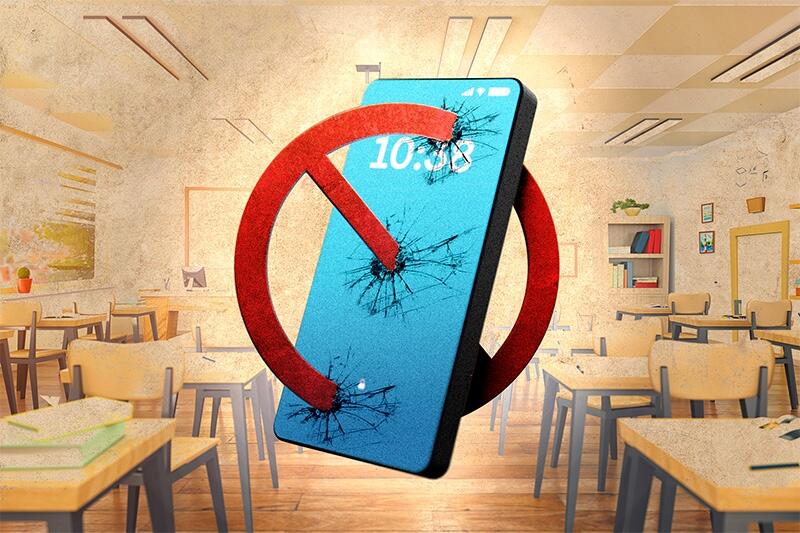
Schools that locked students' phones away for the whole school day saw math and reading scores grow faster, by about one to two extra weeks of learning a year, according to a Harvard study of 3.3 million students released Tuesday.
The study, from Harvard's Center for Education Policy Research, followed students at 4,600 schools from the 2021-22 through the 2025-26 school years. Strict bans - lockable Yondr-style pouches, phones stored centrally, or phones kept off campus altogether - raised annual achievement growth by about 0.01 standard deviations, roughly half of what students have been losing each year since smartphones went mainstream.
"Student achievement has been declining since about 2013 in the U.S., in what we call a 'slow leak' in the paper," Thomas Kane, the center's faculty director and a co-author, told the Harvard Gazette. He wrote the paper with Dartmouth's Douglas Staiger and the testing group NWEA, and it has not been peer-reviewed, NPR reported.
Kane gave the AP the bottom line: "Our answer is yes, phone bans do have a positive effect on growth. But it's not a panacea."
Bans that left it to teachers to police phones in their own classrooms did less, he said. "The key idea is that you're not relying on teachers to enforce it, with inevitably some teachers more lax than others."
The bans also appear to protect the students who were sliding fastest. "Among all students, regardless of their baseline achievement, there's a subset who were seeing big losses in reading over the course of the year, and bans seem to stop that loss," Kane said.
At about $25 a student, or roughly $425 a classroom, the pouches are cheap next to the cost of buying the same gains with extra instruction time, Kane says. The study's pouch estimates rest on student-level scores at 844 schools that used both Yondr's pouches and NWEA's tests, according to NPR, out of more than 3,300 schools nationwide that adopted the pouches between 2019-20 and 2025-26.
Another national study, released this spring, found the same pouches had "close to zero" effect on test scores. That team, led by Stanford's Thomas Dee with researchers from Duke, the University of Michigan and the University of Pennsylvania, tracked more than 43,000 middle and high schools over three years. It found a slight bump in high school math and a slight drop in middle school scores; disciplinary incidents rose in the first year before returning to earlier levels by the third, when student well-being was higher than before the bans.
"The early results from school phone bans are largely disappointing and raise unresolved questions," Dee told the AP. Michigan's Brian Jacob, one of his co-authors, called the Harvard results "encouraging" but told NPR we'll have to "wait and see" whether the benefit lasts.
As of November, 41 states and Washington, DC, have statewide school phone policies, according to the Harvard report, which found suggestive evidence that state-mandated bell-to-bell and instructional-time bans lifted achievement last year, while cautioning that those results could be confounded by trends already underway in the states that passed them.
San Diego State University psychologist Jean Twenge told the AP that enforcement is often spotty: students find workarounds, and some schools with bans on the books still have phones everywhere.
Kane calls students' phone and social media use outside school "the big question." He wants states to demand usage data from the social media companies, and points to the roughly $17 billion Meta agreed to pay states this year, rather than fight their lawsuit over data collection and addictive app design, as a way to pay for the research.
Tyler Durden Wed, 11/18/2026 - 21:20
Continue reading...
[ H/T ZeroHedge ]
Shocker...
Schools that locked students' phones away for the whole school day saw math and reading scores grow faster, by about one to two extra weeks of learning a year, according to a Harvard study of 3.3 million students released Tuesday.
The study, from Harvard's Center for Education Policy Research, followed students at 4,600 schools from the 2021-22 through the 2025-26 school years. Strict bans - lockable Yondr-style pouches, phones stored centrally, or phones kept off campus altogether - raised annual achievement growth by about 0.01 standard deviations, roughly half of what students have been losing each year since smartphones went mainstream.
"Student achievement has been declining since about 2013 in the U.S., in what we call a 'slow leak' in the paper," Thomas Kane, the center's faculty director and a co-author, told the Harvard Gazette. He wrote the paper with Dartmouth's Douglas Staiger and the testing group NWEA, and it has not been peer-reviewed, NPR reported.
Kane gave the AP the bottom line: "Our answer is yes, phone bans do have a positive effect on growth. But it's not a panacea."
Bans that left it to teachers to police phones in their own classrooms did less, he said. "The key idea is that you're not relying on teachers to enforce it, with inevitably some teachers more lax than others."
The bans also appear to protect the students who were sliding fastest. "Among all students, regardless of their baseline achievement, there's a subset who were seeing big losses in reading over the course of the year, and bans seem to stop that loss," Kane said.
At about $25 a student, or roughly $425 a classroom, the pouches are cheap next to the cost of buying the same gains with extra instruction time, Kane says. The study's pouch estimates rest on student-level scores at 844 schools that used both Yondr's pouches and NWEA's tests, according to NPR, out of more than 3,300 schools nationwide that adopted the pouches between 2019-20 and 2025-26.
Another national study, released this spring, found the same pouches had "close to zero" effect on test scores. That team, led by Stanford's Thomas Dee with researchers from Duke, the University of Michigan and the University of Pennsylvania, tracked more than 43,000 middle and high schools over three years. It found a slight bump in high school math and a slight drop in middle school scores; disciplinary incidents rose in the first year before returning to earlier levels by the third, when student well-being was higher than before the bans.
"The early results from school phone bans are largely disappointing and raise unresolved questions," Dee told the AP. Michigan's Brian Jacob, one of his co-authors, called the Harvard results "encouraging" but told NPR we'll have to "wait and see" whether the benefit lasts.
As of November, 41 states and Washington, DC, have statewide school phone policies, according to the Harvard report, which found suggestive evidence that state-mandated bell-to-bell and instructional-time bans lifted achievement last year, while cautioning that those results could be confounded by trends already underway in the states that passed them.
San Diego State University psychologist Jean Twenge told the AP that enforcement is often spotty: students find workarounds, and some schools with bans on the books still have phones everywhere.
Kane calls students' phone and social media use outside school "the big question." He wants states to demand usage data from the social media companies, and points to the roughly $17 billion Meta agreed to pay states this year, rather than fight their lawsuit over data collection and addictive app design, as a way to pay for the research.
Tyler Durden Wed, 11/18/2026 - 21:20
Continue reading...
[ H/T ZeroHedge ]