







Gulf Bond Boom: Record Borrowing Fuels Race To Future-Proof Against Hormuz Shutdown
Gulf monarchies are hitting international debt markets at a record-shattering pace, Bloomberg figures show, amid a conflict-driven rush to harden domestic infrastructure and forge alternative supply corridors that bypass the vulnerable and effectively closed Strait of Hormuz. Added to this, just this month, Red Sea passage has become another problematic area, as the Houthis have targeted several Saudi vessels with missiles and drones.
Regional heavyweights led by the UAE and Saudi Arabia are seeking massive funding for new or expanded deep-water ports along the Red Sea and Gulf of Oman, backed by desert networks and crude oil pipeline bypasses. This modernization will take years, but is being hastened by the urgency of war.
As Bloomberg reports Tuesday, "Borrowers from the United Arab Emirates are tapping global bond markets at a record pace as the Middle East conflict rages, with sales up a third so far in 2026 versus year-ago levels."
Image via Global Capital
The underlying totals underscore the unprecedented size of the paper issuance:
This is consistent with our analysis from April, just a little two months into Trump's Iran "excursion" - as he was calling it at the time, which saw the world's largest bond manager, PIMCO (Pacific Investment Management Co), step in amid the emerging Gulf scramble to find buyers for its bonds.
More broadly among regional Gulf Cooperation Council (GCC) states, bond sales have exploded to a record $112 billion so far this year, according to Bloomberg data, with government debt desks actively probing international banks for additional leverage.
When the US-Israeli war on Iran originally flared and reached a peak in March and April, regional banks froze fundraising and market participants retreated into defensive capital preservation mode to gauge the economic fallout.
But in the wake of the April 8 ceasefire - which was eventually extended before collapsing by mid-summer, UAE lenders drove the charge to tap global capital markets, with UAE-based institutions claiming five of the eight major capital market transactions completed in Q2.
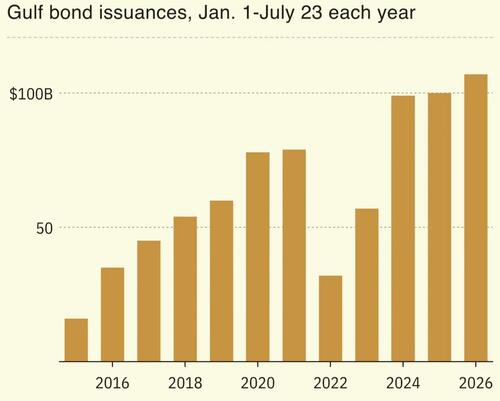
Chart: Ed Clowes/Semafor, Source: Bloomberg
According to UAE's English-language daily Khaleej Times:
Gulf capitals are looking to ensure in a long-term way that even if regional maritime flashpoints flare up or traditional choke points get closed down, the vital flow of energy exports and trade keeps moving along uninterrupted. This is one of the bigger 'lessons' of this ongoing costly Washington adventurism, given it has been largely Gulf infrastructure that's had to absorb the bulk of Iran's retaliation pain.
Tyler Durden Wed, 07/29/2026 - 07:45
Continue reading...
[ H/T ZeroHedge ]
Gulf monarchies are hitting international debt markets at a record-shattering pace, Bloomberg figures show, amid a conflict-driven rush to harden domestic infrastructure and forge alternative supply corridors that bypass the vulnerable and effectively closed Strait of Hormuz. Added to this, just this month, Red Sea passage has become another problematic area, as the Houthis have targeted several Saudi vessels with missiles and drones.
Regional heavyweights led by the UAE and Saudi Arabia are seeking massive funding for new or expanded deep-water ports along the Red Sea and Gulf of Oman, backed by desert networks and crude oil pipeline bypasses. This modernization will take years, but is being hastened by the urgency of war.
As Bloomberg reports Tuesday, "Borrowers from the United Arab Emirates are tapping global bond markets at a record pace as the Middle East conflict rages, with sales up a third so far in 2026 versus year-ago levels."
Image via Global Capital
The underlying totals underscore the unprecedented size of the paper issuance:
This is consistent with our analysis from April, just a little two months into Trump's Iran "excursion" - as he was calling it at the time, which saw the world's largest bond manager, PIMCO (Pacific Investment Management Co), step in amid the emerging Gulf scramble to find buyers for its bonds.
More broadly among regional Gulf Cooperation Council (GCC) states, bond sales have exploded to a record $112 billion so far this year, according to Bloomberg data, with government debt desks actively probing international banks for additional leverage.
When the US-Israeli war on Iran originally flared and reached a peak in March and April, regional banks froze fundraising and market participants retreated into defensive capital preservation mode to gauge the economic fallout.
But in the wake of the April 8 ceasefire - which was eventually extended before collapsing by mid-summer, UAE lenders drove the charge to tap global capital markets, with UAE-based institutions claiming five of the eight major capital market transactions completed in Q2.
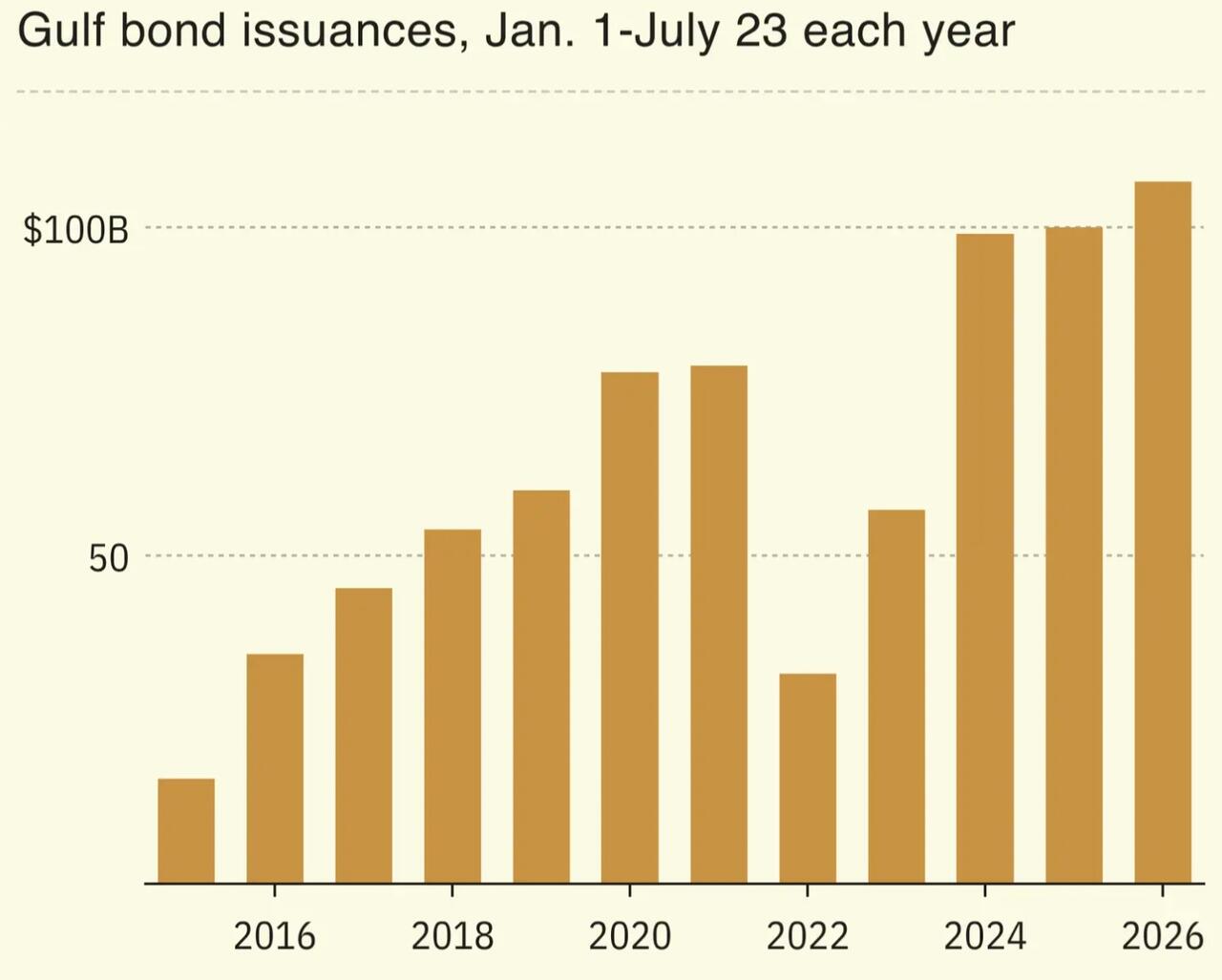
Chart: Ed Clowes/Semafor, Source: Bloomberg
According to UAE's English-language daily Khaleej Times:
Gulf capitals are looking to ensure in a long-term way that even if regional maritime flashpoints flare up or traditional choke points get closed down, the vital flow of energy exports and trade keeps moving along uninterrupted. This is one of the bigger 'lessons' of this ongoing costly Washington adventurism, given it has been largely Gulf infrastructure that's had to absorb the bulk of Iran's retaliation pain.
Tyler Durden Wed, 07/29/2026 - 07:45
Continue reading...
[ H/T ZeroHedge ]
