



Gold Could Crash...Before It Doubles
Submitted by QTR's Fringe Finance
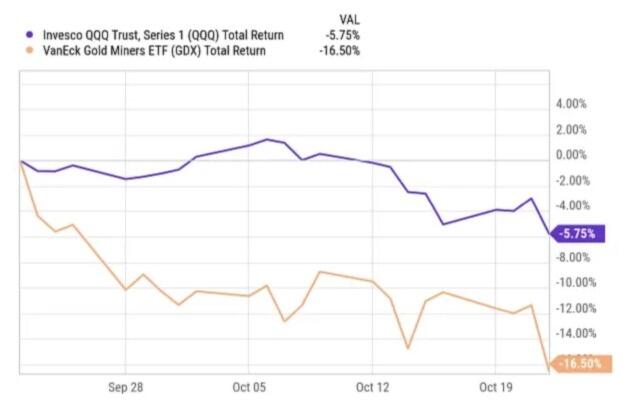
Markets have been volatile over the last several weeks, with selling pressure spreading across tech stocks and speculative assets. Gold and miners have been no exception, with the latter getting caught up in the broader liquidation and suffering significant selling pressure of their own.
While still beating the NASDAQ by about 6% over the last 3 months, miners are down -16.5% in the last month, plunging far more than the QQQ’s which are down just -5.75% in comparison.
I thought it would be a good time to take a few minutes this morning to explain that personally, this is precisely the type of environment I have been anticipating for years (gold and miners plunging alongside a risk selloff), and it does nothing to change my longer-term bullish outlook on gold and gold miners.
What we’re seeing is entirely consistent with the thesis I’ve been laying out over the last few years, though the thesis is far from being proven right.
For years, I’ve said that if we experience a genuine market crash, I expect gold to sell off alongside equities, and I expect gold miners to get hit even harder. The reason is simple: when markets begin deleveraging in earnest, investors don’t sell what they want to sell. They sell what they can sell.
Margin calls need to be met. Leverage needs to be reduced. Cash needs to be raised. And in that environment, even fundamentally attractive assets can get thrown overboard indiscriminately. Gold is not immune to this process, and gold miners, which are ultimately equities with operating leverage to the underlying commodity, are even more vulnerable…they’re easier to sell than physical bullion.
In my August piece, My Favorite Investment In The World Right Now, I wrote:
I went on to explain that miners could easily suffer drawdowns of 20%, 30% or more, even while the longer-term investment case remained intact.
And just days ago, in my market dashboard, I reiterated essentially the same point:
The important part of my thesis has never been what happens during the initial liquidation. It’s what happens afterward.
I’ve thought for a while that the next major financial crisis could produce a two-stage move in precious metals. First comes the deflationary shock, when leverage unwinds, asset prices collapse and investors scramble for dollars. Then comes the policy response, when the Federal Reserve and Treasury are eventually forced to confront the consequences of a financial system that has become hopelessly dependent on cheap credit and abundant liquidity.
That second stage is where I believe the real opportunity lies.
I’ve said repeatedly, including in recent interviews, that I would not be surprised to see gold fall toward $3,000 or $3,500 per ounce during a sufficiently violent market crash. But I’ve also said that I could envision gold subsequently making a beeline toward $7,500, or potentially even higher, quickly over the following months and years if the Federal Reserve responds with aggressive rate cuts, renewed asset purchases, liquidity facilities or other forms of monetary accommodation.
That all remains to be seen if we were to crash now…because inflation has the Fed’s policy responses somewhat hamstrung. But they would figure out a way to make an excuse to print or otherwise ease.
The sequence is what matters. Just earlier this month, during my October 6 appearance on the Macro Dirt podcast with Tony Greer and Jared Dillian, I said:
I then described the possibility of gold moving from deleveraging lows around $3,000 to $3,500 toward $7,500 or even $10,000.

That would represent a 150% advance from $3,000 to $7,500, or roughly 114% from $3,500. And because miners have operating leverage to the gold price, the upside in mining equities could be substantially greater, provided their balance sheets, production costs and underlying businesses remain sound.
Of course, none of this is guaranteed. The Fed could remain restrictive longer than I expect, a crash could damage miners’ fundamentals, and the recovery could take substantially longer to materialize. But those risks have always been part of the thesis.
What I find particularly interesting is that the very forces capable of creating the initial crash could ultimately force the policy response that benefits gold.
A credit event, disorderly bond market, severe equity drawdown or broader liquidity crisis would put enormous pressure on policymakers to intervene. And given the United States’ enormous debt burden, persistent fiscal deficits and growing interest expense, I continue to believe the political and economic incentives overwhelmingly favor intervention over sustained austerity.
In other words, the same financial instability that could temporarily crush gold and miners may ultimately provide the catalyst for their next major move higher.
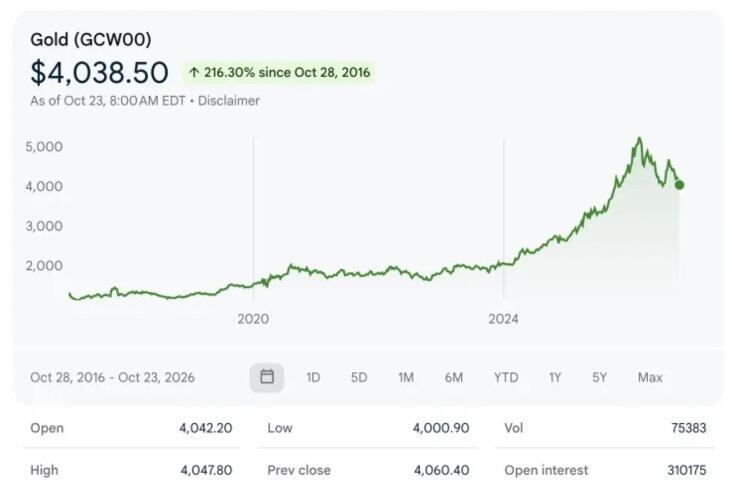
And whenever I start questioning the thesis because of the latest ugly trading session, I find it helpful to zoom out.
Gold was trading around $1,900 per ounce five years ago. Even if it were to fall all the way back to $3,000 during a major liquidation, it would still be up approximately 58% over that period. That’s hardly the destruction of a secular bull market. It’s a reminder of just how far the metal has already come, and how much nominal purchasing power has been lost along the way.
And the structural reasons I have been bullish haven’t disappeared. Federal debt continues to grow. Deficits remain enormous. The government has shown little appetite for meaningful fiscal restraint. Central banks continue to have reasons to diversify reserves away from sovereign paper. And the monetary system remains dependent on policymakers’ willingness to provide liquidity whenever financial conditions become sufficiently dangerous.
None of those problems gets solved because GDX has a terrible week.
So today’s piece is really just a reminder, both to readers and to myself, that I don’t view the current weakness in gold and miners as some alarming development that requires me to rethink everything I’ve written over the last several years.
Instead, this is what I’ve been expecting. This is the volatility I’ve been warning about. And this is the kind of environment I’ve been preparing for.
 85% OFF FOREVER IF YOU SUBSCRIBE TODAY: I am again offering an 85% discount to anyone that wants to become a Fringe Finance annual subscriber today. It’s a discount you can keep and stays applied for as long as you wish to remain a subscriber: Get 85% off forever
I don’t know where the bottom is, how much further miners could fall, or precisely when the Fed will be forced to change course. And I’m certainly not suggesting anyone blindly catch falling knives or underestimate the damage a genuine market crash could inflict on mining equities.
But I do know that the long-term reason I own and follow gold miners has very little to do with whether they are up or down on any particular day.
It has everything to do with what I believe policymakers will eventually be forced to do when the financial system comes under enough pressure.
The liquidation is the part everyone fears. The response to the liquidation is the part I’m interested in.
And if my thesis is correct, the most attractive opportunity in gold miners may arrive precisely when nobody wants to own them…or anything at all.
If Newmont Mining’s earnings yesterday showed us one thing, it’s that not all selloffs are created equal.
Gold miners are not some pre-profit AI garbage trading on promises of profitability a decade from now. Newmont just reported $6.36 billion in quarterly revenue, $2.48 billion in net income, and $1.9 billion in free cash flow, while sitting on $8.8 billion in cash and a net cash position of $3.2 billion.
These are real businesses producing real profits, with enormous operating leverage to the price of gold. And while I fully expect miners to get thrown out with everything else during a broader market liquidation, I think there’s an enormous difference between selling a cash-generating, financially sound business that fits squarely into my long-term gold thesis and dumping some cash-burning AI growth dogshit whose entire valuation depends on a future that may never materialize.
Both may get sold in a panic, but that doesn’t mean both deserve to be sold.
--
QTR’s Disclaimer: Please read my full legal disclaimer on my About page here.
This post represents my opinions only. In addition, please understand I am an idiot and very often get things wrong and lose money. I may own or transact in any names mentioned in this piece at any time without warning, meaning if I’m long I could sell or if I’m short I could cover at any time. Positions can change immediately. This is not a recommendation to buy or sell any stocks or securities, just my opinions. I often lose money on positions I trade/invest in. I may add any name mentioned in this article and sell any name mentioned in this piece at any time, without further warning.
I also may or may not own names I write about and are watching. Sometimes I’m bullish without owning things, sometimes I’m bearish and own things I’m bearish on. Just assume my positions could be exactly the opposite of what you think they are just in case. If I’m long I could quickly be short and vice versa. I won’t update my positions.
I cannot guarantee the accuracy of any or all facts and figures included in this article though I made an effort to get them right. I have been wrong before and will be wrong again, and encourage you to always double check, do your own research and speak to a licensed financial professional, which I am not.
Tyler Durden Sun, 10/25/2026 - 11:35
Continue reading...
[ H/T ZeroHedge ]
Submitted by QTR's Fringe Finance
Markets have been volatile over the last several weeks, with selling pressure spreading across tech stocks and speculative assets. Gold and miners have been no exception, with the latter getting caught up in the broader liquidation and suffering significant selling pressure of their own.
While still beating the NASDAQ by about 6% over the last 3 months, miners are down -16.5% in the last month, plunging far more than the QQQ’s which are down just -5.75% in comparison.
I thought it would be a good time to take a few minutes this morning to explain that personally, this is precisely the type of environment I have been anticipating for years (gold and miners plunging alongside a risk selloff), and it does nothing to change my longer-term bullish outlook on gold and gold miners.
What we’re seeing is entirely consistent with the thesis I’ve been laying out over the last few years, though the thesis is far from being proven right.
For years, I’ve said that if we experience a genuine market crash, I expect gold to sell off alongside equities, and I expect gold miners to get hit even harder. The reason is simple: when markets begin deleveraging in earnest, investors don’t sell what they want to sell. They sell what they can sell.
Margin calls need to be met. Leverage needs to be reduced. Cash needs to be raised. And in that environment, even fundamentally attractive assets can get thrown overboard indiscriminately. Gold is not immune to this process, and gold miners, which are ultimately equities with operating leverage to the underlying commodity, are even more vulnerable…they’re easier to sell than physical bullion.
In my August piece, My Favorite Investment In The World Right Now, I wrote:
I went on to explain that miners could easily suffer drawdowns of 20%, 30% or more, even while the longer-term investment case remained intact.
And just days ago, in my market dashboard, I reiterated essentially the same point:
The important part of my thesis has never been what happens during the initial liquidation. It’s what happens afterward.
I’ve thought for a while that the next major financial crisis could produce a two-stage move in precious metals. First comes the deflationary shock, when leverage unwinds, asset prices collapse and investors scramble for dollars. Then comes the policy response, when the Federal Reserve and Treasury are eventually forced to confront the consequences of a financial system that has become hopelessly dependent on cheap credit and abundant liquidity.
That second stage is where I believe the real opportunity lies.
I’ve said repeatedly, including in recent interviews, that I would not be surprised to see gold fall toward $3,000 or $3,500 per ounce during a sufficiently violent market crash. But I’ve also said that I could envision gold subsequently making a beeline toward $7,500, or potentially even higher, quickly over the following months and years if the Federal Reserve responds with aggressive rate cuts, renewed asset purchases, liquidity facilities or other forms of monetary accommodation.
That all remains to be seen if we were to crash now…because inflation has the Fed’s policy responses somewhat hamstrung. But they would figure out a way to make an excuse to print or otherwise ease.
The sequence is what matters. Just earlier this month, during my October 6 appearance on the Macro Dirt podcast with Tony Greer and Jared Dillian, I said:
I then described the possibility of gold moving from deleveraging lows around $3,000 to $3,500 toward $7,500 or even $10,000.
That would represent a 150% advance from $3,000 to $7,500, or roughly 114% from $3,500. And because miners have operating leverage to the gold price, the upside in mining equities could be substantially greater, provided their balance sheets, production costs and underlying businesses remain sound.
Of course, none of this is guaranteed. The Fed could remain restrictive longer than I expect, a crash could damage miners’ fundamentals, and the recovery could take substantially longer to materialize. But those risks have always been part of the thesis.
What I find particularly interesting is that the very forces capable of creating the initial crash could ultimately force the policy response that benefits gold.
A credit event, disorderly bond market, severe equity drawdown or broader liquidity crisis would put enormous pressure on policymakers to intervene. And given the United States’ enormous debt burden, persistent fiscal deficits and growing interest expense, I continue to believe the political and economic incentives overwhelmingly favor intervention over sustained austerity.
In other words, the same financial instability that could temporarily crush gold and miners may ultimately provide the catalyst for their next major move higher.
And whenever I start questioning the thesis because of the latest ugly trading session, I find it helpful to zoom out.
Gold was trading around $1,900 per ounce five years ago. Even if it were to fall all the way back to $3,000 during a major liquidation, it would still be up approximately 58% over that period. That’s hardly the destruction of a secular bull market. It’s a reminder of just how far the metal has already come, and how much nominal purchasing power has been lost along the way.
And the structural reasons I have been bullish haven’t disappeared. Federal debt continues to grow. Deficits remain enormous. The government has shown little appetite for meaningful fiscal restraint. Central banks continue to have reasons to diversify reserves away from sovereign paper. And the monetary system remains dependent on policymakers’ willingness to provide liquidity whenever financial conditions become sufficiently dangerous.
None of those problems gets solved because GDX has a terrible week.
So today’s piece is really just a reminder, both to readers and to myself, that I don’t view the current weakness in gold and miners as some alarming development that requires me to rethink everything I’ve written over the last several years.
Instead, this is what I’ve been expecting. This is the volatility I’ve been warning about. And this is the kind of environment I’ve been preparing for.
85% OFF FOREVER IF YOU SUBSCRIBE TODAY: I am again offering an 85% discount to anyone that wants to become a Fringe Finance annual subscriber today. It’s a discount you can keep and stays applied for as long as you wish to remain a subscriber: Get 85% off foreverI don’t know where the bottom is, how much further miners could fall, or precisely when the Fed will be forced to change course. And I’m certainly not suggesting anyone blindly catch falling knives or underestimate the damage a genuine market crash could inflict on mining equities.
But I do know that the long-term reason I own and follow gold miners has very little to do with whether they are up or down on any particular day.
It has everything to do with what I believe policymakers will eventually be forced to do when the financial system comes under enough pressure.
The liquidation is the part everyone fears. The response to the liquidation is the part I’m interested in.
And if my thesis is correct, the most attractive opportunity in gold miners may arrive precisely when nobody wants to own them…or anything at all.
If Newmont Mining’s earnings yesterday showed us one thing, it’s that not all selloffs are created equal.
Gold miners are not some pre-profit AI garbage trading on promises of profitability a decade from now. Newmont just reported $6.36 billion in quarterly revenue, $2.48 billion in net income, and $1.9 billion in free cash flow, while sitting on $8.8 billion in cash and a net cash position of $3.2 billion.
These are real businesses producing real profits, with enormous operating leverage to the price of gold. And while I fully expect miners to get thrown out with everything else during a broader market liquidation, I think there’s an enormous difference between selling a cash-generating, financially sound business that fits squarely into my long-term gold thesis and dumping some cash-burning AI growth dogshit whose entire valuation depends on a future that may never materialize.
Both may get sold in a panic, but that doesn’t mean both deserve to be sold.
--
QTR’s Disclaimer: Please read my full legal disclaimer on my About page here.
This post represents my opinions only. In addition, please understand I am an idiot and very often get things wrong and lose money. I may own or transact in any names mentioned in this piece at any time without warning, meaning if I’m long I could sell or if I’m short I could cover at any time. Positions can change immediately. This is not a recommendation to buy or sell any stocks or securities, just my opinions. I often lose money on positions I trade/invest in. I may add any name mentioned in this article and sell any name mentioned in this piece at any time, without further warning.
I also may or may not own names I write about and are watching. Sometimes I’m bullish without owning things, sometimes I’m bearish and own things I’m bearish on. Just assume my positions could be exactly the opposite of what you think they are just in case. If I’m long I could quickly be short and vice versa. I won’t update my positions.
I cannot guarantee the accuracy of any or all facts and figures included in this article though I made an effort to get them right. I have been wrong before and will be wrong again, and encourage you to always double check, do your own research and speak to a licensed financial professional, which I am not.
Tyler Durden Sun, 10/25/2026 - 11:35
Continue reading...
[ H/T ZeroHedge ]