






French Bonds Rally As Le Pen Unveils Shadow Budget To Pull France Back From Fiscal Brink
European bond and currency markets are signaling growing investor unease over France's political crisis and deteriorating fiscal position, as growing budget deficits under President Emmanuel Macron undermine confidence in the government's ability to stabilize public finances.
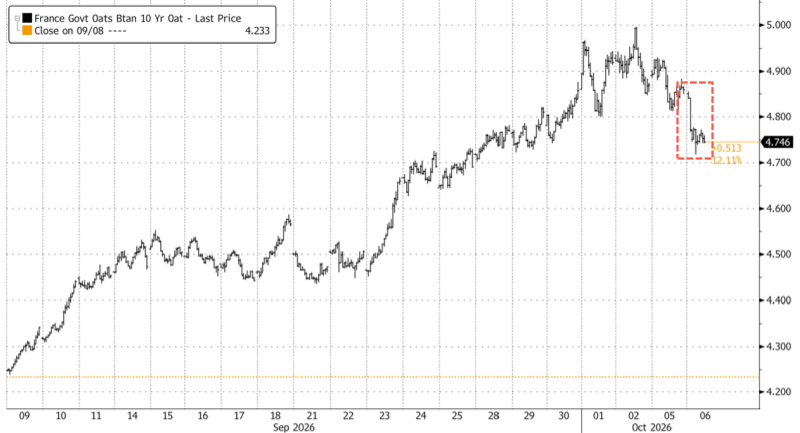
French bond yields rose Monday before reversing sharply on Tuesday, with the 10-year yield falling to around 4.75% after right-wing presidential candidate Marine Le Pen proposed steep deficit cuts.
The bond market reaction suggests investors welcomed the prospect of common-sense fiscal discipline, though austerity never ends well, as far-left riots already plague the streets over school budget constraints.
Le Pen's plan would shrink the deficit to 3.7% of economic output next year, well below the government's 5% target, before bringing it to 2.2% by 2032. Savings would come largely from spending cuts, lower transfers to the EU and reduced migrant spending.
The proposals come as political uncertainty clouds the political landscape and deteriorating public finances drive up France's borrowing costs.
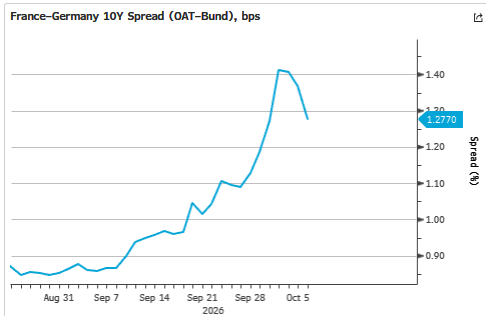
The premium investors demand to hold French 10-year debt over German equivalents has finally narrowed.
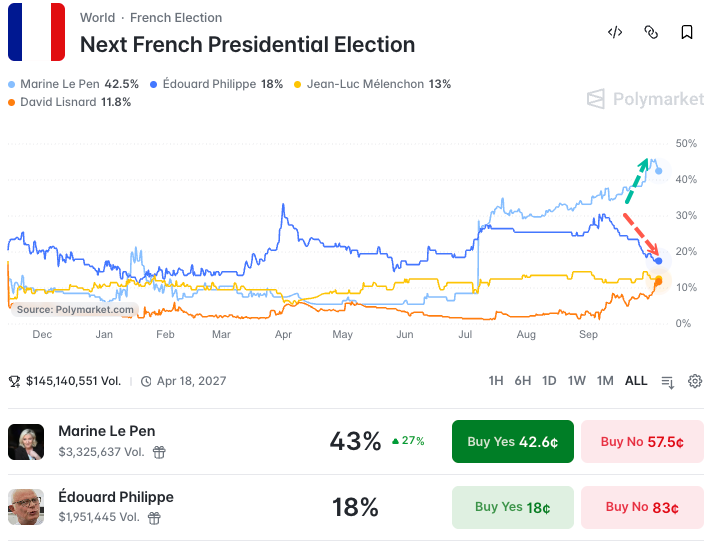
Le Pen has received a notable boost in her odds of winning next year's first-round vote on Polymarket, as the social unrest involving far-left radical kids who burned down schools and torched buses was merely seen as a political gift. It only reaffirms her stance that the country's trajectory under globalist control has been nothing more than nation-killing.
UBS markets analyst Nana Antiedu told clients that "French bonds continue outperformance after Le Pen's shadow budget release."
Antiedu added:
French bonds continue their gains, with the 10y OAT down 12bp to 4.74% after RN leader Marine Le Pen unveiled her budget proposal to reduce France's deficit. The proposal includes plans for the deficit to be below 5% from 2027 and cut spending by more than EUR140 bn, bring the deficit below 3% by 2032 at the latest. She said France could face default if Macron's policy continues. Le Pen also said the ECB should intervene to lower euro-area borrowing costs.
Note that this is a shadow budget, so in effect what she would propose if her party was in power. However, assuming Le Pen's party were to win the 2027 presidential election and go through the legal process of changing the budget, a deficit of 3% by 2032 is quite ambitious, and would require her to gain agreement from the other parties.
Goldman Sachs one-delta desk-head, Rich Privorotsky, told clients:
Le Pen: She presents the RN shadow budget today and OATs have already done an enormous amount for an election still months away, so the bar for a positive surprise feels low. The realistic upside is just credibility. More than €25bn a year of clearly identified domestic spending cuts, less reliance on dubious savings from Brussels/immigration, slower phasing of tax cuts, conservative growth assumptions and a genuinely binding fiscal rule would all help. Anything that credibly accelerates that path toward 2029 would be meaningfully OAT positive. Showing an executable path to stabilize debt without touching electorally sensitive pension promises could be more fiscally credible than the market expects. The caveat is EUR… if more domestic restraint ultimately means less willingness to fund Brussels, that raises a different question around European cohesion. Tactically, I like the chance of a positive surprise in Europe, banks and French risk today.
Far-left rival Jean-Luc Mélenchon criticized Le Pen's budget plan as an attempt to appease financial markets, claiming the cuts would weaken the economy and worsen public finances.
The euro's latest declines against the dollar and other major peers "point to a larger risk premium going into the euro on the back of fiscal woes," said ING Bank NV's head of G10 FX strategy.
As we conveniently pointed out on Monday, the political crisis, whether in France or Spain, has culminated in a "Red October" bond crisis across the continent, which is also facing an energy crisis this coming winter.
Tyler Durden Tue, 10/06/2026 - 07:45
Continue reading...
[ H/T ZeroHedge ]
European bond and currency markets are signaling growing investor unease over France's political crisis and deteriorating fiscal position, as growing budget deficits under President Emmanuel Macron undermine confidence in the government's ability to stabilize public finances.
French bond yields rose Monday before reversing sharply on Tuesday, with the 10-year yield falling to around 4.75% after right-wing presidential candidate Marine Le Pen proposed steep deficit cuts.
The bond market reaction suggests investors welcomed the prospect of common-sense fiscal discipline, though austerity never ends well, as far-left riots already plague the streets over school budget constraints.
Le Pen's plan would shrink the deficit to 3.7% of economic output next year, well below the government's 5% target, before bringing it to 2.2% by 2032. Savings would come largely from spending cuts, lower transfers to the EU and reduced migrant spending.
The proposals come as political uncertainty clouds the political landscape and deteriorating public finances drive up France's borrowing costs.
The premium investors demand to hold French 10-year debt over German equivalents has finally narrowed.
Le Pen has received a notable boost in her odds of winning next year's first-round vote on Polymarket, as the social unrest involving far-left radical kids who burned down schools and torched buses was merely seen as a political gift. It only reaffirms her stance that the country's trajectory under globalist control has been nothing more than nation-killing.
UBS markets analyst Nana Antiedu told clients that "French bonds continue outperformance after Le Pen's shadow budget release."
Antiedu added:
French bonds continue their gains, with the 10y OAT down 12bp to 4.74% after RN leader Marine Le Pen unveiled her budget proposal to reduce France's deficit. The proposal includes plans for the deficit to be below 5% from 2027 and cut spending by more than EUR140 bn, bring the deficit below 3% by 2032 at the latest. She said France could face default if Macron's policy continues. Le Pen also said the ECB should intervene to lower euro-area borrowing costs.
Note that this is a shadow budget, so in effect what she would propose if her party was in power. However, assuming Le Pen's party were to win the 2027 presidential election and go through the legal process of changing the budget, a deficit of 3% by 2032 is quite ambitious, and would require her to gain agreement from the other parties.
Goldman Sachs one-delta desk-head, Rich Privorotsky, told clients:
Le Pen: She presents the RN shadow budget today and OATs have already done an enormous amount for an election still months away, so the bar for a positive surprise feels low. The realistic upside is just credibility. More than €25bn a year of clearly identified domestic spending cuts, less reliance on dubious savings from Brussels/immigration, slower phasing of tax cuts, conservative growth assumptions and a genuinely binding fiscal rule would all help. Anything that credibly accelerates that path toward 2029 would be meaningfully OAT positive. Showing an executable path to stabilize debt without touching electorally sensitive pension promises could be more fiscally credible than the market expects. The caveat is EUR… if more domestic restraint ultimately means less willingness to fund Brussels, that raises a different question around European cohesion. Tactically, I like the chance of a positive surprise in Europe, banks and French risk today.
Far-left rival Jean-Luc Mélenchon criticized Le Pen's budget plan as an attempt to appease financial markets, claiming the cuts would weaken the economy and worsen public finances.
The euro's latest declines against the dollar and other major peers "point to a larger risk premium going into the euro on the back of fiscal woes," said ING Bank NV's head of G10 FX strategy.
As we conveniently pointed out on Monday, the political crisis, whether in France or Spain, has culminated in a "Red October" bond crisis across the continent, which is also facing an energy crisis this coming winter.
Tyler Durden Tue, 10/06/2026 - 07:45
Continue reading...
[ H/T ZeroHedge ]