

Exclusive Sperm Donor Access For IVF Can Now Cost Up To $70,000
Sperm banks and donor-matching services are expanding premium options for patients undergoing in vitro fertilization (IVF), offering greater control over donor selection, identity disclosure and the number of families permitted to use sperm from the same donor. These services are increasingly available to single women, same-sex couples and couples experiencing male infertility, according to Bloomberg.
Traditional donor sperm can cost less than $2,000 per vial, excluding storage, shipping and fertility treatment. Premium donor services charge substantially more for screening, matching, access to donor information and exclusive arrangements that limit the number of recipient families.
Coast to Coast Sperm Donation offers packages starting at approximately $25,000, limiting each donor to six families, with additional fees to reduce that number. The Seed Scout charges $10,500 for standard donor matching or $24,500 for exclusive access, plus approximately $7,000 in legal, counseling and related expenses. Its standard program limits each donor to three recipient families and includes direct contact between donors and prospective parents.
Cryos International offers exclusive donor access for $49,000 before additional fees, while Fairfax Cryobank has offered 10 vials from a donor restricted to one family worldwide for $45,000. California Cryobank charges $70,000 for exclusive access to a donor's stored sperm or $35,000 to limit sales to nine additional families.
Bloomberg writes that these fees generally exclude IVF procedures and may not include genetic testing, medical screening, donor compensation, legal services and other associated expenses. Depending on the provider and level of exclusivity, total donor-related costs can exceed $80,000 before fertility treatment begins.
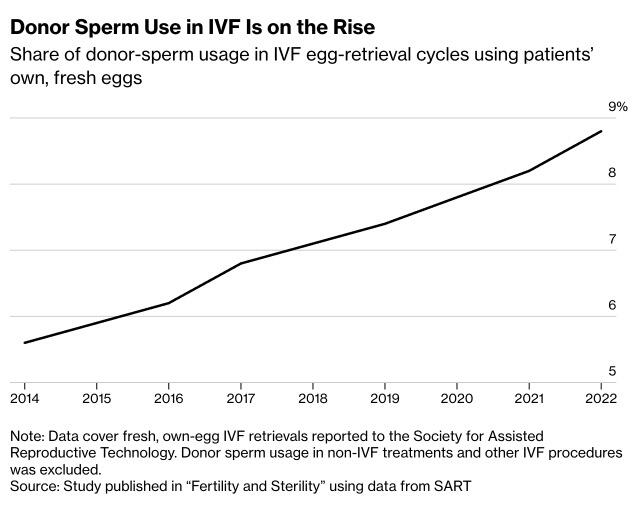
The use of donor sperm in IVF has increased. Among IVF retrieval cycles using patients' own fresh eggs, donor sperm use rose from 5.6% in 2014 to 8.8% in 2022. In 2024, approximately 100,158 babies were born through IVF in the United States, although not all procedures involved donated sperm. The number of female same-sex couples living with their own minor children also increased, reaching approximately 151,000 in 2024, compared with 87,000 a decade earlier.
Premium services also increasingly offer arrangements allowing donor-conceived children to obtain identifying information about their biological donors. Some programs facilitate meetings between donors and prospective parents before donation and establish agreements governing future contact and the sharing of medical information.
Despite the higher prices, exclusive donor arrangements have limitations. The United States lacks a centralized donor registry, and sperm banks cannot fully verify whether donors have contributed to other facilities. Consequently, exclusivity agreements may restrict distribution through individual providers but cannot guarantee that no additional biological siblings will result from donations elsewhere.
The expansion of premium donor services reflects a growing market for donor selection, identity transparency and restrictions on the number of recipient families, with pricing varying considerably according to the services and contractual arrangements provided.
Tyler Durden Thu, 11/05/2026 - 22:10
Continue reading...
[ H/T ZeroHedge ]
Sperm banks and donor-matching services are expanding premium options for patients undergoing in vitro fertilization (IVF), offering greater control over donor selection, identity disclosure and the number of families permitted to use sperm from the same donor. These services are increasingly available to single women, same-sex couples and couples experiencing male infertility, according to Bloomberg.
Traditional donor sperm can cost less than $2,000 per vial, excluding storage, shipping and fertility treatment. Premium donor services charge substantially more for screening, matching, access to donor information and exclusive arrangements that limit the number of recipient families.
Coast to Coast Sperm Donation offers packages starting at approximately $25,000, limiting each donor to six families, with additional fees to reduce that number. The Seed Scout charges $10,500 for standard donor matching or $24,500 for exclusive access, plus approximately $7,000 in legal, counseling and related expenses. Its standard program limits each donor to three recipient families and includes direct contact between donors and prospective parents.
Cryos International offers exclusive donor access for $49,000 before additional fees, while Fairfax Cryobank has offered 10 vials from a donor restricted to one family worldwide for $45,000. California Cryobank charges $70,000 for exclusive access to a donor's stored sperm or $35,000 to limit sales to nine additional families.
Bloomberg writes that these fees generally exclude IVF procedures and may not include genetic testing, medical screening, donor compensation, legal services and other associated expenses. Depending on the provider and level of exclusivity, total donor-related costs can exceed $80,000 before fertility treatment begins.
The use of donor sperm in IVF has increased. Among IVF retrieval cycles using patients' own fresh eggs, donor sperm use rose from 5.6% in 2014 to 8.8% in 2022. In 2024, approximately 100,158 babies were born through IVF in the United States, although not all procedures involved donated sperm. The number of female same-sex couples living with their own minor children also increased, reaching approximately 151,000 in 2024, compared with 87,000 a decade earlier.
Premium services also increasingly offer arrangements allowing donor-conceived children to obtain identifying information about their biological donors. Some programs facilitate meetings between donors and prospective parents before donation and establish agreements governing future contact and the sharing of medical information.
Despite the higher prices, exclusive donor arrangements have limitations. The United States lacks a centralized donor registry, and sperm banks cannot fully verify whether donors have contributed to other facilities. Consequently, exclusivity agreements may restrict distribution through individual providers but cannot guarantee that no additional biological siblings will result from donations elsewhere.
The expansion of premium donor services reflects a growing market for donor selection, identity transparency and restrictions on the number of recipient families, with pricing varying considerably according to the services and contractual arrangements provided.
Tyler Durden Thu, 11/05/2026 - 22:10
Continue reading...
[ H/T ZeroHedge ]