





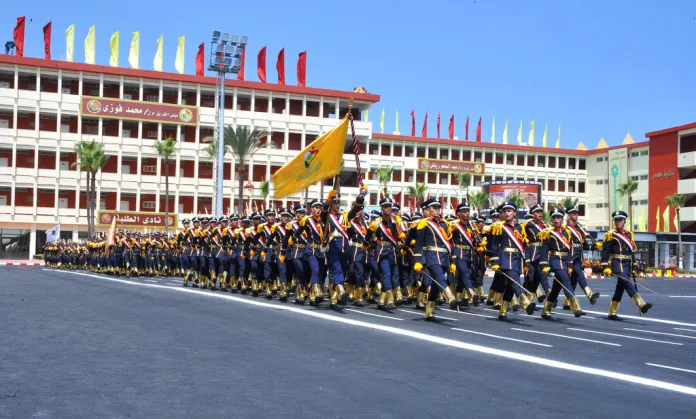
Egypt fields roughly 40,000 troops across the Sinai Peninsula, nearly double the 22,000 limit established by the security annex of the 1979 Egyptian-Israeli peace treaty. Zone C, the strip bordering Gaza and Israel, holds the bulk, backed by armored vehicles, Chinese air defenses, and upgraded runways at al Gora. Cairo calls the surge a “counterterrorism necessity”; that justification no longer holds. Instead, the permanent buildup quietly erodes the demilitarized buffer that has kept the Egyptian-Israeli border peaceful for nearly five decades.
Washington must condition any military assistance and diplomatic cover for Egypt on two linked steps: Cairo’s accession to the Abraham Accords and a verifiable reduction of Sinai’s heavy forces to levels closer to the treaty’s original ceilings. The “cold peace” has preserved quiet borders and delivered a $35 billion natural gas export deal between Israel and Egypt. Yet it has not brought the economic integration, intelligence fusion, or political normalization that the Abraham Accords have delivered to the United Arab Emirates, Bahrain, and Morocco.
Two concrete, reciprocal steps can make this a reality. First, Israel must transfer its proprietary artificial intelligence-driven architecture for sensor fusion and predictive analytics—already battle-tested in Gaza and Lebanon — to Egypt’s Sinai command. The system fuses commercial satellite imagery, ground sensors, and drone feeds into real-time threat maps. With it, Cairo could secure the Sinai Peninsula with half its current manpower while applying the same dual-use tools to protect Red Sea tourism corridors and critical infrastructure.
Second, Egypt and Israel must commit to a joint Sinai desalination and green-hydrogen complex powered by Israeli modular reverse-osmosis technology and high-efficiency solar arrays. Cairo faces chronic water stress affecting its population of more than 110 million, while the Nile’s future remains contested. A large-scale Israeli-Egyptian plant in northern Sinai, open to the Accords investment, would give Cairo tangible progress on a national priority that military deployments alone cannot solve.
Consequently, Egypt’s accession to the Abraham Accords would transform this diplomatic initiative into an “Abrahamic NATO” built on three pillars: intelligence sharing against Iran and its proxies; coordinated maritime security from the Eastern Mediterranean to the Red Sea; and rapid-response protocols for border crises. Egypt would anchor the alliance’s southern flank and thus force Saudi Arabia to recalculate.
Riyadh recently secured a civil nuclear agreement with Washington that will provide American nuclear technology to the Houthi-threatened nation. Although this development risks catalyzing a nuclear arms race, Saudi Arabia is prioritizing energy diversification while simultaneously seeking credible deterrence against Tehran. Therefore, an Egypt-anchored alliance would provide collective weight beyond any bilateral U.S.-Saudi nuclear agreement, making Saudi accession the logical next step rather than a distant aspiration.
OPINION: HEZBOLLAH’S ISLAND HIDEOUT IS JUST HOURS FROM MIAMI BY DRONE
These measures could turn Egypt’s security needs into technological and economic gains while freeing its armed forces to deal with two genuine threats: Libya’s western chaos and the Grand Ethiopian Renaissance Dam dispute to the south. This way, Cairo would be able to address both of these challenges without provoking Israeli anxiety over forces massed opposite the Negev. Otherwise, the “salami-slicing” of the 1979 treaty will continue, with each additional battalion or air-defense battery in Zone C eroding Israeli strategic depth and Washington’s confidence.
Egypt spent tens of billions developing the Sinai Peninsula and battling insurgents, yielding security gains but not a modernized relationship with Israel. Washington has leverage; Jerusalem offers technology and incentives that Cairo wants. Together, they can anchor an “Abrahamic NATO,” give Riyadh a reason to join, and make Egypt a more stable country. The choice is stark: strategic buffer or permanent friction.
Jose Lev Alvarez is an American–Israeli scholar specializing in international security policy. A multilingual veteran of the Israeli special forces and the U.S. Army, he holds three master’s degrees and is completing a doctorate in intelligence and global security in the Washington, D.C., area.
Continue reading...
[ H/T Washington Examiner ]