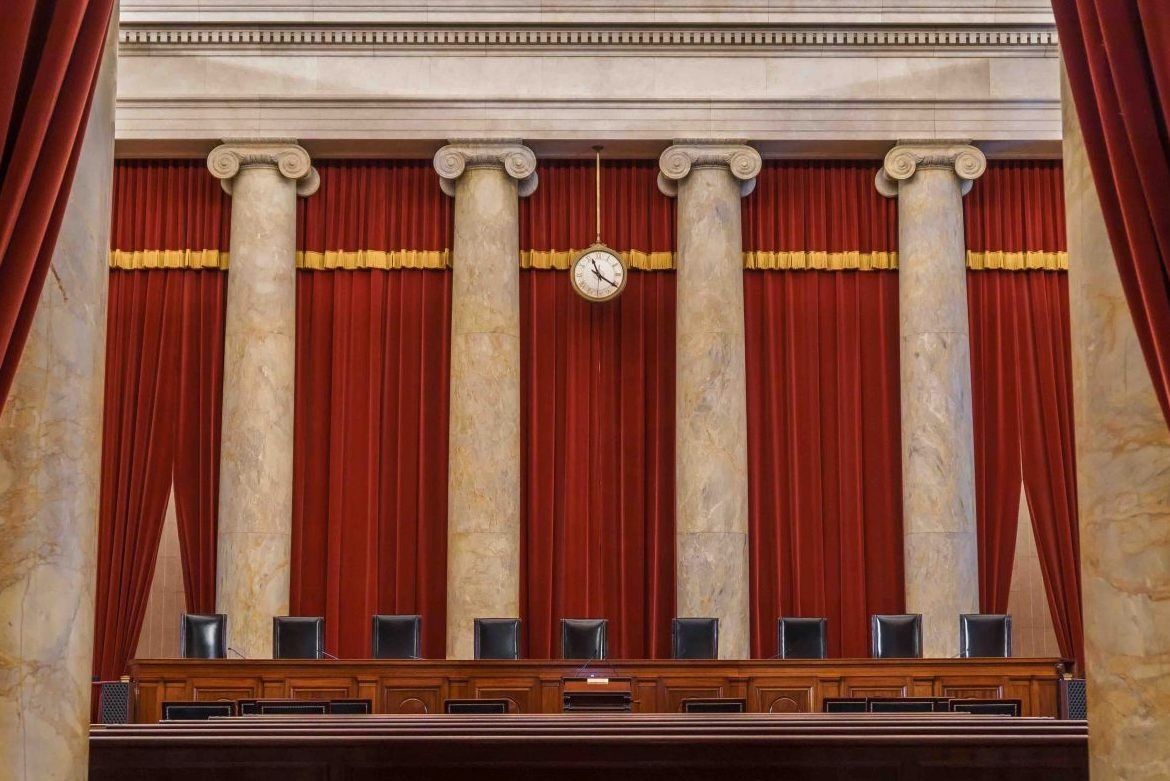



By now, you have probably read a great deal about the Supreme Court’s emergency docket – and a fair amount about the justices who disagree with its orders. Over the past year, in this space alone, I have written about how long the court takes to act on these applications, how often lower courts cite the orders it produces, and the justice shopping that shows up in refiled applications. Almost every part of this docket has been picked over: the speed, the secrecy, and how often it’s used.
But one thing has gone relatively unnoticed: the nature of dissents on the emergency docket. When the Supreme Court rules on an emergency application, the order is usually one sentence long (which has generated much of the criticism of the so-called “shadow docket”). Sometimes the order contains an additional sentence: “Justice Thomas would deny the application.” Court watchers count that as a dissent. They also count as a dissent a 17-page dissenting opinion by Justice Sonia Sotomayor, joined by three colleagues, that works through the standard for interim relief. Yet these are not the same thing. One is a vote. The other is a dissenting opinion, and often the only reasoning that the order contains at all.
This is worth dwelling on because the justices so rarely explain their decisions on these orders. Given this, how a justice chooses to disagree is not simply a matter of style. Rather, it may be the sole information provided in an emergency ruling that lower courts and litigants have to work with.
Four ways to say no
On the merits docket, a dissent is a written opinion. On the emergency docket, that word covers four different things:
- A justice can author a dissenting opinion.
- A justice can join a colleague’s dissenting opinion like Justice Neil Gorsuch here.
- A justice can note a dissent without writing anything at all, so that the order records only that the justice dissents.
- Or a justice can enter a bare notation: a single line stating that he or she “would grant the application” or “would deny the application.”
Remember, this is just what we see in the order. According to internal memos, justices sometimes note a dissent or a would grant/deny, but the order does not disclose that.
Since the 2000-01 term I have identified 153 substantive emergency applications that drew at least one public objection. Counting parallel challenges resolved in a single order as one dispute leaves 129, and across this 129, there have been 386 objections by individual justices. Exactly half of the 386, 193 of them, consist of “would grant/deny” notations (number four above). When commentators tally emergency docket dissents, half of what they are counting thus contains only that information. This matters because tallying every notation as a dissent overstates how often the justices explain themselves. When we count 386 objections and call them all dissents, we imply 386 explanations. But half are bare votes. In other words, the raw count does not oversell how often the justices disagree; it oversells how much reasoning there is in such disagreements.

Who writes
The most frequent objector on the emergency docket has been Justice Sonia Sotomayor, with 65 objections. Justice Clarence Thomas comes in second, with 57. Third is Justice Samuel Alito, with 48.
Four justices do nearly all the writing. Sotomayor has authored 15 dissenting opinions, Alito 13, Justice Elena Kagan 11, and Justice Ketanji Brown Jackson 11. After those four the numbers drop dramatically. Although Thomas is the second most frequent objector on the court (with 57), he has only authored three dissenting opinions in 25 terms on the emergency docket. Forty-one of his objections are “would grant/deny” notations, and 13 are joins. He is neither silent nor disengaged. He signs other justices’ arguments and he logs his own votes, but he almost never writes himself. Alito is Thomas’ mirror. He has objected 48 times, authored 13 opinions, and joined only five. When Alito participates in a written dissent, he is the author 72% of the time. These two justices thus object at nearly the same rate but do so in almost opposite ways.
Chief Justice John Roberts has objected only nine times in 20 years, fewer than any sitting justice except Justice Amy Coney Barrett. He almost never disagrees in public on the emergency docket in any form. Jackson is an outlier in the other direction. In only three terms, she has authored 11 dissenting opinions and joined 11 more, more than seven written participations per term and roughly triple Sotomayor’s career rate. Seven of her authored dissents were solo. Barrett is on the other end, who in five terms has never authored an emergency docket dissent and has joined a mere three. The court’s two newest justices behave very differently when it comes to dissenting on the emergency docket – Jackson vocal, Barrett silent.

Who objects together
Coalition patterns in emergency docket dissents have been written about before, most recently by Adam Feldman, who traced the familiar groups of justices objecting together. But these groups do not just object together. They vary significantly in how they do so.
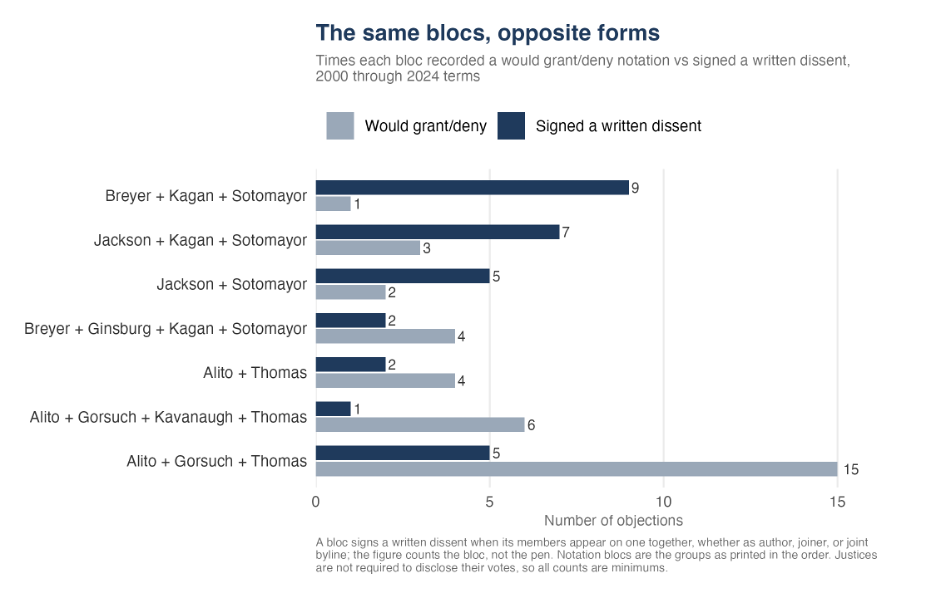
Thomas, Alito, and Justice Neil Gorsuch have recorded a “would grant/deny notation” together 15 times. They signed a written dissent together five times. Coalitions of justices appointed by Democratic presidents show the opposite pattern. Justices Stephen Breyer, Kagan, and Sotomayor noted together once and wrote together nine times. Jackson, Kagan, and Sotomayor are three and seven. The Republican-appointed group simply notes what it would have done, while the Democratic-appointed group more often explains why.
One group breaks this trend. Breyer, Justice Ruth Bader Ginsburg, Kagan, and Sotomayor noted together four times and wrote twice. One of those notations came in the Clean Power Plan stay, the largest environmental order of the era. The four justices would have let the rule stand, and said only that, without a word of explanation.
Since 2014 (when ideological coding is available) Democratic-appointed justices directed 126 of their 159 objections at orders reaching conservative outcomes. Republican-appointed justices directed 118 of their 170 at liberal ones.
What predicts an explanation
So why do the justices write in some cases and not in others? The type of case helps predict a written dissent. Among disputes since 2014, cases coded as judicial power, procedural fights over stays, injunctions, and the authority of lower courts produced a written dissent 78% of the time. In other words, cases about what the judiciary has the authority to do most influenced justices to take up the pen. Next were First Amendment disputes, which produced writing 64% of the time. Criminal procedure disputes produced writing 27% of the time, the lowest of any major category. To put it bluntly: The emergency docket publicly disagrees most about its own authority and least about the people in front of it.
The 2024-25 term
Every pattern above increased last term. During the 2024-25 term, the justices authored 23 dissenting opinions on the emergency docket. That is more than any term in the past 25 years, more than the peak of the pandemic litigation, and nearly one in three of every written emergency docket dissent since 2000, produced in a single year.
This did not occur gradually. From 2000 through 2018, the docket produced one or two authored dissents in a typical year and often none. Writing appeared in volume for the first time in the 2020-21 and 2021-22 terms, 16 and then 14, across the pandemic, election, and vaccine-mandate disputes. Then it stopped. The 2022 term produced three. The 2023-24 term produced five. The 2024-25 term produced 23. The spike is not about volume: The 2024 term actually brought slightly fewer substantive applications than the term before it (49 to 53). What changed was the mix of types of cases. Much of the 2024-25 term’s activity came from applications arising out of challenges to the Trump administration’s executive orders, disputes over the scope of executive power and the authority of courts to check it. Those are precisely the kind of cases that, as the issue area numbers above show, draw written dissents more often than any other.

Why the form matters
At least until recently, the court has rarely explained itself on the emergency docket. In 96 of the 129 disputes, its order came with no opinion at all. Written dissents partially fill that gap: 65 disputes produced one, and in 36 of those, the dissent was the only opinion anywhere in the case.
At the same time, federal courts have cited emergency docket orders more than 6,500 times since 2000. When a citing court reaches for something to work with, an opinion gives it guidance. A bare notation does not. A dissent may then be better than nothing at all. Indeed, on the emergency docket, sometimes this is the only explanation we’re going to get.
***
Methodological note: Counts cover substantive emergency applications from the 2000 through 2024 terms. Of 153 applications drawing at least one public objection, consolidated applications resolved in a single order are counted as one dispute, leaving 129. Notation blocs are the exact groups as printed in the order. Written-dissent blocs are the exact set of justices signing a single opinion, whether as an author or a joiner. Justices are not required to disclose their votes on emergency applications, so every count here is a floor. A justice who says nothing may disagree silently or only in chamber memos. These numbers measure the choice to speak and the form that speech takes, not disagreement itself.
Continue reading...
[ H/T SCOTUSblog ]