









Crop Prices Hit 3-Year High As Heat & War Stoke Supply Fears; Options Whale Places $20M Corn Bet
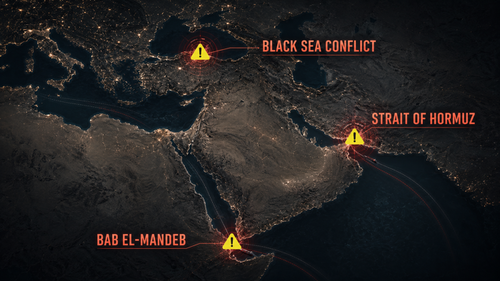
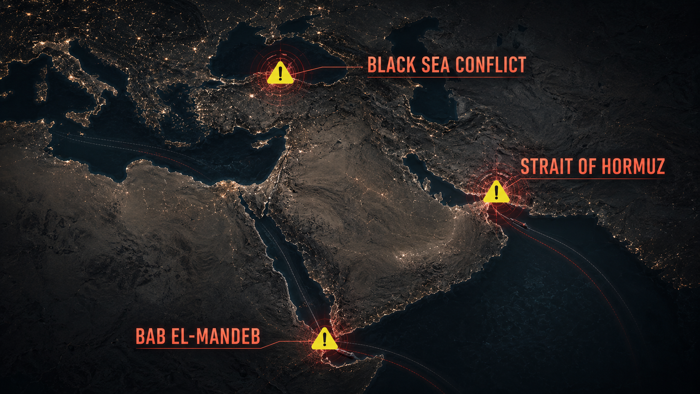
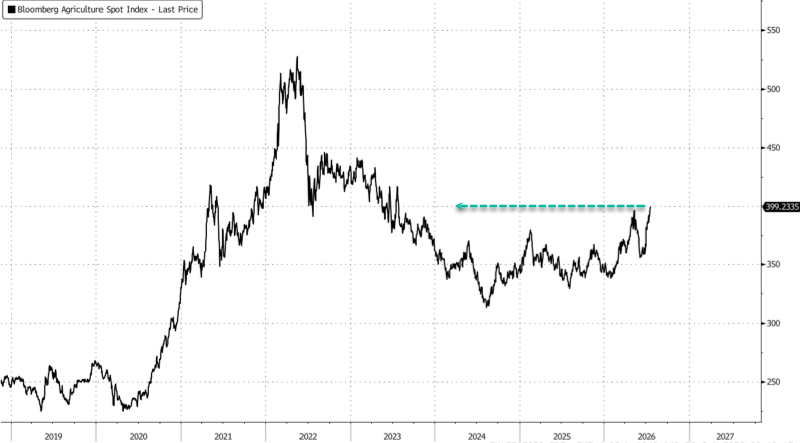
The Bloomberg Agriculture Spot Index (BCOMAGSP) climbed to a three-year high Wednesday as widening conflict across critical energy and grain trade corridors, from the Black Sea to the Strait of Hormuz and the southern Red Sea, collided with scorching heat waves across Europe and the US and mounting El Niño risks in critical agri growing belts, reviving the threat of global food inflation.
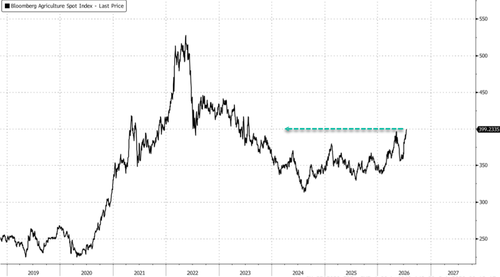
BCOMAGSP is a dollar-denominated benchmark that tracks 10 major agricultural futures, including Chicago and Kansas City wheat, corn, soybeans, soybean meal, soybean oil, coffee, cocoa, sugar, and cotton. On Wednesday, the index jumped to a level not seen since July 2023, continuing a seven-week advance.
Chicago wheat and soybean futures hit two-year highs as Russian and Ukrainian strikes in the Black Sea threatened grain shipments from a region responsible for more than a quarter of global wheat exports. Rising crude prices are also boosting demand for biofuel feedstocks, while heat waves in Europe and the US threaten critical agricultural growing regions.
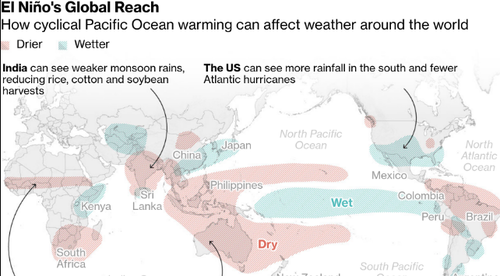
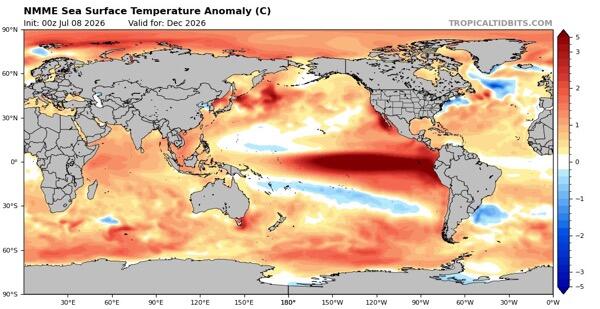
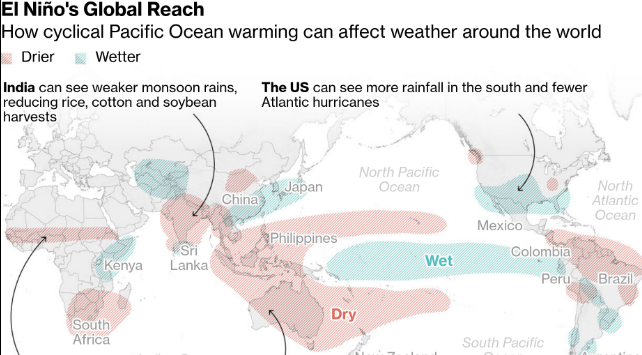
Then there's the El Niño weather phenomenon, which is set to be the strongest in more than 75 years. This raises the risk of adverse weather conditions across the US, Asia, Australia, and South America. The stronger the weather event becomes, the greater the threat to critical food supply chains, which are already vulnerable to drought, flooding, export restrictions, and rising protectionism.
Sea Surface Temps
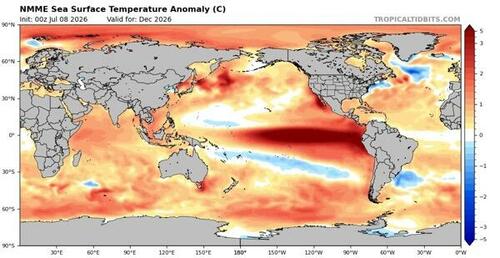
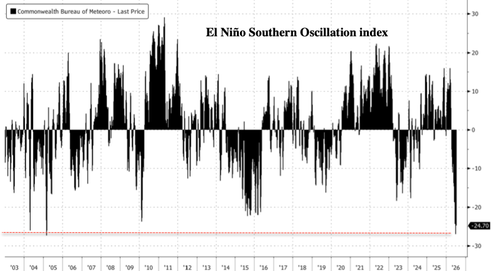
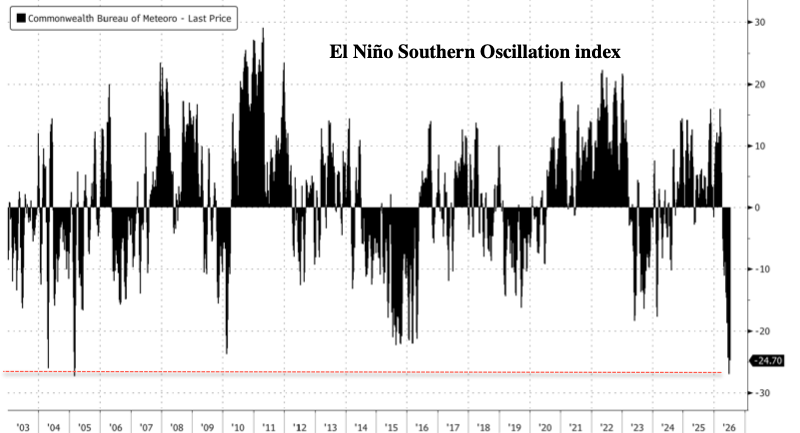
A negative El Niño Southern Oscillation Index indicates pressure patterns consistent with El Niño, typically associated with weaker Pacific trade winds and warmer-than-average sea surface temperatures in the central and eastern Pacific. The SOI is now at levels not seen since 2005.
El Niño Weather Impacts
El Niño coverage:
Must Read:
"What really drives the market is whether there is physical supply coming to those who need it," said Dennis Voznesenski, an agricultural economist at the Commonwealth Bank of Australia, as quoted by Bloomberg.
Voznesenski pointed out that while factors such as heat and conflict in the Gulf area have been simmering for weeks, the Black Sea conflict was "the straw that broke the camel's back."
Given all this, Bloomberg reported that an option trade made a $20 million bet that corn futures will surge to their highest since 2023, as reduced US planting, record exports, and heat-damaged crops tighten the supply outlook. The trade involved 105,000 November $5.50/$6 call spreads, equivalent to more than 500 million bushels.
The position begins paying off if corn rallies nearly 15% to $5.50 a bushel and could generate about $250 million if prices reach $6. December futures rose 2% on Wednesday to $4.8475, extending their July gain to 11%.
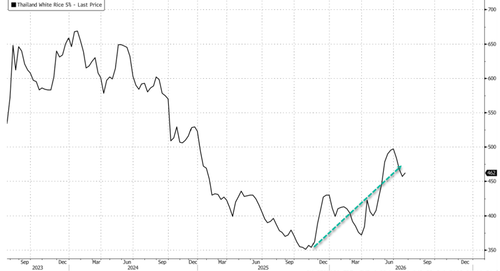
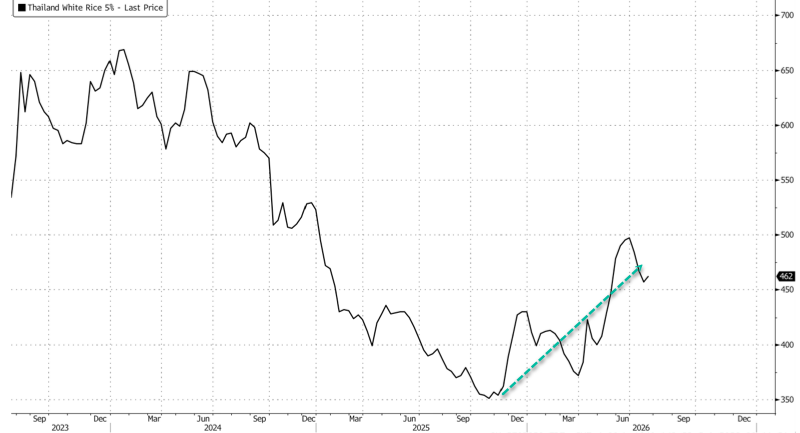
Beyond the BCOMAGSP basket, the grain that feeds half the world, rice is creeping higher and higher...
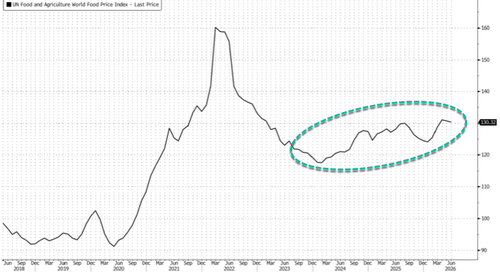
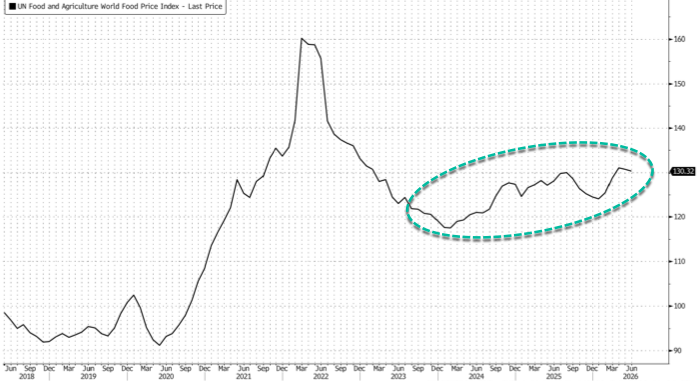
The UN's global food basket is also creeping higher.
Bank of America: The Timing Of The Next Grocery Inflation Surge Revealed By BofA
Tyler Durden Thu, 07/23/2026 - 09:30
Continue reading...
[ H/T ZeroHedge ]
The Bloomberg Agriculture Spot Index (BCOMAGSP) climbed to a three-year high Wednesday as widening conflict across critical energy and grain trade corridors, from the Black Sea to the Strait of Hormuz and the southern Red Sea, collided with scorching heat waves across Europe and the US and mounting El Niño risks in critical agri growing belts, reviving the threat of global food inflation.
BCOMAGSP is a dollar-denominated benchmark that tracks 10 major agricultural futures, including Chicago and Kansas City wheat, corn, soybeans, soybean meal, soybean oil, coffee, cocoa, sugar, and cotton. On Wednesday, the index jumped to a level not seen since July 2023, continuing a seven-week advance.
Chicago wheat and soybean futures hit two-year highs as Russian and Ukrainian strikes in the Black Sea threatened grain shipments from a region responsible for more than a quarter of global wheat exports. Rising crude prices are also boosting demand for biofuel feedstocks, while heat waves in Europe and the US threaten critical agricultural growing regions.
Then there's the El Niño weather phenomenon, which is set to be the strongest in more than 75 years. This raises the risk of adverse weather conditions across the US, Asia, Australia, and South America. The stronger the weather event becomes, the greater the threat to critical food supply chains, which are already vulnerable to drought, flooding, export restrictions, and rising protectionism.
Sea Surface Temps
A negative El Niño Southern Oscillation Index indicates pressure patterns consistent with El Niño, typically associated with weaker Pacific trade winds and warmer-than-average sea surface temperatures in the central and eastern Pacific. The SOI is now at levels not seen since 2005.
El Niño Weather Impacts
El Niño coverage:
- Strongest El Nino In 75 Years Sets Off Food Supply-Chain Alarm Bells
- UBS Warns El Nino May Intensify Food Inflation Across Asia
- First Major Weather Organization Declares El Nino Onset As Food Inflation Risks Intensify
Must Read:
"What really drives the market is whether there is physical supply coming to those who need it," said Dennis Voznesenski, an agricultural economist at the Commonwealth Bank of Australia, as quoted by Bloomberg.
Voznesenski pointed out that while factors such as heat and conflict in the Gulf area have been simmering for weeks, the Black Sea conflict was "the straw that broke the camel's back."
Given all this, Bloomberg reported that an option trade made a $20 million bet that corn futures will surge to their highest since 2023, as reduced US planting, record exports, and heat-damaged crops tighten the supply outlook. The trade involved 105,000 November $5.50/$6 call spreads, equivalent to more than 500 million bushels.
The position begins paying off if corn rallies nearly 15% to $5.50 a bushel and could generate about $250 million if prices reach $6. December futures rose 2% on Wednesday to $4.8475, extending their July gain to 11%.
Beyond the BCOMAGSP basket, the grain that feeds half the world, rice is creeping higher and higher...
The UN's global food basket is also creeping higher.
Bank of America: The Timing Of The Next Grocery Inflation Surge Revealed By BofA
Tyler Durden Thu, 07/23/2026 - 09:30
Continue reading...
[ H/T ZeroHedge ]