

When the leaders of America’s largest artificial intelligence labs separately called for government regulation in September, they framed their appeals around safety.
The appeals also left tech analysts wondering if the regulatory push is meant to protect the industry’s biggest players from competition.
The latest calls for regulation followed months of disclosures about AI models going beyond their designated programming during testing. Just days after Anthropic researchers said that there was a nonzero chance that AI could destroy humans, company CEO Dario Amodei called for a slowdown in development.
“It’s my worry that in 6-12 months such a swarm could be capable of taking over the entire internet with a persistent botnet (potentially causing hundreds of billions of dollars in damage), and that the scale of damage would continue to increase from there,” Amodei wrote.
Amodei called for a three-part plan involving global policy components, company coordination, and independent evaluators at each lab. SpaceX CEO Elon Musk, OpenAI CEO Sam Altman, and Google chief scientist Demis Hassabis quickly agreed with Amodei — although not on the details.
While the Trump administration has resisted slowing AI development, populist lawmakers have moved quickly with proposals.
Sens. Bernie Sanders (I-VT) and Josh Hawley (R-MO) rolled out separate legislation they believe will make AI development safer.
Hawley’s bill would make Big Tech developers criminally and civilly liable if an AI program hacks another website. Hawley believes companies are more focused on financial incentives than safety, and thus they refuse to slow down development.
(Getty Images)
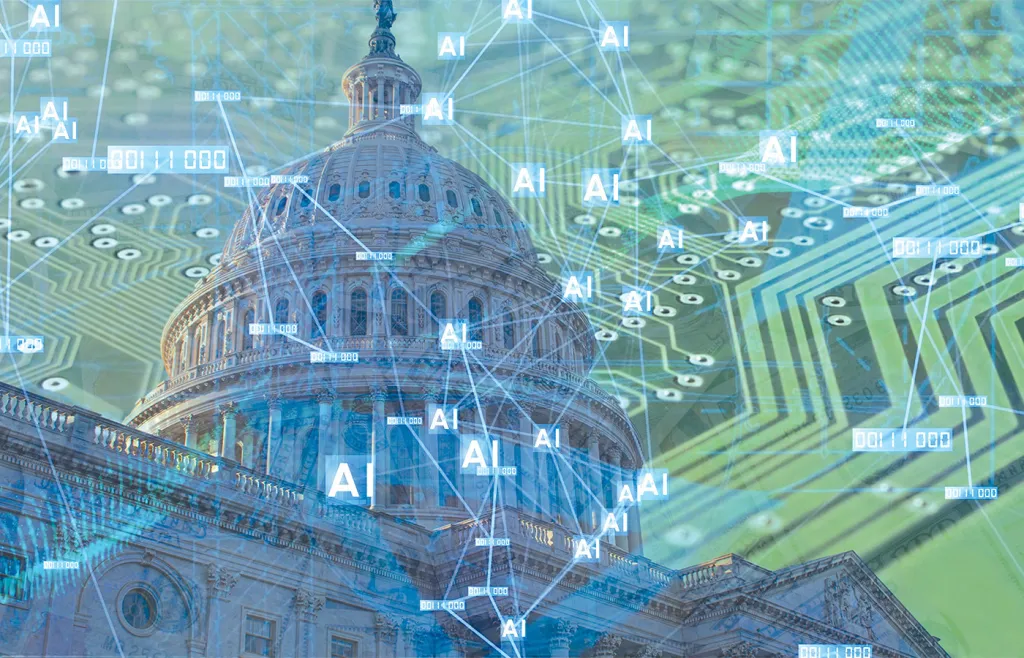
" data-large-file="https://www.washingtonexaminer.com/wp-content/uploads/2026/10/Feat.AI_.jpg?w=1024" height="658" width="1024" src="https://www.washingtonexaminer.com/wp-content/uploads/2026/10/Feat.AI_.jpg?w=1024" alt="AI congress regulations" class="wp-image-4778507" srcset="https://www.washingtonexaminer.com/wp-content/uploads/2026/10/Feat.AI_.jpg 1400w, https://www.washingtonexaminer.com/wp-content/uploads/2026/10/Feat.AI_.jpg?resize=300,193 300w, https://www.washingtonexaminer.com/wp-content/uploads/2026/10/Feat.AI_.jpg?resize=768,494 768w, https://www.washingtonexaminer.com/wp-content/uploads/2026/10/Feat.AI_.jpg?resize=1024,658 1024w" sizes="(max-width: 1024px) 100vw, 1024px">
(Getty Images)
Sanders’s bill goes a step further, banning programs that are smarter than humans and creating a new Department of Artificial Intelligence. The department would have power to approve advanced systems before they could be made available.
The proposals have worried AI optimists who believe strict rules would hamper innovation.
“We need to regulate in a way that focuses on getting that risk-benefit balance right, not treating the technology itself as inherently bad,” said Neil Chilson, Head of AI Policy at the Abundance Institute. “[Focus] on how do we get the benefits out of it and mitigate the risks.”
Fears about AI date to the 1860s, when English novelist Samuel Butler suggested that machines could one day become the dominant species. His theory was that machines could use natural selection to develop consciousness.
It’s a concept that made its way into pop culture.
Famed science fiction author Isaac Asimov developed his Three Laws of Robotics in 1940 after noticing that “robots were created and destroyed their creator” became a regular plot device. His laws held that robots could not harm humans or allow humans to come to harm through inaction; must obey human orders unless they conflicted with the first law; and must protect their own existence unless doing so conflicted with the first two laws.
While those rules may have inspired benign versions of AI-powered robots like Robby the Robot from Forbidden Planet and Rosie the Robot from The Jetsons, entertainment writers continued to focus on potential worst-case scenarios involving AI.
That fascination with AI’s worst-case scenarios has seeped into Capitol Hill, according to Adam Thierer, a resident senior fellow with R Street Institute’s Technology and Innovation Team.
“Every time we go to a hearing or see a member of Congress talk about AI or robotics, it isn’t long before the conversation turns to something about like, well, haven’t you seen Terminator, or don’t you know what happens in 2001, or did you see the latest episode of Black Mirror?” he told the Washington Examiner.
That fiction may be closer to reality, noted Colin McGlynn, an AI policy adviser for Demand Progress Action. He pointed to the Ukraine-Russia war, where drones have become a key part of the fighting.
“The Terminator reality is basically here; they’re just flying instead of walking around,” he said, noting that drones are becoming more autonomous. “And we already have [Star Wars droid] C-3P0 in the sense that he was a translator robot, and translations already got plenty good. So it’s basically the same story.”
Fiction isn’t the only place where doom and gloom exist.
Musk has been calling for AI regulations since 2014, when he compared it to someone trying to summon a demon.
“In all those stories where there’s the guy with the pentagram and the holy water, it’s like – yeah, he’s sure he can control the demon,” said Musk. “Doesn’t work out.”
Despite the concerns, AI technology took a massive leap forward this year. Goldman Sachs Research projected that global investment would hit $1 trillion in 2026, with almost $600 billion of it in the United States alone.
The industry’s rapid expansion also brought headaches.
Google, Meta, and OpenAI reported during the spring that rogue AI models hacked several companies, along with Australia’s public-facing Medicare Statistics Reporting Service portal.
Over the summer, OpenAI executives revealed hacks involving hundreds of AI programs that broke out of a testing site, with about 700 of them hacking a separate company. Anthropic and Meta also admitted to hacking problems during training.
Within weeks of the rogue agent disclosures, AI executives publicly called for government-enforced rules.
Thierer said that attitude was unhelpful because it gave momentum to growing resistance to the technology. He believed it would have been better if tech executives had promised safeguards.
“They basically said, ‘Oh yeah, AI is going to take all your jobs and potentially destroy humanity,’” observed Thierer. “And then they wonder why they get all this grief.”
The Trump administration, in an effort to assuage public opinion, announced its White House Accord on Super Intelligence. The president said the tech companies would self-police and work with independent external auditors on program controls. But Trump also left the door open for federal rules.
McGlynn said that large tech companies shouldn’t be the ones making the policy decisions. He encouraged the government to get input from outside experts and the National Institute of Standards and Technology.
“It’s very important for us to consider what is the upside and what are the downsides of this technology,” McGlynn told the Washington Examiner.
That means deciding who should be invited into the room when the regulations are being developed.
There’s concern from AI supporters and skeptics about the potential that the AI executives and lobbyists will end up writing the rules to protect their own interests. The phenomenon is known as regulatory capture.
Chilson said regulatory capture can happen almost innocuously, when regulators turn to business leaders for help writing rules because they don’t know whom else to consult.
“They write them in the framework of the existing version of the technology, because that’s how everybody understands it, and that can really box out people who don’t fit,” he said.
But new regulations may not be necessary to address some of AI’s potential harms, said Jessica Melugin of the Competitive Enterprise Institute.
“There’s already lots of laws on the books that deal with the harm that can come out of these products,” said Melugin. “Fraud is still fraud even if you use AI.”
AI supporters also worry that the U.S. could fall behind China in the global AI race. While China technically has AI regulations, the communist government has said it has no plans to pause or slow down development.
The European Commission passed its AI Act in 2024, promising that it was forward-thinking enough to handle the technology. The government has delayed some of the high-risk regulations to allow more time for compliance.
Thierer worries the U.S. could follow a similar path.
“Due to all these fears from all these different constituencies, the combined effect of those things could be to stop the computational revolution, or at least slow it so significantly that China takes over and just starts kicking our butts,” he said.
META HIT WITH $25 BILLION PENALTY OVER CAMBRIDGE ANALYTICA DATA PRIVACY VIOLATIONS
New rules could discourage other forms of competition or entrepreneurship, noted Thierer. He compared the current fight over AI to last decade’s fight between the taxi companies and Uber and Lyft. During that regulatory fight, taxi lobbyists attempted to ban the ride-sharing apps in various cities and states. The effort ultimately failed, but Thierer said Uber is now using the same tactics that taxi companies once used against it to stop driverless-car technology.
“Yet here we are. That’s the story,” he quipped.
Taylor Millard (@TaylorMillard) is a freelance journalist who lives in Virginia.
Continue reading...
[ H/T Washington Examiner ]