




June’s Democratic primaries proved that voters are comfortable supporting brash candidates, once-niche ideas, and untested policies. Their personal feelings on these matters tell a different story.
A June survey of likely general election voters in Maine found only 44% of them agreeing that Graham Planter, the state’s soon-to-not-be Democratic nominee for U.S. Senate, has “good character.” Clearly, Platner, who once brandished a Nazi tattoo, sexted several women while married, and was alleged to have sexually abused an ex-girlfriend in 2021, lacks “the right kind of moral values” — at least according to a majority of the polled individuals.
So why, then, did the oysterman ultimately secure more primary votes on June 9 than any other Democratic candidate in Maine history? Platner led his opponent, Sen. Susan Collins (R-ME), by anywhere from 2% to 4% in November’s general election before dropping out.
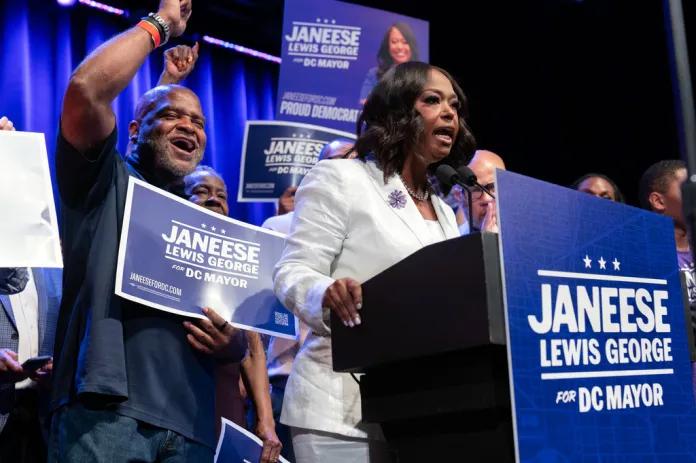
Days before the Washington, D.C., mayoral primary, a Washington Post poll found that only 28% of D.C. residents think the city is headed in the right direction, citing leaders’ neglect of public safety and high housing costs. Yet voters still nominated Janeese Lewis-George, a so-called “democratic socialist,” to rule the deep-blue city. Lewis-George signaled willingness to defund the police and splurge taxpayer money on cosmetic makeovers despite the District budget decreasing by 3.6% from last year.
Then came the DSA tidal wave in New York City’s primaries on June 23. Fifty-nine percent of New Yorkers said their city is on the wrong track, and 63% of voters felt that the city is no longer the world’s greatest city, in part due to affordability and quality-of-life concerns. Grievances meant nothing, as Claire Valdez, Darializa Avila Chevalier, and Brad Lander, three DSA candidates, won their primaries, toppling two incumbents in the process. Combined, the three have praised communism, called to abolish Immigration and Customs Enforcement, and stripped away the city’s energy portfolio.
Colorado, too, had a DSA awakening this week. Fifty-three percent of Coloradans say their Democrat-run state is on the wrong track. Their response was to replace a 15-term incumbent with a socialist who refused to condemn political violence.
The Democratic Party’s strategy rejects conventional wisdom that says disgruntled voters will endorse an adversary. Instead of correcting course on policy, they’re leaning into radical positions. And it’s working. Why? Because they don’t have to put forward a strong candidate with good policy ideas. They don’t have to address the underlying weaknesses of their increasingly radical candidates. All they have to do is put up someone opposed to Donald Trump or the status quo. In fact, the more radically opposed they are, the better.
Take our nation’s capital, for example, where Mayor Muriel Bowser failed to staff the city’s crime-response systems and fix dispatch errors, breeding record levels of carjackings, sexual assaults, and homicides in the District. Rather than acknowledging the poor thinking and execution of these policies, Democrats would rather pick fights with the federal government’s solutions that get the job done.
Now, D.C. mayoral candidate Lewis-George pledges to defend cashless bail and end cooperation with ICE agents. Residents have apparently set aside their safety concerns and aligned with her to stop the perceived “greater danger” of the Trump administration.
Political judgments aren’t detached reasonings — they’re a form of conflict resolution. By focusing on the scary competition rather than the candidate’s defects, the other party becomes the organizing principle. Voting then becomes a way to mitigate harm rather than back a good candidate.
These themes have defined the Maine Senate race, where then-candidate Platner alleged Collins was corrupt and cast her as a Trump loyalist. Collins — who supported Trump’s second impeachment in 2021, backed liberal Ketanji Brown Jackson as Supreme Court justice in 2023, and bucked Trump’s Big Beautiful Bill Act in 2025 and the SAVE America Act in 2026 — has exhibited, and been rewarded by her state, for her independence streak. Democrats, however, are focused on the other side of her record. Collins voted for the president’s agenda 94% of the time and greenlit Justice Brett Kavanaugh’s appointment to the Supreme Court in 2018, who helped overturn Roe v. Wade in 2022. Democrats feel that the erosion of civic, federal, and democratic norms is underway. Bipartisanship is not enough to counter it.
Platner’s character did not pass muster for Maine Democrats — all his endorsers revoked their support following rape accusations. But up until July, his conduct wasn’t as important as who he challenged. With Democrats flooding the polls this cycle, along with high-turnout elections resulting in higher polarization, some people are forced to justify a vote. A 2006 report suggests that casting a ballot psychologically cements support for a candidate, and can “lead to more favorable interpretations of [their] actions in the future.” Indeed, Pine Tree Democrats wanted a partisan who could punish Collins’ moderate performance. Platner’s scandals were a sour taste to which they quickly adjusted — until they couldn’t pretend to normalize his behavior anymore.
In New York City, Democrats didn’t just adapt to reputations of socialists — they celebrated them. As former Mayor Bill de Blasio explained on June 29, people were fed up with the political status quo and compromise. They instead moved toward socialism, not out of enthusiasm, but because the pivot makes their broader political identity feel more coherent. What de Blasio doesn’t understand is that socialism is becoming the new establishment. These major cities are proving grounds for whether their ideologies can endure.
DON’T MISTAKE DEMOCRATS DITCHING GRAHAM PLATNER AS A MORAL STAND
Mayor Zohran Mamdani’s tenure thus far should’ve been enough to halt his backyard’s socialist project. He cut $29 million from the city’s library budget, couldn’t stop the $451 million bankruptcy auction of thousands of rent-stabilized tenants, and alienated many Jewish residents and leaders through symbolic gestures. Breaking these campaign promises reinforced the economic populism, social anxiety, and anti-Israel sentiments that fueled Mamdani’s victory in 2025. Lander, Valdez, and Avila Chevalier capitalized on these trends by telling voters the establishment stymied their progressivism — the one that purportedly fights for them. Citizens did their bidding. All the while, they never denounced the socialist policies that initially failed them.
Cognitive dissonance is now an asset for mobilizing disgruntled Democrats nationwide. The next generation of party thought leaders isn’t interested in mending rifts; they use that energy elsewhere to misguide the electorate and shirk responsibility. Democrats are gambling their security, relationship with the federal government, and their party’s future in the process for short-term wins. It’s a movement charted through confusion, one that doesn’t recognize self-correction as the best survival option.
Alex Rosado is an independent writer. The views expressed in this article are solely those of the author and do not represent those of any workplace or affiliate organization.
Continue reading...
[ H/T Washington Examiner ]