



Chinese Researchers Develop Electronic Comb That Achieves Nearly 98% Hair Regrowth In Mice
Researchers from Beihang University and City University of Hong Kong have developed an innovative electronic comb that could offer a promising new solution for treating hair loss, according to the South China Morning Post.
Called Detangle, the device combines electrical stimulation with advanced drug-delivery technology. During normal combing, it generates controlled electrical pulses that temporarily increase the permeability of hair follicle cells, allowing therapeutic compounds to penetrate deeper into the scalp.
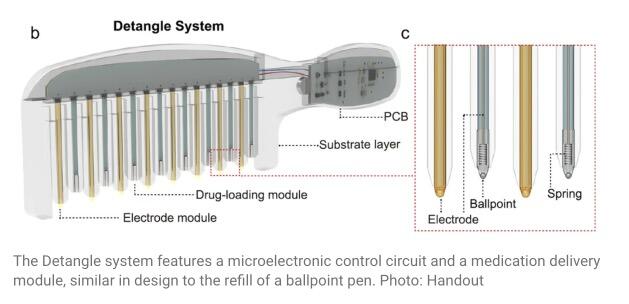
The comb features specially designed teeth equipped with microelectronic components and medication-release mechanisms. This system delivers two therapeutic agents simultaneously: one promotes blood vessel formation around hair follicles, while the other helps block hormonal processes associated with hair loss.
In a 28-day experiment involving mice, the device achieved an impressive 97.85% hair regrowth when electrical stimulation was combined with medication every three days. In comparison, conventional minoxidil treatment produced approximately 70% regrowth, finasteride achieved 50%, and electrical stimulation alone resulted in around 40%.
SCMP writes that researchers also discovered that the technology delivered therapeutic molecules approximately nine times deeper than traditional topical applications, reaching about 660 micrometres beneath the skin within just one second.
Additional testing revealed improvements in hair follicle density, local blood circulation, and blood vessel development. No significant signs of skin irritation, inflammation, or nerve damage were detected under the experimental conditions.
The findings, published in Nature Communications on November 3, 2026, highlight the potential of combining electrical stimulation with precision drug delivery to improve hair-loss treatments.
Despite these encouraging results, the technology remains experimental. Its effectiveness and safety in humans have not yet been established, and researchers have not announced clinical trials or plans for commercial release. The drug-delivery approach may eventually have applications beyond hair restoration.
Tyler Durden Sun, 11/22/2026 - 01:00
Continue reading...
[ H/T ZeroHedge ]
Researchers from Beihang University and City University of Hong Kong have developed an innovative electronic comb that could offer a promising new solution for treating hair loss, according to the South China Morning Post.
Called Detangle, the device combines electrical stimulation with advanced drug-delivery technology. During normal combing, it generates controlled electrical pulses that temporarily increase the permeability of hair follicle cells, allowing therapeutic compounds to penetrate deeper into the scalp.
The comb features specially designed teeth equipped with microelectronic components and medication-release mechanisms. This system delivers two therapeutic agents simultaneously: one promotes blood vessel formation around hair follicles, while the other helps block hormonal processes associated with hair loss.
In a 28-day experiment involving mice, the device achieved an impressive 97.85% hair regrowth when electrical stimulation was combined with medication every three days. In comparison, conventional minoxidil treatment produced approximately 70% regrowth, finasteride achieved 50%, and electrical stimulation alone resulted in around 40%.
SCMP writes that researchers also discovered that the technology delivered therapeutic molecules approximately nine times deeper than traditional topical applications, reaching about 660 micrometres beneath the skin within just one second.
Additional testing revealed improvements in hair follicle density, local blood circulation, and blood vessel development. No significant signs of skin irritation, inflammation, or nerve damage were detected under the experimental conditions.
The findings, published in Nature Communications on November 3, 2026, highlight the potential of combining electrical stimulation with precision drug delivery to improve hair-loss treatments.
Despite these encouraging results, the technology remains experimental. Its effectiveness and safety in humans have not yet been established, and researchers have not announced clinical trials or plans for commercial release. The drug-delivery approach may eventually have applications beyond hair restoration.
Tyler Durden Sun, 11/22/2026 - 01:00
Continue reading...
[ H/T ZeroHedge ]