


China AI Stocks Sink As US Tightens Chip Curbs; Nvidia Forms Export Committee After Jensen's Exit
Nvidia heads into earnings after the market closes today, with attention split between another potentially solid AI-driven beat and concerns over the fallout from Jensen Huang's abrupt departure last week.
With Jensen sidelined, the US Commerce Department proposed tighter rules requiring data center operators in Singapore, Malaysia, Thailand, Indonesia, and Brazil to obtain a US government license before importing advanced AI chips from Nvidia and other US chip companies. The measure seeks to limit the flow of advanced chips that ultimately end up in Chinese data centers.
"The rule is designed to ensure that existing restrictions on access to sensitive American technology cannot be circumvented through remote computing arrangements involving data centers in third countries," the department said Monday in a statement, quoted by Bloomberg.
Nomura analysts Jialong Shi and Rachel Guo told clients, "This is a negative development for China's AI cloud industry, as tighter access to advanced computing resources could constrain AI model training and slow cloud revenue growth."
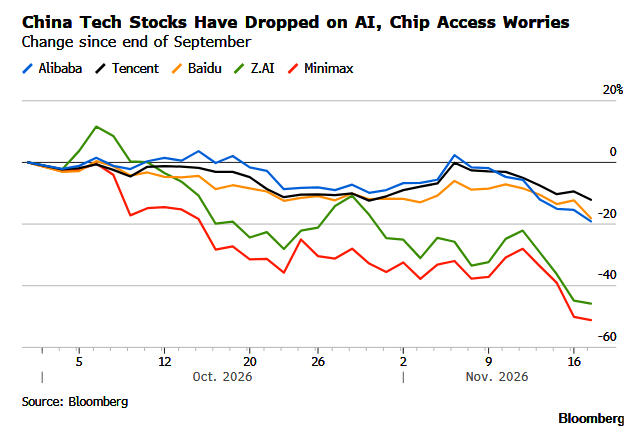
The proposed US restrictions battered Chinese AI stocks overnight, with Alibaba down about 5% in Hong Kong and Baidu down nearly 6% to a record low. Model developers MiniMax Group and Zhipu sank 5%, while robot maker Yushu Technology plunged 12%. The Hang Seng Tech Index declined 1.1%.
Selling spread across other regions. Samsung Electronics fell 3%, Advantest declined 4.4%, and Malaysia's YTL Power International, a beneficiary of anticipated data-center electricity demand, slumped nearly 10%.
UBS market analyst Eva Kindt wrote in a note, "European Equities are extending earlier declines with the Euro Stoxx 50 down 90bp, though off of the intraday lows as the tech sell-off deepens in Europe. Semiconductor stocks are down 2.2% after the slew of NVDA headlines and the new US restrictions on China's access to high-end AI chips."
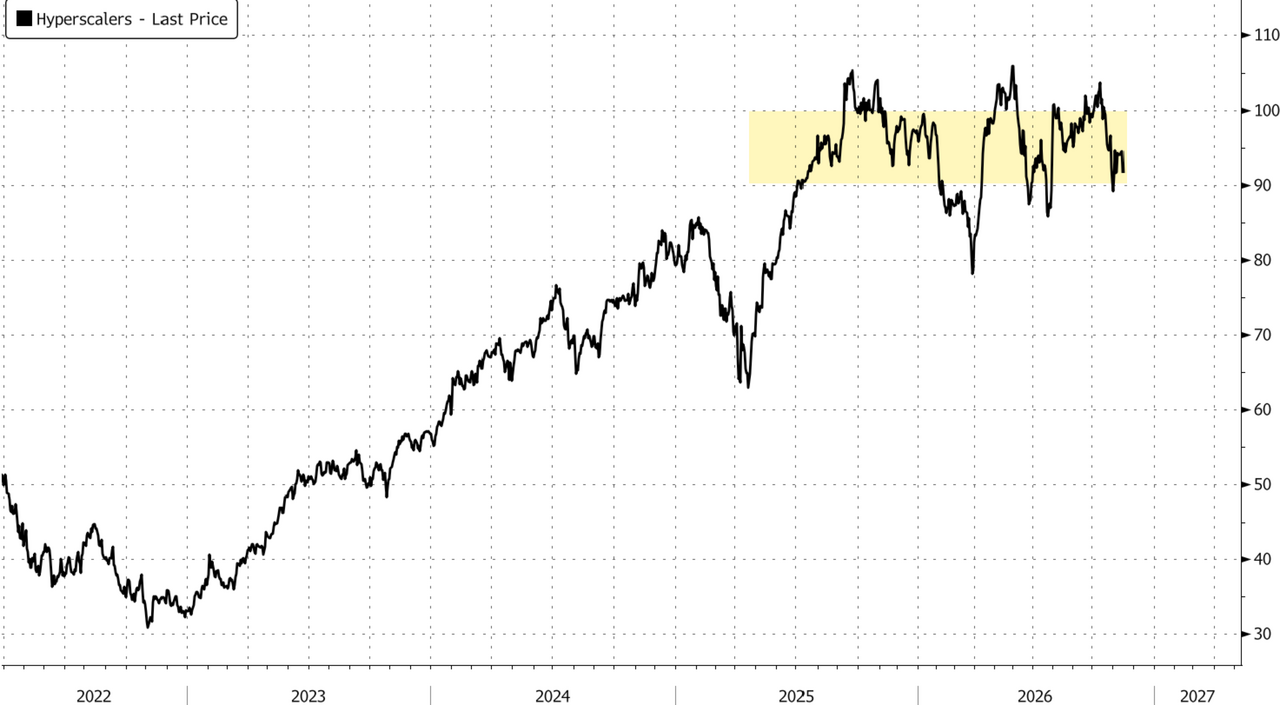
The UBS Hyperscalers Basket Index has traded in a tight lateral range since mid-2025.
Separately, the Financial Times reported that Nvidia has created a board committee to oversee national security and export controls as the US government accelerates efforts to restrict China's access to AI chips with Jensen out of the picture.
"Nvidia recognizes that advanced silicon technologies and the emergence of artificial and superintelligence present unprecedented challenges for national security," said Harvey Jones, who became Nvidia's first board chair last week.
Jones added, "We are committed to working constructively with government and industry partners to help establish and advance a robust framework that uses every tool at our disposal to safeguard national security while supporting continued technological innovation."
On Sunday, US Treasury Secretary Scott Bessent said Nvidia needed what he called a "dramatic shake-up" and questioned "whether Nvidia had a culture of compliance around the US export restrictions," including whether its top executives knew that some of its most advanced chips were reaching China despite US restrictions.
Saxo Markets chief investment strategist Charu Chanana warned that these new restrictions "add a concrete risk to revenues and access to computing capacity, but they are landing in a market already nervous about AI valuations, spending returns and Nvidia's leadership outlook." She noted, "This is a meaningful escalation."
Beyond Nvidia's earnings after the close today, Anthropic's Thursday IPO and trading performance will provide another key test of investor appetite for AI stocks.
Tyler Durden Tue, 11/17/2026 - 07:45
Continue reading...
[ H/T ZeroHedge ]
Nvidia heads into earnings after the market closes today, with attention split between another potentially solid AI-driven beat and concerns over the fallout from Jensen Huang's abrupt departure last week.
With Jensen sidelined, the US Commerce Department proposed tighter rules requiring data center operators in Singapore, Malaysia, Thailand, Indonesia, and Brazil to obtain a US government license before importing advanced AI chips from Nvidia and other US chip companies. The measure seeks to limit the flow of advanced chips that ultimately end up in Chinese data centers.
"The rule is designed to ensure that existing restrictions on access to sensitive American technology cannot be circumvented through remote computing arrangements involving data centers in third countries," the department said Monday in a statement, quoted by Bloomberg.
Nomura analysts Jialong Shi and Rachel Guo told clients, "This is a negative development for China's AI cloud industry, as tighter access to advanced computing resources could constrain AI model training and slow cloud revenue growth."
The proposed US restrictions battered Chinese AI stocks overnight, with Alibaba down about 5% in Hong Kong and Baidu down nearly 6% to a record low. Model developers MiniMax Group and Zhipu sank 5%, while robot maker Yushu Technology plunged 12%. The Hang Seng Tech Index declined 1.1%.
Selling spread across other regions. Samsung Electronics fell 3%, Advantest declined 4.4%, and Malaysia's YTL Power International, a beneficiary of anticipated data-center electricity demand, slumped nearly 10%.
UBS market analyst Eva Kindt wrote in a note, "European Equities are extending earlier declines with the Euro Stoxx 50 down 90bp, though off of the intraday lows as the tech sell-off deepens in Europe. Semiconductor stocks are down 2.2% after the slew of NVDA headlines and the new US restrictions on China's access to high-end AI chips."
The UBS Hyperscalers Basket Index has traded in a tight lateral range since mid-2025.
Separately, the Financial Times reported that Nvidia has created a board committee to oversee national security and export controls as the US government accelerates efforts to restrict China's access to AI chips with Jensen out of the picture.
"Nvidia recognizes that advanced silicon technologies and the emergence of artificial and superintelligence present unprecedented challenges for national security," said Harvey Jones, who became Nvidia's first board chair last week.
Jones added, "We are committed to working constructively with government and industry partners to help establish and advance a robust framework that uses every tool at our disposal to safeguard national security while supporting continued technological innovation."
On Sunday, US Treasury Secretary Scott Bessent said Nvidia needed what he called a "dramatic shake-up" and questioned "whether Nvidia had a culture of compliance around the US export restrictions," including whether its top executives knew that some of its most advanced chips were reaching China despite US restrictions.
Saxo Markets chief investment strategist Charu Chanana warned that these new restrictions "add a concrete risk to revenues and access to computing capacity, but they are landing in a market already nervous about AI valuations, spending returns and Nvidia's leadership outlook." She noted, "This is a meaningful escalation."
Beyond Nvidia's earnings after the close today, Anthropic's Thursday IPO and trading performance will provide another key test of investor appetite for AI stocks.
Tyler Durden Tue, 11/17/2026 - 07:45
Continue reading...
[ H/T ZeroHedge ]