




Californians Pay 68% More At The Pump Than Texans - And Blue States Got Smaller Post-Election Drops
Authored by Andrea Widburg via American Thinker,
As President Trump predicted, gasoline prices have dropped. It would have been nice if they'd done so before the election, but if wishes were horses, then beggars would ride, as the old saying goes. No matter the drop, though, if you live in a state that has had a decade of mostly Democrat-controlled legislatures, you're going to be paying a lot more at the pump than those lucky people in states that have (again, mostly) elected Republicans to office.
This is one of those cases when data matter more than words. These charts rely on information from AAA. The first chart shows prices in all fifty states, along with the party that controlled the legislature for most of the last decade before the 2026 election. (That election will change the future for some states, notably Texas, but I was interested in the past.)
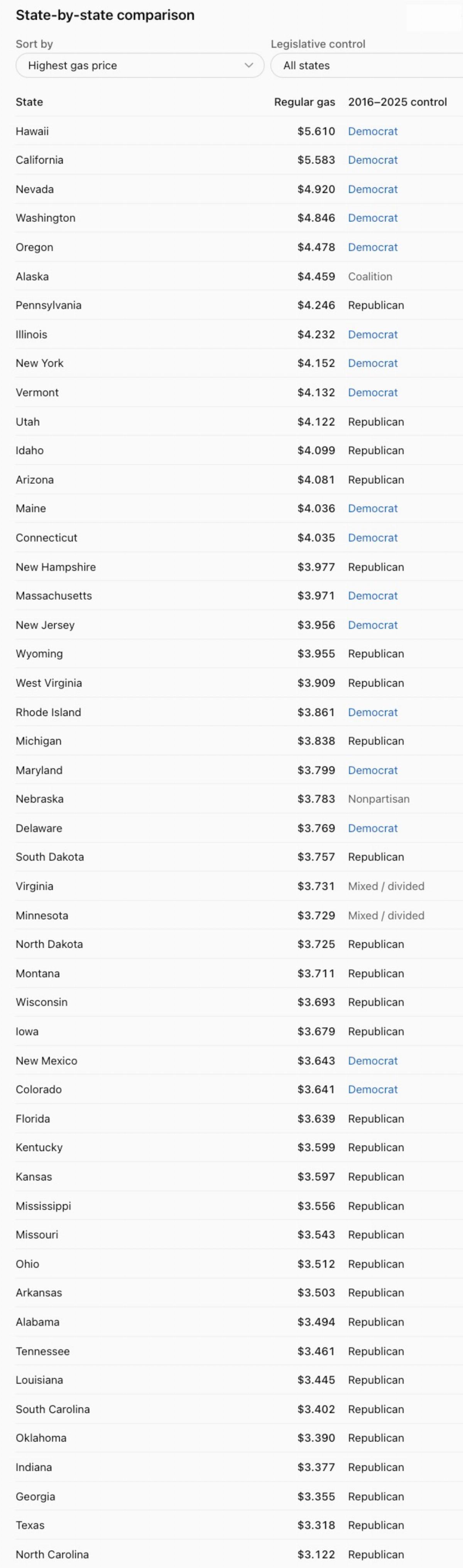
Of the 25 states with the highest gasoline prices, 15 (or 60%) are Democrat-controlled, based on predominant legislative control from 2016-2025. The five states with the very highest gas prices - Hawaii, California, Nevada, Washington, and Oregon - all have predominantly Democrat-controlled legislatures.
It's clear that, for some states, geography and other factors that I haven't researched play a role. Not only is Hawaii an ardently Democrat state, but it's also an island. Everything must be shipped there, raising prices. Inland geography may also be a factor in Utah, Idaho, and Arizona being on that list. As Olivia Murray will be happy to tell you, Arizona is also notoriously corrupt, despite its ostensibly Republican control over the years.
Nevertheless, the trend is clear: If you live in a blue state, you're much more likely to pay more for gas. It cannot have escaped your notice that, just as 15 of the top 25 most costly states have been run by Democrats, the opposite is true - more than true - for the most affordable states. In that metric, 21 out of 25 (84%) have been run by Republicans, with all 16 of the cheapest states having been Republican-run.
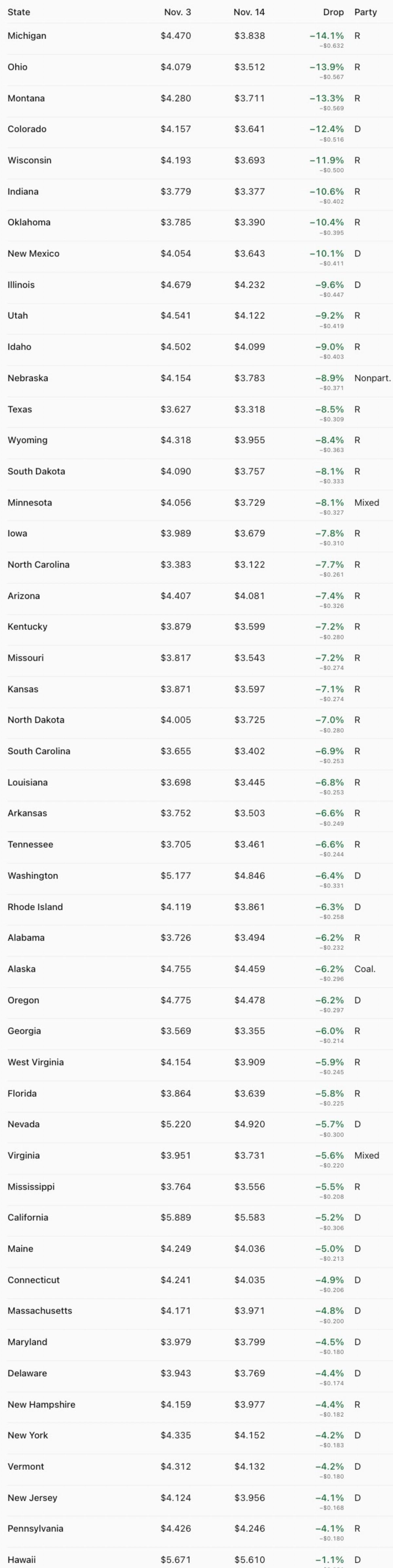
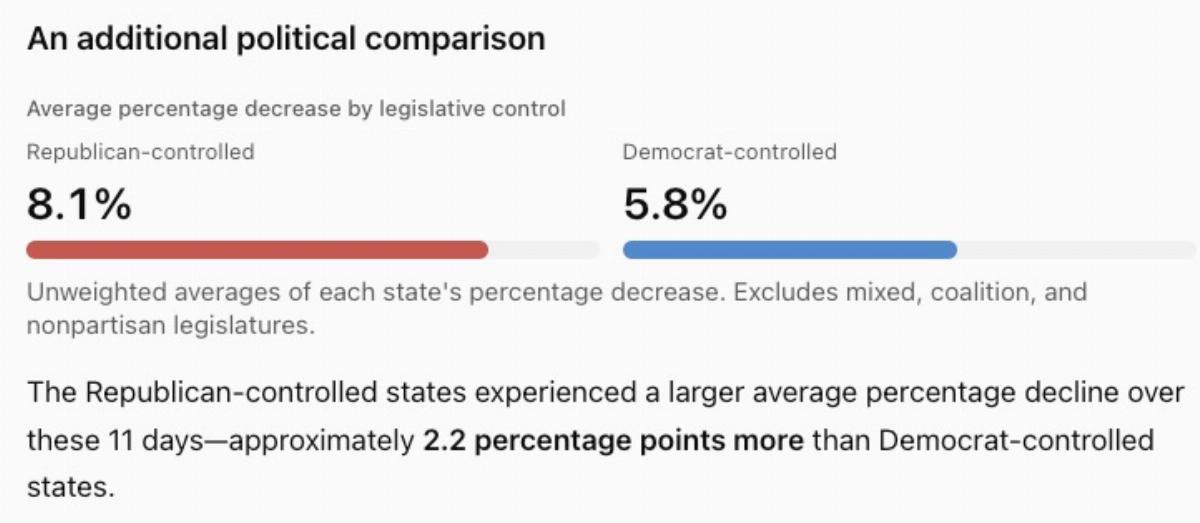
And it's not just that prices are lower. What's even more interesting is that the percentage drop in prices over the 11 days following the election has not been distributed evenly. You might expect falling fuel prices to benefit everyone more or less equally. However, once again, people in states that have been (and will continue to be) controlled by Democrats got the short end, while those in states that, at least until now, have been controlled by Republicans have seen greater savings:
I didn't even have to ask ChatGPT for this analysis. It spontaneously offered it:
California may provide some insight into the big difference between fuel prices there and in Texas. (North Carolina isn't useful because its current extremely low prices partly reflect a tax holiday.) Both California and Texas are coastal, oil-rich states with access to major shipping routes. When you look at those price differences, though, something big is going on.
California was once an oil-producing powerhouse, but its petroleum industry has shrunk dramatically. The state had 43 operable refineries in the early 1980s, compared with just 12 at the beginning of 2026 - a 72% decline. Although its remaining refineries are larger and more efficient than many of those that closed, its total refining capacity has also fallen, reaching approximately 1.5 million barrels per day at the beginning of 2026. Another major refinery has since stopped producing gasoline. Meanwhile, daily crude oil production has plummeted 77%, from 1.08 million barrels in 1985 to just 245,000 in August 2026.
California's cap-and-trade program and Low Carbon Fuel Standard also impose substantial compliance costs, while its specially formulated gasoline is more expensive to manufacture and harder to import. Additionally, drivers pay a 63.4-cent state excise tax, a 2-cent underground storage tank fee, state and local sales taxes, and the federal 18.4-cent gasoline tax.
According to the Western States Petroleum Association's November 2026 estimates, taxes, fees, and estimated climate-program compliance costs add approximately $1.46 per gallon, including roughly 50 cents attributable to California's climate programs. That excludes other costs associated with its special gasoline formulation. There's a reason Californians pay so much at the pump.
Now consider Texas. Unlike California, Texas has dramatically increased its oil production. In 1982, it pumped approximately 2.49 million barrels daily; by 2025, production had reached a record 5.76 million barrels per day - an increase of more than 130%. Texas now produces over 40% of America's crude oil.
Texas has also lost refineries, declining from 65 in 1982 to 34 at the beginning of 2026. However, its surviving facilities are enormous, with a combined refining capacity exceeding six million barrels daily.
Texas imposes a gasoline excise tax of just 20 cents per gallon, compared with California's 63.4 cents. Add the federal 18.4-cent tax, and Texans pay 38.4 cents per gallon in gasoline excise taxes, without California's additional gasoline sales taxes, cap-and-trade program, or Low Carbon Fuel Standard.
Texas isn't regulation-free. Some metropolitan areas require reformulated gasoline, and certain counties have additional fuel requirements. But unlike California, Texas has no statewide carbon-pricing program or Low Carbon Fuel Standard imposing comparable gasoline compliance costs.
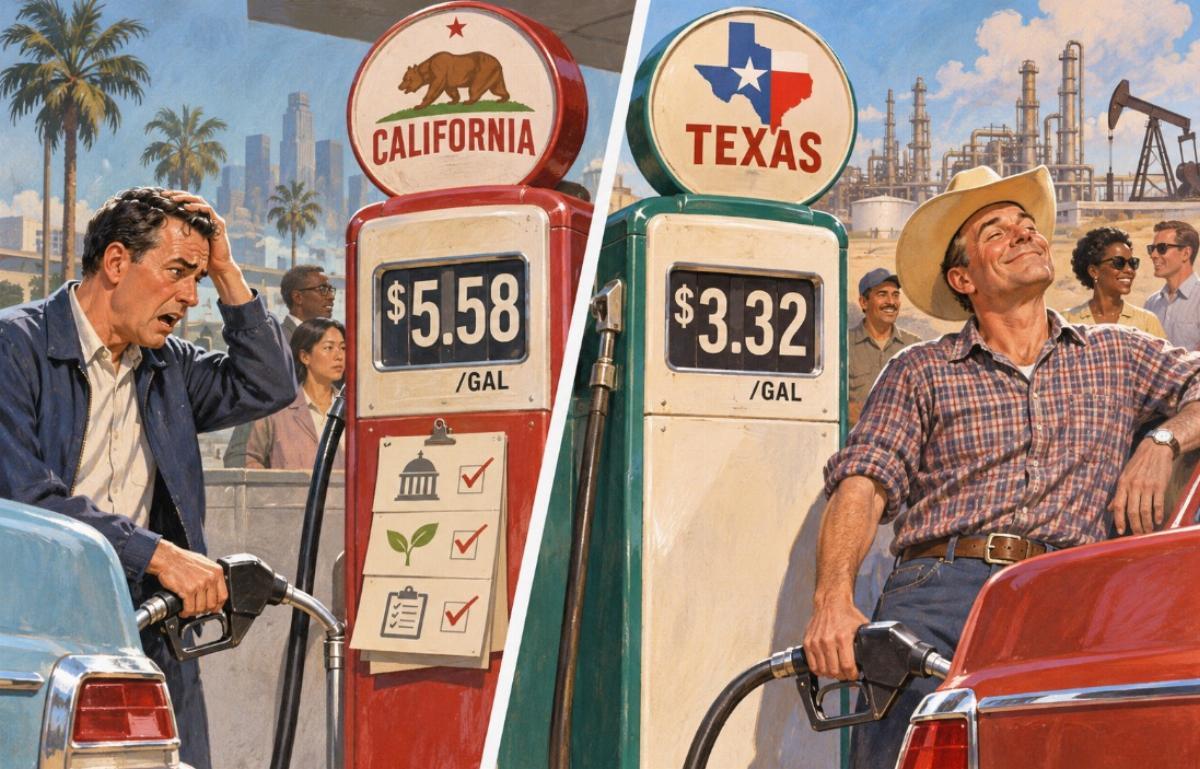
The result? On November 14, gasoline averaged $5.583 per gallon in California, compared with $3.318 in Texas - a difference of $2.265 per gallon, or 68% more in California.
But there's a big problem looming for those Red states. Their low prices attract economic refugees from blue states. And those economic refugees, apparently incapable of understanding that their policies are what destroyed their finances, impose the same destructive policies on their new homes when they reach critical mass. Just look at what they did to Colorado....
Tyler Durden Mon, 11/16/2026 - 22:00
Continue reading...
[ H/T ZeroHedge ]
Authored by Andrea Widburg via American Thinker,
As President Trump predicted, gasoline prices have dropped. It would have been nice if they'd done so before the election, but if wishes were horses, then beggars would ride, as the old saying goes. No matter the drop, though, if you live in a state that has had a decade of mostly Democrat-controlled legislatures, you're going to be paying a lot more at the pump than those lucky people in states that have (again, mostly) elected Republicans to office.
This is one of those cases when data matter more than words. These charts rely on information from AAA. The first chart shows prices in all fifty states, along with the party that controlled the legislature for most of the last decade before the 2026 election. (That election will change the future for some states, notably Texas, but I was interested in the past.)
Of the 25 states with the highest gasoline prices, 15 (or 60%) are Democrat-controlled, based on predominant legislative control from 2016-2025. The five states with the very highest gas prices - Hawaii, California, Nevada, Washington, and Oregon - all have predominantly Democrat-controlled legislatures.
It's clear that, for some states, geography and other factors that I haven't researched play a role. Not only is Hawaii an ardently Democrat state, but it's also an island. Everything must be shipped there, raising prices. Inland geography may also be a factor in Utah, Idaho, and Arizona being on that list. As Olivia Murray will be happy to tell you, Arizona is also notoriously corrupt, despite its ostensibly Republican control over the years.
Nevertheless, the trend is clear: If you live in a blue state, you're much more likely to pay more for gas. It cannot have escaped your notice that, just as 15 of the top 25 most costly states have been run by Democrats, the opposite is true - more than true - for the most affordable states. In that metric, 21 out of 25 (84%) have been run by Republicans, with all 16 of the cheapest states having been Republican-run.
And it's not just that prices are lower. What's even more interesting is that the percentage drop in prices over the 11 days following the election has not been distributed evenly. You might expect falling fuel prices to benefit everyone more or less equally. However, once again, people in states that have been (and will continue to be) controlled by Democrats got the short end, while those in states that, at least until now, have been controlled by Republicans have seen greater savings:
I didn't even have to ask ChatGPT for this analysis. It spontaneously offered it:
California may provide some insight into the big difference between fuel prices there and in Texas. (North Carolina isn't useful because its current extremely low prices partly reflect a tax holiday.) Both California and Texas are coastal, oil-rich states with access to major shipping routes. When you look at those price differences, though, something big is going on.
California was once an oil-producing powerhouse, but its petroleum industry has shrunk dramatically. The state had 43 operable refineries in the early 1980s, compared with just 12 at the beginning of 2026 - a 72% decline. Although its remaining refineries are larger and more efficient than many of those that closed, its total refining capacity has also fallen, reaching approximately 1.5 million barrels per day at the beginning of 2026. Another major refinery has since stopped producing gasoline. Meanwhile, daily crude oil production has plummeted 77%, from 1.08 million barrels in 1985 to just 245,000 in August 2026.
California's cap-and-trade program and Low Carbon Fuel Standard also impose substantial compliance costs, while its specially formulated gasoline is more expensive to manufacture and harder to import. Additionally, drivers pay a 63.4-cent state excise tax, a 2-cent underground storage tank fee, state and local sales taxes, and the federal 18.4-cent gasoline tax.
According to the Western States Petroleum Association's November 2026 estimates, taxes, fees, and estimated climate-program compliance costs add approximately $1.46 per gallon, including roughly 50 cents attributable to California's climate programs. That excludes other costs associated with its special gasoline formulation. There's a reason Californians pay so much at the pump.
Now consider Texas. Unlike California, Texas has dramatically increased its oil production. In 1982, it pumped approximately 2.49 million barrels daily; by 2025, production had reached a record 5.76 million barrels per day - an increase of more than 130%. Texas now produces over 40% of America's crude oil.
Texas has also lost refineries, declining from 65 in 1982 to 34 at the beginning of 2026. However, its surviving facilities are enormous, with a combined refining capacity exceeding six million barrels daily.
Texas imposes a gasoline excise tax of just 20 cents per gallon, compared with California's 63.4 cents. Add the federal 18.4-cent tax, and Texans pay 38.4 cents per gallon in gasoline excise taxes, without California's additional gasoline sales taxes, cap-and-trade program, or Low Carbon Fuel Standard.
Texas isn't regulation-free. Some metropolitan areas require reformulated gasoline, and certain counties have additional fuel requirements. But unlike California, Texas has no statewide carbon-pricing program or Low Carbon Fuel Standard imposing comparable gasoline compliance costs.
The result? On November 14, gasoline averaged $5.583 per gallon in California, compared with $3.318 in Texas - a difference of $2.265 per gallon, or 68% more in California.
But there's a big problem looming for those Red states. Their low prices attract economic refugees from blue states. And those economic refugees, apparently incapable of understanding that their policies are what destroyed their finances, impose the same destructive policies on their new homes when they reach critical mass. Just look at what they did to Colorado....
Tyler Durden Mon, 11/16/2026 - 22:00
Continue reading...
[ H/T ZeroHedge ]