





As Boulder goes, so goes the nation. At least, that is the hope of county officials in Colorado bent on imposing their preferred energy policies on the other 49 states. And Boulder is far from alone. From Maine to Hawaii, progressive cities, counties, and states have substituted tort litigation for the climate mandates they could not win in Congress. Soon, in Suncor Energy (U.S.A.) Inc. v. Board of County Commissioners of Boulder County, the Supreme Court will have the chance to reaffirm what the framers settled long ago: States generally may not govern outside their borders, and questions of national consequence belong to Congress.
Filed in Colorado state court in 2018, Boulder County’s lawsuit claims that America’s energy producers, through their contribution to global carbon emissions, have allegedly caused local climate-related harms for which the county now seeks untold damages. A small cohort of climate activist groups and plaintiffs’ firms drives Boulder’s suit and the tidal wave of copycat litigation behind it. Together, they threaten to bankrupt the energy industry and drive up prices for ordinary Americans. One of Boulder’s own lawyers conceded that this is the point, explaining that “this is a rather convoluted way to achieve the goals of a carbon tax.”
Under our federalist system, neither Boulder County nor Colorado may impose its policy preferences on other states. Boulder concedes that its complaint reaches interstate and international emissions, but it insists that the remedies it seeks are monetary, not policy changes. Multnomah County, Oregon, makes the same claim in its $51.5 billion suit against the industry, as do the more than three dozen other jurisdictions with nearly identical climate suits in state courts around the country. But the distinction collapses in light of what the plaintiffs have set out to achieve.
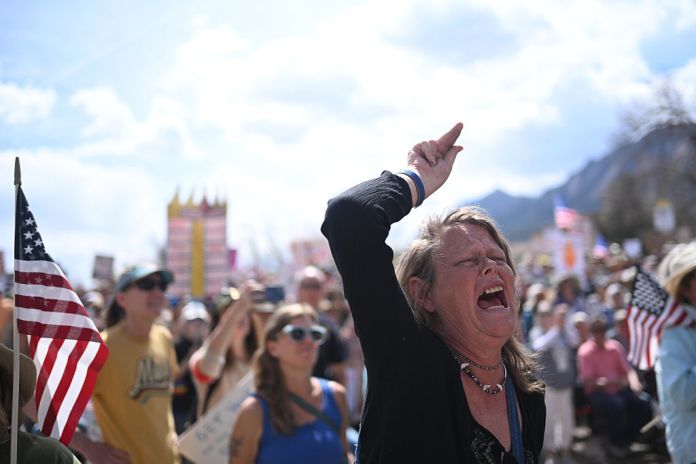
Kelley Henson yells in agreement during a speech at the No Kings march and visibility event on March 28, 2026 in Boulder, Colorado. This is the third nationwide “No Kings” protest held against the Trump administration. (Photo by Mark Makela/Getty Images)
" data-large-file="https://www.washingtonexaminer.com/wp-content/uploads/2026/06/GettyImages-2268343944.jpg?w=696" src="https://www.washingtonexaminer.com/wp-content/uploads/2026/06/GettyImages-2268343944.jpg?w=696" alt="Kelley Henson yells in agreement during a speech at the No Kings march and visibility event on March 28, 2026 in Boulder, Colorado. This is the third nationwide "No Kings" protest held against the Trump administration. (Photo by Mark Makela/Getty Images)" class="wp-image-4608173" srcset="https://www.washingtonexaminer.com/wp-content/uploads/2026/06/GettyImages-2268343944.jpg 1024w, https://www.washingtonexaminer.com/.../06/GettyImages-2268343944.jpg?resize=300,200 300w, https://www.washingtonexaminer.com/.../06/GettyImages-2268343944.jpg?resize=768,512 768w, https://www.washingtonexaminer.com/.../06/GettyImages-2268343944.jpg?resize=150,100 150w, https://www.washingtonexaminer.com/.../06/GettyImages-2268343944.jpg?resize=696,464 696w" sizes="(max-width: 1024px) 100vw, 1024px">
A protester yells in agreement during a speech at a “No Kings” march on Saturday, March 28, 2026, in Boulder, Colorado. (Photo by Mark Makela/Getty Images)
If the Supreme Court lets this climate lawfare proceed, every progressive municipality in the nation will file copycat suits until the plaintiffs’ lawyers bleed dry every industry that lawfully emits carbon — leaving consumers without affordable energy. Any storm, flood, drought, or other weather event allegedly traceable to climate change will result in a lawsuit. The plaintiffs hope litigation will price fossil fuels out of reach, leaving the public no choice but expensive and unproven “green” alternatives. That is the point — to ensure that every company and consumer in America adopts their long-demanded energy transition, or else. As the court explained in a 1959 case, the “obligation to pay compensation can be, indeed is designed to be, a potent method of governing conduct and controlling policy.” A judgment ruinous enough to bankrupt an industry forces that industry to change how it operates, as much in Texas or Louisiana as in Colorado.
The framers foresaw this conflict. They understood that, left unchecked, one state could wield its powers to force its laws and policies on its neighbors. James Madison wrote in Federalist No. 39 that each “state … is considered as a sovereign body, independent of all others, and only to be bound by its own voluntary act.” That is, states generally may not legislate beyond their own borders. The Supreme Court reaffirmed this foundational principle of equal sovereignty among states in Shelby County v. Holder. And in Federalist No. 80, Alexander Hamilton emphasized that “whatever practices may have a tendency to disturb the harmony between the States, are proper objects of federal superintendence and control.”
If global carbon emissions are contributing to a changing climate, it is up to Congress, not a local courtroom, to determine the appropriate response. Boulder County’s abuse of state tort law to regulate the world’s emissions is unconstitutional. By handing Congress’s authority to state court judges, Boulder’s suit strips voters of self-government and states of their equal sovereignty.
JOE CONCHA: CENTRIST DEMOCRATS SHUN AOC
On Monday, the Supreme Court will hear a case that Boulder insists is merely about Boulder. In reality, it is about who governs. If a single Colorado county can reach beyond its borders to dictate energy production in states such as Texas, voters there will have no recourse. The framers entrusted Congress to address questions of national consequence for precisely this reason. The Supreme Court should reaffirm that constitutional structure and end Boulder’s attempt to usurp federal authority over our nation’s energy policy.
Christopher Mills is a constitutional lawyer and former law clerk to Supreme Court Justice Clarence Thomas.
Continue reading...
[ H/T Washington Examiner ]