





"Bad Form To Blow Up Repeatedly": Twice-Burned Leopold Aschenbrenner Plots "Situational Awareness 2.0"... This Time With More Leverage
Some people learn from blowing up. Others raise more money.
Four months after his AI hedge fund went from $20 billion-plus to needing a firesale rescue from Ken Griffin, and two months after he tried to win it all back with out-of-the-money calls (more on those in a second), 25-year-old Leopold Aschenbrenner is plotting a comeback. According to the FT, he has spent recent weeks discussing a new iteration of Situational Awareness, which would include a return to leveraged trading and fresh outside capital, an effort that has been dubbed, and we are not making this up, "Situational Awareness 2.0" (technically it's 3.0 - see below - but he probably thinks his investors are so dumb they can't count that high) in conversations with prime brokers and investors.
One of those investors put it best: "It's bad form to blow up repeatedly."
It certainly is. Which is why we have spent so much time over the past five months making fun of the "hilariously misnamed hedge fund" and its founder: because for all the brilliance of the essay, the trading record looks a lot less like a "Nostradamus of AI" and a lot more like a Robinhood account with a Goldman prime brokerage agreement.
Long-time readers will recall that we were sniffing around for the AI version of Archegos well before anyone knew his name. Back in mid-June, as total return swap funding costs went vertical, we asked the obvious question:
...and three days later we wrote that futures funding rates were exploding amid soaring TRS demand to chase the market higher (Jun 15). We just didn't know who it was. By late July we did: Situational Awareness blew up, its assets reportedly collapsed from $45 billion to $10 billion in less than a month, and most of the public book was dumped on Citadel at a discount, with the proceeds used to pay off prime lenders including Goldman and JPMorgan. In hindsight (as we had warned) the entire chip/memory melt-up was little more than leverage dressed up as narrative, and the trade peaked on the very day TRS funding costs hit a record:
Goldman's Prime Services desk, which had a front-row seat (and, as the FT reported in September, reaped more than $200 million in fees from the fund along the way), later showed just how far the "AI enablers vs. disrupted" trade (aka the Leopold trade) had gone: semis as a share of total prime book net exposure went parabolic into the summer while software collapsed to near zero, before "the July deleveraging" broke the fever:
And who made out like a bandit? The guy on the other side. Citadel's flagship jumped 6% in July thanks to the Leopold swoop, and within weeks Griffin had flipped almost all of the stocks he scooped up. Billions in profit, virtually no risk. Meanwhile, the Dario curse struck again:
Now, any retail trader who has ever been margin called knows exactly what comes next: the revenge trade. Bigger size, shorter dated, further out of the money, because you need to make it all back fast.
Leopold did precisely that. In early September, Nomura's Charlie McElligott flagged a "mystery buyer" spending roughly $315 million in premium on deep out-of-the-money January flex calls in the exact same names that had blown up in July: AMD, Bloom Energy, CoreWeave, the DRAM memory ETF, Intel, SK Hynix and Sandisk. Our first reaction, as we wrote at the time, was that nobody could possibly be dumb enough to rerun the identical trade with a giant bullseye on his back. Two days later the FT confirmed that Situational Awareness was placing large new flex-option bets and rebuilding positions in... AMD, Intel, SK Hynix, Sandisk and CoreWeave. Hence "Leopold Is Back: Situational Awareness Rerunning Exact Same Trades Which Blew It Up A Month Ago" (Sep 11), and the same evening the FT reported that JPMorgan had cut off lending to the fund.
A week later, "somebody" went full WallStreetBets, dropping some $100 million in premium on calls that expired in just two weeks:
And here, in fairness (we are nothing if not fair), a confession: those particular lottery tickets actually hit. On the Oct 2 expiration Micron closed at $1,074.89, Sandisk at $1,719.99, Marvell at $272.29 and Intel at $119.33, all above their strikes. Held to expiry, the $96 million of premium would have been worth roughly $142 million at intrinsic value, a ~47% gain in two weeks (assuming whoever "somebody" was didn't sell early). Even a broken clock...
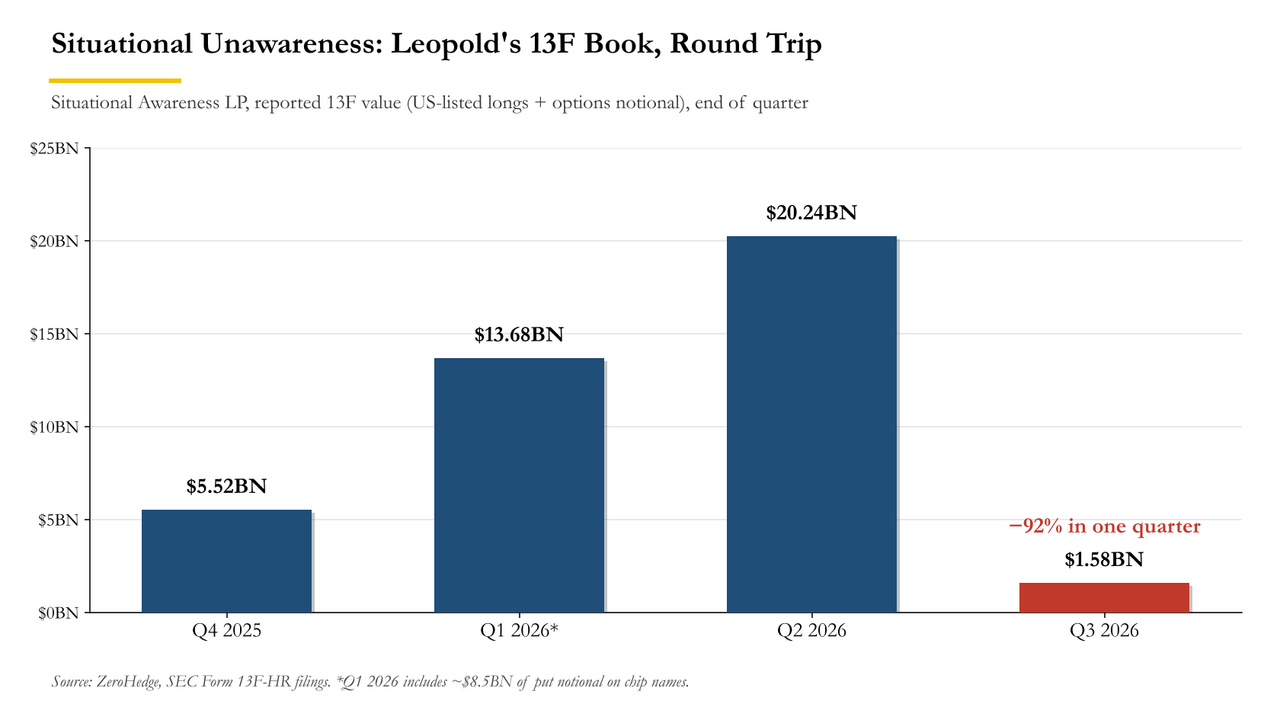
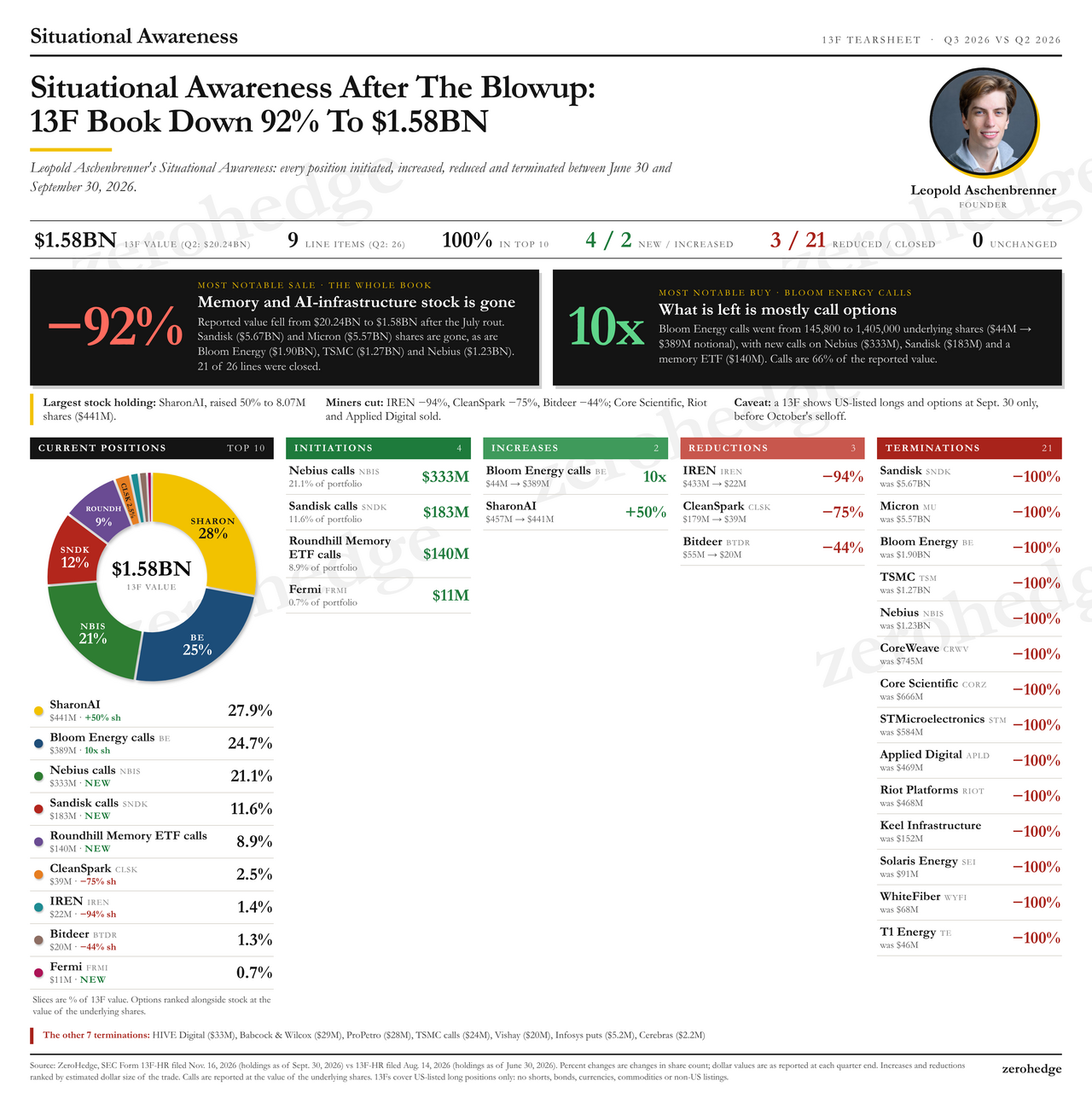
The problem, as every retail trader also knows, is what happens after the lottery ticket pays: you buy more. The quarter-end 13F, which we broke down in detail on Monday, shows that after the July liquidation the public book shrank from $20.24 billion to $1.58 billion, with 21 of 26 lines closed, and that of what was left, 66% was call options: Bloom Energy calls (raised tenfold to $389 million notional), plus new calls on Nebius ($333 million), Sandisk ($183 million) and a memory ETF ($140 million), alongside a $441 million slug of SharonAI stock.
And then came October and November. The AI trade cracked, hedge funds dumped AI exposure for days on end, and, per Goldman's Prime Services data, the entire cumulative net buying of AI stocks by hedge funds since the start of 2025 was wiped out...
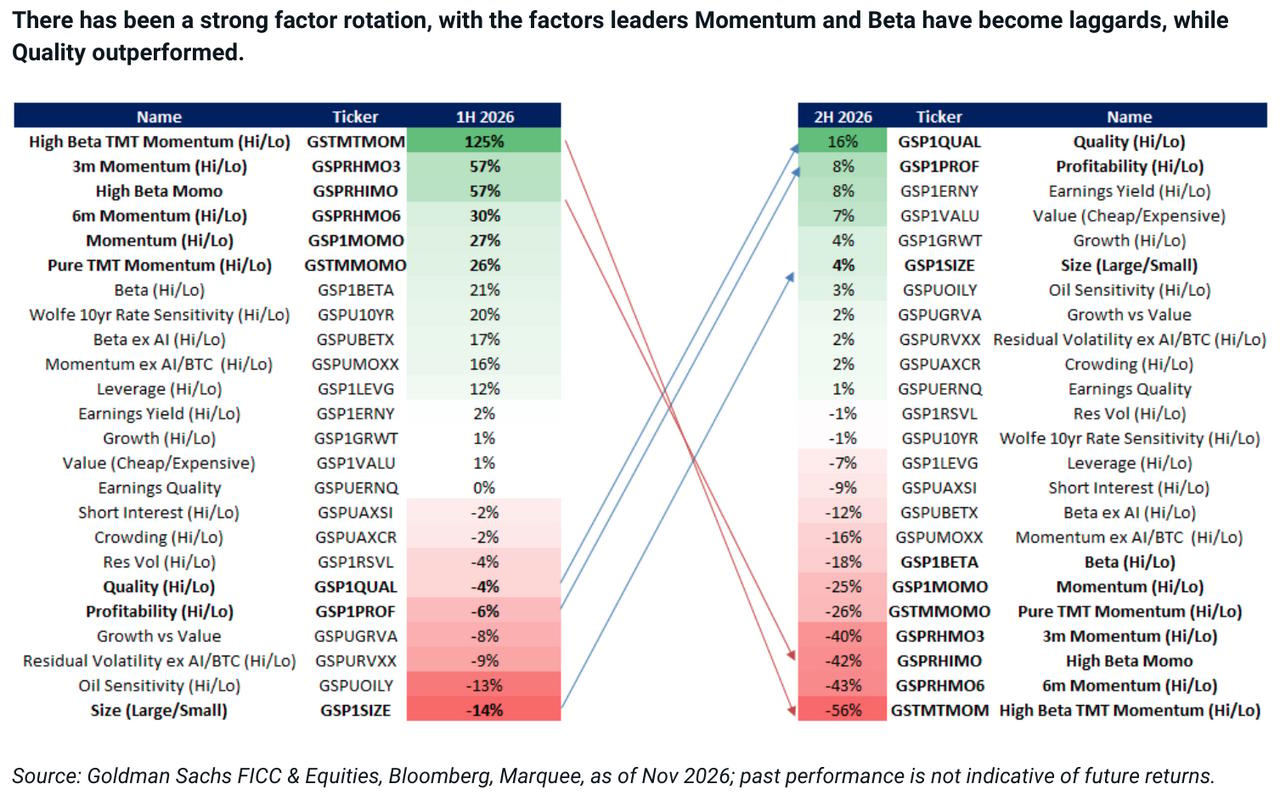
... with net allocation to global AI stocks falling from 31.7% at the June peak to 26.1% by mid-October (as we noted in "Leopold Lows 2.0?" on Oct 15, where a CoreWeave November call that traded at $18 in early September was quoted at $1). UBS's Torsten Sippel went further, writing that the October action looked very similar to the Situational Awareness unwind, and on Nov 5, when the Nasdaq had its worst day since Covid, Vanda found that the names Leopold held in June were among the heaviest retail sales. Leopold's ghost portfolio, as it were.
Here is what happened to the post-blowup book since Sept. 30: every underlying is down between 36% and 58%.
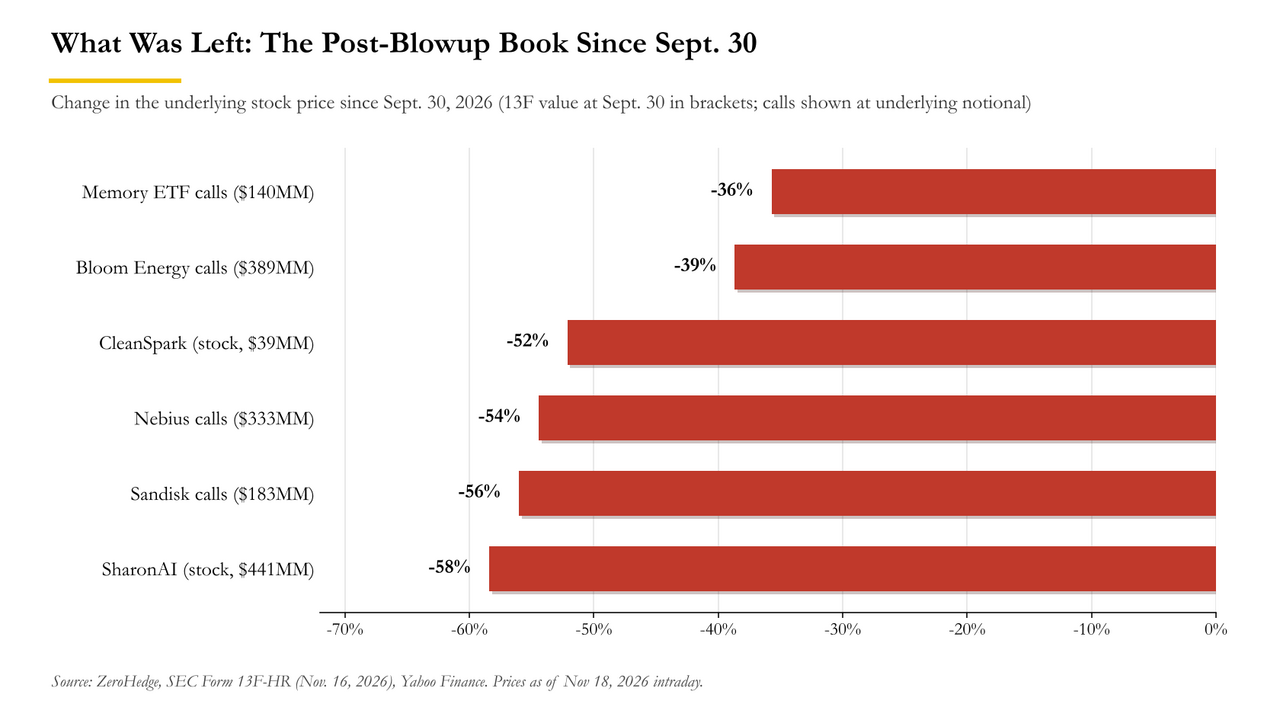
For the calls, we don't know the strikes or expiries (a 13F doesn't say), but with the underlyings cut roughly in half, a book that was two-thirds upside calls has probably been crushed. As for the January flex calls from early September, here is how far each stock would have to rally from today's price just to get back to the strike, never mind pay back the premium:
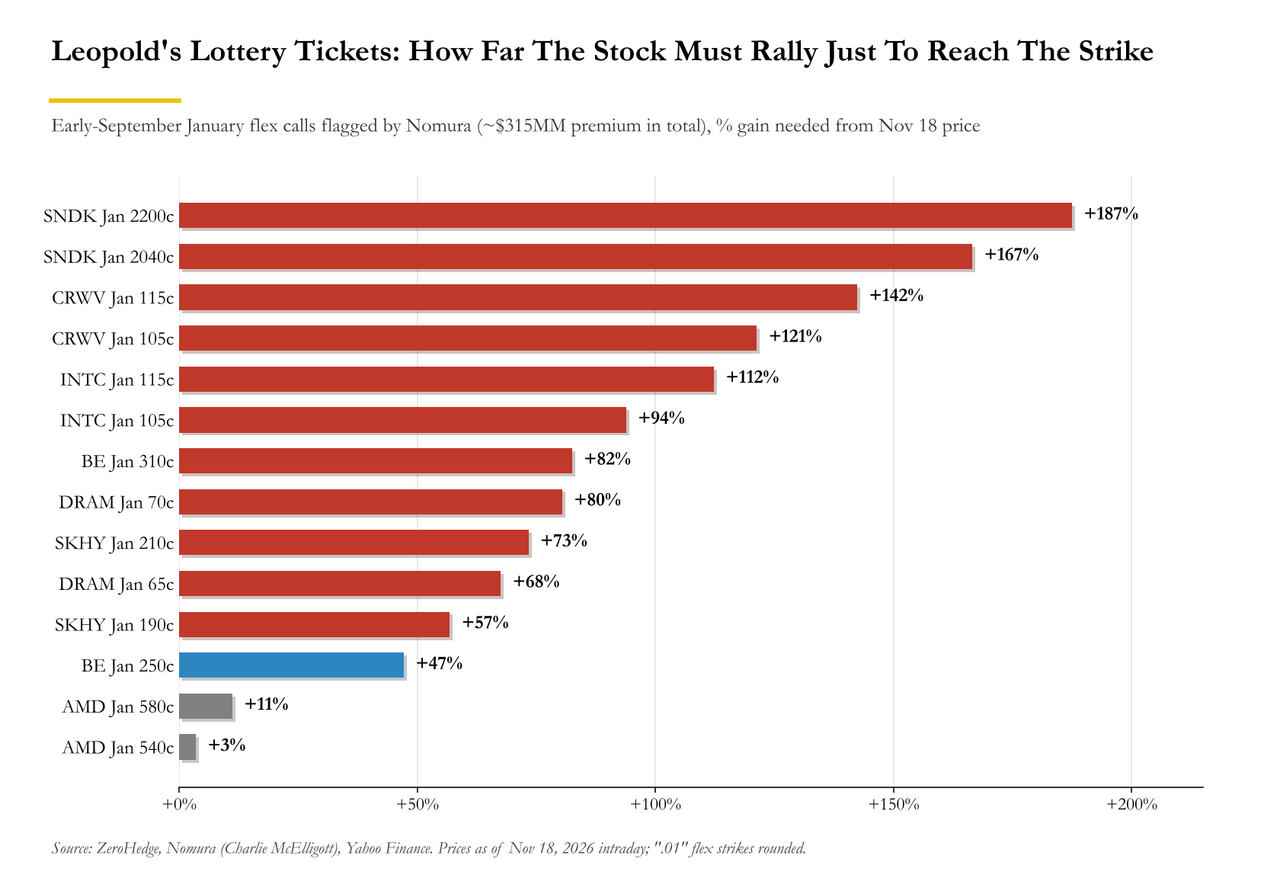
Translation: with the exception of AMD, Sandisk needs to nearly triple, CoreWeave and Intel need to more than double, and the rest need 50-80% rallies in two months. We'd call that a long shot, but that would be unfair to long shots.
Which brings us to Monday night's tweet, which summed up the whole saga in one line:
So what does any self-respecting blown-up retail trader do next? Well, he reopens the margin account (assuming someone is dumb enough to let him). Let's run through the checklist, courtesy of the FT:
A little fine tuning. For what the FT has called the largest loss in the history of the hedge fund industry.
Whether Jefferies, a bank that recently had the pleasure of counting First Brands and Radiant among its clients, says yes this time around is another matter:
To be fair to the fund, there are some signs of adult supervision: headcount has grown to about 30 from just eight in a June filing, and it is now looking for a chief risk officer, which, for a fund that ran $20 billion-plus of levered memory-chip exposure with no CRO, is maybe the most damning detail in the whole story. The FT also notes that Goldman and JPMorgan had extended financing to Aschenbrenner despite his limited trading experience, which tells you everything about how the banks chased the fees (all $200 million+ of them, in Goldman's case) on the way up.
None of this means the original thesis was wrong. The 2024 "Situational Awareness" essay called the trillion-dollar compute race, the power bottleneck and the capex boom earlier and more clearly than almost anyone on Wall Street. The idea was right. The positioning, the leverage and the capital allocation were a catastrophe: concentrated, swap-levered longs in the highest-beta names into a funding-cost spike; a forced sale to Citadel at the bottom; a pivot to deep out-of-the-money calls in the exact same names; and a 13F book that went from $20 billion to $1.58 billion in a quarter. Having the right macro call and still losing tens of billions is, if anything, the most retail thing of all.
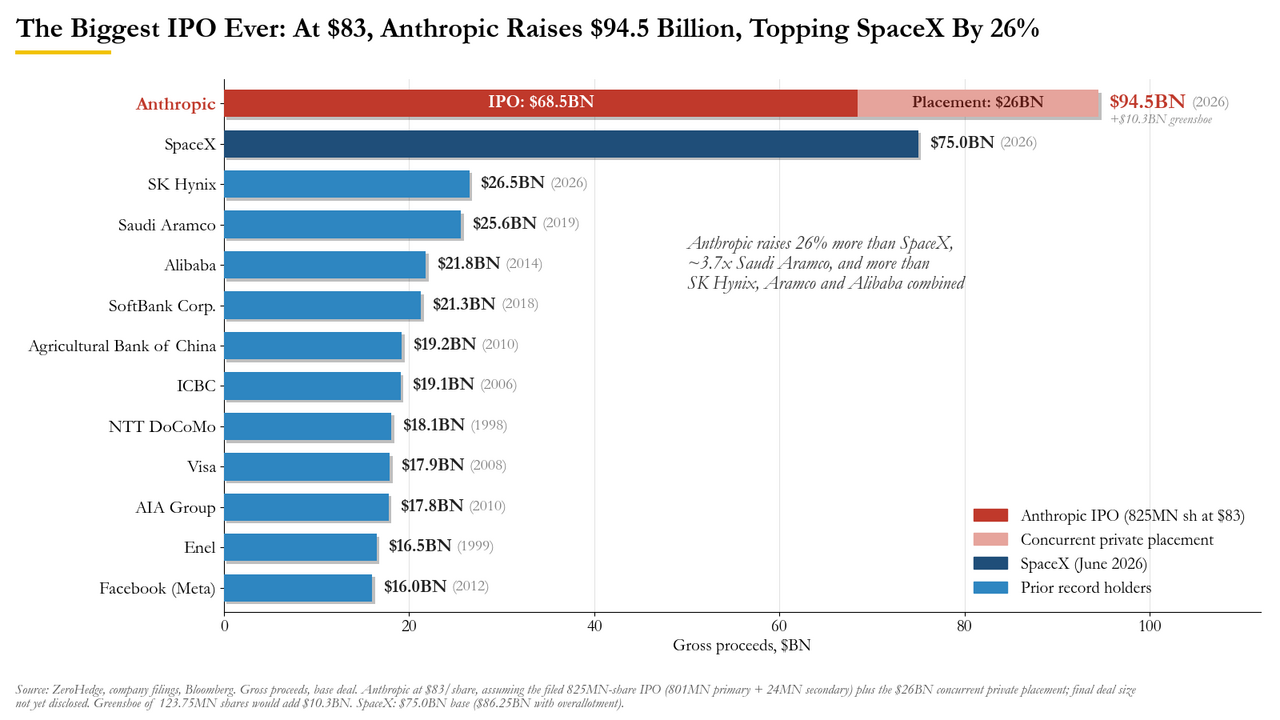
The irony is that his best trade was the one he couldn't trade. Situational Awareness still manages more than $10 billion, mostly in private investments, including an approximately $5 billion stake in Anthropic, where Aschenbrenner's wife is chief of staff to Dario Amodei, and which is expected to be worth significantly more after the IPO that prices tonight, targeting a valuation of around $1.4 trillion, with trading set to start tomorrow. In other words, the illiquid position nobody could margin call is the one that made money, which is exactly why it's the one that should give investors pause about handing him a liquid, levered book again. (Sam Bankman-Fried, another early Anthropic backer, would have made nearly $40 billion on the IPO, per the FT; Dario curse, part two.)
Will he get the money? Probably. This is Wall Street, where a $5 billion Anthropic mark and a viral essay buy a lot of forgiveness, and the FT's last word goes to one of his investors:
We don't doubt it. Then again, Archegos also had believers, right up until the morning the prime brokers stopped answering the phone. When Situational Awareness 2.0 shows up at a dealer near you, we suggest keeping an eye on TRS funding rates; last time, they told us everything a month before the FT did.
Much more in the full Nomura McElligott note and Goldman's Prime Services AI positioning note, both available to pro subs.
Tyler Durden Wed, 11/18/2026 - 18:20
Continue reading...
[ H/T ZeroHedge ]
Some people learn from blowing up. Others raise more money.
Four months after his AI hedge fund went from $20 billion-plus to needing a firesale rescue from Ken Griffin, and two months after he tried to win it all back with out-of-the-money calls (more on those in a second), 25-year-old Leopold Aschenbrenner is plotting a comeback. According to the FT, he has spent recent weeks discussing a new iteration of Situational Awareness, which would include a return to leveraged trading and fresh outside capital, an effort that has been dubbed, and we are not making this up, "Situational Awareness 2.0" (technically it's 3.0 - see below - but he probably thinks his investors are so dumb they can't count that high) in conversations with prime brokers and investors.
One of those investors put it best: "It's bad form to blow up repeatedly."
It certainly is. Which is why we have spent so much time over the past five months making fun of the "hilariously misnamed hedge fund" and its founder: because for all the brilliance of the essay, the trading record looks a lot less like a "Nostradamus of AI" and a lot more like a Robinhood account with a Goldman prime brokerage agreement.
Blow-Up #1: The Swaps
Long-time readers will recall that we were sniffing around for the AI version of Archegos well before anyone knew his name. Back in mid-June, as total return swap funding costs went vertical, we asked the obvious question:
...and three days later we wrote that futures funding rates were exploding amid soaring TRS demand to chase the market higher (Jun 15). We just didn't know who it was. By late July we did: Situational Awareness blew up, its assets reportedly collapsed from $45 billion to $10 billion in less than a month, and most of the public book was dumped on Citadel at a discount, with the proceeds used to pay off prime lenders including Goldman and JPMorgan. In hindsight (as we had warned) the entire chip/memory melt-up was little more than leverage dressed up as narrative, and the trade peaked on the very day TRS funding costs hit a record:
Goldman's Prime Services desk, which had a front-row seat (and, as the FT reported in September, reaped more than $200 million in fees from the fund along the way), later showed just how far the "AI enablers vs. disrupted" trade (aka the Leopold trade) had gone: semis as a share of total prime book net exposure went parabolic into the summer while software collapsed to near zero, before "the July deleveraging" broke the fever:
And who made out like a bandit? The guy on the other side. Citadel's flagship jumped 6% in July thanks to the Leopold swoop, and within weeks Griffin had flipped almost all of the stocks he scooped up. Billions in profit, virtually no risk. Meanwhile, the Dario curse struck again:
Blow-Up #2: The Revenge Trade
Now, any retail trader who has ever been margin called knows exactly what comes next: the revenge trade. Bigger size, shorter dated, further out of the money, because you need to make it all back fast.
Leopold did precisely that. In early September, Nomura's Charlie McElligott flagged a "mystery buyer" spending roughly $315 million in premium on deep out-of-the-money January flex calls in the exact same names that had blown up in July: AMD, Bloom Energy, CoreWeave, the DRAM memory ETF, Intel, SK Hynix and Sandisk. Our first reaction, as we wrote at the time, was that nobody could possibly be dumb enough to rerun the identical trade with a giant bullseye on his back. Two days later the FT confirmed that Situational Awareness was placing large new flex-option bets and rebuilding positions in... AMD, Intel, SK Hynix, Sandisk and CoreWeave. Hence "Leopold Is Back: Situational Awareness Rerunning Exact Same Trades Which Blew It Up A Month Ago" (Sep 11), and the same evening the FT reported that JPMorgan had cut off lending to the fund.
A week later, "somebody" went full WallStreetBets, dropping some $100 million in premium on calls that expired in just two weeks:
And here, in fairness (we are nothing if not fair), a confession: those particular lottery tickets actually hit. On the Oct 2 expiration Micron closed at $1,074.89, Sandisk at $1,719.99, Marvell at $272.29 and Intel at $119.33, all above their strikes. Held to expiry, the $96 million of premium would have been worth roughly $142 million at intrinsic value, a ~47% gain in two weeks (assuming whoever "somebody" was didn't sell early). Even a broken clock...
The problem, as every retail trader also knows, is what happens after the lottery ticket pays: you buy more. The quarter-end 13F, which we broke down in detail on Monday, shows that after the July liquidation the public book shrank from $20.24 billion to $1.58 billion, with 21 of 26 lines closed, and that of what was left, 66% was call options: Bloom Energy calls (raised tenfold to $389 million notional), plus new calls on Nebius ($333 million), Sandisk ($183 million) and a memory ETF ($140 million), alongside a $441 million slug of SharonAI stock.
And then came October and November. The AI trade cracked, hedge funds dumped AI exposure for days on end, and, per Goldman's Prime Services data, the entire cumulative net buying of AI stocks by hedge funds since the start of 2025 was wiped out...

... with net allocation to global AI stocks falling from 31.7% at the June peak to 26.1% by mid-October (as we noted in "Leopold Lows 2.0?" on Oct 15, where a CoreWeave November call that traded at $18 in early September was quoted at $1). UBS's Torsten Sippel went further, writing that the October action looked very similar to the Situational Awareness unwind, and on Nov 5, when the Nasdaq had its worst day since Covid, Vanda found that the names Leopold held in June were among the heaviest retail sales. Leopold's ghost portfolio, as it were.
Here is what happened to the post-blowup book since Sept. 30: every underlying is down between 36% and 58%.
For the calls, we don't know the strikes or expiries (a 13F doesn't say), but with the underlyings cut roughly in half, a book that was two-thirds upside calls has probably been crushed. As for the January flex calls from early September, here is how far each stock would have to rally from today's price just to get back to the strike, never mind pay back the premium:
Translation: with the exception of AMD, Sandisk needs to nearly triple, CoreWeave and Intel need to more than double, and the rest need 50-80% rallies in two months. We'd call that a long shot, but that would be unfair to long shots.
Which brings us to Monday night's tweet, which summed up the whole saga in one line:
Situational Awareness 2.0, Now With Leverage
So what does any self-respecting blown-up retail trader do next? Well, he reopens the margin account (assuming someone is dumb enough to let him). Let's run through the checklist, courtesy of the FT:
- The pledge: in July, Aschenbrenner sent investors a mea culpa promising he would no longer borrow from banks to amplify his bets. Four months later he is discussing a return to leveraged trading.
- Broker-hopping: JPMorgan cut him off after the July debacle. Jefferies turned him away earlier this year because it felt the fund wasn't appropriately hedged, and he has since been back in talks with Jefferies about a prime brokerage account, while also working with specialist broker Clear Street (which, as we pointed out in September, happens to be the biggest provider of swaps to levered ETFs).
- Fresh capital: he has also discussed raising more money from outside investors in the new year.
- The lesson learned: a second investor who recently spoke to management summed up what the firm has taken away from losing tens of billions:
A little fine tuning. For what the FT has called the largest loss in the history of the hedge fund industry.
Whether Jefferies, a bank that recently had the pleasure of counting First Brands and Radiant among its clients, says yes this time around is another matter:
To be fair to the fund, there are some signs of adult supervision: headcount has grown to about 30 from just eight in a June filing, and it is now looking for a chief risk officer, which, for a fund that ran $20 billion-plus of levered memory-chip exposure with no CRO, is maybe the most damning detail in the whole story. The FT also notes that Goldman and JPMorgan had extended financing to Aschenbrenner despite his limited trading experience, which tells you everything about how the banks chased the fees (all $200 million+ of them, in Goldman's case) on the way up.
Great Essay, Terrible Trader
None of this means the original thesis was wrong. The 2024 "Situational Awareness" essay called the trillion-dollar compute race, the power bottleneck and the capex boom earlier and more clearly than almost anyone on Wall Street. The idea was right. The positioning, the leverage and the capital allocation were a catastrophe: concentrated, swap-levered longs in the highest-beta names into a funding-cost spike; a forced sale to Citadel at the bottom; a pivot to deep out-of-the-money calls in the exact same names; and a 13F book that went from $20 billion to $1.58 billion in a quarter. Having the right macro call and still losing tens of billions is, if anything, the most retail thing of all.
The irony is that his best trade was the one he couldn't trade. Situational Awareness still manages more than $10 billion, mostly in private investments, including an approximately $5 billion stake in Anthropic, where Aschenbrenner's wife is chief of staff to Dario Amodei, and which is expected to be worth significantly more after the IPO that prices tonight, targeting a valuation of around $1.4 trillion, with trading set to start tomorrow. In other words, the illiquid position nobody could margin call is the one that made money, which is exactly why it's the one that should give investors pause about handing him a liquid, levered book again. (Sam Bankman-Fried, another early Anthropic backer, would have made nearly $40 billion on the IPO, per the FT; Dario curse, part two.)
Will he get the money? Probably. This is Wall Street, where a $5 billion Anthropic mark and a viral essay buy a lot of forgiveness, and the FT's last word goes to one of his investors:
We don't doubt it. Then again, Archegos also had believers, right up until the morning the prime brokers stopped answering the phone. When Situational Awareness 2.0 shows up at a dealer near you, we suggest keeping an eye on TRS funding rates; last time, they told us everything a month before the FT did.
Much more in the full Nomura McElligott note and Goldman's Prime Services AI positioning note, both available to pro subs.
Tyler Durden Wed, 11/18/2026 - 18:20
Continue reading...
[ H/T ZeroHedge ]