

Arrests, Prosecutions, & Deportations Fuel Record Drop In Crime
Authored by John R. Lott Jr. via RealClearInvestigations,
The United States has been running a real-time experiment on two approaches to criminal justice: the Biden-era emphasis on social justice versus the Trump administration's embrace of traditional law and order. The results are now in.
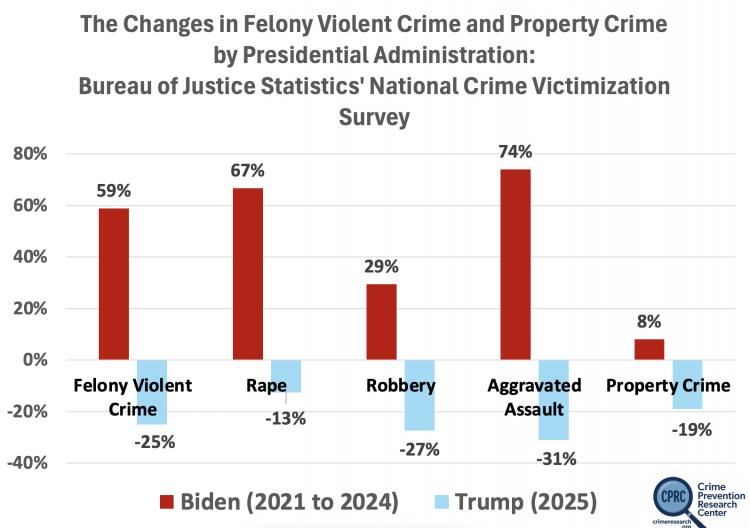
The Bureau of Justice Statistics (BJS) reported on Oct. 26 that felony violent crime fell by 25 percent in 2025. Rape declined by 13 percent, robbery fell by 27 percent, and aggravated assault dropped by 31 percent. Property crime fell by 19 percent. Except for rape, these are the largest one-year reductions recorded since data collection began 53 years ago.
The reductions followed substantial increases during the previous four years, when felony violent crime rose by 59 percent, and violent crime, including misdemeanor simple assault, increased by 42 percent.
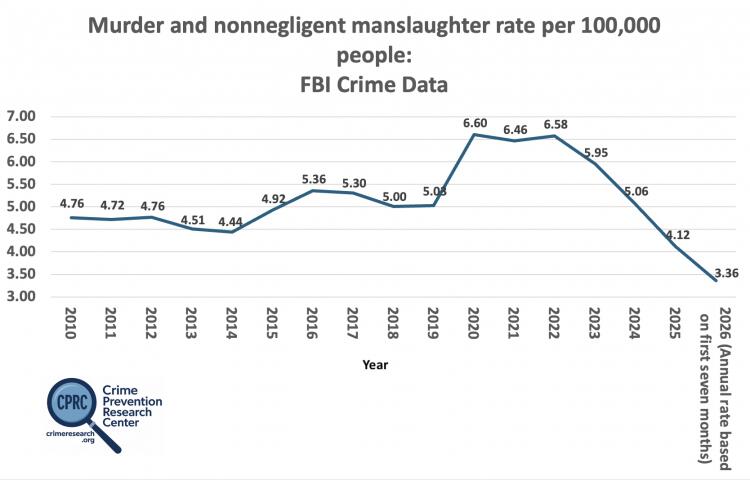
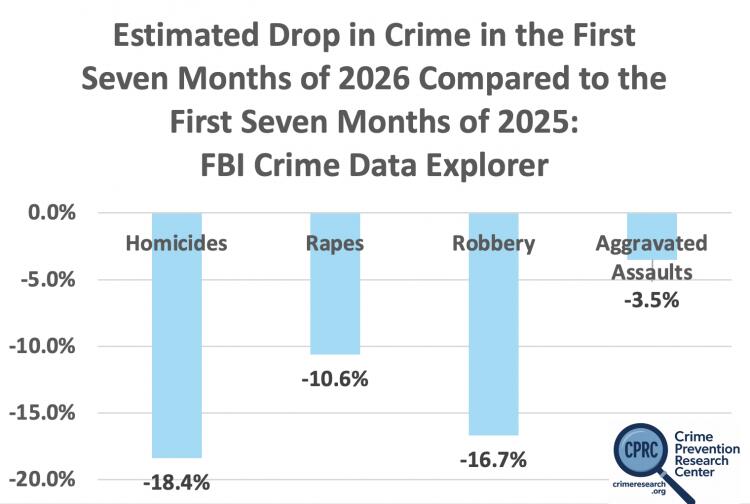
Murder also declined sharply last year. The United States recorded about 4.1 murders per 100,000 people in 2025, a record low, down from roughly 5.1 per 100,000 in 2024. The murder rate has continued to drop. If preliminary FBI data showing an additional 18.4 percent decline during the first seven months of 2026 hold for the full year, the murder rate would fall to approximately 3.36 per 100,000.
"We are witnessing a historic plunge in crime to levels never seen before in the United States," professor Carl Moody, a crime researcher at the College of William & Mary, told RealClearInvestigations. "As a result, we are all safer in our communities than we ever have been. We should all thank our law enforcement professionals."
These declines go far beyond normal cyclical fluctuations in crime. The murder rate has fallen to record lows. Crime also shows a clear pattern over time. Felony violent crime declined during President Donald Trump's first term, surged under President Joe Biden, and is now plunging during Trump's second term. The COVID-19 pandemic can't explain Biden's increase: Felony violent crime rose by 59 percent from 2021 to 2024, including a 4 percent increase in 2024.
The new Bureau of Justice Statistics data show much steeper declines in 2025 than the FBI figures released on Aug. 14. The BJS recorded a decline in felony violent crime that was 157 percent larger than the FBI's figure and a decline in property crime that was 32 percent larger. The agencies also reported sharply different trends under Biden: The BJS found that felony violent crime soared, while the FBI reported an 8 percent decline in police-reported violent crime.
The difference reflects how the agencies measure crime. The FBI counts crimes reported to police. The BJS National Crime Victimization Survey interviews roughly 240,000 Americans each year, and measures both reported and unreported crime.
That distinction matters because most crime never reaches police. In 2024, victims reported only about 48 percent of violent crimes and 31 percent of property crimes. Relying only on FBI data therefore misses most victimization. While the media focus almost exclusively on FBI data, the Justice Department itself describes the BJS National Crime Victimization Survey as the nation's "primary source of information on criminal victimization" and as the "gold standard."
Several major policy changes coincided with the decline.
The FBI dramatically increased enforcement activity in 2025. FBI arrests rose by 184 percent from 2024, while total arrests involving the FBI, including joint operations with state and local agencies, increased by 197 percent.
Trump's federal law enforcement interventions in the District of Columbia, and Memphis, Tennessee, coincided with dramatic declines in murders that far outpaced the national decline. Before Trump intervened, Memphis had the nation's fourth-highest murder rate among cities with more than 100,000 residents, while the District of Columbia ranked 11th.
Trump took federal control of the district's policing on Aug. 11, 2025. From September through December in 2025, murders plunged by 63 percent, to 23 from 63, compared with the same four months in 2024 - the final four full months of the Biden administration.
Trump began a federal law enforcement intervention in Memphis on Sept. 29, 2025. Murders there fell by 42 percent, from 50 during October through December in 2024 to 29 during the same months in 2025.
Prosecution policies also changed in several major jurisdictions. Voters in Los Angeles, San Francisco, Multnomah County, Oregon (which includes Portland), and other jurisdictions replaced progressive prosecutors backed by George Soros with district attorneys who have pursued more aggressive prosecution policies and tougher sentences.
After taking office as Los Angeles County district attorney in December 2024, Los Angeles County District Attorney Nathan Hochman reversed predecessor George Gascón's restrictions on prosecuting many misdemeanors. During the first half of 2025, prosecutors charged nearly 70 percent of the low-level cases that police referred. Gascón had imposed blanket "do-not-prosecute" policies for offenses including criminal threats and resisting arrest. Hochman also reversed Gascón's restrictions on Three Strikes and gun- and gang-related sentencing enhancements, his refusal to prosecute juveniles for misdemeanor shoplifting involving less than $950, and his ban on seeking the death penalty.
The shift in leadership from Gascón to Hochman not only resulted in more prosecutions but also led to more arrests by police. Under Hochman, there was an immediate and highly publicized wave of joint law enforcement crackdowns and targeted arrests. Under Gascón, police were demoralized and stopped arresting people because they "didn't see the point." Police unions openly noted a sense of futility.
Federal prosecutors have also increased charging rates in some jurisdictions. In the District of Columbia, the Biden administration's U.S. attorney brought criminal charges against about 33 percent of those arrested. Under U.S. Attorney Jeanine Pirro, the charging rate rose to 96 percent. "The fact is, if you put criminals in jail, it helps," Moody, the crime researcher, said.
The crime decline has also coincided with increased immigration enforcement. While data indicate that legal immigrants commit fewer crimes than native-born citizens, illegal immigrants commit crimes at a far higher rate. The Department of Homeland Security says approximately 70 percent of illegal immigrants deported under the Trump administration had criminal convictions or pending criminal charges.
The trend represents a reversal from the Biden years, when felony violent crime increased sharply as illegal immigration also reached record levels. During the Biden administration, at least 12.8 million illegal immigrants were encountered at the border, apprehended after illegal crossings, or classified as known gotaways. The total also excludes undetected border crossings. During some surges, officials pulled 80 percent or more of Border Patrol agents away from guarding the border, while 30 percent of the cameras in Border Patrol's main surveillance system were broken. These gaps potentially allowed millions more illegal immigrants to cross the border undetected.
State prison data also illustrate the potential relationship between illegal immigration and crime. At the end of 2025, 7,113 illegal immigrants were incarcerated in New York, accounting for 14 percent of the state's inmate population, at least 3.4 times illegals' share of the state population. That is the best data available, but even that data understates the total because New York does not systematically identify inmates' immigration status, and federal authorities can deport some illegal immigrants before they complete their sentences.
"The increased deportation of illegal immigrants who had a criminal record played an important role in the historic reduction in violent crime in the last two years," David Mustard, a distinguished professor at the University of Georgia who researches crime extensively, told RealClearInvestigations.
At the same time, more Americans report carrying concealed handguns for protection. Surveys show that the share of general-election voters who carry concealed handguns increased to 30.9 percent in July 2026 from 24.3 percent in December 2024. The increase has been especially pronounced among minority voters, who are the most likely victims of violent crime. Hispanic and black voters are 2.6 times as likely as white voters to report carrying all or most of the time.
Recent peer-reviewed research finds that right-to-carry concealed handgun laws reduce violent crime by about 5 percent, while constitutional carry laws reduce it by more than 15 percent.
Researchers point out that the historic decline in crime coincided with more aggressive law enforcement, tougher prosecution policies, increased deportations of criminal illegal immigrants, and more Americans carrying firearms for self-defense.
"The results are unmistakable," said professor Gary Mauser, who has extensively studied crime at Simon Fraser University in Canada. "Americans experienced unprecedented drops in crime rates in 2025, and rates are continuing to fall in 2026. The government's most comprehensive measure of crime shows that the improvement was far greater than the FBI's widely publicized figures suggested."
Tyler Durden Wed, 11/04/2026 - 16:20
Continue reading...
[ H/T ZeroHedge ]
Authored by John R. Lott Jr. via RealClearInvestigations,
The United States has been running a real-time experiment on two approaches to criminal justice: the Biden-era emphasis on social justice versus the Trump administration's embrace of traditional law and order. The results are now in.
The Bureau of Justice Statistics (BJS) reported on Oct. 26 that felony violent crime fell by 25 percent in 2025. Rape declined by 13 percent, robbery fell by 27 percent, and aggravated assault dropped by 31 percent. Property crime fell by 19 percent. Except for rape, these are the largest one-year reductions recorded since data collection began 53 years ago.
The reductions followed substantial increases during the previous four years, when felony violent crime rose by 59 percent, and violent crime, including misdemeanor simple assault, increased by 42 percent.
Murder also declined sharply last year. The United States recorded about 4.1 murders per 100,000 people in 2025, a record low, down from roughly 5.1 per 100,000 in 2024. The murder rate has continued to drop. If preliminary FBI data showing an additional 18.4 percent decline during the first seven months of 2026 hold for the full year, the murder rate would fall to approximately 3.36 per 100,000.
"We are witnessing a historic plunge in crime to levels never seen before in the United States," professor Carl Moody, a crime researcher at the College of William & Mary, told RealClearInvestigations. "As a result, we are all safer in our communities than we ever have been. We should all thank our law enforcement professionals."
These declines go far beyond normal cyclical fluctuations in crime. The murder rate has fallen to record lows. Crime also shows a clear pattern over time. Felony violent crime declined during President Donald Trump's first term, surged under President Joe Biden, and is now plunging during Trump's second term. The COVID-19 pandemic can't explain Biden's increase: Felony violent crime rose by 59 percent from 2021 to 2024, including a 4 percent increase in 2024.
The new Bureau of Justice Statistics data show much steeper declines in 2025 than the FBI figures released on Aug. 14. The BJS recorded a decline in felony violent crime that was 157 percent larger than the FBI's figure and a decline in property crime that was 32 percent larger. The agencies also reported sharply different trends under Biden: The BJS found that felony violent crime soared, while the FBI reported an 8 percent decline in police-reported violent crime.
The difference reflects how the agencies measure crime. The FBI counts crimes reported to police. The BJS National Crime Victimization Survey interviews roughly 240,000 Americans each year, and measures both reported and unreported crime.
That distinction matters because most crime never reaches police. In 2024, victims reported only about 48 percent of violent crimes and 31 percent of property crimes. Relying only on FBI data therefore misses most victimization. While the media focus almost exclusively on FBI data, the Justice Department itself describes the BJS National Crime Victimization Survey as the nation's "primary source of information on criminal victimization" and as the "gold standard."
Several major policy changes coincided with the decline.
Federal Takeovers
The FBI dramatically increased enforcement activity in 2025. FBI arrests rose by 184 percent from 2024, while total arrests involving the FBI, including joint operations with state and local agencies, increased by 197 percent.
Trump's federal law enforcement interventions in the District of Columbia, and Memphis, Tennessee, coincided with dramatic declines in murders that far outpaced the national decline. Before Trump intervened, Memphis had the nation's fourth-highest murder rate among cities with more than 100,000 residents, while the District of Columbia ranked 11th.
Trump took federal control of the district's policing on Aug. 11, 2025. From September through December in 2025, murders plunged by 63 percent, to 23 from 63, compared with the same four months in 2024 - the final four full months of the Biden administration.
Trump began a federal law enforcement intervention in Memphis on Sept. 29, 2025. Murders there fell by 42 percent, from 50 during October through December in 2024 to 29 during the same months in 2025.
More Prosecutions
Prosecution policies also changed in several major jurisdictions. Voters in Los Angeles, San Francisco, Multnomah County, Oregon (which includes Portland), and other jurisdictions replaced progressive prosecutors backed by George Soros with district attorneys who have pursued more aggressive prosecution policies and tougher sentences.
After taking office as Los Angeles County district attorney in December 2024, Los Angeles County District Attorney Nathan Hochman reversed predecessor George Gascón's restrictions on prosecuting many misdemeanors. During the first half of 2025, prosecutors charged nearly 70 percent of the low-level cases that police referred. Gascón had imposed blanket "do-not-prosecute" policies for offenses including criminal threats and resisting arrest. Hochman also reversed Gascón's restrictions on Three Strikes and gun- and gang-related sentencing enhancements, his refusal to prosecute juveniles for misdemeanor shoplifting involving less than $950, and his ban on seeking the death penalty.
The shift in leadership from Gascón to Hochman not only resulted in more prosecutions but also led to more arrests by police. Under Hochman, there was an immediate and highly publicized wave of joint law enforcement crackdowns and targeted arrests. Under Gascón, police were demoralized and stopped arresting people because they "didn't see the point." Police unions openly noted a sense of futility.
Federal prosecutors have also increased charging rates in some jurisdictions. In the District of Columbia, the Biden administration's U.S. attorney brought criminal charges against about 33 percent of those arrested. Under U.S. Attorney Jeanine Pirro, the charging rate rose to 96 percent. "The fact is, if you put criminals in jail, it helps," Moody, the crime researcher, said.
Immigration Enforcement
The crime decline has also coincided with increased immigration enforcement. While data indicate that legal immigrants commit fewer crimes than native-born citizens, illegal immigrants commit crimes at a far higher rate. The Department of Homeland Security says approximately 70 percent of illegal immigrants deported under the Trump administration had criminal convictions or pending criminal charges.
The trend represents a reversal from the Biden years, when felony violent crime increased sharply as illegal immigration also reached record levels. During the Biden administration, at least 12.8 million illegal immigrants were encountered at the border, apprehended after illegal crossings, or classified as known gotaways. The total also excludes undetected border crossings. During some surges, officials pulled 80 percent or more of Border Patrol agents away from guarding the border, while 30 percent of the cameras in Border Patrol's main surveillance system were broken. These gaps potentially allowed millions more illegal immigrants to cross the border undetected.
State prison data also illustrate the potential relationship between illegal immigration and crime. At the end of 2025, 7,113 illegal immigrants were incarcerated in New York, accounting for 14 percent of the state's inmate population, at least 3.4 times illegals' share of the state population. That is the best data available, but even that data understates the total because New York does not systematically identify inmates' immigration status, and federal authorities can deport some illegal immigrants before they complete their sentences.
"The increased deportation of illegal immigrants who had a criminal record played an important role in the historic reduction in violent crime in the last two years," David Mustard, a distinguished professor at the University of Georgia who researches crime extensively, told RealClearInvestigations.
At the same time, more Americans report carrying concealed handguns for protection. Surveys show that the share of general-election voters who carry concealed handguns increased to 30.9 percent in July 2026 from 24.3 percent in December 2024. The increase has been especially pronounced among minority voters, who are the most likely victims of violent crime. Hispanic and black voters are 2.6 times as likely as white voters to report carrying all or most of the time.
Recent peer-reviewed research finds that right-to-carry concealed handgun laws reduce violent crime by about 5 percent, while constitutional carry laws reduce it by more than 15 percent.
Researchers point out that the historic decline in crime coincided with more aggressive law enforcement, tougher prosecution policies, increased deportations of criminal illegal immigrants, and more Americans carrying firearms for self-defense.
"The results are unmistakable," said professor Gary Mauser, who has extensively studied crime at Simon Fraser University in Canada. "Americans experienced unprecedented drops in crime rates in 2025, and rates are continuing to fall in 2026. The government's most comprehensive measure of crime shows that the improvement was far greater than the FBI's widely publicized figures suggested."
Tyler Durden Wed, 11/04/2026 - 16:20
Continue reading...
[ H/T ZeroHedge ]