



Summary
- R. Albert Mohler said that America’s religious consensus broke bown in the 1950s.
- Religious leaders can no longer take for granted that their religious views won’t be scrutinized and even criminlaized.
- Yoram Hazony called for clergy and other religious leaders to actively engage in the political arena.
Profound cultural changes in the West necessitate that church leaders more actively participate in public life, said Protestant and Jewish scholars.
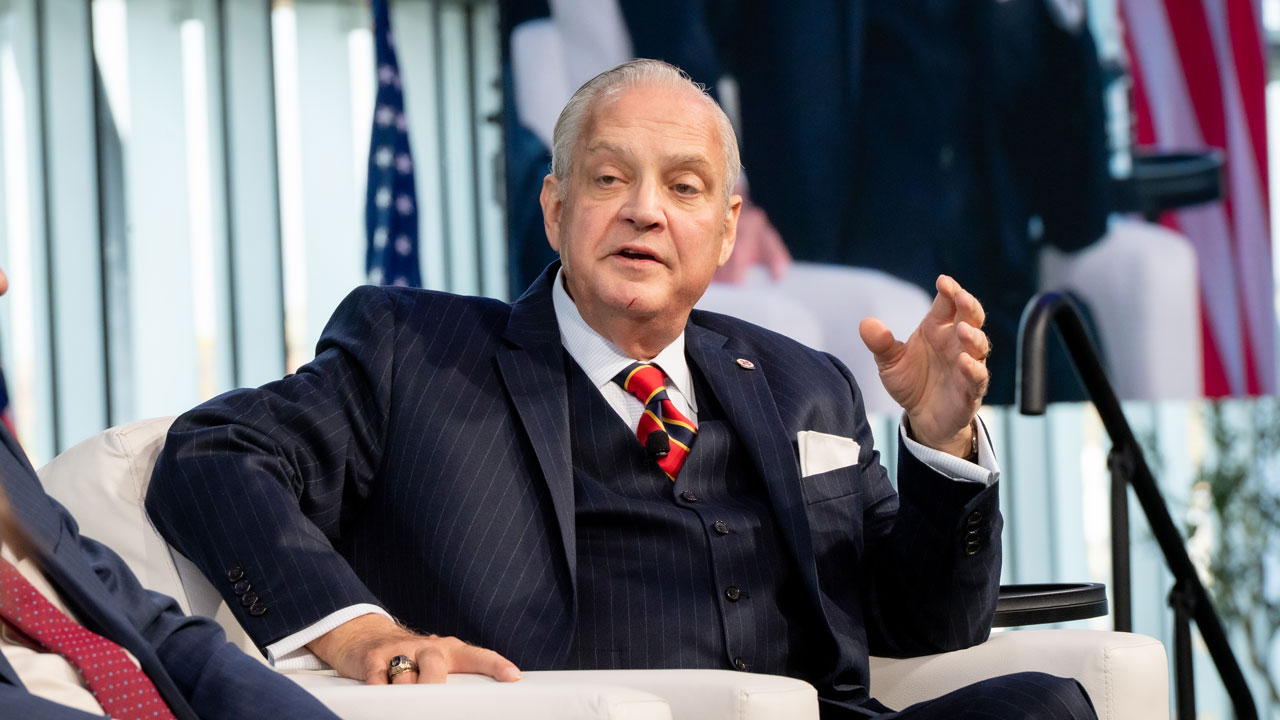
“Now we have a civilization at war with creation order and that’s the issue,” said R. Albert Mohler, president of the Southern Baptist Theological Seminary, at The Heritage Foundation’s conference The Forum on Thursday.
Clergy need to “have the bigger picture of the created world” and must understand that the political word grows out of the moral, said Yoram Hazony, president of the Herzl Institute.
“I’m not saying the president needs to be preaching Sunday sermons necessarily on television, but the president is a figure of tremendous religious significance just as the pastor is a figure of tremendous political significance,” he said.
The two scholars spoke on the role of religion in American politics. Mohler said that the old broad religious cultural consensus has shattered, making political issues far more existential to citizens.
“That radical break that really took place in the United States took place after 1950,” Mohler said, citing a “series of secularizing decisions” by the Supreme Court that assumed a “firm separation between church and state, and religion and the political system.”
Debates never faced by the church are suddenly coming under scrutiny, Mohler said, referring to “LGBTQ, plus, plus, plus” issues.
“The average Evangelical pastor now in a very real sense understands that … it’s going to be of public significance one day that he won’t marry a man to a man,” Mohler said.
“John Calvin didn’t worry about that, Augustine didn’t worry about that, Jonathan Edwards didn’t worry about that. The pastor of the First Baptist Church now has to worry about that.”
Hazony said that the idea of a separation of church and state as a part of the Constitution is now widely accepted as how things have always been, even though the First Amendment wasn’t interpreted that way until 1947. The amendment was originally understood to mean that the federal government was not allowed to favor one church or denomination, he said.
He later said that because Western societies now have this “hang up” about the separation of church and state, there are now downstream “side effects,” including making clergy hesitant to speak out.
This is a mistake, Hazony argued.
In contrast to America, Europe moved from a state where it was impossible not to believe in God toward allowing for doubt, and now generally holds the position that it’s impossible to believe, Mohler said.
“I don’t believe we are in that third condition, comprehensively, in the United States,” Mohler said. “I think the Democratic Party is in that position, but I still think there’s a significant Protestant, Catholic, Jewish presence that represents a theological challenge to the total secularization of the age.”
Continue reading...
[ H/T The Daily Signal ]