






America's Beer Slump Summed Up In One Chart
Bank of America analysts spot a sobering milestone for America's beer industry: shipments are on track to fall below 1980 levels this year as stretched household budgets collide with changing drinking habits. The explosion of GLP-1 drug demand, cannabis products, and growing health concerns about booze are adding pressure on demand.

BofA consumer staples analysts led by Peter Galbo outlined three key industry takeaways in a Tuesday note following their attendance at the annual Beer Insights Seminar, hosted by Beer Marketer's Insights (BMI) in New York City:
Shifting focus to the broader industry, Galbo said US beer shipments fell 3.9% through September. He cited data from BMI that showed if this trajectory holds, this would send annual shipments to 176 million barrels, below the 178 million shipped in 1980.
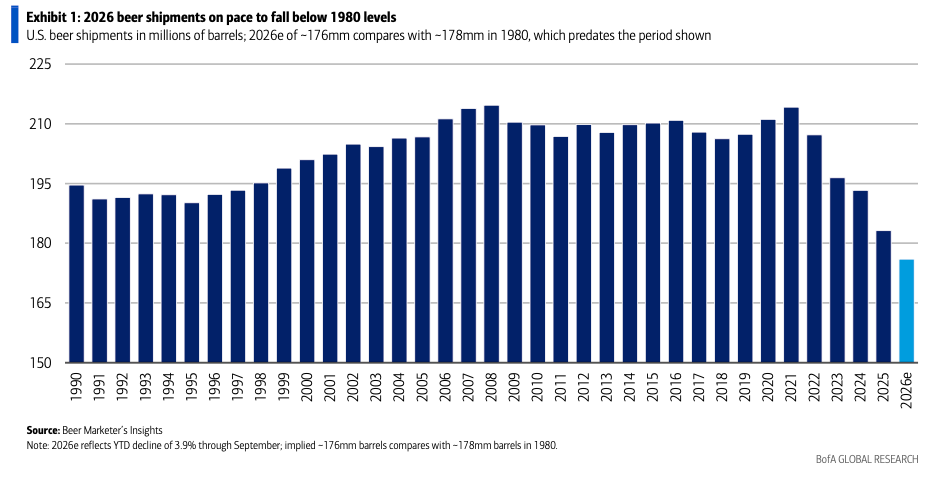
Galbo said BMI's data show a combination of financial pressure and changing drinking habits. Higher prices, inflation, and weaker consumer sentiment are weighing on demand, while ready-to-drink cocktails are capturing beer demand. He pointed out that hemp-derived THC beverages, GLP-1 drugs and increasingly negative sentiment toward alcohol are adding further headwinds.
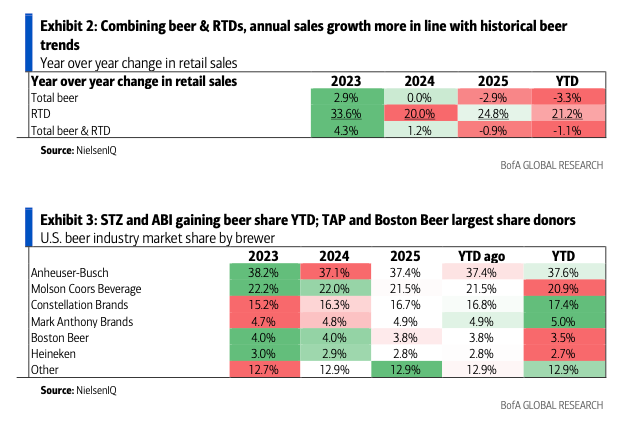
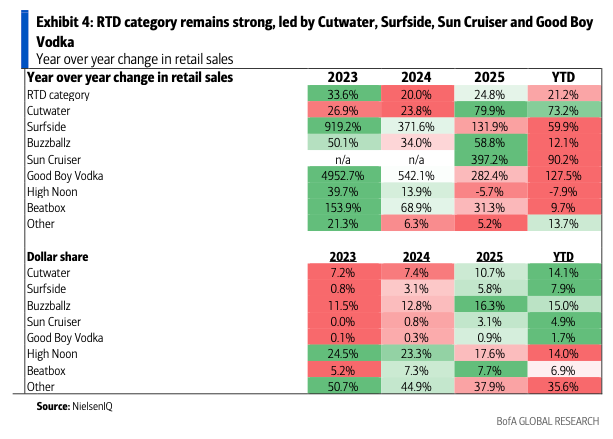
Within the industry, the pressure is uneven. Constellation Brands and AB InBev gained volume share, while Molson Coors and Boston Beer lost the most. Growth remains concentrated in canned cocktails and select nonalcoholic beer brands.
"Finally, the industry is undergoing a changing of the guard: all five of the largest U.S. beer suppliers have changed or announced changes to CEOs over roughly the past 15 months as companies manage core beer declines and search for growth in adjacencies," the analyst said.
More broadly, Italian spirits group Campari, maker of Aperol, Wild Turkey, SKYY vodka and Grand Marnier, reported an unexpected decline in third-quarter North American sales late last month.
"In North America, we are still growing, just to be clear, but the overall growth trajectory for this year is being impacted by the US," CEO Simon Hunt told analysts.
The shift in consumer habits away from alcohol comes as we recently cited a report that found daily marijuana use in the US has surpassed daily alcohol consumption among adults.
Tyler Durden Wed, 11/11/2026 - 13:35
Continue reading...
[ H/T ZeroHedge ]
Bank of America analysts spot a sobering milestone for America's beer industry: shipments are on track to fall below 1980 levels this year as stretched household budgets collide with changing drinking habits. The explosion of GLP-1 drug demand, cannabis products, and growing health concerns about booze are adding pressure on demand.
BofA consumer staples analysts led by Peter Galbo outlined three key industry takeaways in a Tuesday note following their attendance at the annual Beer Insights Seminar, hosted by Beer Marketer's Insights (BMI) in New York City:
- STZ/Hispanic consumer remains top of mind following a mixed weekend for immigration policy. STZ traded higher today, suggesting investors interpreted the developments favorably, while Nicholas Fink reiterated that the Hispanic consumer remains a long-term tailwind for the portfolio.
- Growth continues to shift beyond traditional beer and into RTDs, which continue to see strong growth, while the emerging "ade" segment could represent the next meaningful growth pocket.
- Optimism around NA beer remains high, with Athletic Brewing seeing a path for the category to ultimately reach ~20% of total beer.
Shifting focus to the broader industry, Galbo said US beer shipments fell 3.9% through September. He cited data from BMI that showed if this trajectory holds, this would send annual shipments to 176 million barrels, below the 178 million shipped in 1980.
Galbo said BMI's data show a combination of financial pressure and changing drinking habits. Higher prices, inflation, and weaker consumer sentiment are weighing on demand, while ready-to-drink cocktails are capturing beer demand. He pointed out that hemp-derived THC beverages, GLP-1 drugs and increasingly negative sentiment toward alcohol are adding further headwinds.
Within the industry, the pressure is uneven. Constellation Brands and AB InBev gained volume share, while Molson Coors and Boston Beer lost the most. Growth remains concentrated in canned cocktails and select nonalcoholic beer brands.
"Finally, the industry is undergoing a changing of the guard: all five of the largest U.S. beer suppliers have changed or announced changes to CEOs over roughly the past 15 months as companies manage core beer declines and search for growth in adjacencies," the analyst said.
More broadly, Italian spirits group Campari, maker of Aperol, Wild Turkey, SKYY vodka and Grand Marnier, reported an unexpected decline in third-quarter North American sales late last month.
"In North America, we are still growing, just to be clear, but the overall growth trajectory for this year is being impacted by the US," CEO Simon Hunt told analysts.
The shift in consumer habits away from alcohol comes as we recently cited a report that found daily marijuana use in the US has surpassed daily alcohol consumption among adults.
Tyler Durden Wed, 11/11/2026 - 13:35
Continue reading...
[ H/T ZeroHedge ]