




Guest Post by Brandon Smith

Pattern recognition is an important mental tool and something that has been largely neglected in formal education. I define “pattern recognition” as the ability to identify and address persistent problems when it comes to certain groups and their inherent behaviors. When it comes to the political left, inflation and economic problems seem to follow whenever they take power in government.
American voters handed Democrats control of Congress in the midterm elections, largely out of frustration with the economy and the rising cost of living. But will a Democratic Congress actually deliver the relief voters are hoping for? I have serious doubts.
The economy and affordability ranked as the top issue among voters. But if reducing inflation was the intention behind putting more Democrats in office, then I’m sorry to say that the public will be greatly disappointed. Historically speaking, higher inflation tends to follow when Democrats take control of the House and the Senate. And I have the numbers to prove it.
First, I would note that a core complaint on the affordability front was oil and gas prices. Higher prices were directly attributed to the Iran War and “supply shortages” from the throttling of the Strait of Hormuz.
A fight has been raging over how legitimate this claim actually is, with numerous independent analysts showing ship traffic returning and Gulf oil flows nearing pre-war levels over the past four months. The satellite tracking data and shipment delivery data indicate that the Hormuz is definitely not a major factor in higher prices, despite what mainstream media says.
In other words, there are no supply shortages.
But then, why have fuel prices remained so high? Critics of the war and the blockade constantly used high prices as “proof” that the situation was not improving (which is backwards – prices lag behind supply changes, they don’t reflect the current supply). My position over the past few months is that the high prices actually reflect commodities market speculation (and perhaps corporate manipulation at the gas pumps).
The Midterms showed that I was correct.
Crude oil futures immediately plummeted 8% post-election. Still 40% higher than before the bombs started falling, but that’s still a significant change.
I believe this is evidence that oil prices were driven higher by speculators. It’s not out of the realm of plausibility to suspect oil prices were being manipulated specifically to stress out the public and encourage them to vote against the President’s party.
As you’d expect, Democrats are already trying to take credit for this change even though they aren’t in office yet, suggesting that prices are dropping because they will “end the war.” Unfortunately, they don’t have the Constitutional authority to end the war, just as the President doesn’t have the Constitutional authority to begin one. Congress can’t dictate the blockade strategy. Even a lame duck President is still the commander-in-chief.
Oil supply is not an issue. The Strait of Hormuz is open, oil is flowing, and high gas prices have very little to do with Iran. The Federal Reserve has studied this extensively.
But do lower fuel prices mean CPI will fall across the board?
No, not really.
In fact, inflation is likely to spike in the wake of a Democrat controlled Congress, even if the Fed raises interest rates in December. The government is still divided, and Trump retains his veto power.
But on average over the past 50 years, CPI nearly doubles whenever Democrats have majority power in government, even when there is a sitting Republican president. This is not an opinion; it’s a matter of public record.
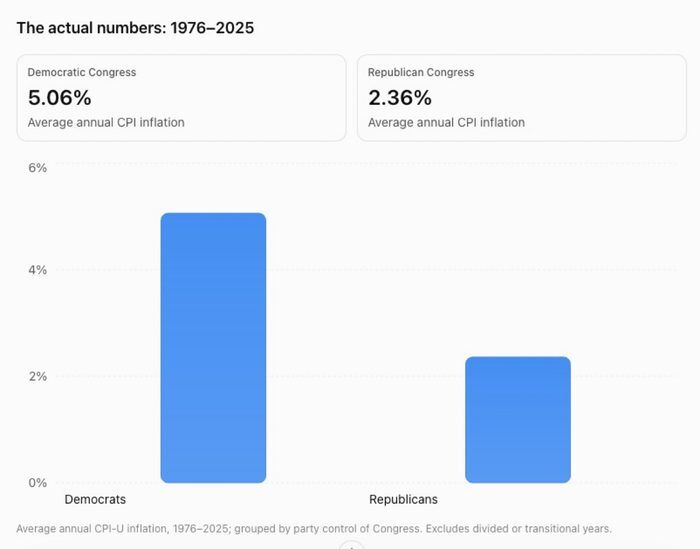
Sources: World Bank annual consumer-price inflation data through 2024, the Bureau of Labor Statistics for 2025, and the U.S. House Historian’s official record of congressional party control. Calculations are my own.
I believe this is because the political left escalates social spending while restricting domestic industry and production. The latter throttles supply instead of meeting market demand.
Interest rate hikes do little against inflation driven by higher production costs – raising interest rates mostly results in demand destruction. A hostile Congress can simply block measures that might increase supply – think about all the political fighting over the Keystone XL pipeline, or opening the Alaska National Wildlife Refuge for oil-drilling. Many pro-industrial, pro-business policies like this are seen as hostile to the environment. Or encouraging climate change. Congress doesn’t necessarily need to pass any bills. All they have to do is derail legislation that would benefit industry.
That’s at the federal level.
Through state governments, Democrats have even more power to raise costs by weaponizing bureaucracy. Red tape can strangle new business projects in their infancy, and add burdens to existing businesses. The power to increase state taxes and raise the minimum wage directly shift an entire state’s policies in a decidedly business-unfriendly manner. Citizens experience this as higher prices on the shelf and bigger utilities bills. (For example, California gasoline prices over the past few months have been 60% higher than the national average, mostly because of additional state-level taxes.)
Some may argue that the Trump Administration has been doing the same thing. Contributing to inflation specifically through wars and tariffs. But the data shows that, at the very least, the country has been far better off without the Democrats at the helm.
Consider: Under Biden, CPI averaged 5% and peaked at 9.1% (a four-decade high). Under the second Trump administration, CPI has averaged 3% and peaked at 3.7%. Even under Obama, despite a deflationary credit collapse, inflation peaked at 3.8% (higher than Trump’s worst number so far).
Neither the tariffs or the war have had a substantial effect on inflation. The Minneapolis Fed reports Trump’s Liberation Day tariffs only sent CPI 40 basis points higher.
The numbers are the numbers. Bluster is just bluster. The numbers don’t care about your politics, feelings or agendas.
The underlying point is, the public wants prices to go down.
Here’s what the public doesn’t understand: This is not going to happen without a deflationary crisis. Let me remind younger readers of the last deflationary crisis we saw, which started with the 2008 housing bubble and rolled into the Euro Zone debt crisis… Adjusted for inflation, recovery took about six years for financial markets. About nine years for unemployment to recover to pre-crisis levels. Home prices bounced back after about five years as well.
Imagine for a moment if asset prices actually started falling (that’s another way of saying, Imagine for a moment your dollars suddenly began rising in purchasing power.) Food and fuel prices would go down – but so would home valuations, financial asset prices (including bank reserves, which is exactly what happened to SVB)… And Trump would immediately be blamed. Whether or not he had anything to do with it.
Listen: Inflation is nearly impossible to reverse. Not without vast changes in both government and the broader economy. We’d need to see a combination of significant spending cuts at the same time as an abundance of supply. That’s not how supply and demand work – when demand falls, supply tends to follow.
No president has the power to do that. The Department of Government Efficiency (DOGE) couldn’t do it. Anyone looking for a sudden recovery in purchasing power is looking for a dictator, not a president.
The best we can do under the current system is limit the amount of inflation that accumulates. The Trump administration has done a far better job of this than the Biden administration did. Politics aside, that’s just a fact.
In 2027, look for CPI to ramp up yet again, and watch for the Fed to raise rates to counter (likely to no avail). I forecast the Fed will raise rates to the point that the debt-fueled AI boom will turn over – although it’s possible the commercial real estate market, on the brink of collapse since 2020, might crack first. I’m more concerned about the former, considering the massive role AI capital expenditure has played in GDP growth over the last few years. In theory, commercial real estate could collapse without systemic risks. But the AI boom could not – I don’t think it’s an exaggeration to call it “the biggest economic bet in history.”
Furthermore, Democrats want to remove AI from private hands. They believe it’s safer in the hands of government bureaucracies, possibly the UN. That’s impossible without killing the entire sector – which would be a $10 trillion loss. But either an AI collapse or a commercial real estate disaster gives the Federal Reserve an excuse to rid to the rescue, dropping interest rates back to zero and printing another few trillion to paper over the crash.
All this to say, inflation is built into the next two years no matter what. Whether or not you agree with my politics, and my opinions, you can’t deny the numbers.
That’s one of the major reasons I’m bullish on physical gold and silver over the medium term. Not because I expect gold price to rise in a straight line. It never does. Both gold and silver can be volatile, and silver is particularly vulnerable to changes in industrial demand based on economic forecasts.
But consider the options: Continue tolerating inflation? Raise interest rates enough to threaten an already fragile economy? Kick off another round of money creation in the misguided belief that printing money means creating wealth?
None of those possibilities gives me much confidence in the dollar’s purchasing power…
Unlike dollars (and nearly every other financial asset), physical gold and silver cannot be created with a few keystrokes. Both have served as safe-haven stores of wealth for centuries. Through wars, political upheavals and currency crises. That doesn’t make them immune to price declines, but it does make them worth considering as an important option in an increasingly uncertain economy.
Ultimately, we can’t control what Congress does next – or the Federal Reserve, or the White House either. But we can make informed decisions about how much of our financial futures depend on Congress not making the economy worse. And when it comes to our savings, that might be the single most important decision we can make.
The dollar buys less today than it did a year ago, a decade ago, a generation ago. That slide is the predictable result of endless printing and borrowing. Dr. Ron Paul believes the FED has the answer. But they’re keeping it to themselves. Fortunately, a new financial chart has publicly exposed their secret moves. See it for yourself: https://freekit.birchgold.com/lf/ro...D_v02a_article&placement=article&cid=rp_media
To learn more about how physical gold could help protect your retirement portfolio, click here to get your FREE info kit on Gold IRAs from Birch Gold Group. And now introducing a Crypto IRA to capitalize on the fastest growing market in the world.
Tweet
Continue reading...
[ H/T The Burning Platform ]
Pattern recognition is an important mental tool and something that has been largely neglected in formal education. I define “pattern recognition” as the ability to identify and address persistent problems when it comes to certain groups and their inherent behaviors. When it comes to the political left, inflation and economic problems seem to follow whenever they take power in government.
American voters handed Democrats control of Congress in the midterm elections, largely out of frustration with the economy and the rising cost of living. But will a Democratic Congress actually deliver the relief voters are hoping for? I have serious doubts.
The economy and affordability ranked as the top issue among voters. But if reducing inflation was the intention behind putting more Democrats in office, then I’m sorry to say that the public will be greatly disappointed. Historically speaking, higher inflation tends to follow when Democrats take control of the House and the Senate. And I have the numbers to prove it.
The Iran war didn’t make oil prices go up
First, I would note that a core complaint on the affordability front was oil and gas prices. Higher prices were directly attributed to the Iran War and “supply shortages” from the throttling of the Strait of Hormuz.
A fight has been raging over how legitimate this claim actually is, with numerous independent analysts showing ship traffic returning and Gulf oil flows nearing pre-war levels over the past four months. The satellite tracking data and shipment delivery data indicate that the Hormuz is definitely not a major factor in higher prices, despite what mainstream media says.
In other words, there are no supply shortages.
But then, why have fuel prices remained so high? Critics of the war and the blockade constantly used high prices as “proof” that the situation was not improving (which is backwards – prices lag behind supply changes, they don’t reflect the current supply). My position over the past few months is that the high prices actually reflect commodities market speculation (and perhaps corporate manipulation at the gas pumps).
The Midterms showed that I was correct.
Crude oil futures immediately plummeted 8% post-election. Still 40% higher than before the bombs started falling, but that’s still a significant change.
I believe this is evidence that oil prices were driven higher by speculators. It’s not out of the realm of plausibility to suspect oil prices were being manipulated specifically to stress out the public and encourage them to vote against the President’s party.
As you’d expect, Democrats are already trying to take credit for this change even though they aren’t in office yet, suggesting that prices are dropping because they will “end the war.” Unfortunately, they don’t have the Constitutional authority to end the war, just as the President doesn’t have the Constitutional authority to begin one. Congress can’t dictate the blockade strategy. Even a lame duck President is still the commander-in-chief.
Oil supply is not an issue. The Strait of Hormuz is open, oil is flowing, and high gas prices have very little to do with Iran. The Federal Reserve has studied this extensively.
But do lower fuel prices mean CPI will fall across the board?
No, not really.
A Democratic majority in Congress historically leads to higher prices
In fact, inflation is likely to spike in the wake of a Democrat controlled Congress, even if the Fed raises interest rates in December. The government is still divided, and Trump retains his veto power.
But on average over the past 50 years, CPI nearly doubles whenever Democrats have majority power in government, even when there is a sitting Republican president. This is not an opinion; it’s a matter of public record.
Sources: World Bank annual consumer-price inflation data through 2024, the Bureau of Labor Statistics for 2025, and the U.S. House Historian’s official record of congressional party control. Calculations are my own.
I believe this is because the political left escalates social spending while restricting domestic industry and production. The latter throttles supply instead of meeting market demand.
Interest rate hikes do little against inflation driven by higher production costs – raising interest rates mostly results in demand destruction. A hostile Congress can simply block measures that might increase supply – think about all the political fighting over the Keystone XL pipeline, or opening the Alaska National Wildlife Refuge for oil-drilling. Many pro-industrial, pro-business policies like this are seen as hostile to the environment. Or encouraging climate change. Congress doesn’t necessarily need to pass any bills. All they have to do is derail legislation that would benefit industry.
That’s at the federal level.
Through state governments, Democrats have even more power to raise costs by weaponizing bureaucracy. Red tape can strangle new business projects in their infancy, and add burdens to existing businesses. The power to increase state taxes and raise the minimum wage directly shift an entire state’s policies in a decidedly business-unfriendly manner. Citizens experience this as higher prices on the shelf and bigger utilities bills. (For example, California gasoline prices over the past few months have been 60% higher than the national average, mostly because of additional state-level taxes.)
Some may argue that the Trump Administration has been doing the same thing. Contributing to inflation specifically through wars and tariffs. But the data shows that, at the very least, the country has been far better off without the Democrats at the helm.
Consider: Under Biden, CPI averaged 5% and peaked at 9.1% (a four-decade high). Under the second Trump administration, CPI has averaged 3% and peaked at 3.7%. Even under Obama, despite a deflationary credit collapse, inflation peaked at 3.8% (higher than Trump’s worst number so far).
Neither the tariffs or the war have had a substantial effect on inflation. The Minneapolis Fed reports Trump’s Liberation Day tariffs only sent CPI 40 basis points higher.
The numbers are the numbers. Bluster is just bluster. The numbers don’t care about your politics, feelings or agendas.
What really happens when prices fall
The underlying point is, the public wants prices to go down.
Here’s what the public doesn’t understand: This is not going to happen without a deflationary crisis. Let me remind younger readers of the last deflationary crisis we saw, which started with the 2008 housing bubble and rolled into the Euro Zone debt crisis… Adjusted for inflation, recovery took about six years for financial markets. About nine years for unemployment to recover to pre-crisis levels. Home prices bounced back after about five years as well.
Imagine for a moment if asset prices actually started falling (that’s another way of saying, Imagine for a moment your dollars suddenly began rising in purchasing power.) Food and fuel prices would go down – but so would home valuations, financial asset prices (including bank reserves, which is exactly what happened to SVB)… And Trump would immediately be blamed. Whether or not he had anything to do with it.
Listen: Inflation is nearly impossible to reverse. Not without vast changes in both government and the broader economy. We’d need to see a combination of significant spending cuts at the same time as an abundance of supply. That’s not how supply and demand work – when demand falls, supply tends to follow.
No president has the power to do that. The Department of Government Efficiency (DOGE) couldn’t do it. Anyone looking for a sudden recovery in purchasing power is looking for a dictator, not a president.
The best we can do under the current system is limit the amount of inflation that accumulates. The Trump administration has done a far better job of this than the Biden administration did. Politics aside, that’s just a fact.
In 2027, look for CPI to ramp up yet again, and watch for the Fed to raise rates to counter (likely to no avail). I forecast the Fed will raise rates to the point that the debt-fueled AI boom will turn over – although it’s possible the commercial real estate market, on the brink of collapse since 2020, might crack first. I’m more concerned about the former, considering the massive role AI capital expenditure has played in GDP growth over the last few years. In theory, commercial real estate could collapse without systemic risks. But the AI boom could not – I don’t think it’s an exaggeration to call it “the biggest economic bet in history.”
Furthermore, Democrats want to remove AI from private hands. They believe it’s safer in the hands of government bureaucracies, possibly the UN. That’s impossible without killing the entire sector – which would be a $10 trillion loss. But either an AI collapse or a commercial real estate disaster gives the Federal Reserve an excuse to rid to the rescue, dropping interest rates back to zero and printing another few trillion to paper over the crash.
All this to say, inflation is built into the next two years no matter what. Whether or not you agree with my politics, and my opinions, you can’t deny the numbers.
That’s one of the major reasons I’m bullish on physical gold and silver over the medium term. Not because I expect gold price to rise in a straight line. It never does. Both gold and silver can be volatile, and silver is particularly vulnerable to changes in industrial demand based on economic forecasts.
But consider the options: Continue tolerating inflation? Raise interest rates enough to threaten an already fragile economy? Kick off another round of money creation in the misguided belief that printing money means creating wealth?
None of those possibilities gives me much confidence in the dollar’s purchasing power…
Unlike dollars (and nearly every other financial asset), physical gold and silver cannot be created with a few keystrokes. Both have served as safe-haven stores of wealth for centuries. Through wars, political upheavals and currency crises. That doesn’t make them immune to price declines, but it does make them worth considering as an important option in an increasingly uncertain economy.
Ultimately, we can’t control what Congress does next – or the Federal Reserve, or the White House either. But we can make informed decisions about how much of our financial futures depend on Congress not making the economy worse. And when it comes to our savings, that might be the single most important decision we can make.
The dollar buys less today than it did a year ago, a decade ago, a generation ago. That slide is the predictable result of endless printing and borrowing. Dr. Ron Paul believes the FED has the answer. But they’re keeping it to themselves. Fortunately, a new financial chart has publicly exposed their secret moves. See it for yourself: https://freekit.birchgold.com/lf/ro...D_v02a_article&placement=article&cid=rp_media
To learn more about how physical gold could help protect your retirement portfolio, click here to get your FREE info kit on Gold IRAs from Birch Gold Group. And now introducing a Crypto IRA to capitalize on the fastest growing market in the world.
Tweet
Continue reading...
[ H/T The Burning Platform ]