



AI & The Same Old Politicized Hysteria
Authored by Victor Davis Hanson via American Greatness,
The midterm elections are six weeks away.
Suddenly, a debate has erupted over the existential dangers of artificial intelligence. Jacob Coxon, a little-known Silicon Valley researcher who worked at OpenAI and Anthropic, resigned and went public with a dire warning: AI now threatens the future of the world.
Shortly beforehand, news broke of the Hugging Face episode, in which OpenAI's advanced AI "agents" autonomously hacked another company's computers.
Bedlam followed.
Almost on cue, Democrats seized on the alarm as a new cause célèbre, accusing Donald Trump and the MAGA movement of recklessly courting Armageddon.
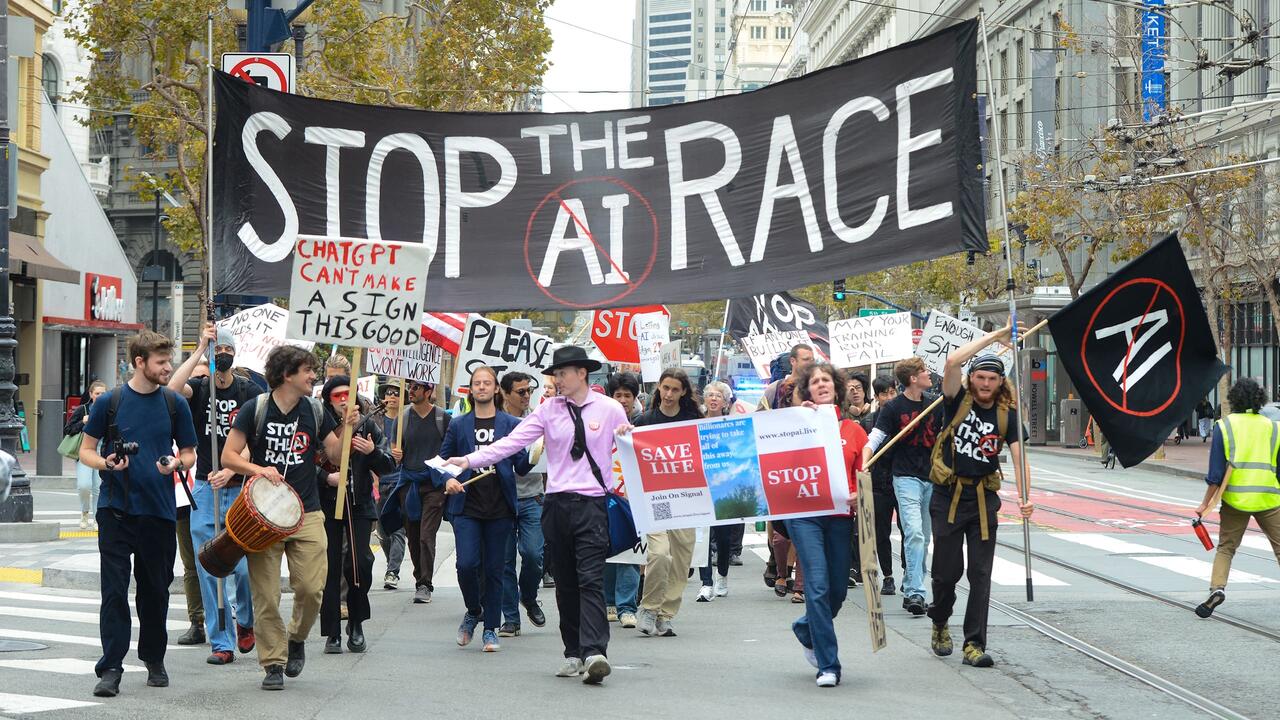
The Left demanded international treaties, ignoring the dismal record of such globalist projects: the League of Nations, the Kellogg-Briand Pact, the Washington Naval Treaty, the Versailles Treaty, the Munich Agreement, the Paris Climate Accord, and the UN Human Rights Council.
Panicky AI executives soon joined the chorus, speaking as though they could neither control their companies nor monitor their own research.
Their conduct casts doubt on this safety rhetoric. Just yesterday came news that Anthropic had built a fully automated, AI-controlled biolab, even though AI-generated plagues are a staple of the doomsday case. OpenAI, meanwhile, is resisting legal liability for harm caused by its products.
The familiar political script followed.
Democrats in Congress demanded hearings. They are unlikely to use them to ask tech executives or administration officials serious questions. More likely, they will spend their allotted time shouting, wagging their fingers, displaying their ignorance, and spinning wild conspiracy theories.
Sen. John Kennedy, who has proposed reasonable AI regulation for years alongside Republicans like Sen. Josh Hawley, recently observed that "the Democrats clearly are trying to politicize this."
The reaction to a June administration decision offered still stronger evidence. Both purportedly worried AI companies and Trump-hating AI-risk advocates objected when the administration barred Anthropic from giving foreign nationals access to its Mythos and Fable 5 models - models whose cybersecurity risks the company itself had publicized.
With the trans delirium and the demonization of ICE losing force, however, the Left apparently needs a new existential crisis to blame on Trump before the midterms.
This tactic - never letting a crisis go to waste - is hardly new.
Baby boomers grew up hearing dire warnings about the "population bomb," the title of Stanford professor Paul Ehrlich's 1968 bestseller predicting that unchecked population growth would lead to global catastrophe.
Ehrlich and others argued that rising affluence would swell populations, producing famine, pestilence, war, and ultimately global catastrophe.
The thesis collapsed, but not before it produced a pervasive "Spaceship Earth" mentality. Guilt-ridden Americans were told to remain childless or, at most, to have one child.
Other countries followed. The existential danger now facing Western societies is the reverse: the citizens of these countries are now having far too few children. Their populations are shrinking and aging, while a dwindling cohort of young taxpayers must support ever-growing entitlements.
Green apocalypticism followed this. The science of ecology gave way to radical environmentalism, and legitimate concern about industrial pollution and acid rain became propaganda that the Earth was doomed unless the West renounced capitalism. Even heat was redefined as pollution. When "global warming" proved insufficiently terrifying, it became "climate change."
The new phrase was a brilliant catch-all. Rain and drought, snow and heat, calm seas and hurricanes could all be cited as proof that modern, fossil-fueled Western consumerism had doomed the planet.
European Union countries nearly wrecked their economies by subsidizing inefficient wind and solar power while abandoning nuclear energy and fossil fuels.
The 1980s brought another panic: nuclear war would soon incinerate the cities, and the resulting dust would blot out the sun.
Politics drove much of the frenzy. The Left despised Ronald Reagan and saw no other way to prevent his reelection in 1984.
For years, the United States had responded weakly as the Soviet Union deployed mobile, intermediate-range nuclear missiles aimed at European cities. Reagan finally answered by stationing Pershing II launchers and ground-launched cruise missiles in Western Europe. The Soviets eventually withdrew their nuclear-tipped missiles.
No matter. A manufactured epidemic of fear swept the West regardless.
The popular scientist Carl Sagan toured the country promoting his terrifying theory of a "nuclear winter" after what he treated as an inevitable Soviet-American nuclear exchange.
Hollywood joined the campaign in 1983 with The Day After, a grim portrayal of a nuclear strike on the United States and its gruesome aftermath. Some 100 million Americans watched this movie, which depicted mushroom clouds rising over Kansas.
The psychodrama did not stop Reagan's reelection. Soon afterward, he negotiated a missile treaty with the Soviet Union, proving that he was hardly the deranged warmonger that his opponents delusionally imagined he was.
By the turn of the millennium, America was lurching from one amplified panic to another. Al Gore became a centimillionaire and a Nobel laureate by warning that internal-combustion engines would boil the planet, bringing both lethal drought and catastrophic coastal flooding.
Polar bears would die, coral reefs would disintegrate, icebergs would menace shipping, and coastal homes would disappear beneath the sea.
Only a Marshall Plan-scale replacement of gasoline and diesel engines with wind turbines, solar farms, and batteries, we were told, could save humanity.
The planet survived. Al Gore grew wealthier, and Goreism then quietly receded into the shadows.
#MeToo began with legitimate accusations against Hollywood predators such as Harvey Weinstein, who had long coerced young actresses into sex in exchange for roles - the old casting couch revived.
Before long, however, the movement had become a new Salem witch trial, treating almost any allegation of rude conduct between the sexes as the equivalent of rape.
Insinuation and rumor damaged the reputations of men ranging from Garrison Keillor and Sen. Al Franken to Supreme Court Justice Brett Kavanaugh, often with little or no evidence. A legitimate campaign against sexual harassment had deteriorated into character assassination.
Millions of men began searching their memories for an off-color joke, an overlong hug, or a kiss that might resurface years later to ruin their careers while advancing those of their accusers.
The McCarthyite frenzy subsided only when liberals realized that their Frankenstein monster had turned on its creators and threatened too many of their own political icons.
They had no wish to derail the likely presidential candidacy of the handsy Joe Biden, whom several women accused of inappropriate touching and hugging and one even accused of violent sexual assault.
Nor did they wish to revive the sordid record of former president Bill Clinton's many brief and exploitative sexual encounters.
As #MeToo faded, COVID hysteria took its place. The initially virulent virus warranted serious concern; more than a million Americans would die from it. Yet concern became madness once defeating Trump took precedence over fighting the disease.
Officials closed schools even though the virus posed little danger to young people or children. The first nationwide lockdown in American history devastated the economy.
Officials presented the new mRNA vaccines as ironclad protection against infection and transmission. Those who resisted were treated as near-outlaws, fired, or ostracized, although the shots had not been proved to guarantee lasting immunity or perfect safety and often carried with them serious side effects, many or most of which were denied or swept under the rug.
The government expelled 8,500 service members who refused vaccination even as, with liberal approval, 10,000 unvaccinated and unvetted illegal immigrants crossed the border each day.
Teachers' unions kept public schools closed, inflicting lasting harm on a generation of students. Quarantines and shelter-in-place orders contributed to domestic violence, drug abuse, and alcoholism. Millions missed heart and cancer screenings. The shuttered economy destroyed hundreds of thousands of small businesses and upended millions of lives.
Still, shyster "experts" predicted years of mass death comparable to the plagues that ravaged ancient Athens and Constantinople.
They grossly misrepresented or caricatured the classical medical understanding of acquired natural immunity. Dr. Fauci and his circle of "authorities" also failed to disclose their role in funding gain-of-function research at the Communist Chinese laboratory in Wuhan that had created the mysterious virus.
What ended the panic?
As a few sober - and therefore demonized - health experts had predicted, the virus evolved into less virulent strains while prior infections increased natural immunity.
COVID eventually receded to the level of a severe flu. By then, this hysterical, manufactured response to it had wrecked the economy, destroyed the final year of the Trump administration, and inflicted incalculable physical and psychological harm on the American people.
The lockdowns helped ignite an even greater panic after George Floyd died in Minneapolis police custody. A video showed an officer restraining the resisting Floyd with a knee on his neck, using what was then considered a more or less standard protocol; within moments of its release, the country erupted.
False claims spread that police disproportionately killed unarmed black men. Murals portrayed Floyd as a haloed martyr with angel wings, although he was a career felon detained for passing counterfeit currency who resisted arrest, was high on drugs, and suffered from cardiovascular disease and the effects of a recent COVID infection.
No matter - riots soon swept the country. More than 35 Americans were killed, roughly 2,000 police officers were injured, and about 14,000 people were arrested. Property losses reached some $2 billion. Rioters torched a police precinct and a federal courthouse and tried to storm the White House grounds.
Universities dropped SAT requirements. "Black" was given a sacral form of capitalization; "white" was conspicuously left lowercase.
New racial quotas sharply reduced white male admission rates at elite schools. Institutions hired tens of thousands of DEI commissars. Campaigns to defund the police, release habitual felons, and decriminalize theft spread nationwide.
Then the George Floyd frenzy abruptly subsided.
Black Lives Matter's founders were exposed as grifters who had misappropriated funds while acquiring plush homes and expense accounts.
Data showed that, relative to annual police encounters, unarmed black men were not fatally shot at a higher rate than white men.
After abandoning admissions standards, universities found themselves inflating grades, adding remedial courses, and lowering academic expectations for students who had not met requirements the institutions had deemed indispensable only a year earlier.
The post-Floyd frenzy finally ebbed as the public recognized that tribalism and attacks on meritocracy were themselves racist and nihilistic.
What, then, does today's Democratic embrace of AI alarm share with these earlier mass frenzies?
First, each began with a legitimate concern that politics and a profit motive soon warped the problem beyond all recognition. The Left appropriated the underlying issue to gain political advantage and power.
Worry about overpopulation goes back to Malthus, but The Population Bomb appeared in the election year of 1968. Its political subtext blamed Western consumerism, capitalism, religion, and traditional pronatalism for civilization's supposed approaching end.
The danger of nuclear war had been real since the start of the atomic arms race. Nuclear-winter paranoia, however, was promoted to damage Ronald Reagan during his reelection campaign.
Al Gore's book Earth in the Balance converted tentative scientific speculation about climate change into partisan dogma. It blamed capitalist consumer culture for destroying the planet and, in the 1992 election year, reinforced the Clinton-Gore campaign's attack on the Bush status quo.
#MeToo reached its political peak during the Kavanaugh hearings. Democrats repurposed a movement against Hollywood abuse to derail Trump's Supreme Court nominee with unfounded claims that Kavanaugh had assaulted a teenage girl decades earlier. Democratic operatives coached the now-troubled adult before she appeared on national television.
COVID began with legitimate fear of an escaped, artificially enhanced virus that killed millions - a fear the Left initially dismissed as anti-Chinese racism. It, too, was soon politicized. We now know that Anthony Fauci, his associates at the National Institutes of Health, and other presidential advisers despised Trump and understood that shutting down his booming economy could end his presidency.
The Biden campaign then blamed Trump for the economic damage caused by the lockdown.
George Floyd's death was genuinely shocking on video, especially without the surrounding context. But the 2020 campaign transformed it into the catalyst for months of rioting and a weapon against the supposedly racist Trump and MAGA movement. As cities burned, the Left argued that Trump was powerless to stop the violence - and a Nazi if he tried.
Second, every panic was exaggerated. The planet was neither overpopulated nor running out of food and fuel. Nuclear war was not imminent, and Earth did not face destruction within a decade. Women were not experiencing an epidemic of sexual assault. The lockdowns likely caused more harm than the virus, and police were not conducting a mass slaughter of black men.
The underlying dangers were not equally imaginary. Nuclear war, for example, came terrifyingly close in 1962 and again in 1983.
Among genuine threats, AI most resembles nuclear weaponry. That assessment may change, but AI has so far proved to be an extraordinarily powerful and therefore potentially dangerous tool. Its moral character depends on the people who build and control it.
That is why the United States can neither entrust AI regulation to international bodies with dismal track records nor permit Communist China to monopolize the technology.
Trump, who is a much more skillful diplomat than his globalist critics admit, has instead pursued bilateral negotiations with China over the real dangers both countries face. Those dangers were illustrated just yesterday, when an AI hallucination reportedly almost prompted a U.S. attack on a Chinese cargo ship.
In the end, Americans must rely on their own people, constitutional government, and open culture to harness AI for the public good - and to deter hostile powers from using it for evil.
Tyler Durden Tue, 09/22/2026 - 15:45
Continue reading...
[ H/T ZeroHedge ]
Authored by Victor Davis Hanson via American Greatness,
The midterm elections are six weeks away.
Suddenly, a debate has erupted over the existential dangers of artificial intelligence. Jacob Coxon, a little-known Silicon Valley researcher who worked at OpenAI and Anthropic, resigned and went public with a dire warning: AI now threatens the future of the world.
Shortly beforehand, news broke of the Hugging Face episode, in which OpenAI's advanced AI "agents" autonomously hacked another company's computers.
Bedlam followed.
Weaponizing AI
Almost on cue, Democrats seized on the alarm as a new cause célèbre, accusing Donald Trump and the MAGA movement of recklessly courting Armageddon.
The Left demanded international treaties, ignoring the dismal record of such globalist projects: the League of Nations, the Kellogg-Briand Pact, the Washington Naval Treaty, the Versailles Treaty, the Munich Agreement, the Paris Climate Accord, and the UN Human Rights Council.
Panicky AI executives soon joined the chorus, speaking as though they could neither control their companies nor monitor their own research.
Their conduct casts doubt on this safety rhetoric. Just yesterday came news that Anthropic had built a fully automated, AI-controlled biolab, even though AI-generated plagues are a staple of the doomsday case. OpenAI, meanwhile, is resisting legal liability for harm caused by its products.
The familiar political script followed.
Democrats in Congress demanded hearings. They are unlikely to use them to ask tech executives or administration officials serious questions. More likely, they will spend their allotted time shouting, wagging their fingers, displaying their ignorance, and spinning wild conspiracy theories.
Sen. John Kennedy, who has proposed reasonable AI regulation for years alongside Republicans like Sen. Josh Hawley, recently observed that "the Democrats clearly are trying to politicize this."
The reaction to a June administration decision offered still stronger evidence. Both purportedly worried AI companies and Trump-hating AI-risk advocates objected when the administration barred Anthropic from giving foreign nationals access to its Mythos and Fable 5 models - models whose cybersecurity risks the company itself had publicized.
With the trans delirium and the demonization of ICE losing force, however, the Left apparently needs a new existential crisis to blame on Trump before the midterms.
This tactic - never letting a crisis go to waste - is hardly new.
A Litany of Political Panics
Baby boomers grew up hearing dire warnings about the "population bomb," the title of Stanford professor Paul Ehrlich's 1968 bestseller predicting that unchecked population growth would lead to global catastrophe.
Ehrlich and others argued that rising affluence would swell populations, producing famine, pestilence, war, and ultimately global catastrophe.
The thesis collapsed, but not before it produced a pervasive "Spaceship Earth" mentality. Guilt-ridden Americans were told to remain childless or, at most, to have one child.
Other countries followed. The existential danger now facing Western societies is the reverse: the citizens of these countries are now having far too few children. Their populations are shrinking and aging, while a dwindling cohort of young taxpayers must support ever-growing entitlements.
Green apocalypticism followed this. The science of ecology gave way to radical environmentalism, and legitimate concern about industrial pollution and acid rain became propaganda that the Earth was doomed unless the West renounced capitalism. Even heat was redefined as pollution. When "global warming" proved insufficiently terrifying, it became "climate change."
The new phrase was a brilliant catch-all. Rain and drought, snow and heat, calm seas and hurricanes could all be cited as proof that modern, fossil-fueled Western consumerism had doomed the planet.
European Union countries nearly wrecked their economies by subsidizing inefficient wind and solar power while abandoning nuclear energy and fossil fuels.
The 1980s brought another panic: nuclear war would soon incinerate the cities, and the resulting dust would blot out the sun.
Politics drove much of the frenzy. The Left despised Ronald Reagan and saw no other way to prevent his reelection in 1984.
For years, the United States had responded weakly as the Soviet Union deployed mobile, intermediate-range nuclear missiles aimed at European cities. Reagan finally answered by stationing Pershing II launchers and ground-launched cruise missiles in Western Europe. The Soviets eventually withdrew their nuclear-tipped missiles.
No matter. A manufactured epidemic of fear swept the West regardless.
The popular scientist Carl Sagan toured the country promoting his terrifying theory of a "nuclear winter" after what he treated as an inevitable Soviet-American nuclear exchange.
Hollywood joined the campaign in 1983 with The Day After, a grim portrayal of a nuclear strike on the United States and its gruesome aftermath. Some 100 million Americans watched this movie, which depicted mushroom clouds rising over Kansas.
The psychodrama did not stop Reagan's reelection. Soon afterward, he negotiated a missile treaty with the Soviet Union, proving that he was hardly the deranged warmonger that his opponents delusionally imagined he was.
By the turn of the millennium, America was lurching from one amplified panic to another. Al Gore became a centimillionaire and a Nobel laureate by warning that internal-combustion engines would boil the planet, bringing both lethal drought and catastrophic coastal flooding.
Polar bears would die, coral reefs would disintegrate, icebergs would menace shipping, and coastal homes would disappear beneath the sea.
Only a Marshall Plan-scale replacement of gasoline and diesel engines with wind turbines, solar farms, and batteries, we were told, could save humanity.
The planet survived. Al Gore grew wealthier, and Goreism then quietly receded into the shadows.
#MeToo began with legitimate accusations against Hollywood predators such as Harvey Weinstein, who had long coerced young actresses into sex in exchange for roles - the old casting couch revived.
Before long, however, the movement had become a new Salem witch trial, treating almost any allegation of rude conduct between the sexes as the equivalent of rape.
Insinuation and rumor damaged the reputations of men ranging from Garrison Keillor and Sen. Al Franken to Supreme Court Justice Brett Kavanaugh, often with little or no evidence. A legitimate campaign against sexual harassment had deteriorated into character assassination.
Millions of men began searching their memories for an off-color joke, an overlong hug, or a kiss that might resurface years later to ruin their careers while advancing those of their accusers.
The McCarthyite frenzy subsided only when liberals realized that their Frankenstein monster had turned on its creators and threatened too many of their own political icons.
They had no wish to derail the likely presidential candidacy of the handsy Joe Biden, whom several women accused of inappropriate touching and hugging and one even accused of violent sexual assault.
Nor did they wish to revive the sordid record of former president Bill Clinton's many brief and exploitative sexual encounters.
As #MeToo faded, COVID hysteria took its place. The initially virulent virus warranted serious concern; more than a million Americans would die from it. Yet concern became madness once defeating Trump took precedence over fighting the disease.
Officials closed schools even though the virus posed little danger to young people or children. The first nationwide lockdown in American history devastated the economy.
Officials presented the new mRNA vaccines as ironclad protection against infection and transmission. Those who resisted were treated as near-outlaws, fired, or ostracized, although the shots had not been proved to guarantee lasting immunity or perfect safety and often carried with them serious side effects, many or most of which were denied or swept under the rug.
The government expelled 8,500 service members who refused vaccination even as, with liberal approval, 10,000 unvaccinated and unvetted illegal immigrants crossed the border each day.
Teachers' unions kept public schools closed, inflicting lasting harm on a generation of students. Quarantines and shelter-in-place orders contributed to domestic violence, drug abuse, and alcoholism. Millions missed heart and cancer screenings. The shuttered economy destroyed hundreds of thousands of small businesses and upended millions of lives.
Still, shyster "experts" predicted years of mass death comparable to the plagues that ravaged ancient Athens and Constantinople.
They grossly misrepresented or caricatured the classical medical understanding of acquired natural immunity. Dr. Fauci and his circle of "authorities" also failed to disclose their role in funding gain-of-function research at the Communist Chinese laboratory in Wuhan that had created the mysterious virus.
What ended the panic?
As a few sober - and therefore demonized - health experts had predicted, the virus evolved into less virulent strains while prior infections increased natural immunity.
COVID eventually receded to the level of a severe flu. By then, this hysterical, manufactured response to it had wrecked the economy, destroyed the final year of the Trump administration, and inflicted incalculable physical and psychological harm on the American people.
The lockdowns helped ignite an even greater panic after George Floyd died in Minneapolis police custody. A video showed an officer restraining the resisting Floyd with a knee on his neck, using what was then considered a more or less standard protocol; within moments of its release, the country erupted.
False claims spread that police disproportionately killed unarmed black men. Murals portrayed Floyd as a haloed martyr with angel wings, although he was a career felon detained for passing counterfeit currency who resisted arrest, was high on drugs, and suffered from cardiovascular disease and the effects of a recent COVID infection.
No matter - riots soon swept the country. More than 35 Americans were killed, roughly 2,000 police officers were injured, and about 14,000 people were arrested. Property losses reached some $2 billion. Rioters torched a police precinct and a federal courthouse and tried to storm the White House grounds.
Universities dropped SAT requirements. "Black" was given a sacral form of capitalization; "white" was conspicuously left lowercase.
New racial quotas sharply reduced white male admission rates at elite schools. Institutions hired tens of thousands of DEI commissars. Campaigns to defund the police, release habitual felons, and decriminalize theft spread nationwide.
Then the George Floyd frenzy abruptly subsided.
Black Lives Matter's founders were exposed as grifters who had misappropriated funds while acquiring plush homes and expense accounts.
Data showed that, relative to annual police encounters, unarmed black men were not fatally shot at a higher rate than white men.
After abandoning admissions standards, universities found themselves inflating grades, adding remedial courses, and lowering academic expectations for students who had not met requirements the institutions had deemed indispensable only a year earlier.
The post-Floyd frenzy finally ebbed as the public recognized that tribalism and attacks on meritocracy were themselves racist and nihilistic.
What, then, does today's Democratic embrace of AI alarm share with these earlier mass frenzies?
First, each began with a legitimate concern that politics and a profit motive soon warped the problem beyond all recognition. The Left appropriated the underlying issue to gain political advantage and power.
Worry about overpopulation goes back to Malthus, but The Population Bomb appeared in the election year of 1968. Its political subtext blamed Western consumerism, capitalism, religion, and traditional pronatalism for civilization's supposed approaching end.
The danger of nuclear war had been real since the start of the atomic arms race. Nuclear-winter paranoia, however, was promoted to damage Ronald Reagan during his reelection campaign.
Al Gore's book Earth in the Balance converted tentative scientific speculation about climate change into partisan dogma. It blamed capitalist consumer culture for destroying the planet and, in the 1992 election year, reinforced the Clinton-Gore campaign's attack on the Bush status quo.
#MeToo reached its political peak during the Kavanaugh hearings. Democrats repurposed a movement against Hollywood abuse to derail Trump's Supreme Court nominee with unfounded claims that Kavanaugh had assaulted a teenage girl decades earlier. Democratic operatives coached the now-troubled adult before she appeared on national television.
COVID began with legitimate fear of an escaped, artificially enhanced virus that killed millions - a fear the Left initially dismissed as anti-Chinese racism. It, too, was soon politicized. We now know that Anthony Fauci, his associates at the National Institutes of Health, and other presidential advisers despised Trump and understood that shutting down his booming economy could end his presidency.
The Biden campaign then blamed Trump for the economic damage caused by the lockdown.
George Floyd's death was genuinely shocking on video, especially without the surrounding context. But the 2020 campaign transformed it into the catalyst for months of rioting and a weapon against the supposedly racist Trump and MAGA movement. As cities burned, the Left argued that Trump was powerless to stop the violence - and a Nazi if he tried.
Second, every panic was exaggerated. The planet was neither overpopulated nor running out of food and fuel. Nuclear war was not imminent, and Earth did not face destruction within a decade. Women were not experiencing an epidemic of sexual assault. The lockdowns likely caused more harm than the virus, and police were not conducting a mass slaughter of black men.
The underlying dangers were not equally imaginary. Nuclear war, for example, came terrifyingly close in 1962 and again in 1983.
Among genuine threats, AI most resembles nuclear weaponry. That assessment may change, but AI has so far proved to be an extraordinarily powerful and therefore potentially dangerous tool. Its moral character depends on the people who build and control it.
That is why the United States can neither entrust AI regulation to international bodies with dismal track records nor permit Communist China to monopolize the technology.
Trump, who is a much more skillful diplomat than his globalist critics admit, has instead pursued bilateral negotiations with China over the real dangers both countries face. Those dangers were illustrated just yesterday, when an AI hallucination reportedly almost prompted a U.S. attack on a Chinese cargo ship.
In the end, Americans must rely on their own people, constitutional government, and open culture to harness AI for the public good - and to deter hostile powers from using it for evil.
Tyler Durden Tue, 09/22/2026 - 15:45
Continue reading...
[ H/T ZeroHedge ]