






After France, Belgium Is Europe's Next Debt Flashpoint
Authored by Thomas Kolbe via American Thinker,
In the shadow of France's sovereign debt crisis, other smoldering fires threaten to become a raging blaze. In Belgium, things could come to a flashpoint that sets the entire eurozone alight.

Among the many catastrophic lessons of the great financial and sovereign debt crisis more than a decade ago, one came as a surprise: it is not the size of an economy that determines the outbreak of a sovereign debt crisis. It was tiny Greece, accounting for just 2.5 percent of the eurozone's total economic output, that came within a hair's breadth of blowing the union apart from within. At the time, Greece's sovereign debt reached 170 percent of GDP. Austerity was then the order of the day, and given the country's homogeneous population and undeniable state lethargy, it was ultimately accepted.
But things hung by a thread. For in the eurozone, states are chained together through the bond market. The EU, and above all the eurozone, is simply not a federation like the United States. Debt consolidation under the leadership of the European Commission may be Brussels' goal, but given the growing tensions on the continent, it is likely to remain an illusion.
Brussels has long been using an instrument that points in this direction: through NextGenerationEU, the Commission raises joint funds on the capital markets in order to make them available to member states in the form of grants and loans. Countries such as Spain and Italy in particular benefit from this. The political trick is to increasingly cushion national financing problems through joint debt and EU funds. Joint liability is thus growing not necessarily through an open decision in favor of a debt union, but gradually through new financing instruments.
In Brussels, it has been recognized: in the event of a crisis, a fragmented capital market exacerbates the problem. If one member comes under pressure in the bond market, speculators shift their capital in cascades through the ranks of the fiscally weakest members, setting off a domino effect. Moreover, the construct stands and falls with the creditworthiness of the Federal Republic of Germany - and lately, that is no longer in such good shape either.
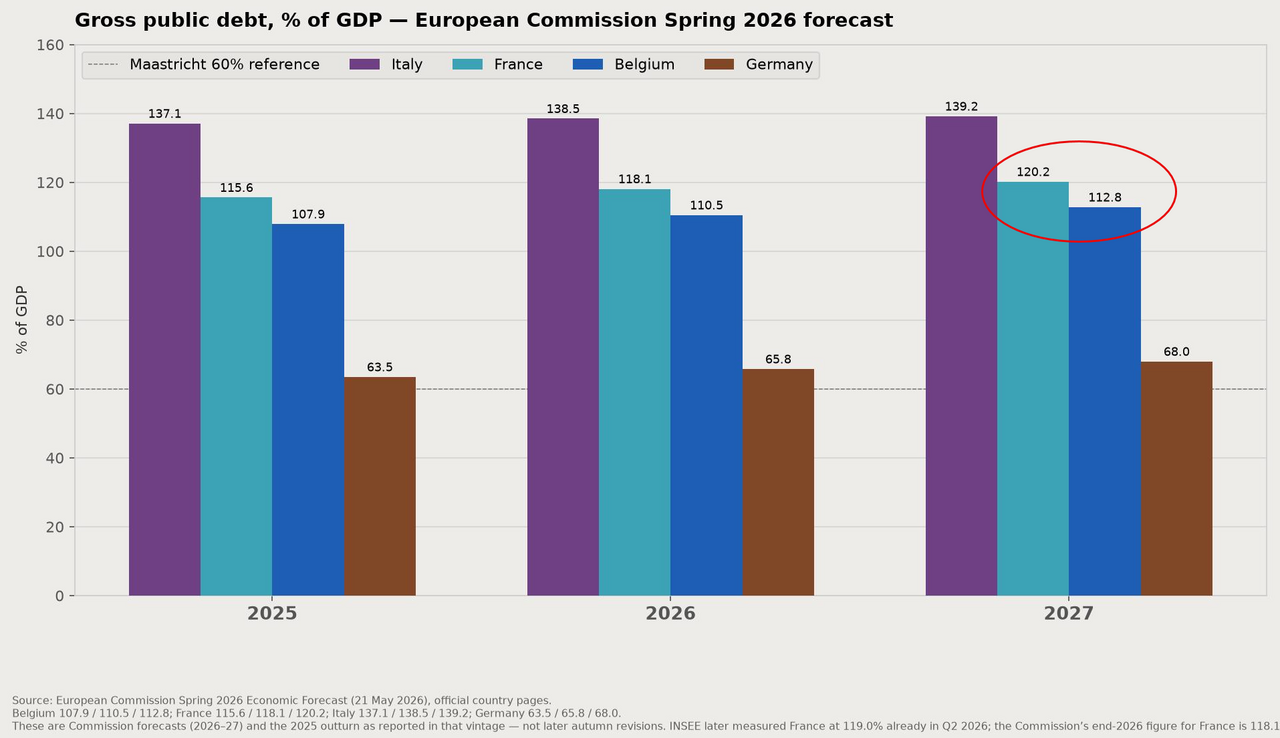
Much has recently been said about France's political paralysis and its sovereign debt, growing at an annual rate of more than five percent, which is likely to reach more than 120 percent of economic output by the end of the year. A financial catastrophe is quite obviously brewing here, one that even a doubled Federal Republic of Germany in better years could hardly cope with out of its own economic strength.
France is undoubtedly currently the biggest problem in the euro debt club. And it remains to be seen whether a possible President Marine Le Pen could turn the fiscal tide - or whether the Germans would be drawn more strongly into joint liability in order to steer Europe's second-largest economy into calmer waters after all.
Right next door, to the north, a similar financial catastrophe is brewing in comparatively manageable Belgium.
Belgium's budget deficit this year is well above the long-expired Maastricht criteria and is likely to come in at around 5.2 percent of economic output. The national debt has piled up to more than 110 percent of GDP. Belgium's situation looks fatal. All the more so as Prime Minister Bart De Wever has crashed and burned with his consolidation plans. A savings plan worth billions was planned up to 2029, but it failed because the coalition fell out over which social groups should ultimately foot the bill for the reform policy. While some in the alliance are pushing for spending cuts, others are calling for tax increases and a greater burden on wealth and capital.
For Belgium is not simply a country with a budget hole. It is a state whose federal architecture has splintered fiscal responsibility between Flanders, Wallonia, and Brussels. While thrifty Flanders insists on cuts, the more free-spending Wallonia demands protection from the fiscal axe. Every austerity policy thus quickly becomes a regional power struggle, a test for the entire federal system.
In Belgium, different fiscal policy views collide, further straining the deep fault lines between the regions. De Wever offered his resignation on November 2nd, thereby making the blockade visible. King Philippe initially did not accept the resignation, but instead instructed the prime minister to enter new negotiations. A solution to the fiscal bottleneck still remains up in the air.
It almost seems as if France's budget-policy paralysis is blowing across the border into Belgium. In this way, the crisis is approaching the country in whose capital the center of power of the EU is located. Belgium appears - as the home of the EU institutions - like the fated place of the looming crisis.
What is more, it is strangely ironic that it is precisely in Brussels, with Euroclear, that the custodian for a large proportion of the frozen Russian central bank assets is based. The enemy's state treasure - within reach and yet so far away. No one has yet dared to commit this fatal breach of the law, to access Russian state assets in order to postpone their own financial problems, at least for a time.
Belgium's internal fragmentation and fiscal vulnerability are also reflected in the financial markets. The yield on Belgian ten-year government bonds rose from around 3.5 to 4.25 percent within a few months. This is unmistakable consolidation pressure: the markets, investors, banks and pension funds are demanding that the overstretched state apparatus, with a state share of around 54 percent of GDP, be consolidated, that the welfare state be cut back and that the excessive taxes be reduced to a normal level. In terms of the burden on the average earner through taxes and social security contributions, Belgium is the OECD leader.
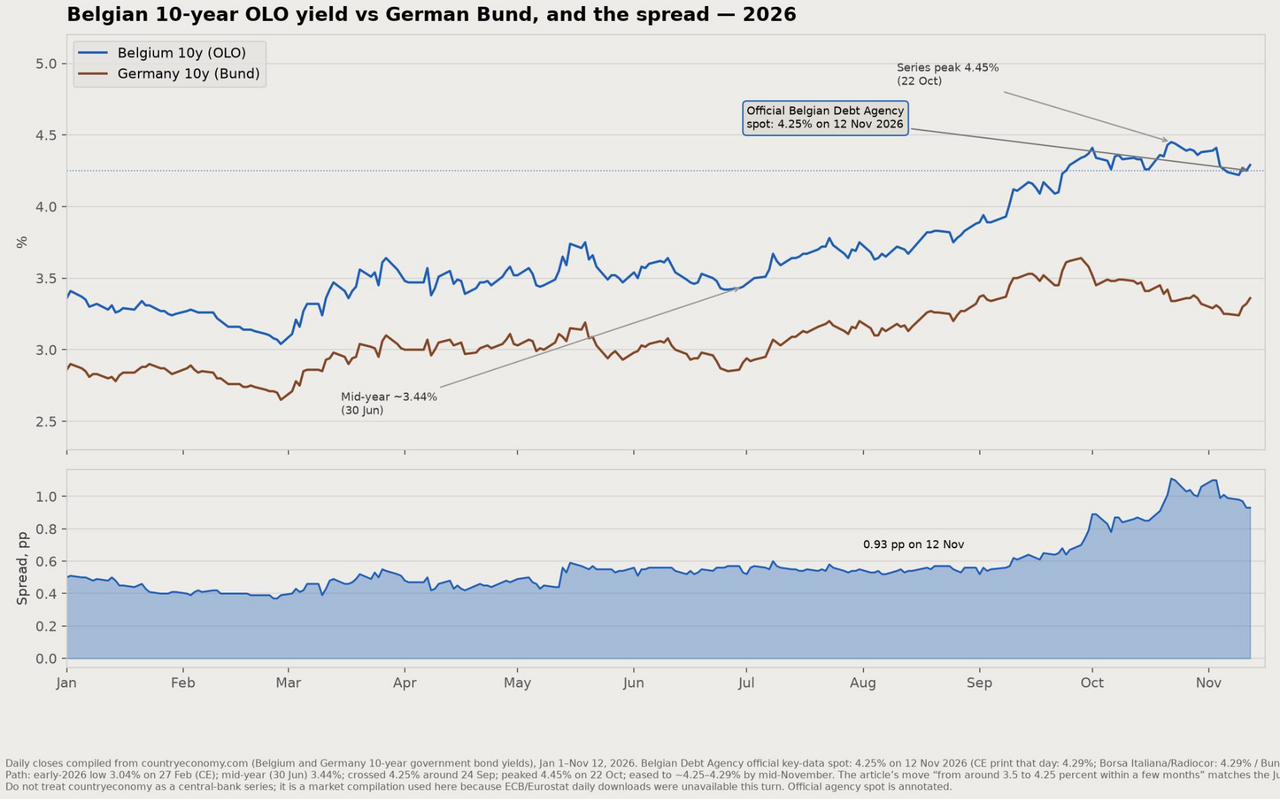
If consolidation fails - and at present there is little to suggest that it could succeed - Belgium too will be drawn into a debt vortex of higher interest rates, rising refinancing costs and growing risk premiums, which could ultimately lead to the collapse of public finances.
Like so many European states, Belgium suffers from a postmodern illusion: that an oversized welfare state is indispensable, that the state must take responsibility for the economy and the distributional processes of a society - down to regulating the details of everyday existence. The costs of this policy are now coming to light. And they could ultimately culminate in a major sovereign debt crisis that would burst the illusions of state omnipotence and the belief in the state's ability to shape society.
Tyler Durden Fri, 11/13/2026 - 06:00
Continue reading...
[ H/T ZeroHedge ]
Authored by Thomas Kolbe via American Thinker,
In the shadow of France's sovereign debt crisis, other smoldering fires threaten to become a raging blaze. In Belgium, things could come to a flashpoint that sets the entire eurozone alight.
Among the many catastrophic lessons of the great financial and sovereign debt crisis more than a decade ago, one came as a surprise: it is not the size of an economy that determines the outbreak of a sovereign debt crisis. It was tiny Greece, accounting for just 2.5 percent of the eurozone's total economic output, that came within a hair's breadth of blowing the union apart from within. At the time, Greece's sovereign debt reached 170 percent of GDP. Austerity was then the order of the day, and given the country's homogeneous population and undeniable state lethargy, it was ultimately accepted.
But things hung by a thread. For in the eurozone, states are chained together through the bond market. The EU, and above all the eurozone, is simply not a federation like the United States. Debt consolidation under the leadership of the European Commission may be Brussels' goal, but given the growing tensions on the continent, it is likely to remain an illusion.
Brussels has long been using an instrument that points in this direction: through NextGenerationEU, the Commission raises joint funds on the capital markets in order to make them available to member states in the form of grants and loans. Countries such as Spain and Italy in particular benefit from this. The political trick is to increasingly cushion national financing problems through joint debt and EU funds. Joint liability is thus growing not necessarily through an open decision in favor of a debt union, but gradually through new financing instruments.
In Brussels, it has been recognized: in the event of a crisis, a fragmented capital market exacerbates the problem. If one member comes under pressure in the bond market, speculators shift their capital in cascades through the ranks of the fiscally weakest members, setting off a domino effect. Moreover, the construct stands and falls with the creditworthiness of the Federal Republic of Germany - and lately, that is no longer in such good shape either.
Much has recently been said about France's political paralysis and its sovereign debt, growing at an annual rate of more than five percent, which is likely to reach more than 120 percent of economic output by the end of the year. A financial catastrophe is quite obviously brewing here, one that even a doubled Federal Republic of Germany in better years could hardly cope with out of its own economic strength.
France is undoubtedly currently the biggest problem in the euro debt club. And it remains to be seen whether a possible President Marine Le Pen could turn the fiscal tide - or whether the Germans would be drawn more strongly into joint liability in order to steer Europe's second-largest economy into calmer waters after all.
Right next door, to the north, a similar financial catastrophe is brewing in comparatively manageable Belgium.
Belgium's budget deficit this year is well above the long-expired Maastricht criteria and is likely to come in at around 5.2 percent of economic output. The national debt has piled up to more than 110 percent of GDP. Belgium's situation looks fatal. All the more so as Prime Minister Bart De Wever has crashed and burned with his consolidation plans. A savings plan worth billions was planned up to 2029, but it failed because the coalition fell out over which social groups should ultimately foot the bill for the reform policy. While some in the alliance are pushing for spending cuts, others are calling for tax increases and a greater burden on wealth and capital.
For Belgium is not simply a country with a budget hole. It is a state whose federal architecture has splintered fiscal responsibility between Flanders, Wallonia, and Brussels. While thrifty Flanders insists on cuts, the more free-spending Wallonia demands protection from the fiscal axe. Every austerity policy thus quickly becomes a regional power struggle, a test for the entire federal system.
In Belgium, different fiscal policy views collide, further straining the deep fault lines between the regions. De Wever offered his resignation on November 2nd, thereby making the blockade visible. King Philippe initially did not accept the resignation, but instead instructed the prime minister to enter new negotiations. A solution to the fiscal bottleneck still remains up in the air.
It almost seems as if France's budget-policy paralysis is blowing across the border into Belgium. In this way, the crisis is approaching the country in whose capital the center of power of the EU is located. Belgium appears - as the home of the EU institutions - like the fated place of the looming crisis.
What is more, it is strangely ironic that it is precisely in Brussels, with Euroclear, that the custodian for a large proportion of the frozen Russian central bank assets is based. The enemy's state treasure - within reach and yet so far away. No one has yet dared to commit this fatal breach of the law, to access Russian state assets in order to postpone their own financial problems, at least for a time.
Belgium's internal fragmentation and fiscal vulnerability are also reflected in the financial markets. The yield on Belgian ten-year government bonds rose from around 3.5 to 4.25 percent within a few months. This is unmistakable consolidation pressure: the markets, investors, banks and pension funds are demanding that the overstretched state apparatus, with a state share of around 54 percent of GDP, be consolidated, that the welfare state be cut back and that the excessive taxes be reduced to a normal level. In terms of the burden on the average earner through taxes and social security contributions, Belgium is the OECD leader.
If consolidation fails - and at present there is little to suggest that it could succeed - Belgium too will be drawn into a debt vortex of higher interest rates, rising refinancing costs and growing risk premiums, which could ultimately lead to the collapse of public finances.
Like so many European states, Belgium suffers from a postmodern illusion: that an oversized welfare state is indispensable, that the state must take responsibility for the economy and the distributional processes of a society - down to regulating the details of everyday existence. The costs of this policy are now coming to light. And they could ultimately culminate in a major sovereign debt crisis that would burst the illusions of state omnipotence and the belief in the state's ability to shape society.
Tyler Durden Fri, 11/13/2026 - 06:00
Continue reading...
[ H/T ZeroHedge ]