











When the summer heat oppresses even the raccoons at night, and the humidity convinces the stags and does to lie in place, and when the Harleys and the Hondas screaming down Arlington Boulevard surrender to the swelter and finally go home, my suburban backyard grows so quiet that, I swear, you can hear the kudzu climbing up my hill.
The legends about this vine may not all be true. It may have never crept in through a bedroom window and strangled a sleeping man, but I still close the windows at bedtime, even on cool nights. If you give this devil an inch, it will take a mile, probably within a week.
Kudzu is a vine imported from Japan last century. Like poison ivy, kudzu has leaves of three, but only a fool or a derelict would leave it be. The vines grow about a foot every day. As it spreads along the ground, the vine puts down a taproot into the soil every 12 inches or so. Like fighting a hydra, you can kill the plant, even dig up the root, but it will just come back — and keep spreading.
And then it starts to climb. “Kudzu creeps with stealthy swiftness over brushpiles and fences,” wrote author Janet Lembke in her book Despicable Species. “It climbs trees and telephone poles and casts its soft but heavy net over thickets and hedgerows.”
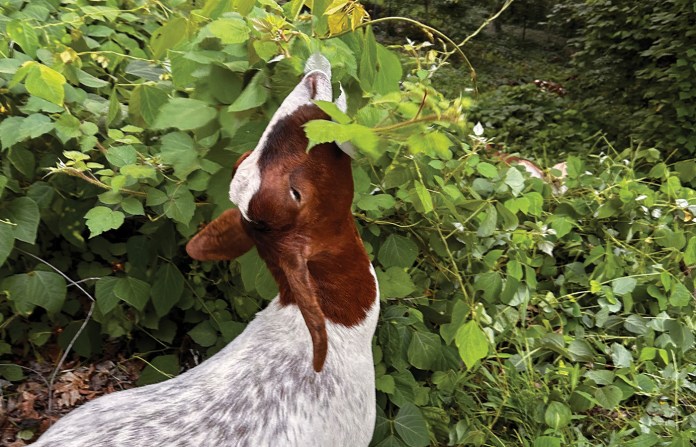
A goat eats some of the kudzu growing around a home in Fairfax County, Virginia. (Timothy P. Carney/Washington Examiner)
" data-large-file="https://www.washingtonexaminer.com/wp-content/uploads/2026/07/LA.LushPlaces.072926.jpg?w=696" height="658" width="1024" src="https://www.washingtonexaminer.com/wp-content/uploads/2026/07/LA.LushPlaces.072926.jpg?w=696" alt="A goat eats some of the kudzu growing around a home in Fairfax County, Virginia. (Timothy P. Carney/Washington Examiner)" class="wp-image-4662902" style="width:360px;height:auto" srcset="https://www.washingtonexaminer.com/wp-content/uploads/2026/07/LA.LushPlaces.072926.jpg 1400w, https://www.washingtonexaminer.com/...26/07/LA.LushPlaces.072926.jpg?resize=300,193 300w, https://www.washingtonexaminer.com/...26/07/LA.LushPlaces.072926.jpg?resize=768,494 768w, https://www.washingtonexaminer.com/...6/07/LA.LushPlaces.072926.jpg?resize=1024,658 1024w, https://www.washingtonexaminer.com/wp-content/uploads/2026/07/LA.LushPlaces.072926.jpg?resize=150,96 150w, https://www.washingtonexaminer.com/...26/07/LA.LushPlaces.072926.jpg?resize=696,447 696w, https://www.washingtonexaminer.com/...6/07/LA.LushPlaces.072926.jpg?resize=1068,687 1068w" sizes="auto, (max-width: 1024px) 100vw, 1024px">
A goat eats some of the kudzu growing around a home in Fairfax County, Virginia. (Timothy P. Carney/Washington Examiner)
James Dickey, the poet and author of the novel Deliverance, called it “a vegetable form of cancer.”
We bought our house on the hill two Junes ago. When we moved in, the backyard — darkened by a canopy of vines — looked like a Southern Gothic painting chosen to illustrate a Flannery O’Connor paperback.
Here, in the middle of suburbia, we had bought a half-acre of true wilderness. I worried that the Environmental Protection Agency would discover in the shadowy corners some new species of amphibian or some uncontacted tribe of the Powhatan.
On moving day, our youngest son ventured into the kudzu and soon disappeared. (Sean has since been found and is thriving in many regards.)
The house had other problems, but none so pressing. Another week with a broken screen door just means another week’s worth of flies and mosquitoes. Another week of kudzu growth meant a few thousand more feet of green vines.
Our first project was to hire the goats. Jessica from Caprine Weed Eaters pulled her trailer onto our cul-de-sac on the Thursday after we moved in, and dropped off 44 goats and a llama named Ramona.
Immediately, they went to work eating the kudzu, day and night. (Thankfully we got them after mating season, so all that chewing was the only nighttime noise.) Within four days, they had devoured everything green in our yard.
It was a truly magical week as the whole neighborhood climbed Goat Hill daily to watch the animals do their job.
Then the hard work began. I would wake my three sons at 6 a.m. daily to continue the job. The goats ate the vines and leaves, but they didn’t dig up the roots. That was left to my boys, each armed with a trowel, shears, and a five-gallon bucket. We were not going to merely fight the vegetative cancer — we were going to eradicate it.
But any time we missed a day or two — maybe I slept in, or maybe my boys were at camp — the kudzu surged. This invasive species was no more apt to surrender than the Japanese after the fall of Saipan. Every free daylight hour, I sprayed, dug, and weed-whacked. In my free evening hours, I did my own research on the plant.
I collected the tap roots. I saved the biggest vines and showed them off to neighbors. As the summer wore on, I could think of only one thing. While I slept, even with windows closed, the kudzu crept its way into my dreams.
Most kudzu content on the internet, perversely, is pro-kudzu. The Japanese apparently have long treated kudzu root as medicine, and online, alternative-health posters outnumber suburban dads plagued by this vine. This content, too, crept into my consciousness, and my curiosity took over.
One night, I washed a taproot, ground it into powder, and dissolved it in boiling water. My oldest, already disturbed by my single-mindedness about this weed, walked in as I sipped this concoction and noted the irony: I was so consumed by kudzu that now I was literally consuming it. My hatred had become an obsession.
“Kudzu cannot withstand regular mowing,” my neighbor told me. The crown of these taproots holds the sugars — the energy. The energy comes from photosynthesis. If you chop off every leaf when you see it, the kudzu vines keep growing, expending energy, but never replenishing it.
WHY ARE TRIAL LAWYERS BLOCKING ROBOT CARS?
So I issued a fatwa — a concept I borrowed from radical Islam: kill the kudzu everywhere and always.
The kudzu is not gone, but the humans are winning the war. Maybe next spring, I’ll sleep with my windows open.
Timothy P. Carney (@tpcarnery) is the senior political columnist at the Washington Examiner and a senior fellow at the American Enterprise Institute.
Continue reading...
[ H/T Washington Examiner ]
