



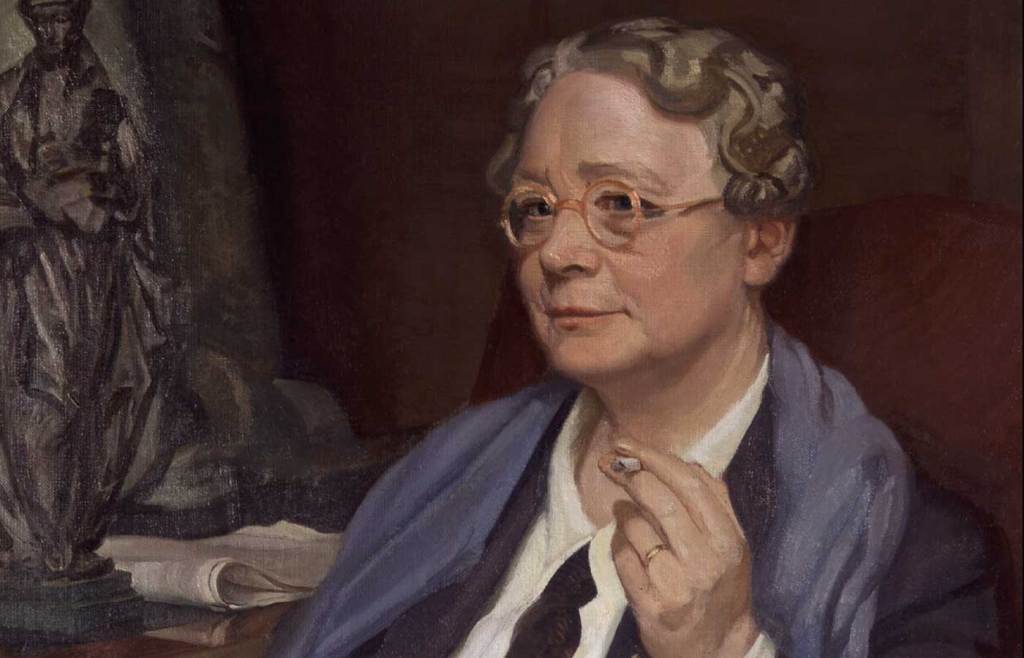
Dorothy L. Sayers deserves magnification in our cultural memory. Looking back at the 20th century, one might be unable to imagine a world without C.S. Lewis or T.S. Eliot, but Dorothy L. Sayers? While those luminaries loom large — studied in academic classrooms, quoted in churches across the world, and, in Lewis’s case, the basis for film adaptations — Sayers does not have her bestselling novels still being adapted, is rarely quoted in American pulpits, and her work is deemed not highbrow enough for many college classrooms.
Yet, in 1963, Lewis reflected that “the first person of importance who ever wrote [him] a fan-letter” was Sayers, a woman who was more famous than Lewis during the interwar period. The biography Dorothy L. Sayers: Works and Days, written by Lewis biographer Alan Jacobs, elevates Sayers to the forefront, casting her in a radiant but fair light, one that she has had to wait far too long to receive.
Sayers was a bestselling mystery novelist during her lifetime, a contemporary of G.K. Chesterton and Agatha Christie (the three founded a club called the Detection Club, which is the foundation of a new BBC miniseries). Her creation, Lord Peter Wimsey, an aristocratic sleuth, entertained readers over 11 novels and 21 short stories, as well as an appearance onstage in the play Busman’s Honeymoon. These stories were adapted multiple times for the radio by the BBC. An adaptation with Ian Carmichael is worth listening to on repeat.
Jacobs places Sayers within her historic context. When Agatha Christie went missing in 1926, Jacobs reveals that Sayers drove to Shere in Surrey, “where Agatha Christie’s automobile had been found abandoned.” While Sayers esteemed her detection colleagues, her literary hero was Wilkie Collins, about whom she tried and failed to write a biography. She wanted to craft a detective novel that fused entertainment with social concerns, as he had in Victorian England. Jacobs notes how Sayers, in her own words, judged herself somewhat successful in Murder Must Advertise where “the criticism of life was not relegated to incidental observations and character sketches, but was actually part of the plot, as it ought to be.”
Dorothy L. Sayers: Works and Days; By Alan Jacobs; Oxford University Press; 242 pp.; $25.00
" data-large-file="https://www.washingtonexaminer.com/wp-content/uploads/2026/11/DorothySayersBook_111826.jpg?w=600" src="https://www.washingtonexaminer.com/wp-content/uploads/2026/11/DorothySayersBook_111826.jpg?w=600" alt="Dorothy L. Sayers: Works and Days; By Alan Jacobs; Oxford University Press; 242 pp.; $25.00" class="wp-image-4804097" style="aspect-ratio:0.6529033505777692;width:236px;height:auto" srcset="https://www.washingtonexaminer.com/wp-content/uploads/2026/11/DorothySayersBook_111826.jpg 600w, https://www.washingtonexaminer.com/...1/DorothySayersBook_111826.jpg?resize=196,300 196w" sizes="(max-width: 600px) 100vw, 600px">
Dorothy L. Sayers: Works and Days; By Alan Jacobs; Oxford University Press; 242 pp.; $25.00
Sayers’s two most literary and social or philosophical novels are The Nine Tailors and Gaudy Night, which Jacobs commends because of their astute “world-building.” He also notes that, through the years, he has posed the question “Which Dorothy L. Sayers novel are you most likely to re-read?” and those two novels are the only two to have received votes. As a literary scholar, Jacobs brings a respected eye to his assessment of Sayers’s novels.
While Jacobs notes the success of these works, he rightly highlights her 1941 BBC radio play cycle The Man Born to Be King, an account of the life of Jesus, as the pinnacle of her oeuvre. “The Man Born to be King is Sayers’ most impressive work, and the one that best rewards repeated attention,” Jacobs writes. C.S. Lewis read Sayers’s Jesus plays every Lent as part of his devotional practice.
The Man Born to Be King was not Sayers’s first foray into playwrighting. In 1937, her play The Zeal of Thy House premiered at the Canterbury Festival, and Sayers’s passion for theater, which she had loved as a youth, was reignited. She wrote several more plays over the next decade. Her immersion in the theater, while simultaneously translating the Gospels from Greek into English for her radio series, influenced her commentaries on the church: “Let us, in Heaven’s name, drag out the Divine Drama from under the dreadful accumulation of slipshod thinking and trashy sentiment heaped upon it, and set it on an open stage to startle the world into some sort of vigorous reaction.” Her notion that Christian dogma and church teachings were, in fact, an exciting, scandalous, and dynamic drama lasted the rest of her life.
Sayers’s biographers have tended to either skirt her faith or be subsumed by it, making it the dullest or most colorful thread of her narrative. While Jacobs’s biography is published within the “Spiritual Lives” series of Oxford University Press, and one fears its treatment of her faith could become heavy-handed, he does the best job among previous biographers of relaying the story of Sayers’s complicated, rather private faith, even as she was a “public Christian” figure in England.
The problem for contemporary American evangelicals, when it has come to Sayers, has been the son she gave up for adoption and hid from even her family and closest friends. Born out of wedlock and thus legally illegitimate if not religiously scandalous, her son John Anthony was her adopted ward, while not acknowledged as her biological child. Similarly disreputable during her lifetime, Sayers married a divorced man, and not the father of her child. While Wilkie Collins notoriously lived with two different women for decades — one who mothered his children — he acted the bachelor for his whole life. However, as a man, he gets away with a lack of moral scrutiny in a way that Sayers seems unable to avoid.
Dorothy Leigh Sayers was an English crime novelist, playwright, translator and critic. (Getty Images)
" data-large-file="https://www.washingtonexaminer.com/wp-content/uploads/2026/11/LA.Books_.Dorothy.111826.jpg?w=1024" height="658" width="1024" src="https://www.washingtonexaminer.com/wp-content/uploads/2026/11/LA.Books_.Dorothy.111826.jpg?w=1024" alt="Dorothy Leigh Sayers" class="wp-image-4804099" srcset="https://www.washingtonexaminer.com/wp-content/uploads/2026/11/LA.Books_.Dorothy.111826.jpg 1400w, https://www.washingtonexaminer.com/...1/LA.Books_.Dorothy.111826.jpg?resize=300,193 300w, https://www.washingtonexaminer.com/...1/LA.Books_.Dorothy.111826.jpg?resize=768,494 768w, https://www.washingtonexaminer.com/.../LA.Books_.Dorothy.111826.jpg?resize=1024,658 1024w" sizes="(max-width: 1024px) 100vw, 1024px">
Dorothy Leigh Sayers was an English crime novelist, playwright, translator and critic. (Getty Images)
Jacobs admits that any attempt to understand Sayers’s faith during these seasons of her life is mere conjecture. There is nothing on record about her church attendance, prayer life, or religious commitments during these years. Jacobs offers a “speculative story” to explain why Sayers maintained such a lengthy absence from her Anglican heritage based on her “sins” of lust and concupiscence. But no matter what kept her away from public witness, Sayers ended her career as an outspoken public intellectual for the Christian faith.
While Sayers declined the honorary Lambeth Doctor of Divinity offered by the Archbishop of Canterbury for her outstanding The Man Born to Be King and her theological treatise on the Trinity, The Mind of the Maker, she did accept an honorary Doctorate of Letters from the University of Durham. Sayers was always more comfortable with the life of the mind than that of the ministry.
C.S. LEWIS’S LIFE ON STAGE
In the final decade of her life, Sayers fell in love with someone else’s art and gave herself over to its translation. Although Sayers had been a scholar of languages at Oxford, she had not spent much of her career translating. When she started reading Dante’s The Divine Comedy during a World War II air raid, Sayers felt a new stirring in her intellectual spirit and took to bringing the epic into common English, as she had for the Gospels. Only this work demanded more poetry than realism. Jacobs calls this work “a love affair that would last the rest of her life.” Sayers died before she completed the translation of the final canticle of The Divine Comedy, that of Paradise.
The subtitle of Jacobs’s biography is Works and Days. Perhaps this reader missed the explanation of the phrase, but it recalled for me Annie Dillard’s insistence that “how we spend our days is, of course, how we spend our lives.” Sayers spent her days working and loving the work. Vocation was what linked her various jobs and her numerous triumphs. “There is something vitally important here,” Jacobs stresses, when it comes to vocation, “something more than a puzzle, perhaps even a mystery — and to understand it became one of the chief tasks of Sayers’s life.” To what are we called to do, and how can we be faithful to that call? Jacobs serves Sayers by showing her as, first and foremost, faithful to her vocation.
Jessica Hooten Wilson is the Fletcher Jones Chair of Great Books at Pepperdine University and the author of several books, most recently Flannery O’Connor’s Why Do the Heathen Rage?: A Behind-the-Scenes Look at a Work in Progress.
Continue reading...
[ H/T Washington Examiner ]