



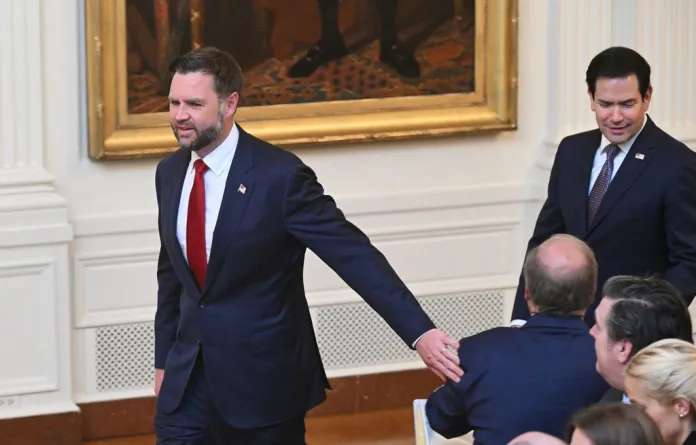
Based on his brief foreign policy experience in Ukraine and Iran, Vice President JD Vance and his advisers have formulated the “Vance Doctrine,” which could soon be tested in the Indo-Pacific.
Vance appears to be reassessing U.S. trade and security agreements in the Indo-Pacific to fit the Vance Doctrine, which says that a small country must ultimately accept a negotiated framework crafted by its superpower patron, even if that framework leaves unresolved threats it considers existential. Vance hopes to end current conflicts and prevent new ones that could damage his chances of being elected president in 2028.
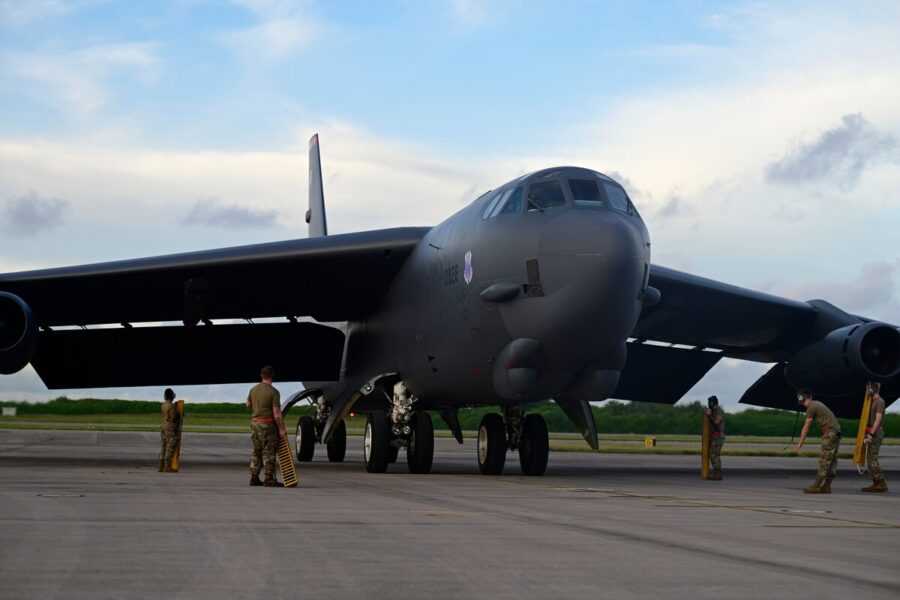
On July 6, while President Donald Trump and Secretary of State Marco Rubio attended NATO meetings in Ankara, a Chinese nuclear submarine launched an intercontinental ballistic missile in the western Pacific. The missile flew near Guam, where the U.S. Department of War has invested billions in a missile defense system to shield the Pacific from accelerating Chinese aggression.
WHY IS IRAN SUDDENLY DESPERATE TO KILL TRUMP?
The United States and other nations said they received insufficient notice from China about the missile launch. This would be a violation of international law.
China‘s state news agency, Xinhua, reported that a “strategic missile carrying a dummy warhead” was launched from a “strategic nuclear submarine.” Sources believe the missile was launched in southeast China, traveled over the Philippines and Palau, and landed near Nauru. If this intelligence is accurate, the missile traveled approximately 4,000 miles.
This was a serious breach in communications between China, the U.S., and Indo-Pacific allies. Missiles with “dummy warheads” launched from nuclear submarines could have resulted in a nuclear response from the U.S., especially given the missile’s proximity to Guam and long-standing tensions between China and the Philippines in the South China Sea.
The surprise launch of the ICBM missile was “a routine part of China’s annual military training, in accordance with international law and practice, and [was] not directed against any specific country or target,” according to Chinese Foreign Minister Mao Ning. The test was “safe” and “relevant countries were notified in advance,” Minister Mao said.
China’s “surprise” launch and Washington’s response are embarrassments to the Trump administration. Trump and Chinese President Xi Jinping held a three-day summit in Beijing in May, where they developed a “constructive China-U.S. relationship of strategic stability.”
U.S. State Department spokesman Tommy Pigott said the U.S. wanted to “engage” with China for “meaningful arms control discussions.” Pigott said China needed to commit to a “regularized notification arrangement for all intercontinental-range ballistic missile and space launches.”
Days later, U.S. Ambassador to NATO Matthew Whitaker, on Fox News, embarrassingly stammered that the Pacific “is an area that we are going to be more capable and ready in.” His suggestion was that the U.S. is planning to become more militarily capable and better prepared to defend allies and interests in the Indo-Pacific.
After Trump’s 2026 National Defense Strategy downplayed China as a threat, Whitaker seemed to backtrack on this. Indo-Pacific leaders need to hear from Trump and Rubio about U.S. plans “to be more capable and ready in” the Indo-Pacific.
Whitaker took extra care when he discussed the Pacific. This could mean he understands that the Trump administration’s policy now is to avoid unnecessary tensions with China. Whitaker’s hesitation could be seen as confusion about the current policy or as a sign that a reassessment is underway about some or all of the U.S. security and trade agreements in the Indo-Pacific.
TRUMP SEES THE CHINA THREAT: AMERICA MUST DO ‘WHATEVER IT TAKES’ TO WIN AI RACE
If a reassessment of China policy and U.S. commitments in the Pacific is underway, this might be at the direction of Vance in furtherance of the Vance Doctrine. Trump’s recent decision to withhold $14 billion in arms sales to Taiwan could be seen as influenced by Vance.
Before China further embarrasses the U.S., Rubio should exert his influence on Trump’s China policy. The future of the Indo-Pacific could be at stake.
James Patterson, a former U.S. diplomat, is a foreign affairs writer, analyst, and commentator based in Washington, D.C.
Continue reading...
[ H/T Washington Examiner ]