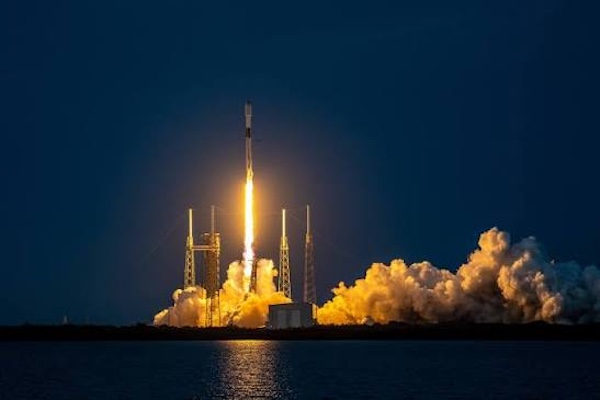
Aerospace firm United Launch Alliance (ULA) announced Sunday that a ULA Vulcan rocket failed to deliver 40 Amazon Leo satellites to orbit after an anomaly approximately 10 minutes into the flight from Space Launch Complex 41 at Cape Canaveral Space Force Station.
The vehicle, which was carrying roughly 40 Amazon Leo satellites, lifted off at 12:40 p.m.Eastern Time. Roughly 10 minutes after launch, an anomaly occurred while the upper stage was operating, and the satellites never reached their intended orbit. The solid rocket boosters separated normally earlier in the flight.
This was the first complete mission failure for a United Launch Alliance rocket since the company was established in 2006
The mission used a Vulcan rocket fitted with six solid rocket boosters — the most it has flown — and a modified upper stage designed for low-Earth orbit missions. It was only the fifth flight of the Vulcan and its first in nine months, following a solid rocket booster nozzle problem on a February national security launch that had kept the vehicle grounded.
The flight was also the first of 38 Vulcan launches Amazon has ordered, and it was intended to carry the heaviest payload United Launch Alliance has attempted. The satellites formed the largest single group Amazon has tried to launch at one time.
POLL: Did You Vote Republican In The Midterms?
VULCAN ROCKET FAILS after 'ANOMALY' 10 MINUTES into FLIGHT, losing all 40 AMAZON INTERNET SATELLITES
American launch service provider United Launch Alliance (ULA) said its Vulcan rocket failed to deliver 40 Amazon Leo broadband satellites into orbit after suffering an…
— Sarwar

 (@ferozwala) November 15, 2026
“Based on data received by our Launch Director, we confirm that the Vulcan vehicle launched from Space Launch Complex 41 suffered an anomaly 10 minutes into the flight and failed to deliver the Amazon mission to orbit,” ULA said in a statement roughly 50 minutes after liftoff.
“Every flight generates data, and every flight teaches us something. Since the anomaly just occurred, we don’t have any specific data yet to understand what occurred today. ULA exists to provide assured access to space for our nation and for the customers who depend on us. That purpose is why we take on some of the hardest missions in spaceflight, and why we hold ourselves to the standard of mission success. Today, we did not meet that standard,” the company continued.
“We will work closely with our customer and other appropriate organizations to find the cause, determine the appropriate corrective action, and return to flight as quickly as possible. ULA is committed to full transparency with our customers, and they will have visibility into the investigation process, which utilizes rigorous methodology and corrective action. We will provide further updates when new information becomes available.”
Amazon also issued a statement in response to the failure. “There is risk with any launch, and that’s especially true for inaugural missions like LV-01. ULA has been a trusted partner for Amazon, and we believe they’ll learn from this mission and deliver on their long-term plans for Vulcan,” the company announced.
Amazon Leo, formerly known as Project Kuiper, is assembling a constellation of more than 3,200 satellites to deliver broadband internet service. Before this attempt, Amazon had launched about 396 production satellites on 14 missions using other rockets, with the most recent success coming this past July.
The cause of Sunday’s anomaly is under investigation, and no specific details have been released yet.
The Trending Politics News app is your home for breaking updates. Download it FREE today!
Continue reading...
[ H/T Trending Politics ]