




Guest Post by John Walter
History doesn’t usually announce itself with trumpets. Most of the time, it whispers. And right now, it’s whispering the same three things it whispered in 2007.
Housing. Oil. Jobs.
These three indicators moved in sequence before the last collapse. They appear to be moving in the same sequence now. Housing tends to stall first—it’s the most leveraged, most rate-sensitive, most emotionally charged asset class. Then energy prices convulse, reflecting demand destruction as economic activity contracts. Finally employment cracks, because companies don’t fire people until they absolutely must.
We appear to be between phase two and phase three.
The people running things see this. They have to. But they’re trapped in institutional theater. Powell’s “very happy” comment isn’t analysis. It’s performance. Central bankers must project confidence because confidence is the only thing keeping the credit flowing. Admit doubt, and the doubt becomes self-fulfilling.
So they wait. They monitor. They remain data-dependent while the data, at least to my eyes, suggests something else entirely.
Here’s what that something else looks like.
Manhattan real estate brokers have stopped being polite.
The emails now read like desperate pleas. Price reduced again. Seller motivated. Free two years of common charges. In Q3 2024, the median one-bedroom dropped to $815,000 according to available market data. Down 4 percent. Sales volume fell 12.7 percent. These aren’t crash numbers. They’re pre-crash numbers. The kind that tend to show up six months or so before the real pain starts.
Pending home sales declined 4.6 percent in October. That’s ten consecutive months. Ten.
New home sales collapsed 12 percent year-over-year. Inventory sits at 7.4 months of supply, up from 5.6 months last year. Builders who scrambled to meet pandemic demand now hold product they can’t sell. Construction loans come due regardless of whether anyone’s buying.
The math is brutal and simple.
A $400,000 mortgage at 3 percent costs $1,686 monthly. At 7.3 percent, it’s $2,741. The difference is $1,055 per month. For a household earning $75,000 annually, that’s not a stretch. That’s a wall.
Families are hitting that wall everywhere. They’re leaving California for Texas, New York for Florida, Illinois for Tennessee. Not because they want to. Because the arithmetic of staying became impossible. I’ve watched friends make this calculation. It usually takes about three months of staring at the bills before they call the movers.
Commercial real estate is arguably worse. Office buildings in downtown cores trade at 50 percent discounts from 2019 valuations. The work-from-home shift didn’t reverse. Companies discovered they don’t need Manhattan addresses. Now $1.5 trillion in commercial debt matures between 2024 and 2026. At current valuations, much of it probably can’t be refinanced at rates that make sense.
The Fed engineered this, at least in part. Eleven rate hikes. They had to fight inflation. But the inflation came from their own money printing, and the cure is killing the housing market.
Energy prices tell the truth when politicians won’t.
In summer 2024, West Texas Intermediate hit $83. By late autumn: $68. An 18 percent drop in weeks. Analysts blame oversupply and weak Chinese demand. They’re not wrong. They’re just incomplete.
Oil tends to crash when the economy stops burning it. Factories go quiet. Truck routes get canceled. Airlines reduce schedules. Consumers stop driving to malls that are already dying. The demand vanishes before supply can adjust.
In 2008, oil went from $147 to $32. Seventy-eight percent in five months. The violence of that decline measured the sudden stop of global commerce.
We’re not there yet. But the direction looks similar.
The International Energy Agency cut its 2024 demand forecast from 2.2 million barrels per day growth to under 900,000. That’s a significant revision. It suggests the recovery many expected failed to materialize.
European economic confidence fell eleven straight months through October, according to available surveys. Germany contracted two consecutive quarters. Switzerland and Sweden both posted negative Q3 GDP.
Switzerland matters. It’s where capital hides when trouble starts. If Switzerland is shrinking, trouble probably isn’t approaching. It likely arrived.
American shale producers generally need $70+ oil to survive. At $68, drilling stops. Financing dries up. The boom towns in Texas and North Dakota face bust. Jobs disappear. Tax revenues crater. Local economies that expanded rapidly now contract just as fast.
This is the insidious part. It’s not one sector failing. It’s three. Housing, energy, employment. Each makes the others worse. The Fed watches and raises rates because its models say inflation is the threat.
The models may be wrong. They were wrong in 2008. They could be wrong now.
Employment was the last excuse. The shield behind which optimists hid.
That shield is cracking.
Initial jobless claims hit 234,000 in late November. Six-month high. Three straight weeks of increases. In 2008, claims started around 320,000 and spiked to 665,000. We’re early in that curve. But the curve appears to be forming.
GM announced 14,000 job cuts in November. Cisco: 5,500. Spotify: 1,500. Citigroup plans 20,000 over two years. Amazon has shed 27,000 since 2022. Meta: 21,000.
These aren’t strategic restructures. These are companies seeing demand soften and cutting to preserve margins. When Cisco eliminates 5 percent of its workforce, it’s not because they found a better way to make routers. It’s because businesses stopped buying them.
Manufacturing employment contracted twenty straight months according to ISM data. Construction lost 34,000 jobs in October. Temp work—the first cut, always—dropped 150,000 since February.
The BLS headline numbers get the press conferences. The revisions get buried. The household survey shows weaker job creation than the establishment survey. History suggests the establishment survey tends to be wrong at turning points.
Unemployment is a lagging indicator. It was 5 percent when the 2008 recession officially started. It peaked at 10 percent in October 2009. By the time unemployment signals trouble, you’re already in it.
The jobs being created now are part-time, low-wage, without benefits. Gig work doesn’t pay mortgages. Real wages fell three straight months. Workers fall behind while productivity rises.
This matters beyond spreadsheets. Employment is identity. It’s family stability. Mental health. Community. The opioid epidemic followed manufacturing decline. Despair follows job loss. I’ve seen it in my own hometown. The plant closes. Then the pills appear. Then the funerals.
We’re building toward another wave. The warnings flash. Powell calls it happiness.
Here’s the data without much interpretation:
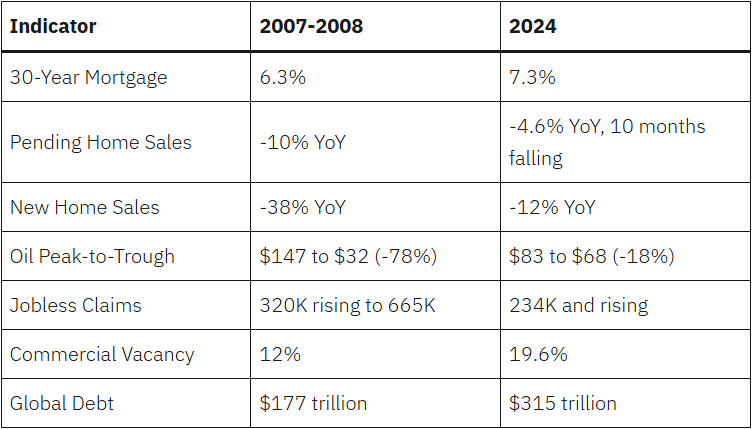
Mortgage rates are higher now than during the worst of 2008. Commercial vacancy is 8 points worse. The yield curve has been inverted over two years—the longest in recent memory. Every previous inversion I know of preceded recession.
Global debt nearly doubled. The banks are bigger. The derivatives market grew. The risk concentrated in fewer hands.
You can find differences if you look. Household balance sheets look stronger—until asset prices deflate. Bank capital ratios improved—while shadow banking exploded. No subprime mortgages—just subprime auto loans and buy-now-pay-later.
The structure looks similar. Credit inflated. Credit deflates. The authorities pretend otherwise because admitting it might trigger the panic they’re trying to prevent.
Powell isn’t stupid. He sees the same data.
When he says he’s “very happy,” he’s performing institutional necessity. Central bankers must project confidence. The job requires optimism. Admitting uncertainty can become self-fulfilling.
This isn’t unique to Powell. It’s the role. Bernanke played it. Greenspan played it. Most of them play it, as far as I can tell.
The public has been trained to trust these institutions. The Fed moderates the business cycle. This may be false. The Fed seems to delay crises, amplify them, then socialize losses while privatizing gains. The boom years came from money printing. The wealth went up. The bill comes down.
Personal savings collapsed from 33 percent pandemic peak to below 4 percent. Credit card debt passed $1.1 trillion. Delinquencies rise among subprime borrowers. Retail sales are weak. Holiday 2024 will likely be the slowest growth in six years.
The consumer is exhausted.
The psychology moves in phases. Boom. Denial. Fear. Panic. Housing is in fear—sellers desperate, buyers scarce. Stocks remain in denial. Jobs are just leaving denial.
The transition to panic happens fast. A bank fails. A money market fund breaks the buck. The system seizes. The Fed intervenes with emergency cuts, liquidity facilities, asset purchases. They fight the tide. The leverage is high.
In 2008, Lehman fell in September. By October, the system was hours from collapse. They stopped the meltdown. They didn’t stop the recession. They didn’t stop millions of foreclosures. They didn’t stop the decade of recovery that never reached everyone.
Next time: different institutions, different triggers, similar shape. Leverage unwinds. Prices fall. Credit contracts. Economy shrinks. They’ll probably say no one saw it coming.
Some of us see it coming.
This isn’t just here. China built ghost cities to hit GDP targets. Its property sector—roughly 25 percent of the economy—appears to be collapsing. Evergrande, Country Garden, Shimao failed. Youth unemployment got so high Beijing stopped publishing the data.
Germany’s manufacturing model—cheap Russian gas plus exports—collapsed with Ukraine. Energy costs drove manufacturers to America, Asia, anywhere cheaper. The social contract frays. The far-right rises.
Italy’s debt-to-GDP exceeds 140 percent, sustained only by ECB ignoring its own rules. The UK is poorer than 2007 despite fifteen years of growth. Japan’s debt-to-GDP is 260 percent.
Sri Lanka defaulted. Ghana defaulted. Pakistan teeters. Argentina has 200 percent inflation. The strong dollar crushes dollar-debtor nations.
The World Bank cut 2024 global growth to 2.4 percent. Per capita, that’s recession for many. Trade volumes shrink. Capital flows reverse. The world fragments into competing blocs.
America can’t export its way out. Its trading partners are broke. It can’t consume its way out. Households are maxed. The question isn’t whether crisis comes. It’s whether it’s a slow grind or sudden collapse.
History suggests sudden. Complex systems don’t gently decline. They function until they don’t. Stability persists until rupture. Then panic, contagion, cascade.
The signs of famine are growing stronger with every passing day.
A forgotten flood may become humanity’s greatest test of survival.
The full story awaits in the video below.
The financial system changed since 2008. Not necessarily improved.
Private equity controls $8 trillion in assets, up from $1 trillion in 2008. These firms bought hospitals, nursing homes, apartments, water systems. Loaded them with debt. When the economy contracts, the debt crushes. Services get disrupted.
Commercial real estate debt—$1.5 trillion maturing 2024-2026—sits on regional banks that can’t absorb losses. Silicon Valley Bank, Signature, First Republic collapsed in 2023. The Fed’s emergency funding program was supposed to be temporary. It’s still open.
Treasury market liquidity deteriorates. The “safest” market shows stress. When crisis hits, the usual flight to quality may not work. Too much debt issuance. The Fed is the buyer of last resort. They’re currently shrinking the balance sheet. When they reverse—inflation likely accelerates.
Derivatives total hundreds of trillions. They concentrate risk in a few institutions. When one falls, counterparties fail. Clearinghouses stress. Central banks must intervene with unlimited liquidity or watch the system implode.
Crypto adds new fragility. Over $1 trillion market, largely unregulated, highly leveraged. When traditional markets seize, crypto crashes harder. Stablecoins break. Exchanges freeze. Contagion spreads.
The repo market—banks lending overnight—remains fragile. The Fed intervenes repeatedly. Collateral quality degrades. In crisis, haircuts increase, forcing fire sales, driving prices lower, creating deleveraging death spirals.
This is the machinery. Designed for profit extraction in good times. Implicit guarantee of bailout in bad times. Moral hazard encourages risk. Risk creates crisis. Crisis requires bailout. The cycle repeats, larger each time.
Ten million Americans lost homes in 2008. Suicide rates rose 40 percent in affected areas. Life expectancy fell. Deaths of despair—suicide, overdose, alcohol—accelerated. Communities shredded. Trust evaporated.
The political fallout—populism, Trump, Brexit—came directly from economic devastation elites called “creative destruction.”
This time starts from weaker ground. Less savings. Eroded safety nets. Overwhelmed mental health services. The opioid epidemic killed 100,000 in 2023. Economic despair will likely worsen it.
Young people who entered the job market in 2008 never recovered. Lower lifetime earnings. Delayed marriage, children, homes. Now a new generation faces the same.
Retirees watch 401(k)s deflate when they need them. Pension funds face insolvency—8 percent return assumptions colliding with reality. Reverse mortgages become traps as home values fall. Medical debt spikes as jobs disappear.
Professionals discover automation and outsourcing. Small business faces demand collapse. Gig workers face flooded markets, falling wages.
This isn’t creative destruction. It’s destruction. Creation comes eventually. Eventually doesn’t help someone evicted next month.
Keynes was right: in the long run, we’re all dead. The crisis is now.
The wealthy will probably be fine. They usually are. Diversified assets, private security, access to policymakers who design bailouts. Pain distributes downward. The poor suffer most. The middle class gets liquidated. Assets transfer to those with cash to buy the dip. This isn’t cynicism. It’s the historical record I’ve observed.
The Fed will likely pivot. “Higher for longer” becomes emergency cuts. Balance sheet reduction becomes quantitative easing. Liquidity opens. Not because they want to. Because they must. The alternative is collapse. The cost is likely final destruction of dollar purchasing power. The revelation that money is political construct, not store of value.
The pivot probably won’t save the economy. It delays reckoning. Makes it worse. Each boom-bust cycle needs more intervention. Each intervention creates more debt, leverage, fragility. We approach the asymptote. Interventions required may exceed capacity to absorb.
The dollar faces confidence crisis. Not immediately—it remains the least dirty shirt. Eventually, debt accumulation, deficit monetization, political inability to reform erodes faith. Persistent inflation. Declining real wages. Slow-motion savings destruction. The 1970s return.
Geopolitical order shifts. American hegemony faces greatest test. Economic weakness constrains military adventure. Alliances fray. New powers emerge. The world becomes more dangerous, less predictable, prone to resource conflict.
Technology doesn’t save. AI displaces workers faster than new opportunities form. Wealth concentrates with machine owners. Techno-optimists sell futures serving their interests, not the displaced.
Climate compounds crisis. Extreme weather disrupts supply chains, destroys infrastructure, displaces populations. Resources compete between adaptation and recovery. Political will exhausts managing both. Future is hotter, poorer, more volatile.
This isn’t pleasant. It isn’t meant to be. Pleasant visions are for marketers. Reality remains when illusions strip away. We built civilization on debt and extraction. The bill comes due.
But crisis creates opportunity. Collapse makes space for new. The question isn’t whether change comes. It’s whether change serves justice and sustainability or authoritarianism and exploitation.
2008 gave us Occupy and Tea Party. Both incomplete. Both co-opted or crushed. Next crisis generates new movements, demands, possibilities.
We must understand mechanics to navigate. Build solidarity with fellow sufferers. Demand costs fall on financiers, speculators, captured regulators—not participants in an economy they didn’t design.
The ghost of 2008 warns. Patterns appear clear. Data suggests what might be coming. Time runs short.
When crisis arrives—and it likely will, perhaps sooner than expected—don’t say you didn’t see it. Say you saw, considered the possibility, and acted for shared recovery, real reform, different future.
“The future is already here—it is just not evenly distributed.”
Gibson’s observation fits economic crisis well. These symptoms aren’t theoretical. They’re present reality for millions struggling with inflation, debt, precarity. The crisis isn’t coming. It’s here, unevenly distributed, waiting to synchronize into something larger.
“Those who make peaceful revolution impossible will make violent revolution inevitable.”
Kennedy’s words resonate. Policy choices—financialization, wage suppression, privatized gains, socialized losses—made peaceful reform difficult. System resists change through institutional capture. When it breaks, change may not be peaceful. Prediction based on historical pattern, not threat.
“It is difficult to get a man to understand something when his salary depends on his not understanding it.”
Sinclair explains Powell, Wall Street analysts, financial media, politicians claiming strength. Their positions, wealth, status require maintaining illusion. They maintain it until collapse. Don’t expect warning from those paid to see what they’re told to see.
Tweet
Continue reading...
[ H/T The Burning Platform ]
The Same Three Knocks
History doesn’t usually announce itself with trumpets. Most of the time, it whispers. And right now, it’s whispering the same three things it whispered in 2007.
Housing. Oil. Jobs.
These three indicators moved in sequence before the last collapse. They appear to be moving in the same sequence now. Housing tends to stall first—it’s the most leveraged, most rate-sensitive, most emotionally charged asset class. Then energy prices convulse, reflecting demand destruction as economic activity contracts. Finally employment cracks, because companies don’t fire people until they absolutely must.
We appear to be between phase two and phase three.
The people running things see this. They have to. But they’re trapped in institutional theater. Powell’s “very happy” comment isn’t analysis. It’s performance. Central bankers must project confidence because confidence is the only thing keeping the credit flowing. Admit doubt, and the doubt becomes self-fulfilling.
So they wait. They monitor. They remain data-dependent while the data, at least to my eyes, suggests something else entirely.
Here’s what that something else looks like.
1. Houses Nobody Can Buy
Manhattan real estate brokers have stopped being polite.
The emails now read like desperate pleas. Price reduced again. Seller motivated. Free two years of common charges. In Q3 2024, the median one-bedroom dropped to $815,000 according to available market data. Down 4 percent. Sales volume fell 12.7 percent. These aren’t crash numbers. They’re pre-crash numbers. The kind that tend to show up six months or so before the real pain starts.
Pending home sales declined 4.6 percent in October. That’s ten consecutive months. Ten.
New home sales collapsed 12 percent year-over-year. Inventory sits at 7.4 months of supply, up from 5.6 months last year. Builders who scrambled to meet pandemic demand now hold product they can’t sell. Construction loans come due regardless of whether anyone’s buying.
The math is brutal and simple.
A $400,000 mortgage at 3 percent costs $1,686 monthly. At 7.3 percent, it’s $2,741. The difference is $1,055 per month. For a household earning $75,000 annually, that’s not a stretch. That’s a wall.
Families are hitting that wall everywhere. They’re leaving California for Texas, New York for Florida, Illinois for Tennessee. Not because they want to. Because the arithmetic of staying became impossible. I’ve watched friends make this calculation. It usually takes about three months of staring at the bills before they call the movers.
Commercial real estate is arguably worse. Office buildings in downtown cores trade at 50 percent discounts from 2019 valuations. The work-from-home shift didn’t reverse. Companies discovered they don’t need Manhattan addresses. Now $1.5 trillion in commercial debt matures between 2024 and 2026. At current valuations, much of it probably can’t be refinanced at rates that make sense.
The Fed engineered this, at least in part. Eleven rate hikes. They had to fight inflation. But the inflation came from their own money printing, and the cure is killing the housing market.
2. Oil That Nobody Needs
Energy prices tell the truth when politicians won’t.
In summer 2024, West Texas Intermediate hit $83. By late autumn: $68. An 18 percent drop in weeks. Analysts blame oversupply and weak Chinese demand. They’re not wrong. They’re just incomplete.
Oil tends to crash when the economy stops burning it. Factories go quiet. Truck routes get canceled. Airlines reduce schedules. Consumers stop driving to malls that are already dying. The demand vanishes before supply can adjust.
In 2008, oil went from $147 to $32. Seventy-eight percent in five months. The violence of that decline measured the sudden stop of global commerce.
We’re not there yet. But the direction looks similar.
The International Energy Agency cut its 2024 demand forecast from 2.2 million barrels per day growth to under 900,000. That’s a significant revision. It suggests the recovery many expected failed to materialize.
European economic confidence fell eleven straight months through October, according to available surveys. Germany contracted two consecutive quarters. Switzerland and Sweden both posted negative Q3 GDP.
Switzerland matters. It’s where capital hides when trouble starts. If Switzerland is shrinking, trouble probably isn’t approaching. It likely arrived.
American shale producers generally need $70+ oil to survive. At $68, drilling stops. Financing dries up. The boom towns in Texas and North Dakota face bust. Jobs disappear. Tax revenues crater. Local economies that expanded rapidly now contract just as fast.
This is the insidious part. It’s not one sector failing. It’s three. Housing, energy, employment. Each makes the others worse. The Fed watches and raises rates because its models say inflation is the threat.
The models may be wrong. They were wrong in 2008. They could be wrong now.
3. Jobs That Are Starting to Vanish
Employment was the last excuse. The shield behind which optimists hid.
That shield is cracking.
Initial jobless claims hit 234,000 in late November. Six-month high. Three straight weeks of increases. In 2008, claims started around 320,000 and spiked to 665,000. We’re early in that curve. But the curve appears to be forming.
GM announced 14,000 job cuts in November. Cisco: 5,500. Spotify: 1,500. Citigroup plans 20,000 over two years. Amazon has shed 27,000 since 2022. Meta: 21,000.
These aren’t strategic restructures. These are companies seeing demand soften and cutting to preserve margins. When Cisco eliminates 5 percent of its workforce, it’s not because they found a better way to make routers. It’s because businesses stopped buying them.
Manufacturing employment contracted twenty straight months according to ISM data. Construction lost 34,000 jobs in October. Temp work—the first cut, always—dropped 150,000 since February.
The BLS headline numbers get the press conferences. The revisions get buried. The household survey shows weaker job creation than the establishment survey. History suggests the establishment survey tends to be wrong at turning points.
Unemployment is a lagging indicator. It was 5 percent when the 2008 recession officially started. It peaked at 10 percent in October 2009. By the time unemployment signals trouble, you’re already in it.
The jobs being created now are part-time, low-wage, without benefits. Gig work doesn’t pay mortgages. Real wages fell three straight months. Workers fall behind while productivity rises.
This matters beyond spreadsheets. Employment is identity. It’s family stability. Mental health. Community. The opioid epidemic followed manufacturing decline. Despair follows job loss. I’ve seen it in my own hometown. The plant closes. Then the pills appear. Then the funerals.
We’re building toward another wave. The warnings flash. Powell calls it happiness.
The Arithmetic of Collapse
Here’s the data without much interpretation:
Mortgage rates are higher now than during the worst of 2008. Commercial vacancy is 8 points worse. The yield curve has been inverted over two years—the longest in recent memory. Every previous inversion I know of preceded recession.
Global debt nearly doubled. The banks are bigger. The derivatives market grew. The risk concentrated in fewer hands.
You can find differences if you look. Household balance sheets look stronger—until asset prices deflate. Bank capital ratios improved—while shadow banking exploded. No subprime mortgages—just subprime auto loans and buy-now-pay-later.
The structure looks similar. Credit inflated. Credit deflates. The authorities pretend otherwise because admitting it might trigger the panic they’re trying to prevent.
Why They Can’t Say It Out Loud
Powell isn’t stupid. He sees the same data.
When he says he’s “very happy,” he’s performing institutional necessity. Central bankers must project confidence. The job requires optimism. Admitting uncertainty can become self-fulfilling.
This isn’t unique to Powell. It’s the role. Bernanke played it. Greenspan played it. Most of them play it, as far as I can tell.
The public has been trained to trust these institutions. The Fed moderates the business cycle. This may be false. The Fed seems to delay crises, amplify them, then socialize losses while privatizing gains. The boom years came from money printing. The wealth went up. The bill comes down.
Personal savings collapsed from 33 percent pandemic peak to below 4 percent. Credit card debt passed $1.1 trillion. Delinquencies rise among subprime borrowers. Retail sales are weak. Holiday 2024 will likely be the slowest growth in six years.
The consumer is exhausted.
The psychology moves in phases. Boom. Denial. Fear. Panic. Housing is in fear—sellers desperate, buyers scarce. Stocks remain in denial. Jobs are just leaving denial.
The transition to panic happens fast. A bank fails. A money market fund breaks the buck. The system seizes. The Fed intervenes with emergency cuts, liquidity facilities, asset purchases. They fight the tide. The leverage is high.
In 2008, Lehman fell in September. By October, the system was hours from collapse. They stopped the meltdown. They didn’t stop the recession. They didn’t stop millions of foreclosures. They didn’t stop the decade of recovery that never reached everyone.
Next time: different institutions, different triggers, similar shape. Leverage unwinds. Prices fall. Credit contracts. Economy shrinks. They’ll probably say no one saw it coming.
Some of us see it coming.
The World Beyond America
This isn’t just here. China built ghost cities to hit GDP targets. Its property sector—roughly 25 percent of the economy—appears to be collapsing. Evergrande, Country Garden, Shimao failed. Youth unemployment got so high Beijing stopped publishing the data.
Germany’s manufacturing model—cheap Russian gas plus exports—collapsed with Ukraine. Energy costs drove manufacturers to America, Asia, anywhere cheaper. The social contract frays. The far-right rises.
Italy’s debt-to-GDP exceeds 140 percent, sustained only by ECB ignoring its own rules. The UK is poorer than 2007 despite fifteen years of growth. Japan’s debt-to-GDP is 260 percent.
Sri Lanka defaulted. Ghana defaulted. Pakistan teeters. Argentina has 200 percent inflation. The strong dollar crushes dollar-debtor nations.
The World Bank cut 2024 global growth to 2.4 percent. Per capita, that’s recession for many. Trade volumes shrink. Capital flows reverse. The world fragments into competing blocs.
America can’t export its way out. Its trading partners are broke. It can’t consume its way out. Households are maxed. The question isn’t whether crisis comes. It’s whether it’s a slow grind or sudden collapse.
History suggests sudden. Complex systems don’t gently decline. They function until they don’t. Stability persists until rupture. Then panic, contagion, cascade.
The signs of famine are growing stronger with every passing day.
A forgotten flood may become humanity’s greatest test of survival.
The full story awaits in the video below.
Where It Breaks
The financial system changed since 2008. Not necessarily improved.
Private equity controls $8 trillion in assets, up from $1 trillion in 2008. These firms bought hospitals, nursing homes, apartments, water systems. Loaded them with debt. When the economy contracts, the debt crushes. Services get disrupted.
Commercial real estate debt—$1.5 trillion maturing 2024-2026—sits on regional banks that can’t absorb losses. Silicon Valley Bank, Signature, First Republic collapsed in 2023. The Fed’s emergency funding program was supposed to be temporary. It’s still open.
Treasury market liquidity deteriorates. The “safest” market shows stress. When crisis hits, the usual flight to quality may not work. Too much debt issuance. The Fed is the buyer of last resort. They’re currently shrinking the balance sheet. When they reverse—inflation likely accelerates.
Derivatives total hundreds of trillions. They concentrate risk in a few institutions. When one falls, counterparties fail. Clearinghouses stress. Central banks must intervene with unlimited liquidity or watch the system implode.
Crypto adds new fragility. Over $1 trillion market, largely unregulated, highly leveraged. When traditional markets seize, crypto crashes harder. Stablecoins break. Exchanges freeze. Contagion spreads.
The repo market—banks lending overnight—remains fragile. The Fed intervenes repeatedly. Collateral quality degrades. In crisis, haircuts increase, forcing fire sales, driving prices lower, creating deleveraging death spirals.
This is the machinery. Designed for profit extraction in good times. Implicit guarantee of bailout in bad times. Moral hazard encourages risk. Risk creates crisis. Crisis requires bailout. The cycle repeats, larger each time.
What the Numbers Don’t Show
Ten million Americans lost homes in 2008. Suicide rates rose 40 percent in affected areas. Life expectancy fell. Deaths of despair—suicide, overdose, alcohol—accelerated. Communities shredded. Trust evaporated.
The political fallout—populism, Trump, Brexit—came directly from economic devastation elites called “creative destruction.”
This time starts from weaker ground. Less savings. Eroded safety nets. Overwhelmed mental health services. The opioid epidemic killed 100,000 in 2023. Economic despair will likely worsen it.
Young people who entered the job market in 2008 never recovered. Lower lifetime earnings. Delayed marriage, children, homes. Now a new generation faces the same.
Retirees watch 401(k)s deflate when they need them. Pension funds face insolvency—8 percent return assumptions colliding with reality. Reverse mortgages become traps as home values fall. Medical debt spikes as jobs disappear.
Professionals discover automation and outsourcing. Small business faces demand collapse. Gig workers face flooded markets, falling wages.
This isn’t creative destruction. It’s destruction. Creation comes eventually. Eventually doesn’t help someone evicted next month.
Keynes was right: in the long run, we’re all dead. The crisis is now.
The wealthy will probably be fine. They usually are. Diversified assets, private security, access to policymakers who design bailouts. Pain distributes downward. The poor suffer most. The middle class gets liquidated. Assets transfer to those with cash to buy the dip. This isn’t cynicism. It’s the historical record I’ve observed.
The Reckoning
The Fed will likely pivot. “Higher for longer” becomes emergency cuts. Balance sheet reduction becomes quantitative easing. Liquidity opens. Not because they want to. Because they must. The alternative is collapse. The cost is likely final destruction of dollar purchasing power. The revelation that money is political construct, not store of value.
The pivot probably won’t save the economy. It delays reckoning. Makes it worse. Each boom-bust cycle needs more intervention. Each intervention creates more debt, leverage, fragility. We approach the asymptote. Interventions required may exceed capacity to absorb.
The dollar faces confidence crisis. Not immediately—it remains the least dirty shirt. Eventually, debt accumulation, deficit monetization, political inability to reform erodes faith. Persistent inflation. Declining real wages. Slow-motion savings destruction. The 1970s return.
Geopolitical order shifts. American hegemony faces greatest test. Economic weakness constrains military adventure. Alliances fray. New powers emerge. The world becomes more dangerous, less predictable, prone to resource conflict.
Technology doesn’t save. AI displaces workers faster than new opportunities form. Wealth concentrates with machine owners. Techno-optimists sell futures serving their interests, not the displaced.
Climate compounds crisis. Extreme weather disrupts supply chains, destroys infrastructure, displaces populations. Resources compete between adaptation and recovery. Political will exhausts managing both. Future is hotter, poorer, more volatile.
This isn’t pleasant. It isn’t meant to be. Pleasant visions are for marketers. Reality remains when illusions strip away. We built civilization on debt and extraction. The bill comes due.
But crisis creates opportunity. Collapse makes space for new. The question isn’t whether change comes. It’s whether change serves justice and sustainability or authoritarianism and exploitation.
2008 gave us Occupy and Tea Party. Both incomplete. Both co-opted or crushed. Next crisis generates new movements, demands, possibilities.
We must understand mechanics to navigate. Build solidarity with fellow sufferers. Demand costs fall on financiers, speculators, captured regulators—not participants in an economy they didn’t design.
The ghost of 2008 warns. Patterns appear clear. Data suggests what might be coming. Time runs short.
When crisis arrives—and it likely will, perhaps sooner than expected—don’t say you didn’t see it. Say you saw, considered the possibility, and acted for shared recovery, real reform, different future.
“The future is already here—it is just not evenly distributed.”
Gibson’s observation fits economic crisis well. These symptoms aren’t theoretical. They’re present reality for millions struggling with inflation, debt, precarity. The crisis isn’t coming. It’s here, unevenly distributed, waiting to synchronize into something larger.
“Those who make peaceful revolution impossible will make violent revolution inevitable.”
Kennedy’s words resonate. Policy choices—financialization, wage suppression, privatized gains, socialized losses—made peaceful reform difficult. System resists change through institutional capture. When it breaks, change may not be peaceful. Prediction based on historical pattern, not threat.
“It is difficult to get a man to understand something when his salary depends on his not understanding it.”
Sinclair explains Powell, Wall Street analysts, financial media, politicians claiming strength. Their positions, wealth, status require maintaining illusion. They maintain it until collapse. Don’t expect warning from those paid to see what they’re told to see.
Tweet
Continue reading...
[ H/T The Burning Platform ]