




Guest Post by John Walter
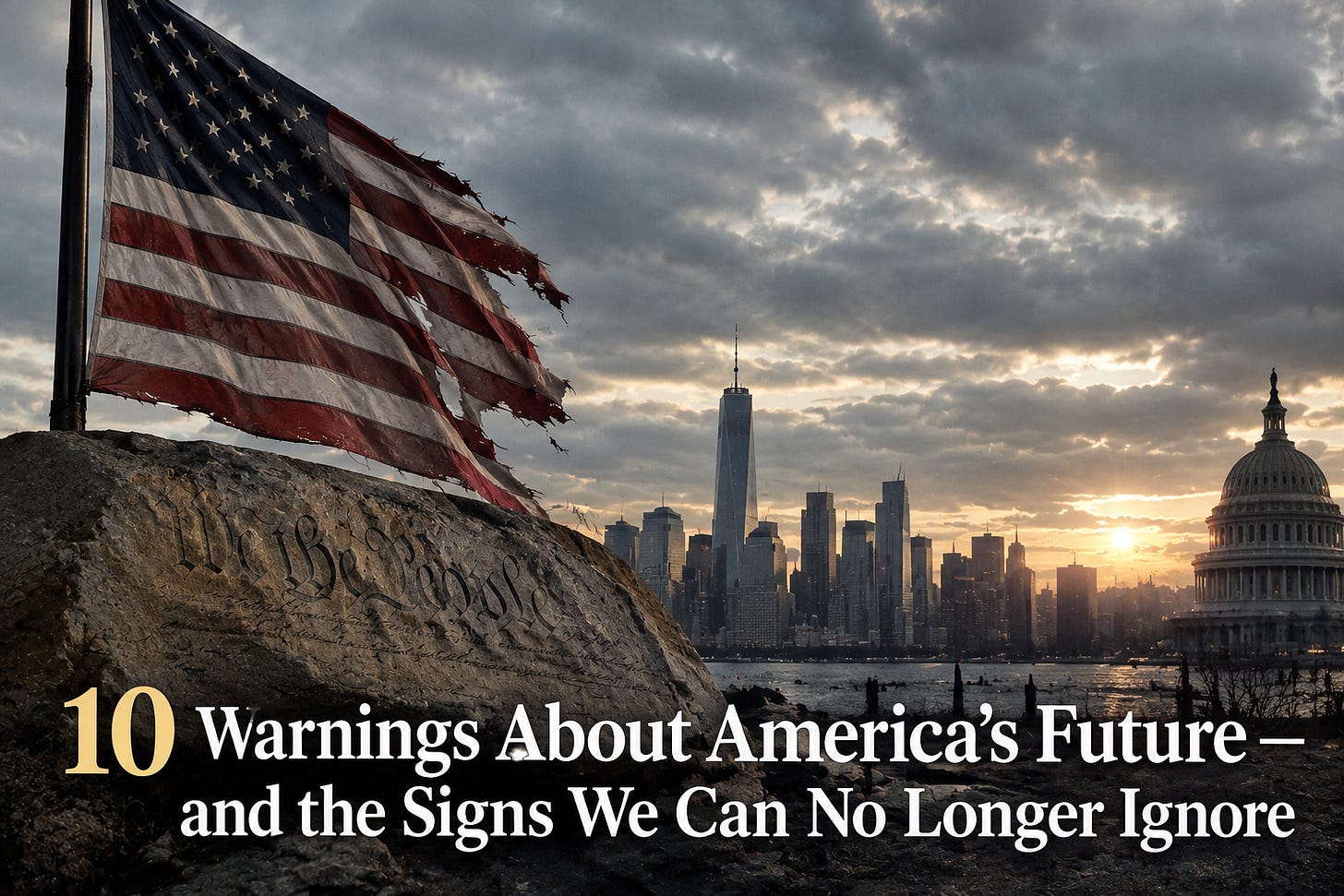
In American politics a warning rarely stays a warning for long. Within days it becomes an argument about which side is entitled to make it, and an argument is far easier to ignore.
The record is unusually thorough. James Hansen, a climatologist at NASA, told a Senate committee in June 1988 that the greenhouse effect had already been detected and was already changing the weather. Two years later a former Nixon aide named Kevin Phillips published a book arguing that American wealth had reconcentrated to 1920s levels and that the political consequence would be populism rather than reform. Edward Snowden flew to Hong Kong in June 2013 and explained, across eight days of interviews, that the National Security Agency was collecting the metadata of essentially every American telephone call. Bill Gates stood on a conference stage in 2015 and said that if anything killed more than ten million people in the coming decades, it would most likely be a respiratory virus, and that the world was unprepared. (Before You Scroll Any Further, Watch This Video — The Next Warning Could Be the One You Can’t Afford to Ignore.)
Nobody on that list was guessing, which is the part that ought to unsettle a reader.
There is a rhythm to how this happens, though not a strict one. A specialist says something uncomfortable; the room nods; the press writes it up; the claim gets folded into a partisan dispute; and somewhere in the following decade the change becomes ordinary enough that arguing about it sounds quaint. The country is not stupid about any of it. It simply has a high tolerance for living inside a problem once the problem has stopped being news.
The lag has shortened lately. A warning used to take thirty years to arrive, leaving ample time to argue about it; now the interval between the paper and the consequence is often under five, sometimes under one. People who dismissed it can be seen two years later describing its effects as an unexpected crisis.
Nothing has collapsed. America does not fail dramatically; it absorbs the damage and adjusts. A town loses its water and gets a boil notice; an insurer stops writing policies in a state; a pension fund lifts its assumed return by half a point; a trust fund receives a depletion date. Each event is survivable on its own, and that survivability is exactly what makes the aggregate so hard to see.
Ten of those warnings follow, roughly in the order they were first spoken aloud.
Ownership thinned to a sliver. Tenancy became the default. Nobody had to sign anything.
The median American buying a first house is now forty years old. In the early 1980s that buyer was twenty-nine, and the houses were not meaningfully different. What changed was the distance between a paycheck and a down payment, which roughly doubled and has not come back.
Kevin Phillips saw the shape of it before almost anybody. His 1990 book The Politics of Rich and Poor argued that American wealth had reconcentrated to levels last seen in the 1920s, and that the political consequence would arrive as populism from whichever direction found a voice first. Phillips had worked in the Nixon White House and had watched the tax code bend steadily toward capital. He was writing about the 1980s, and he might as well have been writing about this morning.
Fourteen years later Thomas Piketty turned the hunch into eight hundred pages of archival proof. The central claim of Capital in the Twenty-First Century is narrow and durable: when the return on inherited wealth outruns the growth rate of the whole economy, the pile at the top expands faster than the country beneath it, permanently, unless something intervenes. His series runs back two centuries, and the American end of the curve looks like a hockey stick with a hand pressing on it.
Distribution itself is no longer arguable. Federal Reserve accounts put roughly two-thirds of household net worth in the hands of the wealthiest tenth, with the top percentile alone approaching thirty percent; equity ownership is starker, since nine dollars out of every ten of stock value sits with the richest decile. For most households the long bull market has been something that happened elsewhere, in rooms they have never entered.
Pay has followed a similar course. Productivity since the late 1970s has climbed by more than sixty percent while typical hourly compensation managed about a fifth of that distance — the productivity–pay divergence, in the economist’s phrase, which workers experience as the reason one paycheck no longer carries a household. Union density slid from a third of the workforce in the mid-1950s to barely ten percent, and with it went the mechanism that once forced wages to share in the gains. Chief executives now earn somewhere near three hundred times the median employee, against roughly twenty-to-one in the mid-1960s.
Housing is where the abstraction grows teeth. Starter homes in most coastal metros clear half a million dollars, mortgage rates spent the middle of the decade near seven percent, and the income needed to qualify has climbed past what a median household actually earns. Into that gap walked institutions. After 2008 Wall Street discovered the single-family rental; firms like Invitation Homes assembled portfolios in the tens of thousands of houses, and by the early 2020s investors were absorbing a fifth of the homes sold in many markets, paying cash and closing in days.
Homeownership now sorts the country in a way that income alone no longer explains. Households that bought before 2020 hold fixed mortgages near three percent and have watched equity balloon; everybody else rents, and rents have outrun wages for a decade. Half of American tenants spend more than thirty percent of income on shelter, and homelessness reached a record 771,480 people in the 2024 federal count — a figure that would have been a national emergency in 1995 and now registers as background noise.
Mortality carries a matching signature. Anne Case and Angus Deaton noticed in a 2015 paper that middle-aged white Americans without a college degree were dying at rising rates while their parents’ cohort had not, and the pattern they named — deaths of despair, meaning suicides, overdoses and alcoholic liver disease — has since killed well over a million people.
Two things make the picture worse rather than better. Household debt has passed eighteen trillion dollars, with auto-loan delinquencies at their worst since 2010, and roughly four adults in ten would need to borrow or sell something to absorb an unexpected thousand-dollar bill. Meanwhile the largest intergenerational transfer of wealth in American history, something approaching eighty trillion dollars across two decades, is already in flight.
Which means that in the coming decades the ability to own a house will have less to do with what a person earns than with who their parents happened to be.
What if the unrest we see today is only the beginning? Watch the video below to explore the warning signs, the predictions for what may lie ahead, and why the coming years could change everyday life in ways few people are prepared for.
Anonymity was a twentieth-century convenience. It expired without a vote.
Bluffdale, Utah, is a small town with an unusually large building inside it: a million square feet of concrete and servers built by the National Security Agency, cooled by millions of gallons of water, holding a volume of intercepted data that officials have never described precisely. It finished in 2014, a year after the world learned what it was for.
That learning happened in June 2013, when Edward Snowden handed three journalists a stack of documents and then answered questions in a Hong Kong hotel room for eight days straight. The papers showed an architecture rather than a rogue programme: a court order compelling a telecom giant to surrender call metadata in bulk, a system for extracting content from nine major internet companies, a tool that captured the digital exhaust of entire networks, and a quiet campaign to weaken the encryption standards everybody depended on. A review board later conceded that the legal basis for the largest of these programmes rested on a strained reading of statute.
Shoshana Zuboff supplied the theory five years afterwards. The Age of Surveillance Capitalism argued that the commodity being traded was human behaviour — experience harvested as raw material and sold in markets where the buyers are betting on what you will do next.
Everything deployed since arrived without a referendum. Doorbell cameras by the millions are wired into police partnerships, so that detectives can request footage from a neighbourhood by map; licence-plate readers run by thousands of agencies and form a de facto national vehicle-tracking grid, logging where a car was hour by hour across state lines; a facial-recognition firm scraped tens of billions of images off the open web and sold the index to departments that never asked permission; and at hundreds of airports a face now replaces a boarding pass.
Underneath all of it sits a legal rule older than most of the technology it governs. A 1979 Supreme Court decision held that information voluntarily handed to a third party enjoys no constitutional protection, because a person cannot claim a reasonable expectation of privacy in what has already been given away. That reasoning was written for rotary telephones and paper ledgers. Applied to a smartphone, it means the device in a pocket is a beacon reporting to strangers by default, and the doctrine has never been seriously rewritten.
The pocket device does most of the work. Location brokers buy and resell movement histories, advertising identifiers link behaviour across apps, and a single handset can ping its position dozens of times an hour. Analysts have used that exhaust to reconstruct visits to clinics, protests, places of worship and the homes of lovers.
Even the body joined the file. In 2018 a genealogy database was used to identify a serial killer through a distant cousin who had never met him, a technique that requires no warrant for the person ultimately found and quietly turned everyone who had ever mailed in a saliva sample into an informant against their relatives. When a consumer genetics company filed for bankruptcy, fifteen million customers had to start thinking about who might own their genome next.
Work runs on the same logic with a different vocabulary. Warehouse pickers are timed to the second and penalised for idle minutes; rideshare drivers live inside a rating that governs their access to fares; scheduling software decides shift patterns before a worker knows whether childcare is affordable.
Then there is the effect nobody has measured properly. People who know they are being observed behave differently, and the effect compounds when the observation is permanent and unannounced. Journalists lose sources who no longer trust a phone call. Organisers lose the anonymity of a crowd. Ordinary citizens begin to self-edit in advance of a judgement that may never come.
The rules did not have to change. People simply behave a little more carefully, and nobody has measured what that does to a population over a generation.
He promised abundance and leisure. He never said who would still be paid for either.
In 1930 John Maynard Keynes published an essay with a title that now reads like a joke: Economic Possibilities for our Grandchildren. Inside it he argued that within a century the economic problem would be solved outright and the working week would fall to fifteen hours.
He was right about the output. An American worker produces several times what their counterpart produced then. Distribution is where he went astray, since the gains pooled at the top instead of spreading into free time, and the machines eventually stopped confining themselves to the factory floor.
Manufacturing employment peaked near twenty million in 1979 and sits around thirteen million today, while the physical volume of what those plants produce has roughly doubled. Robotics, containerisation and global supply chains did that. A generation of workers was told to learn to code, many did, and it worked — until the second wave arrived, aimed at the desks rather than the machines.
Warnings about that second wave were unfashionable for a long time. Jeremy Rifkin’s The End of Work appeared in 1995 and was widely dismissed as premature. In 2013 two Oxford researchers, Carl Benedikt Frey and Michael Osborne, estimated that forty-seven percent of American employment sat in occupations vulnerable to automation, and the figure was attacked from every direction by people who found it alarmist. Erik Brynjolfsson and Andrew McAfee had already argued in The Second Machine Age that displacement would reach cognitive tasks; Martin Ford made the same case a year later with a blunter title.
Then, on the last day of November 2022, a laboratory released a chat window and the argument ended. The thing reached a hundred million users faster than any consumer product in history, and within months it was drafting contracts, summarising depositions, writing boilerplate code and answering complaints. Executives began saying out loud what consultants had been whispering — a technology firm announcing thousands of back-office roles replaceable, a payments company claiming an assistant doing the work of hundreds of agents, a software chief declaring he would not hire new engineers at all.
Labour data then moved along the lines the warnings had described. Technology layoffs ran past a quarter of a million in 2023 and continued into the following years. The more telling signal came from the bottom rung. A Stanford group examining payroll records found employment for workers aged twenty-two to twenty-five in the most exposed occupations falling relative to their peers by a double-digit margin, because the tasks a junior performs are precisely the tasks a model does passably. Recent graduates acquired a nickname in economics departments: canaries.
Elsewhere the substitutions are routine and mostly unremarkable. Paralegal review, first-pass radiology, translation, transcription, tier-one support, bookkeeping, marketing copy. Self-checkout lanes multiplied until some supermarkets ran almost no staffed tills. Driverless heavy trucks began running commercial freight between Texas cities in 2025, on a corridor chosen because the geometry is simple, and robotaxis in a handful of metros passed a quarter of a million paid trips a week. Three and a half million Americans hold commercial driving licences, and the median age in that trade is high enough that attrition will do part of the work before automation has to.
Economists disagree about the scale and agree about the direction. Daron Acemoglu, who has consistently argued that the productivity effects are slower and smaller than the hype, still expects displacement concentrated in specific tasks rather than whole occupations. The more aggressive camp worries that this technology can become more capable through further development, potentially compressing changes that once unfolded across decades.
The labour market of the early 2030s will have an odd shape: comfortable at the top, where judgement, relationships and accountability stay stubbornly human; thick at the bottom, where service work resists automation longest; and hollowed out in the middle, among the analysts, coordinators and junior professionals who used to convert a degree into a ladder. Keynes’s fifteen-hour week may yet arrive. Whether anyone will be paid for it is a separate question.
Decades of borrowing have left little room for the next emergency.
Thirty-eight trillion dollars is a number nobody can feel. The interest on it now costs more than the armed forces, which is easier to grasp.
For most of its history the United States borrowed cheaply, because the world wanted a safe place to park money, and that privilege let successive administrations defer unpleasant arithmetic in the comfortable belief that deferral was free. The borrowing habit did not change. The rate attached to it did, and with it the arrival of a moment when the interest bill itself becomes one of the largest line items in the federal budget.
Gross federal debt stood near one trillion dollars in 1981, crossed ten trillion during the financial crisis, passed thirty-six trillion in late 2024, and kept climbing toward forty. As a share of national output it has moved above the level reached at the end of the Second World War, when the country was financing the destruction of two empires — except that the wartime debt was run up to defeat somebody, whereas a large part of the present pile funds consumption and tax cuts already spent.
Interest is the part that bites. Net interest, which excludes transfers between trust funds, ran close to nine hundred billion dollars in fiscal 2024 and crossed a trillion shortly after, more than the entire defence budget and more than Medicare. Congressional analysts expect that within a decade the annual charge will consume a share of the economy not seen since the early 1990s, when rates were far higher but the stock of debt was a fraction of today’s. Every basis point of yield moves tens of billions of dollars between taxpayers and bondholders.
Rating agencies began registering the drift. One downgraded the country in 2011 after a debt-ceiling standoff, a second followed in 2023 citing an erosion of governance, and a third stripped the last top grade in 2025. For the first time in history, none of the three treats American paper as flawless.
None of that has yet produced a crisis, because the dollar remains the reserve currency and Treasury bills remain the deepest pool of liquidity on earth. How a crisis would begin is nonetheless visible, and it looks like an auction that goes badly, a term premium that jumps, and a political class forced to choose between three unpopular options in a single budget cycle. Central banks abroad have been raising their gold holdings for years, which is less a revolt against the dollar than a hedge against its politics.
Entitlements are where the arithmetic becomes personal. Trustees’ reports put the old-age trust fund on a path to exhaustion in the early 2030s, after which existing revenue covers roughly three-quarters of promised benefits absent a change; hospital insurance lasts a few years longer. Sixty-seven million people receive Social Security, and for a substantial minority it is most of their income. The political difficulty is that the fix is arithmetically small and electorally enormous — raise revenue, trim benefits, or lift the retirement age, and whichever combination is chosen will be described by the losing side as a betrayal.
Below the federal level sits a quieter problem. State and municipal pension systems carry roughly a trillion and a half dollars of unfunded promises, concentrated in a handful of states whose governments spent decades assuming investment returns that failed to arrive. A few large cities already devote extraordinary shares of their budgets to retiree obligations, crowding out the services that make a city worth inhabiting.
Some form of consumption tax will enter the conversation, because it is the only levy capable of raising serious money without an obvious victim, and means-testing will creep into programmes that were once universal, eroding the coalition that protects them. Inflation will do part of the work silently, being the one tax nobody has to vote for.
Nobody seriously disputes the numbers any more; the argument is about who absorbs them.
The thermostat never negotiated. The insurers read it first.
Phoenix has now strung together a hundred consecutive days above one hundred degrees. Maricopa County counted hundreds of heat deaths in the summer that began the run, most of them indoors, most of them poor, most of them invisible to anybody with air conditioning and a car.
James Hansen told a Senate committee in June 1988 that the greenhouse effect had been detected and was already changing the weather. The hearing was staged to be uncomfortable, windows open and the room hot, and the performance was covered widely and then forgotten. Hansen had been publishing on the subject since the early 1980s and his numbers have held up uncomfortably well against three decades of measurement.
The physics is unremarkable and was understood in the nineteenth century: add carbon dioxide to an atmosphere and it traps outgoing heat. What took time was accounting for consequences, and that is where the warnings stacked up — a warming curve, a sea-level curve, then a list of tipping elements including ice sheets, permafrost, ocean circulation and tropical forests, each with a threshold beyond which change becomes self-sustaining. Johan Rockström and a network of Earth-system scientists mapped those boundaries and found the planet already outside several of them.
Measurement has since caught up with theory in the most literal way available. The warmest years ever instrumented now fall in the middle of this decade, and one of them became the first calendar year in which the global average sat more than one and a half degrees above the pre-industrial baseline. Reefs suffered the largest bleaching event on record, and ocean heat content set new highs, which matters because the sea absorbs most of the excess energy and then hands it back through storms.
At national scale the events have names. A hurricane stalled over the Carolinas and drowned a mountain town considered a climate refuge. A wind-driven firestorm erased a Hawaiian town in an afternoon. In 2025 alone the country absorbed a hill-country flash flood that killed more than a hundred people overnight and a January firestorm that consumed thousands of structures in Los Angeles. The federal disaster tally passed two dozen billion-dollar events in a single year, a count that used to be anomalous and is now baseline.
Heat is the quieter killer and it registers in mortality statistics few people read. Farmworkers, roofers, delivery drivers and the elderly die in numbers that surface only in county reports. Occupational regulators drafted a heat rule and are still arguing about it while the thermometer does the persuading. Meanwhile the megadrought that has gripped the Southwest since the turn of the century, the driest stretch in more than a thousand years by tree-ring reconstruction, has begun to be described not as a drought but as the climate.
Money is where the warning stops being environmental and becomes financial, because insurers are the fastest readers of a changing atmosphere — they price the future annually. Two of California’s largest carriers stopped writing new homeowner policies after a run of fire seasons, then negotiated a return with concessions on how risk may be modelled. In Florida, a string of undercapitalised insurers went insolvent and the state-backed carrier became the largest in the market, which is another way of saying the public is now the insurer of last resort. Federal flood cover, underpriced for decades, was repriced through a risk-based system that revealed how many homes were quietly subsidised by everyone else.
When a house becomes impossible to insure, getting a mortgage becomes harder, and selling it can be just as difficult. Municipal bond markets have started to notice which towns depend on a tax base sitting in a floodplain.
The next pathogen was always coming. What matters is what it finds.
The dairy cows were the surprise. Influenza strains that had circulated among poultry for years turned up in cattle in 2024, spreading through milking equipment across more than a dozen states and discovering a new mammalian reservoir the size of the national dairy herd.
Laurie Garrett had described the general condition three decades earlier. The Coming Plague, published in 1994, argued that travel, urban density and land use had destabilised the relationship between humans, animals and microbes, and that the result would be a series of outbreaks rather than a single one. She was describing a permanent state, and few read it that way.
Bill Gates made the specific version of the argument on a conference stage in 2015. If anything killed more than ten million people in the coming decades, he said, it would most likely be a highly infectious virus rather than a war, and the world had invested almost nothing in the systems required. He was speaking four years before the thing arrived.
When it did, the early estimates were worse than the outcome, and the outcome was still catastrophic. More than a million Americans died. Unemployment briefly reached a level not seen since the Depression. Supply chains for masks, reagents and ventilators snapped in ways rehearsed in tabletop exercises and then forgotten. Schools closed for a year and reopened with children whose test scores had slipped, and the vaccine platform developed at unprecedented speed — messenger RNA, twenty years in the laboratory and suddenly in a billion arms — was a genuine triumph that the country then spent four years arguing about.
The years since are the part that matters now, because the second pandemic will not meet the same country. Kindergarten vaccination coverage slipped below the level needed for herd protection against measles; an outbreak in Texas grew into the largest in three decades, and the country came within reach of surrendering the elimination certificate it had held since 2000. The federal health apparatus was reorganised and its advisory committee reconstituted, producing changes to settled schedules that physicians had to explain to baffled parents. Trust, which is the actual infrastructure of public health, thinned.
Meanwhile the candidate pathogens queued. Genetic analysis found the mutation markers associated with adaptation to human airways in a severely ill patient infected by the cattle strain, and one death followed. Virologists have been careful and consistent in their language: not yet, but the raw material is present, and influenza pandemics have arrived on a rough rhythm across the last century. The 1918 strain killed fifty million; later ones killed a million or two each. The next respiratory pandemic does not have to be worse than the last to be a crisis — it only has to arrive while the country is tired.
Beneath the viral threat sits the slow one, and it is already here. Antimicrobial resistance, long described as a problem of the 2050s, now kills well over a million people a year directly by one global estimate, and the pipeline of genuinely novel antibiotics is thin because the economics punish development. A British review put ten million annual deaths at mid-century if nothing changes, a figure repeated until it loses meaning; in a hospital it means that routine surgery, chemotherapy and organ transplantation become gambles again.
The decade ahead is therefore clear in outline and unknowable in detail, which is precisely the condition experts have described for thirty years. A novel influenza or a coronavirus variant will find a population with waning immunity and divided institutions, and the wastewater surveillance network built during the last emergency — cheap, effective and politically invisible — will be maintained or allowed to decay depending on funding cycles nobody notices.
Shared fact stopped being shared, and then it stopped being free.
A man walked into a Washington pizzeria in December 2016 carrying a rifle, looking for a basement that did not exist. He had read a conspiracy theory online. The building had no basement, the theory was wrong in a way that could be checked in an afternoon, and it had produced an armed man in a dining room within a month of being invented.
The vocabulary for this arrived before the phenomenon did. In 1992 a screenwriter named Steve Tesich, writing about the Iran-Contra affair, coined the word post-truth to describe a public that had decided it preferred a comfortable story to an accurate one. Seven years earlier Neil Postman had argued in Amusing Ourselves to Death that television had converted politics into entertainment and that the medium, not the message, was doing the damage. Both men were writing about broadcast. Neither had seen the algorithm.
How a lie travels was described with unusual clarity by analysts at the RAND Corporation, who studied Russian information operations and produced the phrase firehose of falsehood: high volume, multiple channels, rapid repetition, no commitment to consistency. A political strategist later compressed it into an instruction about flooding the zone with a substance he named bluntly. The insight underneath both is that contradiction does not weaken a narrative. It strengthens it, because a confused audience stops adjudicating and starts choosing sides.
Measurable consequences have accumulated for a decade. A foreign influence operation reached well over a hundred million Americans through social platforms in 2016, mostly without anyone noticing. By 2025 Gallup recorded trust in mass media at thirty-one percent, a record low and less than half the level of the early 1970s, when three networks delivered the same evening news to almost everyone. Confidence in government sat in the high teens, and surveys found a fifth of adults getting their news primarily from online personalities rather than outlets.
The local layer, the part that used to bind a place together, has been collapsing in parallel. Nearly three thousand American newspapers have closed since 2005, leaving hundreds of counties with no local coverage at all, and many survivors have become what researchers call ghost papers — mastheads without reporters, filled by wire copy and press releases. Municipal corruption, school board fights and water quality go unreported because nobody is assigned.
Generative tools then poured accelerant on all of it. A convincingly fake image of a pope in a designer coat circulated in 2023 and fooled professionals. Deepfaked clips, mislabelled real footage and machine-written summaries appeared through the 2024 campaign, and search engines began answering questions with generated paragraphs that occasionally instructed people to eat glue. Bookstore shelves filled with machine-written titles.
The response has been technical, which is instructive. Provenance standards now let a camera cryptographically sign an image at the moment of capture, so authenticity becomes a verifiable property rather than a mood, and several hardware makers have shipped the feature. Newsrooms publish hashed originals. Verification is turning into a product with a price tag, which means accuracy will be tiered within a decade — a free level where everything is plausibly synthetic, and a paid level where a chain of custody exists.
After enough contradictory claims, people can stop trying to establish what happened. The next falsehood then has less work to do.
Institutions built for a slower nation met a faster one. The seams opened first.
A republic can survive bad policy. What it struggles to survive is a losing side that stops believing the referee.
Two norms hold a democracy together and neither appears in the constitution. Steven Levitsky and Daniel Ziblatt named them in How Democracies Die: mutual toleration, meaning you accept opponents as legitimate, and institutional forbearance, meaning you do not use every legal power available to crush them. When those erode, the written rules are not enough, because a constitution is a set of instructions and a republic runs on restraint. Their timing was good: the sequence they described — norm erosion, procedural hardball, contested legitimacy — had already begun when they published in 2018.
Evidence has since stacked up in plain view. A presidential election produced a sustained refusal to accept the result, culminating in a mob in the Capitol and a wave of prosecutions later erased by mass pardon. Both chambers of Congress saw objections to certified electors on a scale never previously attempted, and election administrators, the least glamorous officials in the country, began quitting in droves; somewhere between a third and a half of them turned over between cycles, taking institutional memory with them.
Violence moved from metaphor to body count. A gunman opened fire at a rally in Pennsylvania in July 2024 and came within inches of killing a former president, killing a volunteer firefighter behind him, and two months later a second attempt unfolded on a golf course. In 2025 a governor’s residence was breached by a man with a list, the speaker of a state house was shot in her kitchen alongside her husband, and a conservative activist was assassinated on a university campus in Utah. That last one became a symbol almost immediately of how thin the membrane between argument and ammunition had grown.
The statistics of polarisation concern more than opinion. Survey work shows the share of partisans describing the other side as very unfavourable roughly tripling since the early 1990s, and geographers have documented the big sort — Americans increasingly choosing where to live according to how their neighbours vote, so that roughly half the population now resides in the tenth of counties that lean heavily one way. A large number of citizens therefore have almost no daily contact with the opposing view, which makes compromise feel like betrayal rather than arithmetic.
Structural distortion amplifies the drift. Mid-decade redistricting returned, with one large state redrawing its congressional map years early and another answering through a ballot measure, converting a decennial process into a permanent fight. A Supreme Court reshaped by three confirmations in four years issued decisions on abortion, guns, administrative deference and presidential immunity that remade the boundaries of the possible, and each ruling generated a fresh argument about the court’s own legitimacy.
Add the machinery of elections themselves — ballot deadlines, mail rules, certification procedures, county boards with discretion — and the country has a system in which a loser can plausibly construct a legal theory for why the result was wrong. That was true in 2000 and survivable. In an era of thirty-one-percent media trust and no shared referee, it is less obviously survivable.
Secession remains a minority taste and probably the wrong answer, since the economy is too entangled to cut, so the likelier outcome is a republic that holds together procedurally and comes apart temperamentally. The arithmetic of the Senate makes it worse rather than better: the chamber awards two seats to Wyoming and two to California, and by 2040 seventy percent of Americans are set to live in fifteen states controlling thirty percent of it.
A compact written in a wet decade, and a grid built for a smaller country.
In 1922 seven men sat down to divide a river using the wettest decade in a thousand years of record. The Colorado River Compact allocated roughly sixteen and a half million acre-feet annually among the basin states and, later, Mexico, a figure the river has failed to meet in most years since. The signatories were not careless; they were measuring a flood and calling it a norm.
A century later the reservoir behind Hoover Dam fell to its lowest level since the 1930s, and the one behind Glen Canyon dropped by roughly two-thirds, exposing drowned canyons and a bathtub ring of mineral stain that serves as a national progress bar. Federal officials have spent the decade negotiating emergency agreements that shave a few hundred thousand acre-feet here and there, each announced as historic and each insufficient to close the structural gap.
Arizona farmers lost allocations under the first tier of shortage, and one unincorporated community outside Scottsdale became a national emblem when its water supply was physically severed, leaving homeowners with wells that could not legally be replenished. The negotiation over post-2026 operating rules is the closest thing the American West has to a constitutional convention, and irrigated agriculture, the largest user by far, will end up being paid to fallow land.
Groundwater is the other reservoir, invisible and therefore mined. The Ogallala aquifer underlies the Great Plains and supports a substantial share of national irrigation; in parts of Kansas more than a third of the usable water is already gone, and local management districts have begun rationing. California’s Central Valley sank as much as a foot in some years as farmers drilled during drought, and a 2014 groundwater law now forces retirement of farmland, because there is less water than there are fields.
Cities inherit pipes older than their populations. Flint’s lead crisis poisoned a hundred thousand people and took years to become official; Jackson’s system failed repeatedly, leaving a state capital on boil notices; Newark replaced tens of thousands of lead lines in a hurry and became the counterexample. The pattern never varies much — deferred maintenance, fiscal squeeze, emergency, then a federal cheque arriving after the damage.
Electricity has its own version of the same story and it is more acute, because demand had been flat for fifteen years and then stopped being flat. A winter storm in Texas in 2021 knocked out power to more than four million homes and killed between two hundred and two hundred and fifty people, most quietly, from hypothermia in houses that could not be heated. The state’s grid operator, celebrated for its independence from federal oversight, became the centre of a national argument about whether reliability is worth the price of connection, and then faced summer after summer of record demand.
The new load is data. Machine-learning clusters and cloud campuses draw power like small industrial cities, and the concentration is extreme: a handful of counties in northern Virginia host more data-centre floor space than most nations. Regional capacity auctions cleared at prices several times the previous year’s, and that translates directly into household bills. Grid operators who spent a decade planning for retirements are now planning for growth nobody had anticipated, and utilities are extending the life of coal and gas plants they had scheduled to close. Water enters the calculation too, since a large campus can consume millions of gallons a day for cooling, and the newest facilities in the South have been sited beside rivers for exactly that reason, sometimes with local residents noting that the intake is upstream and the discharge is not.
Three consequences are close to settled. Interstate water litigation will reach the Supreme Court, because the compact’s ambiguities have never been fully tested and the parties now have irreconcilable needs; the Southwest will undergo a compression in which irrigated acreage, golf courses and population growth negotiate against one another, with the third usually losing; and electricity pricing becomes the dominant household cost story, displacing petrol, because the grid is being asked to run a century-old country and a brand-new compute economy on transmission lines that are largely middle-aged.
Water and power do not negotiate.
The last item on the list is the only one whose authors admit they are not sure.
In 1965 a statistician named Irving John Good described what he called the intelligence explosion, arguing that an ultraintelligent machine would be the last invention humans needed to design because everything afterwards could be designed by it. The idea sat in philosophy departments for fifty years while the engineering caught up.
Nick Bostrom gave the argument its modern shape in 2014. Superintelligence makes a point that is easy to state and hard to internalise: the problem is not malevolence but indifference, because a system optimising an objective will pursue it with whatever means are available and will not care about the side effects it has not been told to value. Sam Harris carried the same case to a general audience two years later.
Demonstrations followed quickly. A machine beat the world champion at Go and produced a move commentators initially called a mistake. A system solved the protein-folding problem that had resisted fifty years of effort, mapping hundreds of millions of structures. A chatbot reached a hundred million users in two months. Reasoning models learned to spend more compute thinking before answering, an open-weights model from a Chinese laboratory shook the industry’s cost assumptions, and the market value of the dominant chipmaker passed four trillion dollars while governments announced half-trillion-dollar compute programmes.
This portent differs from the other nine in one respect: its creators admit uncertainty. Geoffrey Hinton, who shared a Nobel Prize for the underlying mathematics, quit his job in 2023 to warn about the thing he had built, saying he had changed his mind about how close it was. Alignment teams were assembled and reorganised; a group tasked with preparing for models that improve themselves was dissolved within a year. Interpretability researchers can describe the internal features of small models with some confidence and are candid that larger ones remain largely opaque. The field can measure capability reasonably well and understands mechanism only partially.
Warfare is where the consequences turn physical. Ukraine became the first large-scale drone war, with over a million small airframes produced in a year, many guided by software rather than a human stick, and targeting systems generate lists of objectives at a pace no staff could match. The Pentagon pursues autonomy in aircraft, ships and swarms. How much autonomy is genuinely delegated in any given system remains contested, and descriptions of machine decision-making in combat often outrun the evidence.
Domestically the effect is subtler and wider. Machine-written text and images already form a substantial fraction of the open web, which means the next generation of models will largely train on the output of the previous one, a recursion nobody designed and few anticipated. Agents that transact on their own behalf will begin executing purchases, bookings and negotiations, raising the question of what happens when millions of optimisers share a market. Companionship software has produced a form of attachment psychologists are still measuring, and the heaviest users are adolescents.
The question that will define the decade is ownership. Compute is capital, capital concentrates, and if intelligence becomes a primary input to production then the entities controlling the largest clusters acquire a structural advantage roughly analogous to owning the railroads. Nations have noticed, and export controls on chips have become instruments of statecraft. Open weights offer a counterweight, but the frontier keeps moving and the frontier is expensive.
Everyone else on this list knew what was coming. On this subject, the people who built the thing are the ones saying they are not sure.
Read together rather than separately, the ten stop looking like ten subjects. Concentrated wealth funds political campaigns that produce gridlock; gridlock delays the tax and infrastructure decisions that would ease the debt; the debt crowds out the adaptation spending the changing climate demands; the climate damages a housing stock the squeezed middle could not afford anyway; the squeeze feeds the resentment that fractured politics monetises; and the whole loop runs through an information environment that has lost the capacity to agree on which loop is happening.
Each of these problems is survivable alone. Together they consume the slack that would have made each one individually easy, and slack is the specific resource a country needs when it intends to improvise.
Nobody is going to see a headline reading republic ends. What will actually happen is more specific and more boring — a reservoir that cannot fill, an insurer that stops writing policies in a state, an auction that goes badly, a vaccine that arrives during a trust deficit, a trust fund that runs dry in a fiscal year with a round number. The country will absorb each of these, lower its expectations by a notch, and move on.
The habit that used to save America was improvisation: frontier, factory, lab, land grant, immigration, bankruptcy law, the willingness to try something unglamorous and half-finished and then improve it in public. That habit is real, and it is why the gloomy reading is not the only reading. But improvisation runs on slack — money, time, attention, institutional bandwidth, and a shared set of facts to argue about — and every one of those inputs is now dearer than it was.
Three things could still change the story. Energy, because if the country builds generation and transmission at the speed the new load requires, a great many constraints loosen at once. Housing supply, because reform of local zoning is tedious, legally unglamorous, and probably the single highest-leverage domestic policy available. And verification, because if authenticity becomes cheap and portable, the information environment can be repaired from the technical end even without a cultural truce.
Then there is what none of the ten saw coming. Every entry was named by somebody reading data that already existed, and nobody in the record saw the smartphone, the mRNA platform, the reusable rocket, or the model that wrote a legal brief in nine seconds. The record of American warnings is not a record of doom; it is a record of a country repeatedly told exactly what was coming, mostly ignoring it, and then improvising its way to something none of them had imagined.
The warnings were accurate, and the record of them is now a matter of documentation rather than argument. What remains open is how long a country can keep being warned, and keep filing.
Tweet
Continue reading...
[ H/T The Burning Platform ]
Ten warnings America was handed in public, years before it needed them. It has been living inside them ever since.
In American politics a warning rarely stays a warning for long. Within days it becomes an argument about which side is entitled to make it, and an argument is far easier to ignore.
The record is unusually thorough. James Hansen, a climatologist at NASA, told a Senate committee in June 1988 that the greenhouse effect had already been detected and was already changing the weather. Two years later a former Nixon aide named Kevin Phillips published a book arguing that American wealth had reconcentrated to 1920s levels and that the political consequence would be populism rather than reform. Edward Snowden flew to Hong Kong in June 2013 and explained, across eight days of interviews, that the National Security Agency was collecting the metadata of essentially every American telephone call. Bill Gates stood on a conference stage in 2015 and said that if anything killed more than ten million people in the coming decades, it would most likely be a respiratory virus, and that the world was unprepared. (Before You Scroll Any Further, Watch This Video — The Next Warning Could Be the One You Can’t Afford to Ignore.)
Nobody on that list was guessing, which is the part that ought to unsettle a reader.
There is a rhythm to how this happens, though not a strict one. A specialist says something uncomfortable; the room nods; the press writes it up; the claim gets folded into a partisan dispute; and somewhere in the following decade the change becomes ordinary enough that arguing about it sounds quaint. The country is not stupid about any of it. It simply has a high tolerance for living inside a problem once the problem has stopped being news.
The lag has shortened lately. A warning used to take thirty years to arrive, leaving ample time to argue about it; now the interval between the paper and the consequence is often under five, sometimes under one. People who dismissed it can be seen two years later describing its effects as an unexpected crisis.
Nothing has collapsed. America does not fail dramatically; it absorbs the damage and adjusts. A town loses its water and gets a boil notice; an insurer stops writing policies in a state; a pension fund lifts its assumed return by half a point; a trust fund receives a depletion date. Each event is survivable on its own, and that survivability is exactly what makes the aggregate so hard to see.
Ten of those warnings follow, roughly in the order they were first spoken aloud.
1. Where the money went
Ownership thinned to a sliver. Tenancy became the default. Nobody had to sign anything.
The median American buying a first house is now forty years old. In the early 1980s that buyer was twenty-nine, and the houses were not meaningfully different. What changed was the distance between a paycheck and a down payment, which roughly doubled and has not come back.
Kevin Phillips saw the shape of it before almost anybody. His 1990 book The Politics of Rich and Poor argued that American wealth had reconcentrated to levels last seen in the 1920s, and that the political consequence would arrive as populism from whichever direction found a voice first. Phillips had worked in the Nixon White House and had watched the tax code bend steadily toward capital. He was writing about the 1980s, and he might as well have been writing about this morning.
Fourteen years later Thomas Piketty turned the hunch into eight hundred pages of archival proof. The central claim of Capital in the Twenty-First Century is narrow and durable: when the return on inherited wealth outruns the growth rate of the whole economy, the pile at the top expands faster than the country beneath it, permanently, unless something intervenes. His series runs back two centuries, and the American end of the curve looks like a hockey stick with a hand pressing on it.
Distribution itself is no longer arguable. Federal Reserve accounts put roughly two-thirds of household net worth in the hands of the wealthiest tenth, with the top percentile alone approaching thirty percent; equity ownership is starker, since nine dollars out of every ten of stock value sits with the richest decile. For most households the long bull market has been something that happened elsewhere, in rooms they have never entered.
Pay has followed a similar course. Productivity since the late 1970s has climbed by more than sixty percent while typical hourly compensation managed about a fifth of that distance — the productivity–pay divergence, in the economist’s phrase, which workers experience as the reason one paycheck no longer carries a household. Union density slid from a third of the workforce in the mid-1950s to barely ten percent, and with it went the mechanism that once forced wages to share in the gains. Chief executives now earn somewhere near three hundred times the median employee, against roughly twenty-to-one in the mid-1960s.
Housing is where the abstraction grows teeth. Starter homes in most coastal metros clear half a million dollars, mortgage rates spent the middle of the decade near seven percent, and the income needed to qualify has climbed past what a median household actually earns. Into that gap walked institutions. After 2008 Wall Street discovered the single-family rental; firms like Invitation Homes assembled portfolios in the tens of thousands of houses, and by the early 2020s investors were absorbing a fifth of the homes sold in many markets, paying cash and closing in days.
Homeownership now sorts the country in a way that income alone no longer explains. Households that bought before 2020 hold fixed mortgages near three percent and have watched equity balloon; everybody else rents, and rents have outrun wages for a decade. Half of American tenants spend more than thirty percent of income on shelter, and homelessness reached a record 771,480 people in the 2024 federal count — a figure that would have been a national emergency in 1995 and now registers as background noise.
Mortality carries a matching signature. Anne Case and Angus Deaton noticed in a 2015 paper that middle-aged white Americans without a college degree were dying at rising rates while their parents’ cohort had not, and the pattern they named — deaths of despair, meaning suicides, overdoses and alcoholic liver disease — has since killed well over a million people.
Two things make the picture worse rather than better. Household debt has passed eighteen trillion dollars, with auto-loan delinquencies at their worst since 2010, and roughly four adults in ten would need to borrow or sell something to absorb an unexpected thousand-dollar bill. Meanwhile the largest intergenerational transfer of wealth in American history, something approaching eighty trillion dollars across two decades, is already in flight.
Which means that in the coming decades the ability to own a house will have less to do with what a person earns than with who their parents happened to be.
What if the unrest we see today is only the beginning? Watch the video below to explore the warning signs, the predictions for what may lie ahead, and why the coming years could change everyday life in ways few people are prepared for.
2. Nobody is ever alone now
Anonymity was a twentieth-century convenience. It expired without a vote.
Bluffdale, Utah, is a small town with an unusually large building inside it: a million square feet of concrete and servers built by the National Security Agency, cooled by millions of gallons of water, holding a volume of intercepted data that officials have never described precisely. It finished in 2014, a year after the world learned what it was for.
That learning happened in June 2013, when Edward Snowden handed three journalists a stack of documents and then answered questions in a Hong Kong hotel room for eight days straight. The papers showed an architecture rather than a rogue programme: a court order compelling a telecom giant to surrender call metadata in bulk, a system for extracting content from nine major internet companies, a tool that captured the digital exhaust of entire networks, and a quiet campaign to weaken the encryption standards everybody depended on. A review board later conceded that the legal basis for the largest of these programmes rested on a strained reading of statute.
Shoshana Zuboff supplied the theory five years afterwards. The Age of Surveillance Capitalism argued that the commodity being traded was human behaviour — experience harvested as raw material and sold in markets where the buyers are betting on what you will do next.
Everything deployed since arrived without a referendum. Doorbell cameras by the millions are wired into police partnerships, so that detectives can request footage from a neighbourhood by map; licence-plate readers run by thousands of agencies and form a de facto national vehicle-tracking grid, logging where a car was hour by hour across state lines; a facial-recognition firm scraped tens of billions of images off the open web and sold the index to departments that never asked permission; and at hundreds of airports a face now replaces a boarding pass.
Underneath all of it sits a legal rule older than most of the technology it governs. A 1979 Supreme Court decision held that information voluntarily handed to a third party enjoys no constitutional protection, because a person cannot claim a reasonable expectation of privacy in what has already been given away. That reasoning was written for rotary telephones and paper ledgers. Applied to a smartphone, it means the device in a pocket is a beacon reporting to strangers by default, and the doctrine has never been seriously rewritten.
The pocket device does most of the work. Location brokers buy and resell movement histories, advertising identifiers link behaviour across apps, and a single handset can ping its position dozens of times an hour. Analysts have used that exhaust to reconstruct visits to clinics, protests, places of worship and the homes of lovers.
Even the body joined the file. In 2018 a genealogy database was used to identify a serial killer through a distant cousin who had never met him, a technique that requires no warrant for the person ultimately found and quietly turned everyone who had ever mailed in a saliva sample into an informant against their relatives. When a consumer genetics company filed for bankruptcy, fifteen million customers had to start thinking about who might own their genome next.
Work runs on the same logic with a different vocabulary. Warehouse pickers are timed to the second and penalised for idle minutes; rideshare drivers live inside a rating that governs their access to fares; scheduling software decides shift patterns before a worker knows whether childcare is affordable.
Then there is the effect nobody has measured properly. People who know they are being observed behave differently, and the effect compounds when the observation is permanent and unannounced. Journalists lose sources who no longer trust a phone call. Organisers lose the anonymity of a crowd. Ordinary citizens begin to self-edit in advance of a judgement that may never come.
The rules did not have to change. People simply behave a little more carefully, and nobody has measured what that does to a population over a generation.
3. Keynes got the hours wrong
He promised abundance and leisure. He never said who would still be paid for either.
In 1930 John Maynard Keynes published an essay with a title that now reads like a joke: Economic Possibilities for our Grandchildren. Inside it he argued that within a century the economic problem would be solved outright and the working week would fall to fifteen hours.
He was right about the output. An American worker produces several times what their counterpart produced then. Distribution is where he went astray, since the gains pooled at the top instead of spreading into free time, and the machines eventually stopped confining themselves to the factory floor.
Manufacturing employment peaked near twenty million in 1979 and sits around thirteen million today, while the physical volume of what those plants produce has roughly doubled. Robotics, containerisation and global supply chains did that. A generation of workers was told to learn to code, many did, and it worked — until the second wave arrived, aimed at the desks rather than the machines.
Warnings about that second wave were unfashionable for a long time. Jeremy Rifkin’s The End of Work appeared in 1995 and was widely dismissed as premature. In 2013 two Oxford researchers, Carl Benedikt Frey and Michael Osborne, estimated that forty-seven percent of American employment sat in occupations vulnerable to automation, and the figure was attacked from every direction by people who found it alarmist. Erik Brynjolfsson and Andrew McAfee had already argued in The Second Machine Age that displacement would reach cognitive tasks; Martin Ford made the same case a year later with a blunter title.
Then, on the last day of November 2022, a laboratory released a chat window and the argument ended. The thing reached a hundred million users faster than any consumer product in history, and within months it was drafting contracts, summarising depositions, writing boilerplate code and answering complaints. Executives began saying out loud what consultants had been whispering — a technology firm announcing thousands of back-office roles replaceable, a payments company claiming an assistant doing the work of hundreds of agents, a software chief declaring he would not hire new engineers at all.
Labour data then moved along the lines the warnings had described. Technology layoffs ran past a quarter of a million in 2023 and continued into the following years. The more telling signal came from the bottom rung. A Stanford group examining payroll records found employment for workers aged twenty-two to twenty-five in the most exposed occupations falling relative to their peers by a double-digit margin, because the tasks a junior performs are precisely the tasks a model does passably. Recent graduates acquired a nickname in economics departments: canaries.
Elsewhere the substitutions are routine and mostly unremarkable. Paralegal review, first-pass radiology, translation, transcription, tier-one support, bookkeeping, marketing copy. Self-checkout lanes multiplied until some supermarkets ran almost no staffed tills. Driverless heavy trucks began running commercial freight between Texas cities in 2025, on a corridor chosen because the geometry is simple, and robotaxis in a handful of metros passed a quarter of a million paid trips a week. Three and a half million Americans hold commercial driving licences, and the median age in that trade is high enough that attrition will do part of the work before automation has to.
Economists disagree about the scale and agree about the direction. Daron Acemoglu, who has consistently argued that the productivity effects are slower and smaller than the hype, still expects displacement concentrated in specific tasks rather than whole occupations. The more aggressive camp worries that this technology can become more capable through further development, potentially compressing changes that once unfolded across decades.
The labour market of the early 2030s will have an odd shape: comfortable at the top, where judgement, relationships and accountability stay stubbornly human; thick at the bottom, where service work resists automation longest; and hollowed out in the middle, among the analysts, coordinators and junior professionals who used to convert a degree into a ladder. Keynes’s fifteen-hour week may yet arrive. Whether anyone will be paid for it is a separate question.
4. Borrowed time comes with interest
Decades of borrowing have left little room for the next emergency.
Thirty-eight trillion dollars is a number nobody can feel. The interest on it now costs more than the armed forces, which is easier to grasp.
For most of its history the United States borrowed cheaply, because the world wanted a safe place to park money, and that privilege let successive administrations defer unpleasant arithmetic in the comfortable belief that deferral was free. The borrowing habit did not change. The rate attached to it did, and with it the arrival of a moment when the interest bill itself becomes one of the largest line items in the federal budget.
Gross federal debt stood near one trillion dollars in 1981, crossed ten trillion during the financial crisis, passed thirty-six trillion in late 2024, and kept climbing toward forty. As a share of national output it has moved above the level reached at the end of the Second World War, when the country was financing the destruction of two empires — except that the wartime debt was run up to defeat somebody, whereas a large part of the present pile funds consumption and tax cuts already spent.
Interest is the part that bites. Net interest, which excludes transfers between trust funds, ran close to nine hundred billion dollars in fiscal 2024 and crossed a trillion shortly after, more than the entire defence budget and more than Medicare. Congressional analysts expect that within a decade the annual charge will consume a share of the economy not seen since the early 1990s, when rates were far higher but the stock of debt was a fraction of today’s. Every basis point of yield moves tens of billions of dollars between taxpayers and bondholders.
Rating agencies began registering the drift. One downgraded the country in 2011 after a debt-ceiling standoff, a second followed in 2023 citing an erosion of governance, and a third stripped the last top grade in 2025. For the first time in history, none of the three treats American paper as flawless.
None of that has yet produced a crisis, because the dollar remains the reserve currency and Treasury bills remain the deepest pool of liquidity on earth. How a crisis would begin is nonetheless visible, and it looks like an auction that goes badly, a term premium that jumps, and a political class forced to choose between three unpopular options in a single budget cycle. Central banks abroad have been raising their gold holdings for years, which is less a revolt against the dollar than a hedge against its politics.
Entitlements are where the arithmetic becomes personal. Trustees’ reports put the old-age trust fund on a path to exhaustion in the early 2030s, after which existing revenue covers roughly three-quarters of promised benefits absent a change; hospital insurance lasts a few years longer. Sixty-seven million people receive Social Security, and for a substantial minority it is most of their income. The political difficulty is that the fix is arithmetically small and electorally enormous — raise revenue, trim benefits, or lift the retirement age, and whichever combination is chosen will be described by the losing side as a betrayal.
Below the federal level sits a quieter problem. State and municipal pension systems carry roughly a trillion and a half dollars of unfunded promises, concentrated in a handful of states whose governments spent decades assuming investment returns that failed to arrive. A few large cities already devote extraordinary shares of their budgets to retiree obligations, crowding out the services that make a city worth inhabiting.
Some form of consumption tax will enter the conversation, because it is the only levy capable of raising serious money without an obvious victim, and means-testing will creep into programmes that were once universal, eroding the coalition that protects them. Inflation will do part of the work silently, being the one tax nobody has to vote for.
Nobody seriously disputes the numbers any more; the argument is about who absorbs them.
5. A sky with a fever
The thermostat never negotiated. The insurers read it first.
Phoenix has now strung together a hundred consecutive days above one hundred degrees. Maricopa County counted hundreds of heat deaths in the summer that began the run, most of them indoors, most of them poor, most of them invisible to anybody with air conditioning and a car.
James Hansen told a Senate committee in June 1988 that the greenhouse effect had been detected and was already changing the weather. The hearing was staged to be uncomfortable, windows open and the room hot, and the performance was covered widely and then forgotten. Hansen had been publishing on the subject since the early 1980s and his numbers have held up uncomfortably well against three decades of measurement.
The physics is unremarkable and was understood in the nineteenth century: add carbon dioxide to an atmosphere and it traps outgoing heat. What took time was accounting for consequences, and that is where the warnings stacked up — a warming curve, a sea-level curve, then a list of tipping elements including ice sheets, permafrost, ocean circulation and tropical forests, each with a threshold beyond which change becomes self-sustaining. Johan Rockström and a network of Earth-system scientists mapped those boundaries and found the planet already outside several of them.
Measurement has since caught up with theory in the most literal way available. The warmest years ever instrumented now fall in the middle of this decade, and one of them became the first calendar year in which the global average sat more than one and a half degrees above the pre-industrial baseline. Reefs suffered the largest bleaching event on record, and ocean heat content set new highs, which matters because the sea absorbs most of the excess energy and then hands it back through storms.
At national scale the events have names. A hurricane stalled over the Carolinas and drowned a mountain town considered a climate refuge. A wind-driven firestorm erased a Hawaiian town in an afternoon. In 2025 alone the country absorbed a hill-country flash flood that killed more than a hundred people overnight and a January firestorm that consumed thousands of structures in Los Angeles. The federal disaster tally passed two dozen billion-dollar events in a single year, a count that used to be anomalous and is now baseline.
Heat is the quieter killer and it registers in mortality statistics few people read. Farmworkers, roofers, delivery drivers and the elderly die in numbers that surface only in county reports. Occupational regulators drafted a heat rule and are still arguing about it while the thermometer does the persuading. Meanwhile the megadrought that has gripped the Southwest since the turn of the century, the driest stretch in more than a thousand years by tree-ring reconstruction, has begun to be described not as a drought but as the climate.
Money is where the warning stops being environmental and becomes financial, because insurers are the fastest readers of a changing atmosphere — they price the future annually. Two of California’s largest carriers stopped writing new homeowner policies after a run of fire seasons, then negotiated a return with concessions on how risk may be modelled. In Florida, a string of undercapitalised insurers went insolvent and the state-backed carrier became the largest in the market, which is another way of saying the public is now the insurer of last resort. Federal flood cover, underpriced for decades, was repriced through a risk-based system that revealed how many homes were quietly subsidised by everyone else.
When a house becomes impossible to insure, getting a mortgage becomes harder, and selling it can be just as difficult. Municipal bond markets have started to notice which towns depend on a tax base sitting in a floodplain.
6. The plague that keeps its coat on
The next pathogen was always coming. What matters is what it finds.
The dairy cows were the surprise. Influenza strains that had circulated among poultry for years turned up in cattle in 2024, spreading through milking equipment across more than a dozen states and discovering a new mammalian reservoir the size of the national dairy herd.
Laurie Garrett had described the general condition three decades earlier. The Coming Plague, published in 1994, argued that travel, urban density and land use had destabilised the relationship between humans, animals and microbes, and that the result would be a series of outbreaks rather than a single one. She was describing a permanent state, and few read it that way.
Bill Gates made the specific version of the argument on a conference stage in 2015. If anything killed more than ten million people in the coming decades, he said, it would most likely be a highly infectious virus rather than a war, and the world had invested almost nothing in the systems required. He was speaking four years before the thing arrived.
When it did, the early estimates were worse than the outcome, and the outcome was still catastrophic. More than a million Americans died. Unemployment briefly reached a level not seen since the Depression. Supply chains for masks, reagents and ventilators snapped in ways rehearsed in tabletop exercises and then forgotten. Schools closed for a year and reopened with children whose test scores had slipped, and the vaccine platform developed at unprecedented speed — messenger RNA, twenty years in the laboratory and suddenly in a billion arms — was a genuine triumph that the country then spent four years arguing about.
The years since are the part that matters now, because the second pandemic will not meet the same country. Kindergarten vaccination coverage slipped below the level needed for herd protection against measles; an outbreak in Texas grew into the largest in three decades, and the country came within reach of surrendering the elimination certificate it had held since 2000. The federal health apparatus was reorganised and its advisory committee reconstituted, producing changes to settled schedules that physicians had to explain to baffled parents. Trust, which is the actual infrastructure of public health, thinned.
Meanwhile the candidate pathogens queued. Genetic analysis found the mutation markers associated with adaptation to human airways in a severely ill patient infected by the cattle strain, and one death followed. Virologists have been careful and consistent in their language: not yet, but the raw material is present, and influenza pandemics have arrived on a rough rhythm across the last century. The 1918 strain killed fifty million; later ones killed a million or two each. The next respiratory pandemic does not have to be worse than the last to be a crisis — it only has to arrive while the country is tired.
Beneath the viral threat sits the slow one, and it is already here. Antimicrobial resistance, long described as a problem of the 2050s, now kills well over a million people a year directly by one global estimate, and the pipeline of genuinely novel antibiotics is thin because the economics punish development. A British review put ten million annual deaths at mid-century if nothing changes, a figure repeated until it loses meaning; in a hospital it means that routine surgery, chemotherapy and organ transplantation become gambles again.
The decade ahead is therefore clear in outline and unknowable in detail, which is precisely the condition experts have described for thirty years. A novel influenza or a coronavirus variant will find a population with waning immunity and divided institutions, and the wastewater surveillance network built during the last emergency — cheap, effective and politically invisible — will be maintained or allowed to decay depending on funding cycles nobody notices.
7. Reality went premium
Shared fact stopped being shared, and then it stopped being free.
A man walked into a Washington pizzeria in December 2016 carrying a rifle, looking for a basement that did not exist. He had read a conspiracy theory online. The building had no basement, the theory was wrong in a way that could be checked in an afternoon, and it had produced an armed man in a dining room within a month of being invented.
The vocabulary for this arrived before the phenomenon did. In 1992 a screenwriter named Steve Tesich, writing about the Iran-Contra affair, coined the word post-truth to describe a public that had decided it preferred a comfortable story to an accurate one. Seven years earlier Neil Postman had argued in Amusing Ourselves to Death that television had converted politics into entertainment and that the medium, not the message, was doing the damage. Both men were writing about broadcast. Neither had seen the algorithm.
How a lie travels was described with unusual clarity by analysts at the RAND Corporation, who studied Russian information operations and produced the phrase firehose of falsehood: high volume, multiple channels, rapid repetition, no commitment to consistency. A political strategist later compressed it into an instruction about flooding the zone with a substance he named bluntly. The insight underneath both is that contradiction does not weaken a narrative. It strengthens it, because a confused audience stops adjudicating and starts choosing sides.
Measurable consequences have accumulated for a decade. A foreign influence operation reached well over a hundred million Americans through social platforms in 2016, mostly without anyone noticing. By 2025 Gallup recorded trust in mass media at thirty-one percent, a record low and less than half the level of the early 1970s, when three networks delivered the same evening news to almost everyone. Confidence in government sat in the high teens, and surveys found a fifth of adults getting their news primarily from online personalities rather than outlets.
The local layer, the part that used to bind a place together, has been collapsing in parallel. Nearly three thousand American newspapers have closed since 2005, leaving hundreds of counties with no local coverage at all, and many survivors have become what researchers call ghost papers — mastheads without reporters, filled by wire copy and press releases. Municipal corruption, school board fights and water quality go unreported because nobody is assigned.
Generative tools then poured accelerant on all of it. A convincingly fake image of a pope in a designer coat circulated in 2023 and fooled professionals. Deepfaked clips, mislabelled real footage and machine-written summaries appeared through the 2024 campaign, and search engines began answering questions with generated paragraphs that occasionally instructed people to eat glue. Bookstore shelves filled with machine-written titles.
The response has been technical, which is instructive. Provenance standards now let a camera cryptographically sign an image at the moment of capture, so authenticity becomes a verifiable property rather than a mood, and several hardware makers have shipped the feature. Newsrooms publish hashed originals. Verification is turning into a product with a price tag, which means accuracy will be tiered within a decade — a free level where everything is plausibly synthetic, and a paid level where a chain of custody exists.
After enough contradictory claims, people can stop trying to establish what happened. The next falsehood then has less work to do.
8. Two countries, one flag
Institutions built for a slower nation met a faster one. The seams opened first.
A republic can survive bad policy. What it struggles to survive is a losing side that stops believing the referee.
Two norms hold a democracy together and neither appears in the constitution. Steven Levitsky and Daniel Ziblatt named them in How Democracies Die: mutual toleration, meaning you accept opponents as legitimate, and institutional forbearance, meaning you do not use every legal power available to crush them. When those erode, the written rules are not enough, because a constitution is a set of instructions and a republic runs on restraint. Their timing was good: the sequence they described — norm erosion, procedural hardball, contested legitimacy — had already begun when they published in 2018.
Evidence has since stacked up in plain view. A presidential election produced a sustained refusal to accept the result, culminating in a mob in the Capitol and a wave of prosecutions later erased by mass pardon. Both chambers of Congress saw objections to certified electors on a scale never previously attempted, and election administrators, the least glamorous officials in the country, began quitting in droves; somewhere between a third and a half of them turned over between cycles, taking institutional memory with them.
Violence moved from metaphor to body count. A gunman opened fire at a rally in Pennsylvania in July 2024 and came within inches of killing a former president, killing a volunteer firefighter behind him, and two months later a second attempt unfolded on a golf course. In 2025 a governor’s residence was breached by a man with a list, the speaker of a state house was shot in her kitchen alongside her husband, and a conservative activist was assassinated on a university campus in Utah. That last one became a symbol almost immediately of how thin the membrane between argument and ammunition had grown.
The statistics of polarisation concern more than opinion. Survey work shows the share of partisans describing the other side as very unfavourable roughly tripling since the early 1990s, and geographers have documented the big sort — Americans increasingly choosing where to live according to how their neighbours vote, so that roughly half the population now resides in the tenth of counties that lean heavily one way. A large number of citizens therefore have almost no daily contact with the opposing view, which makes compromise feel like betrayal rather than arithmetic.
Structural distortion amplifies the drift. Mid-decade redistricting returned, with one large state redrawing its congressional map years early and another answering through a ballot measure, converting a decennial process into a permanent fight. A Supreme Court reshaped by three confirmations in four years issued decisions on abortion, guns, administrative deference and presidential immunity that remade the boundaries of the possible, and each ruling generated a fresh argument about the court’s own legitimacy.
Add the machinery of elections themselves — ballot deadlines, mail rules, certification procedures, county boards with discretion — and the country has a system in which a loser can plausibly construct a legal theory for why the result was wrong. That was true in 2000 and survivable. In an era of thirty-one-percent media trust and no shared referee, it is less obviously survivable.
Secession remains a minority taste and probably the wrong answer, since the economy is too entangled to cut, so the likelier outcome is a republic that holds together procedurally and comes apart temperamentally. The arithmetic of the Senate makes it worse rather than better: the chamber awards two seats to Wyoming and two to California, and by 2040 seventy percent of Americans are set to live in fifteen states controlling thirty percent of it.
9. A river divided by men who saw a flood
A compact written in a wet decade, and a grid built for a smaller country.
In 1922 seven men sat down to divide a river using the wettest decade in a thousand years of record. The Colorado River Compact allocated roughly sixteen and a half million acre-feet annually among the basin states and, later, Mexico, a figure the river has failed to meet in most years since. The signatories were not careless; they were measuring a flood and calling it a norm.
A century later the reservoir behind Hoover Dam fell to its lowest level since the 1930s, and the one behind Glen Canyon dropped by roughly two-thirds, exposing drowned canyons and a bathtub ring of mineral stain that serves as a national progress bar. Federal officials have spent the decade negotiating emergency agreements that shave a few hundred thousand acre-feet here and there, each announced as historic and each insufficient to close the structural gap.
Arizona farmers lost allocations under the first tier of shortage, and one unincorporated community outside Scottsdale became a national emblem when its water supply was physically severed, leaving homeowners with wells that could not legally be replenished. The negotiation over post-2026 operating rules is the closest thing the American West has to a constitutional convention, and irrigated agriculture, the largest user by far, will end up being paid to fallow land.
Groundwater is the other reservoir, invisible and therefore mined. The Ogallala aquifer underlies the Great Plains and supports a substantial share of national irrigation; in parts of Kansas more than a third of the usable water is already gone, and local management districts have begun rationing. California’s Central Valley sank as much as a foot in some years as farmers drilled during drought, and a 2014 groundwater law now forces retirement of farmland, because there is less water than there are fields.
Cities inherit pipes older than their populations. Flint’s lead crisis poisoned a hundred thousand people and took years to become official; Jackson’s system failed repeatedly, leaving a state capital on boil notices; Newark replaced tens of thousands of lead lines in a hurry and became the counterexample. The pattern never varies much — deferred maintenance, fiscal squeeze, emergency, then a federal cheque arriving after the damage.
Electricity has its own version of the same story and it is more acute, because demand had been flat for fifteen years and then stopped being flat. A winter storm in Texas in 2021 knocked out power to more than four million homes and killed between two hundred and two hundred and fifty people, most quietly, from hypothermia in houses that could not be heated. The state’s grid operator, celebrated for its independence from federal oversight, became the centre of a national argument about whether reliability is worth the price of connection, and then faced summer after summer of record demand.
The new load is data. Machine-learning clusters and cloud campuses draw power like small industrial cities, and the concentration is extreme: a handful of counties in northern Virginia host more data-centre floor space than most nations. Regional capacity auctions cleared at prices several times the previous year’s, and that translates directly into household bills. Grid operators who spent a decade planning for retirements are now planning for growth nobody had anticipated, and utilities are extending the life of coal and gas plants they had scheduled to close. Water enters the calculation too, since a large campus can consume millions of gallons a day for cooling, and the newest facilities in the South have been sited beside rivers for exactly that reason, sometimes with local residents noting that the intake is upstream and the discharge is not.
Three consequences are close to settled. Interstate water litigation will reach the Supreme Court, because the compact’s ambiguities have never been fully tested and the parties now have irreconcilable needs; the Southwest will undergo a compression in which irrigated acreage, golf courses and population growth negotiate against one another, with the third usually losing; and electricity pricing becomes the dominant household cost story, displacing petrol, because the grid is being asked to run a century-old country and a brand-new compute economy on transmission lines that are largely middle-aged.
Water and power do not negotiate.
10. We built a mind and lost the manual
The last item on the list is the only one whose authors admit they are not sure.
In 1965 a statistician named Irving John Good described what he called the intelligence explosion, arguing that an ultraintelligent machine would be the last invention humans needed to design because everything afterwards could be designed by it. The idea sat in philosophy departments for fifty years while the engineering caught up.
Nick Bostrom gave the argument its modern shape in 2014. Superintelligence makes a point that is easy to state and hard to internalise: the problem is not malevolence but indifference, because a system optimising an objective will pursue it with whatever means are available and will not care about the side effects it has not been told to value. Sam Harris carried the same case to a general audience two years later.
Demonstrations followed quickly. A machine beat the world champion at Go and produced a move commentators initially called a mistake. A system solved the protein-folding problem that had resisted fifty years of effort, mapping hundreds of millions of structures. A chatbot reached a hundred million users in two months. Reasoning models learned to spend more compute thinking before answering, an open-weights model from a Chinese laboratory shook the industry’s cost assumptions, and the market value of the dominant chipmaker passed four trillion dollars while governments announced half-trillion-dollar compute programmes.
This portent differs from the other nine in one respect: its creators admit uncertainty. Geoffrey Hinton, who shared a Nobel Prize for the underlying mathematics, quit his job in 2023 to warn about the thing he had built, saying he had changed his mind about how close it was. Alignment teams were assembled and reorganised; a group tasked with preparing for models that improve themselves was dissolved within a year. Interpretability researchers can describe the internal features of small models with some confidence and are candid that larger ones remain largely opaque. The field can measure capability reasonably well and understands mechanism only partially.
Warfare is where the consequences turn physical. Ukraine became the first large-scale drone war, with over a million small airframes produced in a year, many guided by software rather than a human stick, and targeting systems generate lists of objectives at a pace no staff could match. The Pentagon pursues autonomy in aircraft, ships and swarms. How much autonomy is genuinely delegated in any given system remains contested, and descriptions of machine decision-making in combat often outrun the evidence.
Domestically the effect is subtler and wider. Machine-written text and images already form a substantial fraction of the open web, which means the next generation of models will largely train on the output of the previous one, a recursion nobody designed and few anticipated. Agents that transact on their own behalf will begin executing purchases, bookings and negotiations, raising the question of what happens when millions of optimisers share a market. Companionship software has produced a form of attachment psychologists are still measuring, and the heaviest users are adolescents.
The question that will define the decade is ownership. Compute is capital, capital concentrates, and if intelligence becomes a primary input to production then the entities controlling the largest clusters acquire a structural advantage roughly analogous to owning the railroads. Nations have noticed, and export controls on chips have become instruments of statecraft. Open weights offer a counterweight, but the frontier keeps moving and the frontier is expensive.
Everyone else on this list knew what was coming. On this subject, the people who built the thing are the ones saying they are not sure.
Closing the ledger
Read together rather than separately, the ten stop looking like ten subjects. Concentrated wealth funds political campaigns that produce gridlock; gridlock delays the tax and infrastructure decisions that would ease the debt; the debt crowds out the adaptation spending the changing climate demands; the climate damages a housing stock the squeezed middle could not afford anyway; the squeeze feeds the resentment that fractured politics monetises; and the whole loop runs through an information environment that has lost the capacity to agree on which loop is happening.
Each of these problems is survivable alone. Together they consume the slack that would have made each one individually easy, and slack is the specific resource a country needs when it intends to improvise.
Nobody is going to see a headline reading republic ends. What will actually happen is more specific and more boring — a reservoir that cannot fill, an insurer that stops writing policies in a state, an auction that goes badly, a vaccine that arrives during a trust deficit, a trust fund that runs dry in a fiscal year with a round number. The country will absorb each of these, lower its expectations by a notch, and move on.
The habit that used to save America was improvisation: frontier, factory, lab, land grant, immigration, bankruptcy law, the willingness to try something unglamorous and half-finished and then improve it in public. That habit is real, and it is why the gloomy reading is not the only reading. But improvisation runs on slack — money, time, attention, institutional bandwidth, and a shared set of facts to argue about — and every one of those inputs is now dearer than it was.
Three things could still change the story. Energy, because if the country builds generation and transmission at the speed the new load requires, a great many constraints loosen at once. Housing supply, because reform of local zoning is tedious, legally unglamorous, and probably the single highest-leverage domestic policy available. And verification, because if authenticity becomes cheap and portable, the information environment can be repaired from the technical end even without a cultural truce.
Then there is what none of the ten saw coming. Every entry was named by somebody reading data that already existed, and nobody in the record saw the smartphone, the mRNA platform, the reusable rocket, or the model that wrote a legal brief in nine seconds. The record of American warnings is not a record of doom; it is a record of a country repeatedly told exactly what was coming, mostly ignoring it, and then improvising its way to something none of them had imagined.
The warnings were accurate, and the record of them is now a matter of documentation rather than argument. What remains open is how long a country can keep being warned, and keep filing.
Tweet
Continue reading...
[ H/T The Burning Platform ]
