







Guest Post by John Walter
EDITOR’S NOTE:
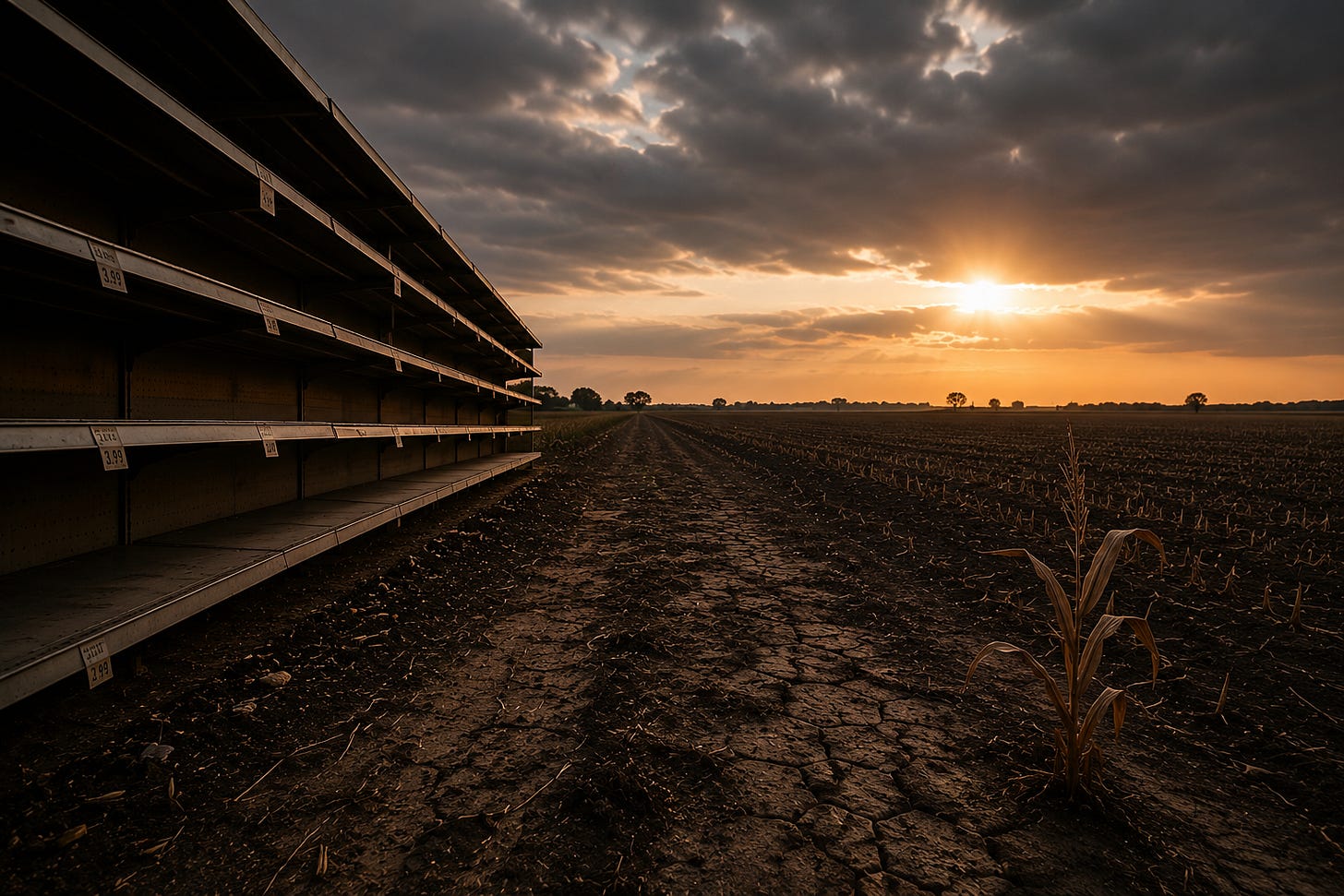
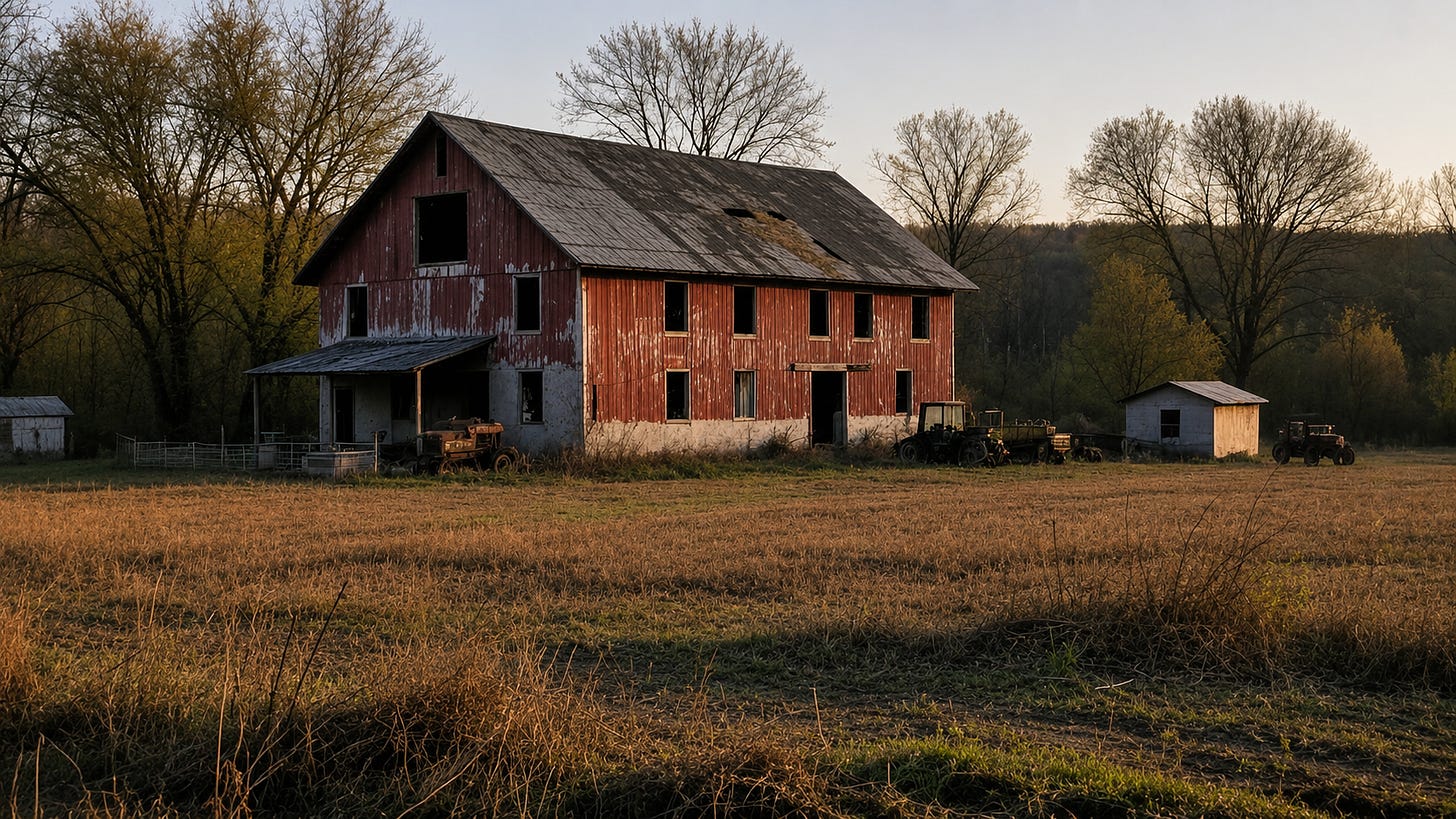
A cattleman in Nebraska told me last month that he sold the last of his breeding stock. Not because he wanted to. Because the well went dry at 180 feet and the cost to drill to 400 was more than his land was worth. He’d been ranching that property since 1987. “Just couldn’t make the numbers work anymore,” he said, shrugging like he’d misplaced a set of keys rather than ended a multi-generational livelihood. This is the tone of the present moment—quiet exhaustion, not dramatic catastrophe. People are giving up. Systems are grinding down. The food supply we assumed was permanent turns out to have been conditional, and the conditions have changed.
What follows documents ten mechanisms of disappearance. Some are climatic, others economic or biological. Together they form a lattice of constraint that no policy, no technology, no market adjustment can resolve within the timeframe that matters. We have perhaps two growing seasons of genuine abundance remaining. After that, scarcity mathematics takes over. Not famine—not immediately—but the end of cheap, reliable, abundant food. The psychology of that shift will reshape American society more profoundly than any political movement of the last half-century.
Read this carefully. Then decide what you’ll do with the information. Most won’t act. Some will. The difference between those groups will matter enormously in the years ahead.
1.
 The Herds Are Shrinking and Nobody’s Rebuilding
Ranchers in the western United States have been selling their herds at rates not seen since the 1980s farm crisis, and unlike that period, they’re not rebuilding. The mathematics are brutal and straightforward: when pasture grass doesn’t grow due to drought, ranchers must either purchase supplemental feed or reduce animal numbers. Feed costs tripled between 2020 and 2023. Pasture availability in the Southwest declined by 40-60% depending on location. The rational business response—the only response that keeps operations solvent—is liquidation.
By mid-2023, the national beef cow herd had contracted to 30.1 million head, the lowest inventory since 1962. That year matters because it predates the feedlot system, the grain-fed beef model, the entire industrial architecture of modern meat production. We’re rewinding to pre-modern livestock numbers without the pre-modern infrastructure that once distributed that production. The 2024 numbers, when they’re finalized, will show further contraction. Industry analysts at Rabobank and Steiner Consulting have already revised their projections downward twice this year.
Here’s what liquidation means in practical terms: beef production in 2025 will decline 12-15% from 2020 levels. Prices will increase proportionally more because demand for protein is inelastic—people don’t simply stop eating when prices rise, they shift budgets, go into debt, reduce other expenditures. Ground beef, the working-class protein staple, has already reached nominal price levels that would have seemed absurd five years ago. The $8/lb organic ground beef at Whole Foods is now the $5/lb conventional product at Walmart. The discount product is disappearing entirely.
Tyson Foods, JBS USA, Cargill Beef, and National Beef Packing Company collectively control 85% of American beef processing capacity. Their quarterly reports acknowledge “headwind challenges” and “protein complexity,” but the operational reality is plant closures and shift reductions. A feedlot in the Texas Panhandle that processed 4,000 head daily in 2019 now handles 2,200. The physical infrastructure remains but the animals don’t. Rebuilding the national herd would require three to four years of retained heifers, reduced slaughter, and—crucially—improved pasture conditions. Meteorologists who study the Southwestern drought using paleoclimate data from tree rings and lake sediments confirm what ranchers suspect: this isn’t a temporary dry spell. It’s a regime shift to drier baseline conditions that may persist for decades.
The social implications extend beyond grocery bills. Rural communities dependent on cattle economies are hollowing out. Equipment dealerships close. Veterinary practices consolidate. Schools lose enrollment. The network effects of agricultural abandonment ripple through counties that already struggled with demographic decline. When the last rancher sells out, the tax base evaporates. County governments can’t maintain roads. The spiral accelerates downward.
2.
 The Bird Flu That Won’t Leave
Highly pathogenic avian influenza H5N1 achieved endemic status in North American wild waterfowl populations sometime in 2022, which means commercial poultry operations now face permanent infection risk rather than episodic outbreak. The virus travels the Pacific and Central flyways each spring and fall, shedding from apparently healthy migratory birds into the environment—onto ponds, into feed, across equipment, onto boots. Biosecurity protocols that once sufficed now fail regularly. Operations that invested millions in perimeter defenses still get hit.
The 2022 outbreak destroyed 52 million birds. The 2023 outbreak destroyed 68 million. The 2024 trajectory, as of August, suggests similar or greater losses. Each detection triggers immediate depopulation of the entire affected facility—sometimes a single barn of 100,000 hens, sometimes a complex of multiple barns totaling half a million birds. Federal indemnification programs compensate farmers at market value, but the cash flow interruption, the psychological trauma of mass euthanasia, and the months-long quarantine requirements that follow detection drive many out of the industry entirely.
Egg prices demonstrate the supply impact with brutal clarity. A dozen large Grade A eggs that cost $1.50 in January 2021 reached $4.82 in January 2023, dipped briefly, then spiked again to $5.17 in August 2024. These aren’t seasonal fluctuations. They’re structural price resets reflecting permanently reduced laying capacity. The volatility itself is economically damaging—restaurants can’t menu-plan, bakeries can’t contract for supply, consumers can’t budget. The egg becomes a luxury item, which sounds absurd until you live it.
Turkey production faces identical pressures with worse Thanksgiving timing. The 2023 holiday season saw frozen turkey availability at 60% of normal levels in major metropolitan markets. Retailers substituted fresh for frozen, smaller for larger, anything to keep shelves from gaping empty. The social ritual of the American Thanksgiving—centered on an abundant roasted bird—fractures when the bird costs $75 and weighs twelve pounds instead of twenty.
Industry consolidation compounds the vulnerability. Three companies control 90% of egg production. When one major facility goes down, the ripple effects hit entire regions simultaneously. There’s no redundancy, no slack in the system, no small producers to ramp up and fill gaps. The just-in-time poultry supply chain assumes continuous operation. Disruptions cascade immediately to empty shelves.
Vaccination research proceeds but faces insurmountable trade barriers. Vaccinated birds produce antibodies that current testing can’t distinguish from infected birds. Trading partners—Japan, Mexico, Canada—would ban American poultry imports if we adopted widespread vaccination. The industry chooses culling over market exclusion, which means continued mass depopulation and supply volatility. There is no technical fix on the relevant horizon.
3.
 Winter Wheat Production Enters Freefall
Hard red winter wheat—the variety milled into bread flour, the foundation of American baking—grows predominantly in the southern Great Plains: Kansas, Oklahoma, Texas, eastern Colorado. These same regions experience the most severe precipitation deficits. The 2022 winter wheat crop totaled 1.173 billion bushels, down 8% from 2021. The 2023 crop fell to 1.087 billion. The 2024 preliminary estimates suggest 980 million bushels, a level not seen since the 1980s.
Yield declines tell only part of the story. Quality degradation—specifically protein content—poses equal danger. Wheat kernels need protein to develop gluten, the elastic network that traps fermentation gases and allows bread to rise. Low-protein wheat produces dense, crumbly loaves suitable only for animal feed. Protein levels in the 2022-2024 crops have run 1.5-2 percentage points below normal, forcing millers to blend with higher-protein stocks from previous years. Those stocks deplete. By 2025, there will be no high-quality reserve to blend with.
The USDA’s Foreign Agricultural Service tracks global wheat trade with growing alarm. World stocks excluding China—a metric that matters because Chinese reserves are largely unavailable to the global market—have fallen to 75 million metric tons, covering approximately 28 days of global consumption. The rule of thumb among grain traders is that below 60 days of coverage, markets become volatile. Below 30 days, they become dangerous. We’re approaching dangerous.
Egypt, Indonesia, Nigeria, Bangladesh—these nations depend on imported wheat, much of it American. When U.S. exports contract due to reduced production, they turn to alternative suppliers: Russia, Ukraine, Australia, Argentina. But Russian exports face sanctions complications and insurance limitations. Ukrainian exports remain severely impaired by Black Sea blockade and infrastructure damage. Australian production fluctuates wildly with El Niño cycles. Argentine wheat faces identical drought pressures to the American crop. There is no spare capacity in the global system.
Bread prices in American supermarkets have increased 35% since 2020, but this understates the real cost because loaf sizes have shrunk simultaneously. The “pound loaf” now weighs 14 ounces. The 20-ounce loaf now weighs 16. Shrinkflation masks price inflation. Consumers notice something is wrong but can’t quite identify what—the bread feels lighter, less substantial, the sandwiches don’t fill you up the same way. These subtle degradations of daily life accumulate into ambient anxiety about the future.
4.
 The Planting Window Collapse
Midwestern corn planting follows a rigid calendar. Soil temperatures must reach 50°F. Moisture levels must allow equipment access without compaction. The optimal window runs roughly April 20 to May 15 for most of the Corn Belt. Miss it, and yield penalties accumulate weekly.
2022 delivered impossible conditions. Persistent rains across Iowa, Illinois, Indiana, and Ohio kept fields saturated through late May. Planting reached only 49% completion by May 22, compared to 78% the five-year average. Farmers faced the choice of planting late into June—accepting 15-30% yield reductions—or collecting prevented-plant insurance and leaving fields fallow. Many chose the latter. The 2022 corn harvest came in at 13.75 billion bushels, down from the 14.8 billion projected in early spring.
2023 repeated the pattern in different regions. North Dakota, Minnesota, and Wisconsin saw delays so severe that millions of acres never got planted. The USDA’s June Acreage report showed 4.2 million prevented-plant acres for corn alone, concentrated in the northern tier states where the growing season is shortest. Each prevented-plant acre represents zero production where 180 bushels might have grown.
2024 brought early dryness followed by June flooding in Iowa and Illinois. The pattern isn’t simply “wet” or “dry”—it’s volatility, unpredictability, the breakdown of the climatic stability that allowed corn monoculture to dominate Midwestern agriculture for a century. Farmers can’t adapt planting schedules to weather that won’t stabilize. They plant into marginal conditions and hope, or they wait and watch the window close.
Late-planted corn faces autumn frost risk. Immature kernels don’t develop full starch content. Moisture levels at harvest require expensive drying. The energy costs of production increase while yields decrease. The Midwestern corn economy—built on cheap energy, stable weather, and massive yields—faces compression from multiple directions simultaneously.
Soybeans tolerate later planting better than corn, but they too suffer from delayed establishment. The 2022-2024 soybean crops have shown reduced pod counts and smaller seed size, translating to lower oil extraction rates and reduced meal protein content. The vegetable oil shortage—already acute due to Ukrainian sunflower oil export disruptions—intensifies. Margarine becomes expensive. Fried foods become luxury items. The cheap calories that built the American diet become unavailable at the bottom of the income distribution.
5.
 Citrus Greening and the End of Florida Oranges
Florida citrus has faced periodic freezes, hurricanes, and market competition for a century, but Candidatus Liberibacter asiaticus—the bacterium causing citrus greening—represents existential threat. Transmitted by the Asian citrus psyllid, a tiny sap-sucking insect, the disease blocks nutrient transport in infected trees. Fruit becomes misshapen, bitter, unmarketable. Roots die back. Canopy thins. Without intensive antibiotic treatment and pesticide application, infected trees die within five years.
Nearly every commercial grove in Florida now carries the infection. The 2022-2023 orange crop totaled 15.8 million boxes, the smallest since 1937. The 2023-2024 crop fell to 12.3 million boxes. For perspective, Florida produced 244 million boxes in the 1997-1998 season. The decline isn’t gradual—it’s catastrophic, a 95% reduction in a generation.
Processing infrastructure follows production. Juice plants close. Concentrate storage facilities empty. The Brazilian industry—already larger than Florida’s—absorbs market share that won’t return. Even if Florida solved greening tomorrow, the infrastructure to process a large crop no longer exists. The knowledge base departs too—retired horticulturists take their expertise with them, young people don’t enter a dying industry.
The American consumer encounters Florida citrus scarcity as absence. The “Florida’s Natural” brand now sources heavily from Mexico and Brazil. “Not From Concentrate” orange juice becomes “From Concentrate” because shipping concentrate requires less volume than shipping fresh juice. Quality degrades subtly. The bright, acidic, fresh flavor of Florida Valencia oranges becomes a memory for those old enough to remember, an unknown experience for those born after 2000.
Grapefruit faces identical pressures. Tangerines, tangelos, specialty varieties—all succumb. The psyllid expands its range northward as winters warm. Georgia and South Carolina groves face imminent infection. There is no resistant variety commercially available. There is no cure. The Florida citrus industry is terminal, running on borrowed time and accumulated capital.
6.
 Ogallala Depletion and the End of Irrigation
Beneath eight states from South Dakota to Texas lies the Ogallala Aquifer, containing fossil water deposited during the Pleistocene. It has supported irrigated agriculture in the semi-arid High Plains since the 1950s, turning marginal rangeland into corn and cotton production. It is depleting at rates that render the word “unsustainable” inadequate.
Some regions report water table declines of 150 feet since systematic pumping began in the 1950s. The saturated thickness—the vertical column of water-bearing rock—thins annually. Wells that once reached water at 100 feet now require 300-foot drilling. Pumping costs increase exponentially with depth.
The physics are unforgiving. Aquifer recharge rates in the semi-arid High Plains average 0.5 inches annually. Extraction rates exceed 15 inches annually. The imbalance drains the account. Projections suggest complete depletion of economically recoverable water in the Texas Panhandle and Kansas portions within two decades. Portions of the aquifer already approach exhaustion.
Irrigated acreage contracts as water becomes unavailable or unaffordable. Corn yields in dryland production—dependent entirely on rainfall—run 40-60% below irrigated benchmarks. The American breadbasket reverts to wheat-fallow rotation systems that prevailed before the diesel pump. Output per acre collapses.
The policy response has proven inadequate. Local groundwater management districts impose pumping restrictions that farmers circumvent through deeper drilling. Federal conservation programs incentivize efficiency improvements that merely slow depletion rather than reverse it. The tragedy of the commons plays out across millions of acres: individual rationality (pump while water remains) produces collective catastrophe (no water for anyone).
The aquifer crisis intersects with drought. When surface water fails, farmers turn to groundwater. When groundwater fails, production stops. The safety net has holes.
7.
 The Fertilizer Cost Squeeze
Synthetic nitrogen fertilizer—manufactured through the Haber-Bosch process that converts atmospheric nitrogen to ammonia using natural gas as feedstock and energy source—supports roughly half of global food production. American corn, wheat, and cotton production depends absolutely on supplemental nitrogen application.
Natural gas prices spiked in 2021-2022. European fertilizer manufacturers curtailed production. Chinese export restrictions removed additional supply from global markets. The result: anhydrous ammonia prices tripled. Urea prices quadrupled. Potassium chloride—mined in Canada, Russia, Belarus—faced similar disruptions.
American farmers faced impossible choices. Apply full fertilizer rates and accept negative returns on investment. Reduce application and accept yield penalties. Rotate to shorter-season varieties with lower genetic yield potential. Collect crop insurance and leave fields fallow. Each option reduces aggregate food output.
The 2022 growing season saw nitrogen application rates decline 15-20% across the Corn Belt. Yield monitors confirmed the consequences: striping in fields where application was skipped, overall productivity declines in regions where farmers economized. The fertilizer shortage of 2022 becomes the grain shortage of 2023.
Geopolitical factors compound the structural problem. Russia and Belarus supplied 40% of global potash exports before sanctions. Natural gas infrastructure damage in Europe—whether from sabotage or maintenance neglect—extends the energy crisis that drives fertilizer costs. The transition to “green” ammonia production remains decades from commercial scale.
Farmers cannot simply return to pre-synthetic practices. The soil organic matter that supported historical fertility has been mined through a century of intensive cultivation. Cover crops and manure applications cannot replace synthetic inputs at scale within relevant timeframes.
The fertilizer cost squeeze intersects with interest rate increases. Farmers who financed 2022 inputs at variable rates face debt service costs that consume operating capital for 2023-2024. Credit tightens. Input dealers demand cash upfront. The working capital crunch forces further production reductions. The spiral tightens.
8.
 The Pollinator Collapse
One-third of American food crops require insect pollination. Commercial honeybee operations—transported by flatbed truck to California almond orchards, to Washington apple groves, to Maine blueberry barrens—report colony mortality rates exceeding 40% annually. Varroa mites, viral complexes, pesticide exposure, nutritional stress from monoculture foraging: the death by a thousand cuts continues.
Wild pollinators fare worse. Bumblebee species have declined 90% in regions of intensive agriculture. Native bee diversity collapses as habitat fragments and pesticide loads increase. The intricate mutualisms that evolved over millions of years unravel in decades.
Almond production—California’s $6 billion industry, consuming 60% of managed honeybee colonies in the United States—faces existential threat. Each acre requires two hives for adequate pollination. Colony availability constrains orchard expansion. Orchard contraction follows colony losses. The $6 billion industry contracts toward $4 billion, then $2 billion.
Tree fruits, berries, melons, vegetables: the produce section of American supermarkets depends absolutely on pollination services that grow less reliable annually. Prices escalate as supply constricts. Quality degrades as misshapen, unpollinated fruit enters channels. The visual abundance of American grocery retail—the pyramids of perfect produce—becomes artifact rather than norm.
Hand pollination—already practiced in portions of China where wild pollinators have vanished—represents theoretical alternative. The economics fail. An apple orchard requiring 50,000 honeybee hives for mechanical pollination would require 500,000 human labor hours for hand pollination. At $15 hourly wages, pollination costs alone add $7.50 per apple.
The pollinator crisis proceeds invisibly. Consumers notice only the price increases, the occasional shortages, the gradual disappearance of varieties that prove uneconomical to produce without reliable pollination. The biological foundation of agriculture erodes beneath the economic superstructure.
9.
 The Processing Concentration Bottleneck
Even when crops grow, they must be transformed. Four meatpacking companies control 85% of American beef processing. Four grain traders control 90% of global grain commerce. Three corporations dominate fertilizer production. Two companies control 50% of seed genetics. The entire food system rests on infrastructure so concentrated that single-point failures cascade nationally.
COVID-19 exposed the fragility. Plant closures—due to workforce infection—created livestock backlogs that forced farmers to euthanize animals while supermarkets limited purchases. The disconnection between farm gate and retail shelf revealed a system optimized for efficiency at the expense of resilience. Nothing fundamental has changed since.
Labor shortages persist. Meatpacking jobs—dangerous, repetitive, poorly compensated—attract fewer American workers. Immigration restrictions limit the undocumented workforce that historically filled processing plants. Automation promises relief that remains decades from implementation at scale.
Transportation infrastructure ages. The Mississippi River—carrying 60% of American grain exports—experienced historic low water levels in 2022 that stranded barges and backed up harvest delivery. Rail networks lack surge capacity. Trucking faces driver shortages and regulatory constraints.
The processing bottleneck means that harvests can rot in fields while shelves go empty. The disconnect between production and consumption—mediated by complex supply chains that assume continuous operation—creates simultaneous scarcity and waste.
Consolidation continues. Smaller processors, unable to access capital or achieve scale economies, sell to larger competitors. The system becomes more concentrated, more fragile, more vulnerable to disruption. Resilience through redundancy disappears in pursuit of margin through efficiency.
10.
 The Global Squeeze
America does not eat in isolation. China’s grain imports have increased 400% since 2010. The nation’s pork production—dependent on imported soybeans for feed—drives global oilseed markets. When Chinese buyers enter commodity markets, prices rise. American consumers compete with Chinese purchasing power for the same finite calories.
India, Indonesia, Nigeria, Egypt: population growth outpaces domestic production increases. Each nation becomes a net food importer. Each adds demand pressure to global markets. The era of American agricultural surpluses—of grain mountains and dairy lakes—ends as export demand absorbs domestic production.
Climate failures compound globally. The 2022 Pakistan floods destroyed 4 million acres of crops. European drought reduced corn and soybean yields by 20%. Argentine drought collapsed wheat exports. Each regional failure redirects trade flows, spikes prices, and reduces the aggregate available for American consumption.
War disrupts. Ukraine—the world’s fourth-largest corn exporter, fifth-largest wheat exporter—faces indefinite production impairment. Russian grain exports face sanctions and insurance complications. The Black Sea grain initiative provides temporary relief but no permanent solution. Twenty million tons of Ukrainian grain that once fed Africa and the Middle East now requires replacement from alternative sources—primarily American.
The dollar’s strength—while beneficial for import purchasing power—makes American grain uncompetitive in global markets. Export volumes decline. Farm incomes suffer. Acreage shifts from grain to less export-dependent crops. The feedback loop tightens. Domestic supply doesn’t increase because exports decrease—production adjusts downward to match reduced demand.
Sara Menker, chief executive of Gro Intelligence, recently warned the UN Security Council that global food supplies are dwindling fast. Current global grain inventories cover approximately ten weeks of consumption. Not months. Weeks. The lowest levels since 2007 and 2008. We have less buffer now. The strategic reserves that once provided market stability have been liquidated through decades of just-in-time efficiency optimization. There is no cavalry coming.
THE CONVERGENCE: When Systems Collapse Together
Individual crises generate manageable disruptions. Synchronous crises produce catastrophe. The ten factors documented above do not operate independently. Drought reduces forage, forcing cattle liquidation, reducing beef supply, while simultaneously reducing winter wheat yields and spring planting windows. Fertilizer price spikes reduce corn yields, reducing ethanol production, increasing gasoline prices, increasing food transportation costs. Pollinator collapse reduces fruit and vegetable availability just as avian influenza reduces chicken and egg supply. Each crisis amplifies others.
The American food system—engineered over a century for abundance, efficiency, and low cost—assumed climatic stability, cheap energy, functional ecosystems, and global trade. All four assumptions fail simultaneously.
Grocery retailers operate on 3-5 day inventory cycles. The just-in-time logistics that deliver freshness eliminate buffer stocks. When supply disruptions occur, shelves empty within 72 hours. Panic buying accelerates the process. The social contract—that supermarkets will always contain affordable food—frays.
Government response capabilities have atrophied. The Strategic Grain Reserve—established during the Cold War—has been liquidated. Commodity programs support farm income rather than food security. SNAP benefits—food stamps—adjust to price increases with lags that leave recipients purchasing fewer calories. The institutional memory of 1930s hunger has faded.
What emerges from this convergence is not gradual adjustment but phase transition. The system shifts from abundance to scarcity regime. Prices become the rationing mechanism that determines who eats and who hungers. The social safety net—designed for poverty in an age of abundance—proves inadequate for abundance’s end.
In fact, we are being told that one-fifth of the global population could soon fall into poverty and hunger. For months, the specter of a global hunger crisis has been looming. The war in Ukraine is a compounding factor, blocking key value chains for food and fertilizer just as the world reckons with the impacts of the COVID-19 pandemic on global hunger. Add the pervasive effects of climate change to the mix, and the result is what the United Nations is calling a “perfect storm” that risks as many as 1.7 billion people falling into poverty and hunger.
Those that regularly follow this analysis know that warnings about a coming global famine have been relentless. Now it is here.
Just a few days ago, it was already being reported that demand at food banks all over the planet has been dramatically increasing. The Global Food Banking Network works with member food banks in 44 countries, and many of them in Africa, Asia, and Latin America are already reporting that higher food prices are contributing to an increase in demand for emergency food assistance. For example, a partner food bank in Ecuador, Banco de Alimentos Quito, has reported a 50 percent increase in demand for services, while another partner, India Food Banking Network, has warned the number of people requesting food has doubled recently.
Most of us don’t have a frame of reference for what is about to happen, because most of us have never been through anything like this before.
Right now, we are still in the very early stages of this crisis, and experts are telling us that it will be significantly worse by the end of the year.
Those on the lowest rungs of the economic food chain will be hit the hardest, but things will soon get quite uncomfortable even in the wealthiest of nations.
The timeline accelerates. 2025 brings protein shortages across all categories. 2026 brings grain price spikes that trigger political instability. 2027 brings genuine hunger in wealthy nations—not widespread starvation, but caloric deficiency, the biological experience of insufficient energy intake that characterized human existence for most of history.
Whether this proves temporary disruption or permanent regression depends on choices made now. The window for preemptive action narrows daily. The systems described above possess momentum that resists rapid reversal. Adaptation becomes the only viable strategy when prevention fails.
Most households will not prepare. They will hope the experts are wrong, that technology will save them, that the government has a plan. They will be disappointed. The small percentage that recognizes structural failure early and acts—storing food, developing local networks, learning production skills—will weather the transition differently than those caught unprepared.
The emptying has already begun. You can see it in the rancher selling his breeding stock, the empty egg shelves, the smaller loaf sizes, the higher prices. The question is not whether the food supply will continue to disappear. It will. The question is what you will do about it.
Tweet
Continue reading...
[ H/T The Burning Platform ]
EDITOR’S NOTE:
A cattleman in Nebraska told me last month that he sold the last of his breeding stock. Not because he wanted to. Because the well went dry at 180 feet and the cost to drill to 400 was more than his land was worth. He’d been ranching that property since 1987. “Just couldn’t make the numbers work anymore,” he said, shrugging like he’d misplaced a set of keys rather than ended a multi-generational livelihood. This is the tone of the present moment—quiet exhaustion, not dramatic catastrophe. People are giving up. Systems are grinding down. The food supply we assumed was permanent turns out to have been conditional, and the conditions have changed.
What follows documents ten mechanisms of disappearance. Some are climatic, others economic or biological. Together they form a lattice of constraint that no policy, no technology, no market adjustment can resolve within the timeframe that matters. We have perhaps two growing seasons of genuine abundance remaining. After that, scarcity mathematics takes over. Not famine—not immediately—but the end of cheap, reliable, abundant food. The psychology of that shift will reshape American society more profoundly than any political movement of the last half-century.
Read this carefully. Then decide what you’ll do with the information. Most won’t act. Some will. The difference between those groups will matter enormously in the years ahead.
1.
Ranchers in the western United States have been selling their herds at rates not seen since the 1980s farm crisis, and unlike that period, they’re not rebuilding. The mathematics are brutal and straightforward: when pasture grass doesn’t grow due to drought, ranchers must either purchase supplemental feed or reduce animal numbers. Feed costs tripled between 2020 and 2023. Pasture availability in the Southwest declined by 40-60% depending on location. The rational business response—the only response that keeps operations solvent—is liquidation.
By mid-2023, the national beef cow herd had contracted to 30.1 million head, the lowest inventory since 1962. That year matters because it predates the feedlot system, the grain-fed beef model, the entire industrial architecture of modern meat production. We’re rewinding to pre-modern livestock numbers without the pre-modern infrastructure that once distributed that production. The 2024 numbers, when they’re finalized, will show further contraction. Industry analysts at Rabobank and Steiner Consulting have already revised their projections downward twice this year.
Here’s what liquidation means in practical terms: beef production in 2025 will decline 12-15% from 2020 levels. Prices will increase proportionally more because demand for protein is inelastic—people don’t simply stop eating when prices rise, they shift budgets, go into debt, reduce other expenditures. Ground beef, the working-class protein staple, has already reached nominal price levels that would have seemed absurd five years ago. The $8/lb organic ground beef at Whole Foods is now the $5/lb conventional product at Walmart. The discount product is disappearing entirely.
Tyson Foods, JBS USA, Cargill Beef, and National Beef Packing Company collectively control 85% of American beef processing capacity. Their quarterly reports acknowledge “headwind challenges” and “protein complexity,” but the operational reality is plant closures and shift reductions. A feedlot in the Texas Panhandle that processed 4,000 head daily in 2019 now handles 2,200. The physical infrastructure remains but the animals don’t. Rebuilding the national herd would require three to four years of retained heifers, reduced slaughter, and—crucially—improved pasture conditions. Meteorologists who study the Southwestern drought using paleoclimate data from tree rings and lake sediments confirm what ranchers suspect: this isn’t a temporary dry spell. It’s a regime shift to drier baseline conditions that may persist for decades.
The social implications extend beyond grocery bills. Rural communities dependent on cattle economies are hollowing out. Equipment dealerships close. Veterinary practices consolidate. Schools lose enrollment. The network effects of agricultural abandonment ripple through counties that already struggled with demographic decline. When the last rancher sells out, the tax base evaporates. County governments can’t maintain roads. The spiral accelerates downward.
2.
Highly pathogenic avian influenza H5N1 achieved endemic status in North American wild waterfowl populations sometime in 2022, which means commercial poultry operations now face permanent infection risk rather than episodic outbreak. The virus travels the Pacific and Central flyways each spring and fall, shedding from apparently healthy migratory birds into the environment—onto ponds, into feed, across equipment, onto boots. Biosecurity protocols that once sufficed now fail regularly. Operations that invested millions in perimeter defenses still get hit.
The 2022 outbreak destroyed 52 million birds. The 2023 outbreak destroyed 68 million. The 2024 trajectory, as of August, suggests similar or greater losses. Each detection triggers immediate depopulation of the entire affected facility—sometimes a single barn of 100,000 hens, sometimes a complex of multiple barns totaling half a million birds. Federal indemnification programs compensate farmers at market value, but the cash flow interruption, the psychological trauma of mass euthanasia, and the months-long quarantine requirements that follow detection drive many out of the industry entirely.
Egg prices demonstrate the supply impact with brutal clarity. A dozen large Grade A eggs that cost $1.50 in January 2021 reached $4.82 in January 2023, dipped briefly, then spiked again to $5.17 in August 2024. These aren’t seasonal fluctuations. They’re structural price resets reflecting permanently reduced laying capacity. The volatility itself is economically damaging—restaurants can’t menu-plan, bakeries can’t contract for supply, consumers can’t budget. The egg becomes a luxury item, which sounds absurd until you live it.
Turkey production faces identical pressures with worse Thanksgiving timing. The 2023 holiday season saw frozen turkey availability at 60% of normal levels in major metropolitan markets. Retailers substituted fresh for frozen, smaller for larger, anything to keep shelves from gaping empty. The social ritual of the American Thanksgiving—centered on an abundant roasted bird—fractures when the bird costs $75 and weighs twelve pounds instead of twenty.
Industry consolidation compounds the vulnerability. Three companies control 90% of egg production. When one major facility goes down, the ripple effects hit entire regions simultaneously. There’s no redundancy, no slack in the system, no small producers to ramp up and fill gaps. The just-in-time poultry supply chain assumes continuous operation. Disruptions cascade immediately to empty shelves.
Vaccination research proceeds but faces insurmountable trade barriers. Vaccinated birds produce antibodies that current testing can’t distinguish from infected birds. Trading partners—Japan, Mexico, Canada—would ban American poultry imports if we adopted widespread vaccination. The industry chooses culling over market exclusion, which means continued mass depopulation and supply volatility. There is no technical fix on the relevant horizon.
3.
Hard red winter wheat—the variety milled into bread flour, the foundation of American baking—grows predominantly in the southern Great Plains: Kansas, Oklahoma, Texas, eastern Colorado. These same regions experience the most severe precipitation deficits. The 2022 winter wheat crop totaled 1.173 billion bushels, down 8% from 2021. The 2023 crop fell to 1.087 billion. The 2024 preliminary estimates suggest 980 million bushels, a level not seen since the 1980s.
Yield declines tell only part of the story. Quality degradation—specifically protein content—poses equal danger. Wheat kernels need protein to develop gluten, the elastic network that traps fermentation gases and allows bread to rise. Low-protein wheat produces dense, crumbly loaves suitable only for animal feed. Protein levels in the 2022-2024 crops have run 1.5-2 percentage points below normal, forcing millers to blend with higher-protein stocks from previous years. Those stocks deplete. By 2025, there will be no high-quality reserve to blend with.
The USDA’s Foreign Agricultural Service tracks global wheat trade with growing alarm. World stocks excluding China—a metric that matters because Chinese reserves are largely unavailable to the global market—have fallen to 75 million metric tons, covering approximately 28 days of global consumption. The rule of thumb among grain traders is that below 60 days of coverage, markets become volatile. Below 30 days, they become dangerous. We’re approaching dangerous.
Egypt, Indonesia, Nigeria, Bangladesh—these nations depend on imported wheat, much of it American. When U.S. exports contract due to reduced production, they turn to alternative suppliers: Russia, Ukraine, Australia, Argentina. But Russian exports face sanctions complications and insurance limitations. Ukrainian exports remain severely impaired by Black Sea blockade and infrastructure damage. Australian production fluctuates wildly with El Niño cycles. Argentine wheat faces identical drought pressures to the American crop. There is no spare capacity in the global system.
Bread prices in American supermarkets have increased 35% since 2020, but this understates the real cost because loaf sizes have shrunk simultaneously. The “pound loaf” now weighs 14 ounces. The 20-ounce loaf now weighs 16. Shrinkflation masks price inflation. Consumers notice something is wrong but can’t quite identify what—the bread feels lighter, less substantial, the sandwiches don’t fill you up the same way. These subtle degradations of daily life accumulate into ambient anxiety about the future.
4.
Midwestern corn planting follows a rigid calendar. Soil temperatures must reach 50°F. Moisture levels must allow equipment access without compaction. The optimal window runs roughly April 20 to May 15 for most of the Corn Belt. Miss it, and yield penalties accumulate weekly.
2022 delivered impossible conditions. Persistent rains across Iowa, Illinois, Indiana, and Ohio kept fields saturated through late May. Planting reached only 49% completion by May 22, compared to 78% the five-year average. Farmers faced the choice of planting late into June—accepting 15-30% yield reductions—or collecting prevented-plant insurance and leaving fields fallow. Many chose the latter. The 2022 corn harvest came in at 13.75 billion bushels, down from the 14.8 billion projected in early spring.
2023 repeated the pattern in different regions. North Dakota, Minnesota, and Wisconsin saw delays so severe that millions of acres never got planted. The USDA’s June Acreage report showed 4.2 million prevented-plant acres for corn alone, concentrated in the northern tier states where the growing season is shortest. Each prevented-plant acre represents zero production where 180 bushels might have grown.
2024 brought early dryness followed by June flooding in Iowa and Illinois. The pattern isn’t simply “wet” or “dry”—it’s volatility, unpredictability, the breakdown of the climatic stability that allowed corn monoculture to dominate Midwestern agriculture for a century. Farmers can’t adapt planting schedules to weather that won’t stabilize. They plant into marginal conditions and hope, or they wait and watch the window close.
Late-planted corn faces autumn frost risk. Immature kernels don’t develop full starch content. Moisture levels at harvest require expensive drying. The energy costs of production increase while yields decrease. The Midwestern corn economy—built on cheap energy, stable weather, and massive yields—faces compression from multiple directions simultaneously.
Soybeans tolerate later planting better than corn, but they too suffer from delayed establishment. The 2022-2024 soybean crops have shown reduced pod counts and smaller seed size, translating to lower oil extraction rates and reduced meal protein content. The vegetable oil shortage—already acute due to Ukrainian sunflower oil export disruptions—intensifies. Margarine becomes expensive. Fried foods become luxury items. The cheap calories that built the American diet become unavailable at the bottom of the income distribution.
5.
Florida citrus has faced periodic freezes, hurricanes, and market competition for a century, but Candidatus Liberibacter asiaticus—the bacterium causing citrus greening—represents existential threat. Transmitted by the Asian citrus psyllid, a tiny sap-sucking insect, the disease blocks nutrient transport in infected trees. Fruit becomes misshapen, bitter, unmarketable. Roots die back. Canopy thins. Without intensive antibiotic treatment and pesticide application, infected trees die within five years.
Nearly every commercial grove in Florida now carries the infection. The 2022-2023 orange crop totaled 15.8 million boxes, the smallest since 1937. The 2023-2024 crop fell to 12.3 million boxes. For perspective, Florida produced 244 million boxes in the 1997-1998 season. The decline isn’t gradual—it’s catastrophic, a 95% reduction in a generation.
Processing infrastructure follows production. Juice plants close. Concentrate storage facilities empty. The Brazilian industry—already larger than Florida’s—absorbs market share that won’t return. Even if Florida solved greening tomorrow, the infrastructure to process a large crop no longer exists. The knowledge base departs too—retired horticulturists take their expertise with them, young people don’t enter a dying industry.
The American consumer encounters Florida citrus scarcity as absence. The “Florida’s Natural” brand now sources heavily from Mexico and Brazil. “Not From Concentrate” orange juice becomes “From Concentrate” because shipping concentrate requires less volume than shipping fresh juice. Quality degrades subtly. The bright, acidic, fresh flavor of Florida Valencia oranges becomes a memory for those old enough to remember, an unknown experience for those born after 2000.
Grapefruit faces identical pressures. Tangerines, tangelos, specialty varieties—all succumb. The psyllid expands its range northward as winters warm. Georgia and South Carolina groves face imminent infection. There is no resistant variety commercially available. There is no cure. The Florida citrus industry is terminal, running on borrowed time and accumulated capital.
6.
Beneath eight states from South Dakota to Texas lies the Ogallala Aquifer, containing fossil water deposited during the Pleistocene. It has supported irrigated agriculture in the semi-arid High Plains since the 1950s, turning marginal rangeland into corn and cotton production. It is depleting at rates that render the word “unsustainable” inadequate.
Some regions report water table declines of 150 feet since systematic pumping began in the 1950s. The saturated thickness—the vertical column of water-bearing rock—thins annually. Wells that once reached water at 100 feet now require 300-foot drilling. Pumping costs increase exponentially with depth.
The physics are unforgiving. Aquifer recharge rates in the semi-arid High Plains average 0.5 inches annually. Extraction rates exceed 15 inches annually. The imbalance drains the account. Projections suggest complete depletion of economically recoverable water in the Texas Panhandle and Kansas portions within two decades. Portions of the aquifer already approach exhaustion.
Irrigated acreage contracts as water becomes unavailable or unaffordable. Corn yields in dryland production—dependent entirely on rainfall—run 40-60% below irrigated benchmarks. The American breadbasket reverts to wheat-fallow rotation systems that prevailed before the diesel pump. Output per acre collapses.
The policy response has proven inadequate. Local groundwater management districts impose pumping restrictions that farmers circumvent through deeper drilling. Federal conservation programs incentivize efficiency improvements that merely slow depletion rather than reverse it. The tragedy of the commons plays out across millions of acres: individual rationality (pump while water remains) produces collective catastrophe (no water for anyone).
The aquifer crisis intersects with drought. When surface water fails, farmers turn to groundwater. When groundwater fails, production stops. The safety net has holes.
7.
Synthetic nitrogen fertilizer—manufactured through the Haber-Bosch process that converts atmospheric nitrogen to ammonia using natural gas as feedstock and energy source—supports roughly half of global food production. American corn, wheat, and cotton production depends absolutely on supplemental nitrogen application.
Natural gas prices spiked in 2021-2022. European fertilizer manufacturers curtailed production. Chinese export restrictions removed additional supply from global markets. The result: anhydrous ammonia prices tripled. Urea prices quadrupled. Potassium chloride—mined in Canada, Russia, Belarus—faced similar disruptions.
American farmers faced impossible choices. Apply full fertilizer rates and accept negative returns on investment. Reduce application and accept yield penalties. Rotate to shorter-season varieties with lower genetic yield potential. Collect crop insurance and leave fields fallow. Each option reduces aggregate food output.
The 2022 growing season saw nitrogen application rates decline 15-20% across the Corn Belt. Yield monitors confirmed the consequences: striping in fields where application was skipped, overall productivity declines in regions where farmers economized. The fertilizer shortage of 2022 becomes the grain shortage of 2023.
Geopolitical factors compound the structural problem. Russia and Belarus supplied 40% of global potash exports before sanctions. Natural gas infrastructure damage in Europe—whether from sabotage or maintenance neglect—extends the energy crisis that drives fertilizer costs. The transition to “green” ammonia production remains decades from commercial scale.
Farmers cannot simply return to pre-synthetic practices. The soil organic matter that supported historical fertility has been mined through a century of intensive cultivation. Cover crops and manure applications cannot replace synthetic inputs at scale within relevant timeframes.
The fertilizer cost squeeze intersects with interest rate increases. Farmers who financed 2022 inputs at variable rates face debt service costs that consume operating capital for 2023-2024. Credit tightens. Input dealers demand cash upfront. The working capital crunch forces further production reductions. The spiral tightens.
8.
One-third of American food crops require insect pollination. Commercial honeybee operations—transported by flatbed truck to California almond orchards, to Washington apple groves, to Maine blueberry barrens—report colony mortality rates exceeding 40% annually. Varroa mites, viral complexes, pesticide exposure, nutritional stress from monoculture foraging: the death by a thousand cuts continues.
Wild pollinators fare worse. Bumblebee species have declined 90% in regions of intensive agriculture. Native bee diversity collapses as habitat fragments and pesticide loads increase. The intricate mutualisms that evolved over millions of years unravel in decades.
Almond production—California’s $6 billion industry, consuming 60% of managed honeybee colonies in the United States—faces existential threat. Each acre requires two hives for adequate pollination. Colony availability constrains orchard expansion. Orchard contraction follows colony losses. The $6 billion industry contracts toward $4 billion, then $2 billion.
Tree fruits, berries, melons, vegetables: the produce section of American supermarkets depends absolutely on pollination services that grow less reliable annually. Prices escalate as supply constricts. Quality degrades as misshapen, unpollinated fruit enters channels. The visual abundance of American grocery retail—the pyramids of perfect produce—becomes artifact rather than norm.
Hand pollination—already practiced in portions of China where wild pollinators have vanished—represents theoretical alternative. The economics fail. An apple orchard requiring 50,000 honeybee hives for mechanical pollination would require 500,000 human labor hours for hand pollination. At $15 hourly wages, pollination costs alone add $7.50 per apple.
The pollinator crisis proceeds invisibly. Consumers notice only the price increases, the occasional shortages, the gradual disappearance of varieties that prove uneconomical to produce without reliable pollination. The biological foundation of agriculture erodes beneath the economic superstructure.
9.
Even when crops grow, they must be transformed. Four meatpacking companies control 85% of American beef processing. Four grain traders control 90% of global grain commerce. Three corporations dominate fertilizer production. Two companies control 50% of seed genetics. The entire food system rests on infrastructure so concentrated that single-point failures cascade nationally.
COVID-19 exposed the fragility. Plant closures—due to workforce infection—created livestock backlogs that forced farmers to euthanize animals while supermarkets limited purchases. The disconnection between farm gate and retail shelf revealed a system optimized for efficiency at the expense of resilience. Nothing fundamental has changed since.
Labor shortages persist. Meatpacking jobs—dangerous, repetitive, poorly compensated—attract fewer American workers. Immigration restrictions limit the undocumented workforce that historically filled processing plants. Automation promises relief that remains decades from implementation at scale.
Transportation infrastructure ages. The Mississippi River—carrying 60% of American grain exports—experienced historic low water levels in 2022 that stranded barges and backed up harvest delivery. Rail networks lack surge capacity. Trucking faces driver shortages and regulatory constraints.
The processing bottleneck means that harvests can rot in fields while shelves go empty. The disconnect between production and consumption—mediated by complex supply chains that assume continuous operation—creates simultaneous scarcity and waste.
Consolidation continues. Smaller processors, unable to access capital or achieve scale economies, sell to larger competitors. The system becomes more concentrated, more fragile, more vulnerable to disruption. Resilience through redundancy disappears in pursuit of margin through efficiency.
10.
America does not eat in isolation. China’s grain imports have increased 400% since 2010. The nation’s pork production—dependent on imported soybeans for feed—drives global oilseed markets. When Chinese buyers enter commodity markets, prices rise. American consumers compete with Chinese purchasing power for the same finite calories.
India, Indonesia, Nigeria, Egypt: population growth outpaces domestic production increases. Each nation becomes a net food importer. Each adds demand pressure to global markets. The era of American agricultural surpluses—of grain mountains and dairy lakes—ends as export demand absorbs domestic production.
Climate failures compound globally. The 2022 Pakistan floods destroyed 4 million acres of crops. European drought reduced corn and soybean yields by 20%. Argentine drought collapsed wheat exports. Each regional failure redirects trade flows, spikes prices, and reduces the aggregate available for American consumption.
War disrupts. Ukraine—the world’s fourth-largest corn exporter, fifth-largest wheat exporter—faces indefinite production impairment. Russian grain exports face sanctions and insurance complications. The Black Sea grain initiative provides temporary relief but no permanent solution. Twenty million tons of Ukrainian grain that once fed Africa and the Middle East now requires replacement from alternative sources—primarily American.
The dollar’s strength—while beneficial for import purchasing power—makes American grain uncompetitive in global markets. Export volumes decline. Farm incomes suffer. Acreage shifts from grain to less export-dependent crops. The feedback loop tightens. Domestic supply doesn’t increase because exports decrease—production adjusts downward to match reduced demand.
Sara Menker, chief executive of Gro Intelligence, recently warned the UN Security Council that global food supplies are dwindling fast. Current global grain inventories cover approximately ten weeks of consumption. Not months. Weeks. The lowest levels since 2007 and 2008. We have less buffer now. The strategic reserves that once provided market stability have been liquidated through decades of just-in-time efficiency optimization. There is no cavalry coming.
THE CONVERGENCE: When Systems Collapse Together
Individual crises generate manageable disruptions. Synchronous crises produce catastrophe. The ten factors documented above do not operate independently. Drought reduces forage, forcing cattle liquidation, reducing beef supply, while simultaneously reducing winter wheat yields and spring planting windows. Fertilizer price spikes reduce corn yields, reducing ethanol production, increasing gasoline prices, increasing food transportation costs. Pollinator collapse reduces fruit and vegetable availability just as avian influenza reduces chicken and egg supply. Each crisis amplifies others.
The American food system—engineered over a century for abundance, efficiency, and low cost—assumed climatic stability, cheap energy, functional ecosystems, and global trade. All four assumptions fail simultaneously.
Grocery retailers operate on 3-5 day inventory cycles. The just-in-time logistics that deliver freshness eliminate buffer stocks. When supply disruptions occur, shelves empty within 72 hours. Panic buying accelerates the process. The social contract—that supermarkets will always contain affordable food—frays.
Government response capabilities have atrophied. The Strategic Grain Reserve—established during the Cold War—has been liquidated. Commodity programs support farm income rather than food security. SNAP benefits—food stamps—adjust to price increases with lags that leave recipients purchasing fewer calories. The institutional memory of 1930s hunger has faded.
What emerges from this convergence is not gradual adjustment but phase transition. The system shifts from abundance to scarcity regime. Prices become the rationing mechanism that determines who eats and who hungers. The social safety net—designed for poverty in an age of abundance—proves inadequate for abundance’s end.
In fact, we are being told that one-fifth of the global population could soon fall into poverty and hunger. For months, the specter of a global hunger crisis has been looming. The war in Ukraine is a compounding factor, blocking key value chains for food and fertilizer just as the world reckons with the impacts of the COVID-19 pandemic on global hunger. Add the pervasive effects of climate change to the mix, and the result is what the United Nations is calling a “perfect storm” that risks as many as 1.7 billion people falling into poverty and hunger.
Those that regularly follow this analysis know that warnings about a coming global famine have been relentless. Now it is here.
Just a few days ago, it was already being reported that demand at food banks all over the planet has been dramatically increasing. The Global Food Banking Network works with member food banks in 44 countries, and many of them in Africa, Asia, and Latin America are already reporting that higher food prices are contributing to an increase in demand for emergency food assistance. For example, a partner food bank in Ecuador, Banco de Alimentos Quito, has reported a 50 percent increase in demand for services, while another partner, India Food Banking Network, has warned the number of people requesting food has doubled recently.
Most of us don’t have a frame of reference for what is about to happen, because most of us have never been through anything like this before.
Right now, we are still in the very early stages of this crisis, and experts are telling us that it will be significantly worse by the end of the year.
Those on the lowest rungs of the economic food chain will be hit the hardest, but things will soon get quite uncomfortable even in the wealthiest of nations.
The timeline accelerates. 2025 brings protein shortages across all categories. 2026 brings grain price spikes that trigger political instability. 2027 brings genuine hunger in wealthy nations—not widespread starvation, but caloric deficiency, the biological experience of insufficient energy intake that characterized human existence for most of history.
Whether this proves temporary disruption or permanent regression depends on choices made now. The window for preemptive action narrows daily. The systems described above possess momentum that resists rapid reversal. Adaptation becomes the only viable strategy when prevention fails.
Most households will not prepare. They will hope the experts are wrong, that technology will save them, that the government has a plan. They will be disappointed. The small percentage that recognizes structural failure early and acts—storing food, developing local networks, learning production skills—will weather the transition differently than those caught unprepared.
The emptying has already begun. You can see it in the rancher selling his breeding stock, the empty egg shelves, the smaller loaf sizes, the higher prices. The question is not whether the food supply will continue to disappear. It will. The question is what you will do about it.
Tweet
Continue reading...
[ H/T The Burning Platform ]